Ankara Trilateral: Denuclearization Rhetoric
US, Japan, and Korea focus on nuclear exports over denuclearization.
Model Diplomat7 min readIndo-Pacific
Ankara Trilateral: Denuclearization Rhetoric, Nuclear-Export Reality
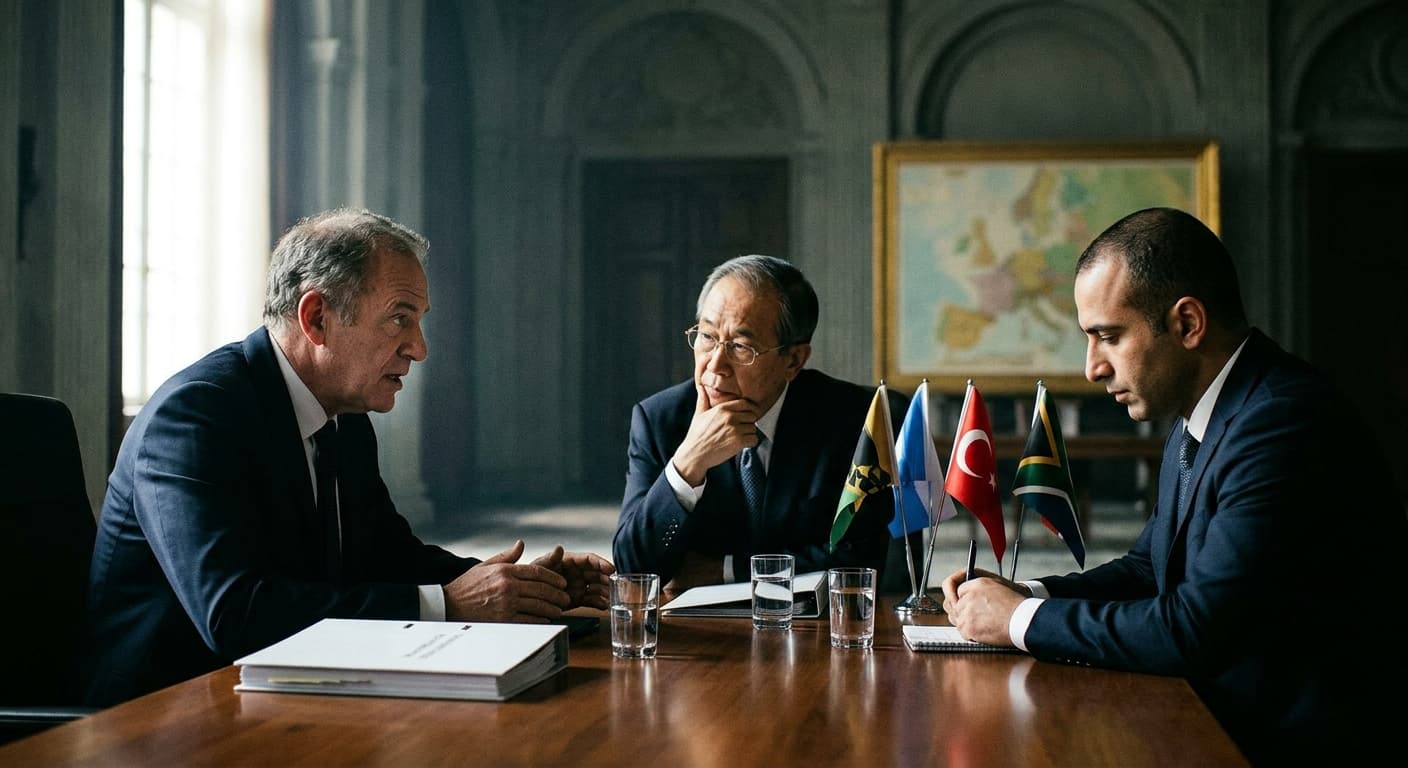
The July 7, 2026 US–Japan–Korea meeting reaffirmed North Korea denuclearization, but the operative deliverable was a small modular reactor pact aimed at China and Russia's Indo-Pacific market.
On July 7, 2026, Secretary of State Marco Rubio, Japanese Foreign Minister Toshimitsu Motegi and South Korean Foreign Minister Cho Hyun stood on the margins of the NATO summit in Ankara and did two things at once. They restated a line — "the complete denuclearization of the DPRK" — that has not moved Pyongyang in a decade. And they signed the first-ever trilateral Memorandum of Cooperation on small modular reactor deployments in third countries, initially targeting the Indo-Pacific. The rhetoric was aimed at Kim Jong Un. The document was aimed at Xi Jinping and Vladimir Putin. That gap — between what the three ministers say the alliance is for and what its new instruments actually do — is the real story out of Ankara, and it reshapes the security geometry of the Korean peninsula, the Taiwan Strait, and the South China Sea.
The Yonhap News Agency reported the meeting reaffirmed denuclearization, illicit-cyber cooperation, supply-chain resilience and coordination against "economic coercion" — code, in trilateral communiqués since Camp David, for Chinese leverage. But the deliverable with a signature and a budget was the reactor pact. It is worth taking seriously.
The denuclearization line has become a placeholder
North Korea has not been "denuclearizing" for any operational purpose since the 2019 Hanoi collapse. Pyongyang codified its nuclear-armed status in a 2022 doctrine that authorises pre-emptive use against South Korea, and Kim Jong Un told the party congress in early 2026 that the status is "irreversible," per Al Jazeera. IAEA Director-General Rafael Grossi assessed this year that North Korea has made "very serious" advances, including a new uranium-enrichment facility. Pyongyang has conducted at least seven ballistic-missile launches in 2026 alone.
Meanwhile the three governments in Ankara do not actually agree on what "denuclearization" means. Brookings scholar Andrew Yeo, in a June 2026 analysis, notes that President Lee Jae Myung's administration has quietly begun substituting "a nuclear-free Korean Peninsula" for "denuclearization," signalling a phased freeze-first approach. Some second-Trump-administration officials publicly called the North "a nuclear state" in early 2025 before the White House walked it back, a shift
CSIS's Sue Mi Terry warned against as fatal to alliance trust. Only Japan — as Motegi told the Diet in February and Yeo documents in a
companion piece — still treats complete, verifiable, irreversible dismantlement as an operational objective, and Tokyo now worries about being left alone on that position.
That is why the joint language in Ankara matters less than it looks. The three parties are keeping a shared vocabulary while their strategies diverge. The communiqué is holding the alliance together; it is not moving the DPRK.
The reactor memorandum is where the leverage now lives
Read the State Department release carefully. The MOC is not a research pact. It is an industrial-policy vehicle designed, in Washington's phrasing, to "de-risk project development, achieve economies of scale, catalyze private investment, streamline licensing processes, and optimize supply chains" for allied SMR exports to third countries. The US is putting $10 million behind the State Department's FIRST programme, funding an SMR Regional Training Hub, and — this is the concrete bit — announcing a GE Vernova, Hitachi, Samsung C&T and SGE consortium to push the BWRX-300 reactor into Europe.
Why this, why now. The market the three allies are targeting is dominated by their rivals. According to a February 2026 CSIS assessment, Rosatom has at least 20 reactor units under active construction in seven countries and claims roughly 60% of world reactor sales in the 2012–21 decade. China's CNNC and CGN have targeted 30 exported reactors by 2030, worth roughly $145.5 billion, with state financing at 1.4–4% interest — terms Western vendors cannot match unilaterally. Carnegie Endowment
analysis from November 2025 put Russia and China's combined on-order nuclear capacity at over 60 gigawatts, much of it earmarked for foreign markets in Asia and Africa.
Alone, no member of the trilateral competes with that. The United States has not commissioned a vendor-led export reactor in a decade and cannot manufacture large forgings domestically. South Korea has the construction machine — Barakah in the UAE came in on budget, and KHNP won the Czech Dukovany contract in 2024 — but its Westinghouse intellectual-property dispute has hobbled bids in Saudi Arabia. Japan supplies world-class components but has no export prime contractor since Fukushima. As CSIS's Jane Nakano argued, Doosan's forgings, Hitachi's supply chain and US designs are complementary — separately, second-tier; together, competitive.
The MOC operationalises that complementarity. It is, in effect, a rules-based counter-offer to China's Nuclear Belt and Road.
Why this reshapes Indo-Pacific security, not just energy policy
The strategic pay-off runs on three tracks.
First, nuclear vendor status confers decades of influence. A reactor is a 60-to-80-year relationship: fuel supply, spent-fuel management, training, regulatory alignment. Every SMR sold to Vietnam, the Philippines, Indonesia or Thailand ties that country to a US-Japan-Korea safety, security and non-proliferation regime rather than to Rosatom's or CNNC's. In effect, the trilateral is now competing to write the operating system for the Indo-Pacific's next 200 gigawatts of electricity, which is what the Carnegie analysis projects the region will add by 2040.
Second, the MOC hardens the economic-security architecture the trilateral has been building since the 2023 Camp David summit. Rubio, Motegi and Cho pledged in Ankara to counter "economic coercion" — the operating term Seoul and Tokyo use for Beijing's 2017 THAAD retaliation, its 2010 rare-earths embargo on Japan, and its more recent gallium and germanium export controls. According to a
CSIS 'New Perspectives on Asia' brief, the three governments have already institutionalised a Trilateral Early Warning System on critical-minerals disruptions and, at the 2026 Critical Minerals Ministerial, South Korea took the chair of the Forum on Resource Geostrategic Engagement. Ankara added nuclear infrastructure to the same coalition.
Third, and this is the Korea-specific point, the reactor pact is how Seoul earns strategic autonomy without breaking with Washington. President Lee, who addressed the NATO Defence Industry Forum in Ankara and pitched a "Korea–NATO defence industry partnership 2.0" per
Al Jazeera's summit liveblog, is under pressure from a Trump administration seeking 5% of GDP defence spending from allies and a more limited US role in Korean defence, per
Chatham House. Exporting Korean-built reactors under a US-Japan umbrella gives Lee an economic wedge into the alliance that survives any Trump-Kim summit outcome — including one that quietly parks denuclearization in favour of arms control.
The North Korean angle is real — but it is a cyber and economic story now
The most concrete anti-Pyongyang commitment in Ankara was the pledge to deepen cooperation against North Korea's illicit cyber activities. That is not boilerplate. According to a March 2025 BBC investigation, the Lazarus Group's February 2025 ByBit heist netted $1.5 billion in Ethereum — the largest crypto theft on record. Deputy National Security Adviser Anne Neuberger stated in 2023 that cyber operations were funding nearly half of North Korea's missile programme, and the CSIS
ByBit analysis argues that share has grown as sanctions on conventional revenue tighten.
That, plus the roughly 11,000 troops Pyongyang has rotated through Russia's Kursk operations — with about 6,000 killed or wounded and 2,300 memorialised by name at the museum Kim opened in April, per the BBC — is the actual North Korea problem the trilateral is trying to solve. Not warheads; the ecosystem of revenue, doctrine-sharing, and technology transfer that Pyongyang has assembled with Moscow. Rubio, Motegi and Cho reaffirmed that they will meet regularly to deliver "tangible" results on this file. That commitment survives even if the denuclearization line becomes fully aspirational.
Diplomat View
The Ankara meeting is best read as a hedge that has become the strategy. Publicly, Washington, Tokyo and Seoul cannot yet retire the denuclearization objective — Japan will not accept it, and Seoul fears a nuclear-armed North recognised de jure by its own ally. Operationally, all three have accepted that Kim's arsenal is a fact and are redirecting alliance energy toward the terrain where they can still win: economic-security architecture, critical-minerals decoupling, and, from July 7, 2026 onward, civil-nuclear exports into the Indo-Pacific's fastest-growing energy market.
The forecast that follows from that reading: the trilateral's centre of gravity has permanently shifted from deterrence to economic statecraft. Expect the next 18 months to produce a joint SMR bid — most likely into the Philippines, Vietnam or Poland — and a formal critical-minerals compact. What would falsify this call: a Trump–Kim summit that produces a substantive arms-control deal Seoul accepts, or a rupture over US tariffs on Korean auto exports that pulls Lee's government toward Beijing's orbit. Neither is the base case as of today.
What to watch:
- September 2026 UNGA week: the trilateral secretariat is due to publish its first annual work plan; watch whether SMR deployment appears as a named workstream.
- October–November 2026: China's APEC host year concludes; a US–China summit remains penciled in and would be the venue for any Trump–Kim overture.
- Q1 2027: expected first joint US–Japan–Korea SMR bid into a named Indo-Pacific customer country. If none materialises, the Ankara MOC is signalling, not statecraft.
The Bottom Line
The Ankara trilateral reaffirmed a denuclearization goal that Pyongyang has already made obsolete, and quietly signed the document that matters: a three-way pact to sell small modular reactors into the Indo-Pacific markets Russia and China now dominate. The alliance's operating purpose has moved from stopping Kim's bomb to writing the region's energy and economic-security rules — and that shift, not the communiqué language, is what China should read as the real result.
Discover more

India
BJP's Misunderstanding of Women's Quota Needs
The BJP's linking of the Women Reservation Bill to delimitation risks delaying women's empowerment in India, misreading the aspirations of female voters.
India
700 Activists Accuse PM Modi of MCC Breach
Over 700 activists allege PM Modi breached election code with a televised address attacking opposition parties just before state elections.
India
UN Expert Albanese: India Violates Law
UN Rapporteur Francesca Albanese accuses India of breaching international law, spotlighting human rights concerns in Kashmir and prompting diplomatic pushback.

Conflict & Security
Drone Warfare Killing Aid Workers at Unprec
Over 1,000 humanitarian workers killed in three years as cheap armed drones collapse legal protections. Gaza, Sudan, Ukraine, and DRC see deliberate targeting of aid convoys and hospitals with zero prosecutions.