Yogi Adityanath's BJP March on Women's Bill
Yogi Adityanath's padyatra reshapes UP's political landscape.
Model Diplomat10 min readUttar Pradesh
Yogi's Women's Bill March: A Rehearsal for UP 2027
How Yogi Adityanath's April 21, 2026 Jan Aakrosh Padyatra in Lucknow converted the 131st Amendment's defeat into a template for 2027 — and what West Bengal already told us about whether it works.
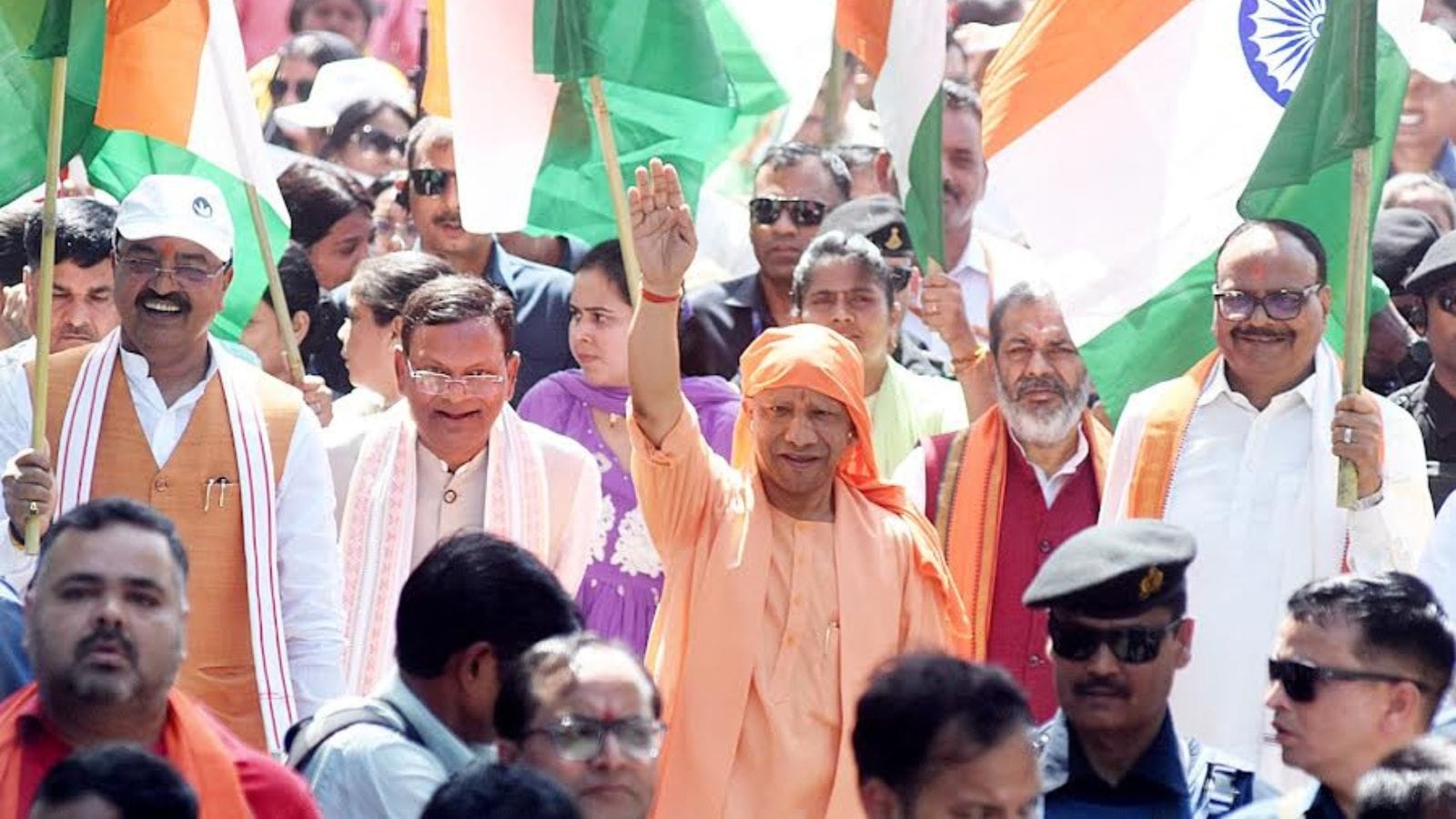
On April 21, 2026, four days after the Constitution (131st Amendment) Bill fell in the Lok Sabha by 298 votes to 230, Uttar Pradesh Chief Minister Yogi Adityanath tied a saffron scarf around his head and walked the 20 minutes from his official residence on Kalidas Marg to the Vidhan Sabha. The 'Jan Aakrosh Mahila Padyatra' — cabinet, both Deputy CMs, MLAs and NDA allies in tow — was staged not to mourn a lost bill but to weaponise its loss. The BJP knew it did not have the two-thirds majority to pass the amendment when it tabled it; the defeat was the campaign, not the setback. That is why the choreography moved from Parliament to Lucknow's streets within 96 hours, why the target of every placard was Akhilesh Yadav's Samajwadi Party rather than the Congress that had voted the same way, and why the strategy is now being industrialised for the 2027 Uttar Pradesh assembly poll — after a dry run that just delivered West Bengal to the BJP for the first time.
The march, and what it was really for
The Indian Express reported that outside the Assembly, Adityanath told the crowd that "whether it is the Congress or the Samajwadi Party, their character is undemocratic and their actions are anti-women." Deputy CM Keshav Prasad Maurya was blunter: "No one can win the 2027 elections without women. If there is no reservation for women, then don't vote for SP or Congress." The BJP's messaging discipline was total — the placards along Kalidas Marg read SaPa ki pehchan, nari shakti ka apman ("The identity of SP is disrespecting women") and SP ka haath nari shakti ke khilaf ("The SP hand is against women's power"). Congress, despite voting identically in the House, barely featured.
That selectivity is the tell. The Samajwadi Party is the only vehicle capable of dislodging the BJP in UP in 2027; the Congress in the state is a junior partner without a seat share worth targeting. The march was followed by district-wide foot marches across UP and, per the same Indian Express report, a special one-day Assembly session on April 30 devoted to "women's empowerment" — a legislative echo of the street theatre, calibrated to keep the story alive for a fortnight.
The BJP-aligned Organiser framed the exercise as a channel for "public outrage." Akhilesh Yadav, quoted in the
New Indian Express, dismissed the padyatra as "theatrics" and said his party's objection was to delimitation without a caste census, not to women's reservation itself. He accused the BJP of practising a "CMF formula — create mistrust or fear." That distinction, whatever its parliamentary merits, did not survive the pavement. Once the "anti-women" label was affixed within four days of the defeat, Yadav's rebuttal was chasing the narrative, not shaping it.
The bill nobody expected to pass
The arithmetic was public before the vote. Al Jazeera reported on April 16 that Modi's National Democratic Alliance held 293 Lok Sabha seats — a two-thirds majority would have required 360. Home Minister Amit Shah tabled the package anyway, at a specially convened three-day session that ran April 16–18. Speaking to BBC Hindi, senior journalist Sharad Gupta
captured the calculation plainly: the government "knew it did not have the numbers, yet brought the bill in the middle of an election season — because they wanted to secure women's votes in West Bengal. Now the BJP will keep repeating in campaigns that the Opposition blocked women's rights."
The mechanics of the bill explain why the Opposition balked. Under the Constitution (One Hundred and Sixth Amendment) Act, 2023 — the Nari Shakti Vandan Adhiniyam — 33% reservation for women in the Lok Sabha and state assemblies is contingent on "an exercise of delimitation… undertaken for this purpose after the relevant figures for the first census taken after commencement" of the Act have been published. The 2023 law was passed unanimously; the fight now is over what comes after "the first census."
The 131st Amendment sought to sever that link on the government's terms: use the 2011 census, expand the Lok Sabha to 850 seats (815 from states, 35 from Union Territories), and roll women's reservation and delimitation out together for the 2029 general election. The BBC reported that Amit Shah told the House the pro-rata expansion would take the southern states' Lok Sabha allocation from 129 to 195 seats — a 50% rise — while their overall share of the House would remain near 24%. Analysts at the Vidhi Centre for Legal Policy, quoted by the
BBC, were not persuaded: the 850-seat cap has "no clear proportional formula," and the bill contained no matching expansion for state assemblies — "creating a mismatch: fast-growing states could gain more MPs without a corresponding rise in MLAs."
DMK's M.K. Stalin burned copies of the bill in Chennai; some southern MPs turned up in the House dressed in black. Leader of the Opposition Rahul Gandhi told the Lok Sabha, in remarks carried by Al Jazeera, that "the proposal that the government is now bringing has no connection to women's reservation. It is merely an attempt to seize power through delimitation and gerrymandering." Congress MP Gaurav Gogoi called it delimitation "through the backdoor." When the division was called on April 17, the government fell 62 short —
the first bill defeated under Prime Minister Modi in twelve years.
Why Uttar Pradesh, and why now
The march was staged in Lucknow for a reason older than the bill. Uttar Pradesh sends 80 MPs to the Lok Sabha and, in 2027, will elect a 403-member assembly. Of roughly 15 crore voters, about 7 crore are women — the largest women's electorate of any Indian state and, on its own, larger than the total electorate of any country in Europe. Since 2019, women have been voting for the BJP in higher proportions than men in state after state; a
Lokniti-CSDS post-poll survey found that in 2024 the party's edge with women had narrowed nationally — 36% of women voted BJP against 37% of men — but held firm in Hindi-belt states.
Adityanath's calculation is that the SP's core Yadav-Muslim base leaves it structurally exposed on the women's-vote axis, particularly among upper-caste, non-Yadav OBC and Dalit women who have been the demographic engine of BJP dominance in UP since 2017. The Padyatra's slogan discipline reflects that vulnerability. The BJP does not need to convert SP's core voters; it needs to prevent the SP from expanding beyond them, and a fortnight of "anti-women" framing is designed precisely to close that door.
There is also a specific piece of political ju-jitsu at work. In 2023, the Nari Shakti Vandan Adhiniyam — as the Prime Minister's Office reminded readers ahead of the special session — was passed unanimously, "with all parties agreeing that it should be implemented by 2029 in any case." The Opposition's line has been consistent since: implement the 2023 law on the current 543 seats now, decouple it from a controversial delimitation exercise, and wait for the caste census. The BJP's counter, ratified by the streets of Lucknow, is that the Opposition's vote against the 131st Amendment can be sold as a vote against reservation itself. Whether that is a fair reading of the parliamentary record is beside the point — it is the reading that will run for a year.
The manoeuvre has a precedent Adityanath will remember. In UP's 2022 assembly election, Priyanka Gandhi's Congress fielded 40% women candidates under the Ladki Hoon, Lad Sakti Hoon banner, forcing every party to compete on women-centric schemes; the BJP absorbed the frame and won 255 seats. The 2026 padyatra is the same play in reverse — this time it is the incumbent who is setting the frame, and it is the challenger who has to decide whether to fight on the BJP's chosen ground.
What the Bengal result already proved
The strategy did not begin in Lucknow. It was piloted, and validated, in West Bengal.
Polling in Bengal took place on April 23 and 29, 2026 — days after the Padyatra, and while the "anti-women" placards were still up in UP district capitals. The BBC noted that the first phase alone put 152 of 294 seats in play, with 1,478 candidates in the fray, and that the campaign was unfolding against a "controversy over the electoral roll revision" that had removed roughly nine million voters. Within that storm, the BJP made a direct challenge to Mamata Banerjee's women-voter fortress — the same fortress the
Lokniti-CSDS post-poll survey in 2021 had recorded as the TMC's structural advantage, with women's support running four points ahead of men's.
When results came in on May 4, Modi's party had taken one of India's most politically formidable states. Home Minister Amit Shah, who ran the campaign, worked through party spokesperson Dharmendra Pradhan to credit "voters, particularly women angered by atrocities and law-and-order failures." A subsequent BBC profile of Banerjee's defeat noted that the Reserve Bank had estimated four of her women-focused welfare schemes were consuming nearly a quarter of the state's own-source revenue — proof that even at fiscally punishing levels, cash transfers alone were no longer sticky.
That is the finding that should worry every incumbent chief minister and every Opposition strategist in New Delhi. A BBC News round-up of the 2026 cycle observed that the DMK lost Tamil Nadu, the TMC lost Bengal, and the LDF lost Kerala — three governments whose brand rested on women-focused welfare. Researcher Prabha Kotiswaran, cited in the same piece, interviewed women beneficiaries a year after cash transfers were introduced in Assam, Bengal, Tamil Nadu and Karnataka: "The majority of the women in all these states said they did not vote for the party in power due to the cash transfers." What worked in Bengal for the BJP was a bundled message — welfare parity, women's safety, women's representation — anchored to a national narrative the 131st Amendment defeat handed them ready-made. UP is where that bundle gets scaled.
Who benefits, who loses
The immediate winner is Adityanath. Every week he leads a padyatra is a week his succession is not being discussed in Delhi and a week Yadav is on the defensive on a terrain — women voters — where the SP has never been strong. The second beneficiary is Amit Shah, whose Bengal victory has now given him ownership of the "campaign the Opposition tried to portray as a defeat." The third is the party's 2027 organisational planning: the district-wide foot marches double as a mobilisation audit for every constituency the BJP needs to defend or flip.
The losers are more interesting. The Samajwadi Party is the obvious one — its principled objection to a hasty delimitation without a caste census is now being drowned by a slogan. But the deeper loser is the 2023 law itself. The Nari Shakti Vandan Adhiniyam, as the Prime Minister reminded a Vigyan Bhawan gathering, was supposed to be implemented "through dialogue, cooperation and participation." Instead it has become a partisan cudgel: a reform passed unanimously in 2023 has been converted, by design, into a wedge issue for 2027. Southern states are collateral damage — the delimitation frame, whatever the Home Minister's pro-rata assurances, will reshape federal arithmetic in favour of the Hindi belt for a generation.
There is one more loser worth naming: parliamentary process. When a government tables a constitutional amendment it knows it cannot pass, the vote is no longer legislation — it is a press release with 528 signatories. The 131st Amendment was, functionally, the most expensive campaign advertisement ever purchased with parliamentary time.
What to watch
Three catalysts sit on the near horizon. First, the outcome of the special one-day UP Assembly session on April 30, 2026, and whether the BJP uses it to send the Centre a formal proposal for 33% reservation — a manoeuvre that would let Adityanath claim ownership of the demand while daring the SP to oppose it. Second, the timing of the ongoing national census, launched in April 2026: the government has said it will not wait for fresh data, but a completed census before 2028 would collapse the Opposition's "caste census first" argument. Third, whether the government reintroduces a modified 131st Amendment in the winter session with a narrower delimitation formula designed to peel off DMK or BJD support — a scenario that would either pass the law or produce a second, more damaging defeat.
The falsifier for this analysis is straightforward: if the SP recovers ground among women voters in UP's 2027 polls despite the padyatra campaign — say, if the Lokniti-CSDS post-poll survey shows the BJP's edge among women narrowing rather than widening — then the Bengal model does not travel, and Adityanath will have burned political capital on a rerun that did not work. That is the scoreboard that matters.
The Bottom Line
The 131st Amendment was designed to lose in Parliament and win on the streets. Yogi Adityanath's April 21 padyatra is the operational template — piloted in Bengal, now scaled to Uttar Pradesh — for converting a parliamentary defeat into a 2027 campaign asset. The story of the women's reservation bill is no longer about representation; it is about which party gets to tell women who blocked their seat at the table, and in India's next general and state elections, that narrative — not the law itself — is what will determine who governs._
Discover more
India
Congress Accuses Modi of Stalling Women's Law
Congress accuses Modi of stalling women's reservation law by linking it to delimitation, revealing a deeper electoral strategy.
India
Modi's Women’s Convention in Varanasi
Modi's Varanasi rally frames women's reservation as a national mission, targeting the 2027 Uttar Pradesh elections with a strategic narrative.

Conflict & Security
Drone Warfare Killing Aid Workers at Unprec
Over 1,000 humanitarian workers killed in three years as cheap armed drones collapse legal protections. Gaza, Sudan, Ukraine, and DRC see deliberate targeting of aid convoys and hospitals with zero prosecutions.
Global
World Normalises Taliban as Afghan Women Eras
UN data shows Afghan women erased from public life as Russia recognises the Taliban, EU hosts officials in Brussels, and ICC warrants for gender persecution go unenforced.