55M face hunger as three shocks hit Africa
Three shocks converge on West and Central Africa during the 2026 planting season
Model Diplomat10 min readAfrica
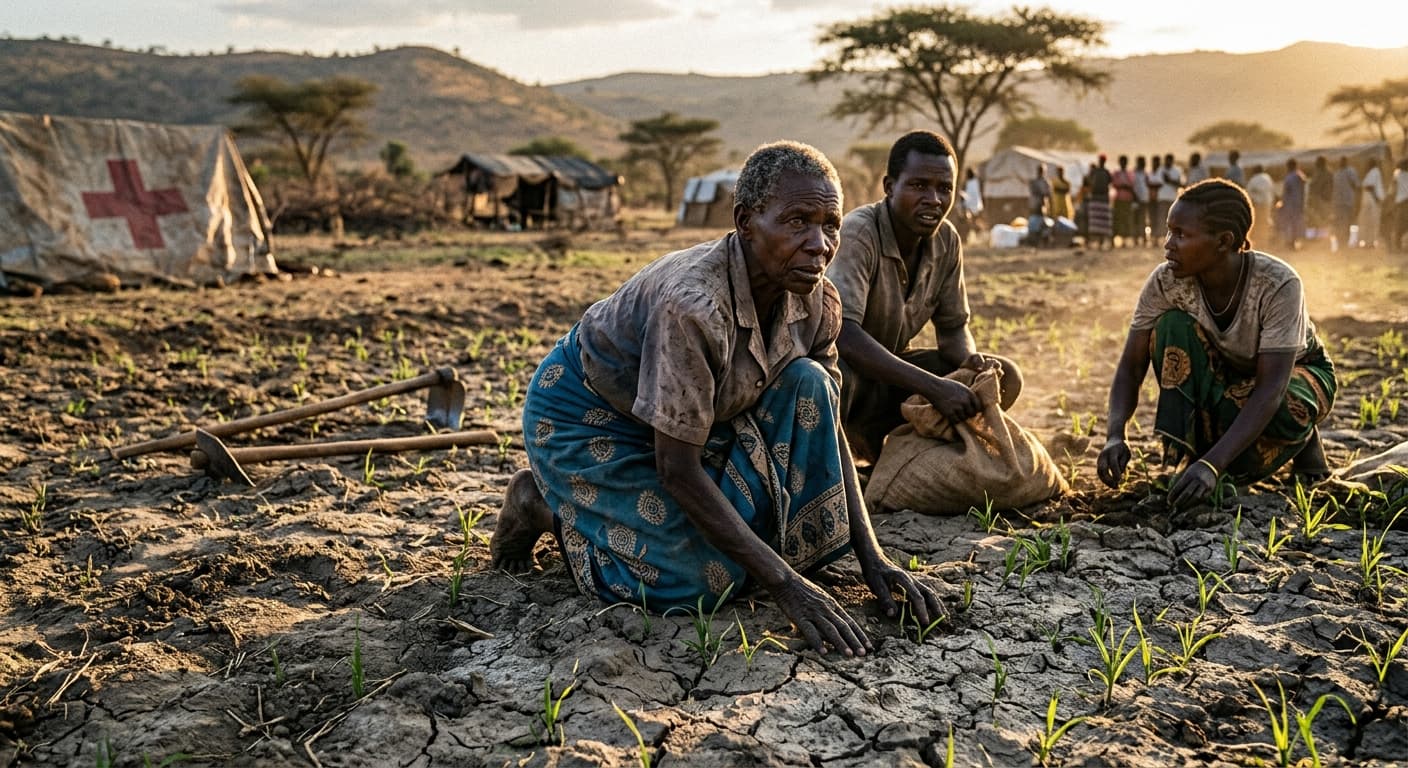
Nearly 55 million people across West and Central Africa face acute food insecurity during the June–August 2026 lean season — including 3.1 million already in IPC Phase 4 (Emergency), according to the Food Security and Nutrition Working Group's (FSNWG) July 2026 analytical brief. That number is not driven by drought or crop failure: the 2025 harvest was strong, with regional cereal production reaching 80.4 million tonnes, about 4 percent above the previous season and 7 percent above the five-year average, according to the World Bank. Three external shocks — a war 2,000 miles away, a viral strain with no vaccine, and a near-total humanitarian funding collapse — are converging precisely as the 2026/27 planting window opens, and the damage will be locked in through mid-2027 regardless of what donors do later.
A strong harvest, a brutal paradox
The starting conditions were meant to be favourable. After two consecutive seasons of good rainfall across the Sahel, cereal markets in March and April 2026 were well supplied, and coarse grain prices remained stable or declining year-on-year — millet, sorghum, and maize prices in Mali, Niger, Burkina Faso, and Chad were between 41 and 56 percent below early-2025 levels, according to the World Bank's December 2025 food security update. Ghana's annual food inflation had declined to 2.4 percent by February 2026.
Yet even with full granaries, an estimated 41.8 million people were already facing acute food insecurity in early 2026, driven overwhelmingly by conflict in the central Sahel, the Lake Chad Basin, and northeastern Nigeria. Fatalities from security incidents in the West African Economic and Monetary Union (WAEMU) zone reached close to 14,000 in 2024, the IMF reported, with insecurity spilling from Burkina Faso, Mali, and Niger into northern Benin, Côte d'Ivoire, and Togo. The baseline was already a crisis. Then February 28 arrived.
Shock one: The Strait of Hormuz and the fertilizer cliff
On February 28, 2026, the United States and Israel launched joint military strikes on Iran. Iran retaliated with attacks across the Middle East, and the Strait of Hormuz — through which roughly one-third of global fertilizer trade and 20 percent of liquefied natural gas normally pass — was effectively closed to commercial shipping. According to the Center for Strategic and International Studies, strikes on three commercial vessels and the suspected deployment of sea mines elevated risk to levels that made insurers unwilling to cover transit. The U.S. Navy declined near-daily escort requests from commercial operators.
For West and Central Africa, where about 80 percent of fertilizer is imported, the shock was immediate and asymmetrical. The FSNWG brief notes that fuel prices surged by up to 85 percent in Nigeria within weeks, while urea prices jumped an average of 86 percent across the region. Dangote's urea plant in Nigeria — Africa's largest — hiked domestic prices by 40 percent in early March, matching international spot rates rather than local affordability, as Al Jazeera reported.
"We're up to half a million tons of nitrogen fertiliser not being produced in the world right now because of the situation we are in," Svein Tore Holsether, CEO of fertilizer giant Yara, told the
BBC. "What does that mean for food production? I would get to up to 10 billion meals that will not be produced every week as a result of the lack of fertilisers."
The timing is what matters. The lean season — June through August — is when households are already at their most vulnerable, having drawn down stocks from the previous harvest. It is also when the 2026/27 planting season begins. Farmers who cannot afford fertilizer now will plant less, apply fewer inputs, or skip the season entirely. According to the FAO, even a 10 percent reduction in fertilizer availability could result in up to 25 percent less maize, rice, and wheat grown in sub-Saharan Africa — triggering food inflation of up to 8 percent.
The World Bank's April 2026 Commodity Markets Outlook projected fertilizer prices would rise 31 percent in 2026 on average, reaching their worst affordability levels since 2022. In West and Central Africa, already the world's most import-dependent region for agricultural inputs, the second-order effects are cascading: higher transport costs push up food prices even where local production is adequate, and higher fuel costs constrain pastoral mobility just as herders need to move livestock to dry-season grazing areas.
Shock two: Ebola Bundibugyo — no vaccine, spreading fast
On May 15, 2026, the Democratic Republic of the Congo declared its 17th Ebola outbreak, caused by the rare Bundibugyo strain — for which there is no approved vaccine or treatment. As of July 27, 2026, confirmed cases in the DRC had surged to approximately 3,200, with at least 1,405 deaths, according to Al Jazeera. The WHO's director-general, Tedros Adhanom Ghebreyesus, warned that the outbreak had "expanded faster than any previous outbreak," reaching 2,000 confirmed cases in just two months — a milestone that took over 10 months during the 2018–2020 epidemic.
The epicentre is Ituri province in eastern DRC, a densely populated mining region where armed groups control significant territory and over 900,000 people live in displacement camps. Ugandan authorities, who recorded 20 cases and two deaths before discharging their last patient on June 16 — starting a 42-day countdown to being declared Ebola-free — introduced border restrictions that have since been lifted on their side.
But the disruption to trade and pastoral movement has already bitten. Bunia, Ituri's capital, relies on Uganda as its primary supply route for goods. The DRC suspended all flights to and from Bunia, and Uganda initially closed its border, leaving perishable goods to rot and traders unable to fill orders. "We are going to face a severe shortage of goods, and when goods become scarce, prices are likely to skyrocket," warned Pascal Tudja, an economic analyst in Bunia, speaking to Al Jazeera. The FSNWG brief underscores that previous Ebola outbreaks have demonstrated how epidemics disrupt trade corridors, pastoral mobility, and household incomes — each one a vector through which a health crisis becomes a food crisis.
The outbreak's spread to Kisangani, a major trading hub of over 1 million people with direct links to Kinshasa, raises the stakes further. As the Council on Foreign Relations noted, unreported border crossings — driven by conflict displacement, armed group movements, and smuggling — make tracking the virus's true spread "extraordinarily difficult." The WHO's own estimate, as of mid-July, was that the true case count could be two to four times the official tally.
The WHO's joint response plan with the Africa CDC, costed at $518 million, faced a funding shortfall of over $400 million as of mid-July, according to NPR. Health workers in Ituri went on strike over unpaid wages, blocking the entrance to Bunia General Hospital. Oxford University launched the first clinical trial of an experimental Bundibugyo vaccine on July 26 — but even under accelerated timelines, a deployable vaccine remains months away at best.
Shock three: The aid recession becomes a collapse
The FSNWG's most damning figure is the quietest one: as of May 15, 2026, humanitarian funding for West and Central Africa stood at just 21.1 percent of assessed requirements. If the gap persists, the number of people reached will fall from 15.3 million to 8.3 million — a 46 percent cut in coverage. The projected sectoral cuts are savage: water, hygiene, and sanitation down 52 percent; protection and nutrition down 49 percent each; health down 47 percent; and food security down 41 percent.
These cuts did not begin in 2026. The Council on Foreign Relations characterised 2025 as "the great aid recession," documenting how the U.S. foreign assistance freeze — starting with an executive order in January 2025 — cascaded into the demolition of USAID programming globally. Total humanitarian funding dropped to 2016 levels. The WFP's acting country director for Nigeria, Emmanuel Bigenimana, told
Al Jazeera in August 2025 that the WFP had received "zero aid from the US this year" for its northeast Nigeria operations. By July 2025, the agency had already run out of grain reserves.
In 2026, the situation has worsened. The WFP's 2026 Global Outlook, released in November 2025, estimated that 318 million people globally would face acute food insecurity — more than double the 2019 figure — while the agency anticipated receiving only about half of its $13 billion operational requirement. For West and Central Africa specifically, the FAO and WFP's Global Report on Food Crises 2026 estimated that approximately 1.4 million people worldwide now face catastrophic hunger (IPC Phase 5), including 2,600 people in northern Mali.
The funding crisis is structural, not cyclical. The Trump administration's withdrawal from multilateral humanitarian financing, combined with European donors diverting aid budgets to defence spending amid the Russia-Ukraine war and the Middle East conflict, has left the humanitarian system with no obvious path back to pre-2025 funding levels. Private sector pledges touted as alternatives have not materialised: in 2025, just five private contributions were made to the UN Central Emergency Response Fund — the largest being $2 million from an unidentified donor "QC," according to the Council on Foreign Relations.
The FSNWG brief is explicit about what happens next: 11.3 million children across five Sahel countries are suffering or projected to suffer acute malnutrition, and nearly half of severe cases risk going untreated because of insufficient funding and supply-chain breakdowns for nutritional inputs.
The compound effect: why 2027 is already being decided
What makes July 2026 a genuine inflection point is the interaction of these three shocks with each other — and with the agricultural calendar.
Farmers who cannot afford urea in July cannot plant adequately for the October harvest. Pastoralists cut off from cross-border routes by Ebola restrictions or insecurity cannot reach dry-season water and grazing. Households whose food assistance has been cut — in Nigeria, the WFP can now reach only 72,000 people compared to the 1.3 million assisted during the 2025 lean season — will sell productive assets to eat, eroding their capacity to farm next year.
The IMF's May 2026 Article IV consultation with Nigeria captured the contradictory dynamics at work. Nigeria, as an oil exporter, benefits from elevated crude prices triggered by the Strait of Hormuz closure — boosting fiscal revenues. But higher fuel, fertilizer, and food prices simultaneously push inflation up to a projected 17 percent year-on-year by end-2026, about 3.5 percentage points above pre-war projections. With poverty at 63 percent of the population and 27 million Nigerians already food-insecure in late 2025, the net effect is deeply regressive.
Nigeria, Chad, Cameroon, and Niger together account for 77 percent of the region's acute food insecurity caseload. Across the Sahel, nearly 4 million people remain displaced by conflict and climate events, with repeated displacement cycles having exhausted household coping capacity. As the World Bank's May 2026 update noted, pastoral conditions are worsening in the western and central Sahel because of pasture and water shortages, bushfires, and insecurity-related movement restrictions — all compounded now by the Ebola-linked trade restrictions in the eastern DRC and Uganda corridor.
A further risk looms: the World Bank's June 2026 food security update flagged an 82 percent probability of El Niño conditions developing and persisting into early 2027, which could reduce crop yields across the Sahel by disrupting rainfall patterns. If realised, it would compound the fertilizer-price shock and lock in a second consecutive year of below-optimal planting.
The FSNWG's recommendation — flexible, predictable, multi-year funding mobilised "dès maintenant" (right now) — reflects the diagnosis: the window between the lean season and the planting season is measured in weeks, not months, and once closed, the food-insecurity effects persist for at least 12 months.
What to watch
- July–September 2026: The 2026/27 planting season is underway. Fertilizer affordability data from Nigeria, Mali, Burkina Faso, and Niger will be the earliest indicator of whether farmers applied adequate inputs. Watch for FAO/WFP rapid assessments and FEWS NET updates on planting progress.
- July 28, 2026: Uganda declared itself Ebola-free on this date after completing its 42-day monitoring period. DRC's outbreak, now spreading to Tshopo and Haut-Uele provinces, remains uncontrolled — the next milestone is whether cases reach Kinshasa via the Kisangani trading corridor.
- September–October 2026: The UN General Assembly high-level week is traditionally when major humanitarian pledging conferences take place. The FSNWG brief effectively sets the table for an emergency funding appeal. If no significant new pledges materialise, the 46 percent cut in targeted beneficiaries becomes operational reality.
- October–December 2026: Harvest outcomes. Even with a successful planting season, reduced fertilizer application during July–August will show up as lower yields. FAO's November cereal production estimates will be the first hard data point on whether the 2027 lean season will be worse than 2026.
- 2026–2027: El Niño development. An 82 percent probability, per the World Bank. If confirmed, rainfall deficits in the Sahel would compound all three existing shocks.
The bottom line
The FSNWG's July 2026 brief describes a crisis that is not yet a famine — and therein lies the analytical precision that makes it important. The 55 million figure is a projection, not a body count. It is a warning that the three shocks converging on West and Central Africa — a distant war blocking fertilizer shipments, a vaccine-less Ebola strain disrupting trade routes, and a humanitarian funding system in structural decline — will intersect during the planting season, not after it. The damage being decided in July and August 2026 will not be visible in mortality data until mid-2027. That lag is the window. And according to the brief, it is closing.
Discover more

Global Politics
U.S. Naval Blockade Heightens Iran Tensions
The U.S. naval blockade of Iran collapsed oil exports, creating a new maritime regime in Hormuz that favors Tehran.
International Relations
Economist Impact Sustainability Week 2026
Economist Impact Sustainability Week 2026 spotlights the energy transition, AI in clean technology, and supply chain resilience as themes for global leaders.
US Politics
Washington's Scrutiny of Iran War Prediction
The Iran war prediction market scandal exposes political ties and regulatory challenges in Washington, as insider trading concerns rise.

Conflict & Security
Drone Warfare Killing Aid Workers at Unprec
Over 1,000 humanitarian workers killed in three years as cheap armed drones collapse legal protections. Gaza, Sudan, Ukraine, and DRC see deliberate targeting of aid convoys and hospitals with zero prosecutions.