Australia's New Samoa Brief Signals Change
Canberra updates its Samoa strategy for new leadership.
Model Diplomat4 min readoceania
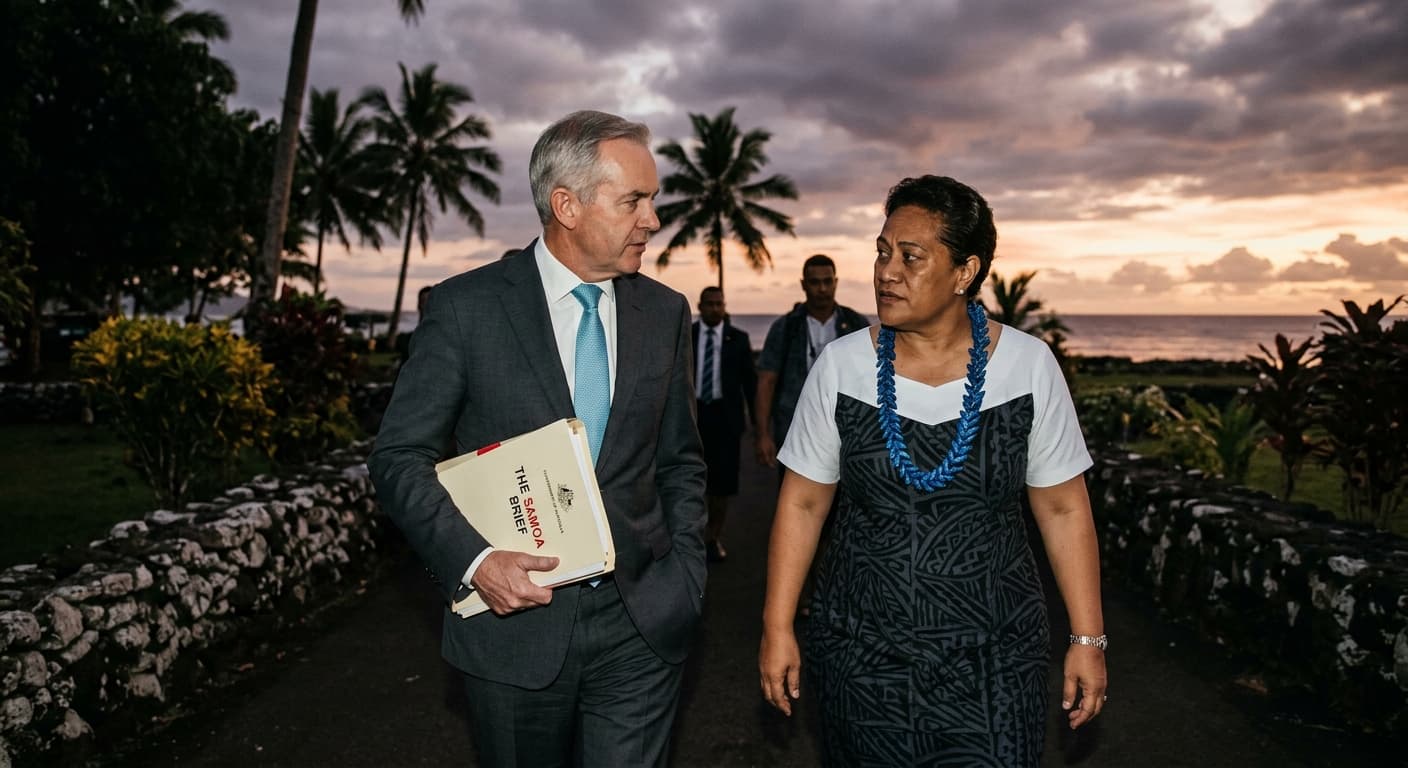
DFAT Rewrites Its Samoa Brief for a New Prime Minister — and a More Contested Pacific
A routine country brief update reveals Canberra's calculus: Schmidt is the man to work with, and the relationship must outlast any single leader.
The Australian Department of Foreign Affairs and Trade has quietly updated its Samoa country brief to reflect a transformed political landscape in Apia — one Canberra appears keen to treat as settled. The brief now names La'aulialemalietoa Leuatea Polataivao Fosi Schmidt as Prime Minister, following his FAST party's decisive win in the 29 August 2025 election, in which it captured 30 of 50 parliamentary seats. The update is procedural, but its timing and content amount to a diplomatic signal: Australia is moving on from the Fiame Naomi Mata'afa era and locking in continuity with the new government.
Schmidt's rise marks the end of a turbulent chapter. Mata'afa — who made history in 2021 as Samoa's first female prime minister and earned the moniker "Iron Lady of the Pacific" — was expelled from FAST in January 2025 amid a factional dispute. She formed the Samoa Uniting Party, which secured just three seats, including her own, in the August election. The main opposition Human Rights Protection Party took 14 seats, while independents claimed four, as reported by Al Jazeera. Schmidt, a FAST founder who once declared "democracy must prevail, always" during the 2021 constitutional crisis, now holds the majority his predecessor lost.
Canberra's interests are straightforward: a stable, cooperative Apia. The brief underscores the relationship's institutional depth — the Bilateral Partnership Arrangement signed by Prime Minister Albanese and then-PM Mata'afa in March 2023, the Samoa-Australia Policing Partnership (in its 15th year), the Pacific Maritime Security Program that delivered the Guardian-class patrol boat Nafanua III in January 2024, and the Pacific Australia Labour Mobility scheme, which counted 2,550 Samoan workers in Australia as of November 2025. None of these depend on who occupies the prime minister's office, and the brief makes that clear by omission — Mata'afa is not mentioned.
The economic stakes reinforce why Australia needs this relationship to work. Samoa's economy — valued at approximately AUD 1.76 billion in 2024 — is structurally dependent on two external flows: tourism, which contributes roughly 20 percent of GDP, and remittances, which hit 30.6 percent of GDP in 2025, according to the World Bank's May 2026 Pacific Economic Update. Australia is both the second-largest source of tourists and the second-largest source of remittances after New Zealand. The PALM scheme alone channels wages back to roughly 80 percent of Samoan households receiving remittances. Any political instability that disrupted these flows would hit household consumption directly — a vulnerability the IMF flagged when it noted that remittances are "macro-critical" for Samoa, peaking above 30 percent of GDP during pandemic years.
The geopolitical backdrop gives the brief a sharper edge. In May 2025, China hosted 11 Pacific Island nations — including Samoa — at a foreign ministers' meeting in Xiamen, the first such gathering on Chinese soil, where Wang Yi pushed trade, infrastructure, and "a shared future," as CSIS analysis documented. The September 2025 Pacific Islands Forum Leaders Meeting in Honiara then saw dialogue partners — including the US and China — excluded, a move widely read as a compromise after Beijing pressured host Solomon Islands to disinvite Taiwan. Mata'afa, still acting PM at the time, had threatened to boycott the forum over Taiwan's exclusion. Schmidt inherited that decision and attended.
Australia's response to this contest has been to bind Pacific states through bilateral agreements — most dramatically the Nakamal Agreement with Vanuatu, signed on 29 June 2026, which bars foreign military bases and requires consultation on third-party infrastructure investment, as Al Jazeera reported. No equivalent security pact exists with Samoa, but the DFAT brief signals that Canberra's toolkit — policing partnerships, maritime patrol boats, labour mobility — is designed to make such formal constraints unnecessary by embedding Australian interests so deeply that disruption becomes costly for both sides.
What to watch next: Schmidt's first budget will test whether his government maintains the fiscal discipline that the IMF praised in its 2024 Article IV consultation, or pivots to spending that strains the relationship. The PALM scheme's expansion — Samoan workers now account for nearly 40 percent of participants alongside Tonga and Vanuatu — will be a live political issue in both Canberra and Apia as Australia heads toward its own federal election. And Palau's hosting of the 2026 Pacific Islands Forum will force Schmidt to pick a side on Taiwan, again.
Discover more

US Politics
SNAP Food Assistance Faces Legal Challenges
In 2026, SNAP faces stricter eligibility rules and mounting legal challenges, threatening food assistance for the millions of Americans who rely on the program.

US Politics
House Ethics Committee Pushes Sexual Miscond.
The House Ethics Committee has shifted responsibility for sexual harassment settlement records to the Office of Congressional Workplace Rights, complicating disclosure efforts.
US Politics
Congress Targets AI Chatbot Access for Terror
The House passed the Generative AI Terrorism Risk Assessment Act, focusing on AI's role in terrorism and potential surveillance implications.

Conflict & Security
Drone Warfare Killing Aid Workers at Unprec
Over 1,000 humanitarian workers killed in three years as cheap armed drones collapse legal protections. Gaza, Sudan, Ukraine, and DRC see deliberate targeting of aid convoys and hospitals with zero prosecutions.