World Ocean Summit 2026
Montreal summit highlights deep-sea mining tensions.
Model Diplomat8 min readGlobal
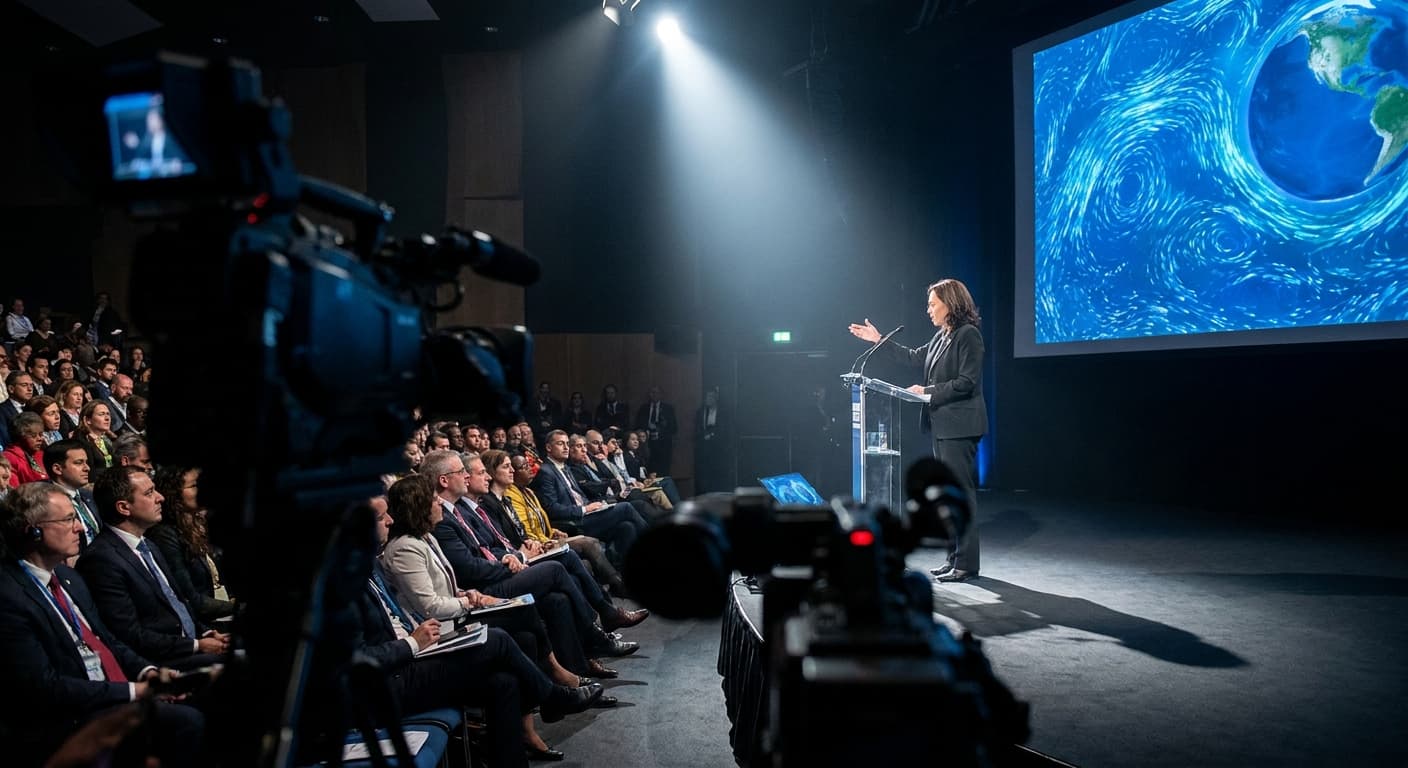
World Ocean Summit 2026: Montreal Meets a Fractured Ocean Order
The 13th World Ocean Summit convened in Montreal on March 4–5, 2026 — six weeks after the High Seas Treaty took force and one week before US regulators fast-tracked the first commercial deep-sea mining permit in history.
The 13th annual World Ocean Summit met in Montreal on March 4–5, 2026, and the room was celebrating a legal architecture that its single most consequential participant no longer accepts. In the seven months before Economist Impact rang the opening bell, the WTO's Agreement on Fisheries Subsidies took force, the BBNJ High Seas Treaty crossed its 60-ratification threshold and entered into force, and Washington quietly walked away from the seabed governance track both treaties presume. The Montreal summit was less a policy launch than an autopsy of the "one ocean, one rulebook" era — and the concrete winner of that collapse is not a country, it is a single Canadian-listed company positioned to mine international waters under a US permit while everyone else waits for the International Seabed Authority to write a code.
That is the story worth telling from Montreal: the summit's stated agenda — investment, restoration, science — cannot be assessed independently of who now sets the rules on the water.
What actually happened in Montreal
The summit — organized by Economist Impact, hosted this year in Canada rather than by The Nippon Foundation in Tokyo as in 2025 — was a two-day, invitation-heavy convening on financing the "blue economy." Speakers listed on the Economist Impact programme included Palau President Surangel Whipps Jr., UN Special Envoy for the Ocean Peter Thomson, Canadian Chief Science Advisor Mona Nemer, Grenada's Ambassador for Oceans Jerry Enoe, and Canada's Secretary of State for Nature Nathalie Provost. The framing was explicit: the ocean is now "critical climate, economic and strategic infrastructure," and "the question now is not whether the ocean matters, but how quickly investment and policy can align to scale these solutions sustainably."
The signal from the organizers is that they have accepted the pivot from conservation to capital. The 14th edition, per the same programme page, moves to Aqaba, Jordan on March 16–18, 2027 — the first time the summit has been hosted in the Middle East, and a clear tilt toward Gulf sovereign capital, Red Sea port infrastructure, and the offshore renewables buildout that follows both.
That commercial tilt was reinforced by Canadian federal spending. At the Our Ocean Conference in Mombasa three months after Montreal, Canada committed C$682 million to its Small Craft Harbours Program, part of a broader package the World Resources Institute tallied at $6.4 billion in 320 new pledges — the largest annual sum since the OOC series began in 2014.
The two treaties Montreal celebrated
Two primary documents defined the mood in the room. The first is the WTO Agreement on Fisheries Subsidies, which — after three years of ratification pressure and a public push at the 2024 World Ocean Summit by WTO Deputy Director-General Angela Ellard — cleared the two-thirds threshold on September 15, 2025 when Brazil, Kenya and Viet Nam deposited their instruments of acceptance. Per the
WTO's own record, it is "the first WTO agreement to focus on the environment" and only the second multilateral agreement concluded at the WTO since its creation. It prohibits subsidies to illegal, unreported and unregulated fishing, to fishing overfished stocks, and to fishing on the unregulated high seas — the same $21 billion in annual harmful subsidies UN Deputy Secretary-General Amina Mohammed
flagged in a 2023 World Ocean Summit keynote as the single most distorting subsidy in the ocean economy.
The second is the BBNJ Agreement — the "High Seas Treaty" — which the UN's BBNJ secretariat confirmed entered into force on January 17, 2026, 120 days after the 60th ratification. It is the third implementing agreement under UNCLOS and, per the
LSE Grantham Institute, had 145 signatories and 89 parties as of May 2026. The first Conference of the Parties is scheduled for around January 2027 — a date every negotiator in Montreal was already tracking. Together, the two instruments cover roughly two-thirds of the ocean's surface with binding rules for the first time.
The problem is what is missing from both signatures pages.
The gap Washington drove through
On April 24, 2025 — eleven months before the Montreal summit — President Donald Trump signed Executive Order 14285, "Unleashing America's Offshore Critical Minerals and Resources." The White House fact sheet framed it as restoring "American dominance in offshore critical minerals," directed NOAA to expedite exploration and commercial recovery licenses in areas beyond national jurisdiction, and made explicit that the goal was to counter China's influence over seabed mineral supply chains.
The mechanism matters. Because the United States never ratified UNCLOS, Washington is not a voting member of the International Seabed Authority. The Congressional Research Service notes the order invokes the 1980 Deep Seabed Hard Mineral Resources Act — a statute passed as an interim measure before UNCLOS existed — to authorize licenses the ISA cannot recognize. As of February 2026, per the same CRS product, 40 countries had announced opposition to deep-seabed mining, and the ISA's Secretary-General had warned that unilateral action "sets a dangerous precedent that could destabilize the entire system of global ocean governance." The
Atlantic Council goes further, arguing the executive order may have already put the United States in violation of customary international law and could deter mainstream insurers and non-US flag states from touching the cargo.
The company that walked through the door is The Metals Company, a Canadian-listed firm previously sponsored by Nauru and Tonga at the ISA. Per NPR's March 13, 2026 reporting, TMC filed a combined exploration-and-extraction application under the new NOAA fast-track in January 2026 covering between 3 million and 20 million tons of polymetallic nodules per year over a 20-year lease in the Clarion-Clipperton Zone — territory that directly overlaps areas the ISA had already contracted to TMC's own subsidiaries under Pacific island sponsorships. Its share price jumped 44% on the day EO 14285 was signed, per
Al Jazeera — a figure TMC has not disputed publicly.
That is the concrete beneficiary. The World Ocean Summit's audience — Palau, Grenada, Papua New Guinea, France, the European Union — is the concrete loser: their leverage depended on the ISA being the only door, and Washington has now built a second one. On February 2, 2026, the US Export-Import Bank went further, launching "Project Vault," a $10 billion strategic critical minerals reserve with roughly $2 billion in matching private capital — a stockpiling mechanism the Stimson Center reports was designed in part to bridge the roughly five-year lag before any US-based seabed processing capacity can exist.
The table
| Instrument | Status | In force | Notable gap |
|---|---|---|---|
| UNCLOS (1982) | 169 states parties | Nov 16, 1994 | United States never ratified |
| WTO Fisheries Subsidies Agreement | Two-thirds threshold met | Sept 15, 2025 | Second-wave overcapacity rules pending |
| BBNJ / High Seas Treaty | 89 parties, 145 signatories (May 2026) | Jan 17, 2026 | US signed but not ratified |
| ISA Mining Code | Draft — not finalized | Not yet | US operates via 1980 DSHMRA outside the ISA |
| Kunming-Montreal 30x30 | Global political target | Adopted 2022 (target 2030) | EEZ MPA coverage rose 8% → 11% by UNOC3 |
The scientific backdrop nobody in Montreal could dismiss
Two pieces of research reframed the conference. The first, published in Global Change Biology, concluded that by 2020 the average global ocean had already crossed the planetary boundary for ocean acidification — the ninth of nine planetary boundaries. The paper estimated that up to 60% of the global subsurface ocean down to 200 metres had breached the boundary, tropical and subtropical coral reef habitat had contracted 43%, and polar pteropod habitat had shrunk by up to 61%.
The second is the Third World Ocean Assessment, released by the UN on World Oceans Day, June 8, 2026 — three months after Montreal. Compiled by roughly 600 experts from 86 countries, it documented what Secretary-General António Guterres called "a deepening crisis driven by climate change, overfishing, biodiversity loss and marine pollution" — the strongest primary-document rebuttal to the conservation-to-capital pivot that framed the Montreal programme. The underlying trend, the Assessment says, is still down.
That is the tension the summit could not resolve. On paper, marine protected area coverage of exclusive economic zones rose from 8% to 11% between the 2022 Kunming-Montreal target and the Nice UN Ocean Conference in June 2025, per the RSIS analysis of UNOC3. In practice, the trajectory required to reach 30% by 2030 assumes a functioning ISA, a functioning BBNJ COP, and a US that respects both. None of those conditions is now given.
The historical parallel — and the second-order effect
The closest analogue is the mid-1980s Reagan administration decision not to ratify UNCLOS itself, which produced a decade in which US firms operated seabed exploration licenses under domestic law while the rest of the world built the ISA around them. That episode ended when Washington accepted the 1994 Implementation Agreement modifying UNCLOS Part XI — an accommodation the United States extracted precisely because it had walked out first. The 2025–26 sequence is a rerun on faster tempo and higher stakes: this time the leverage is critical minerals for the energy transition and defence supply chains, not just polymetallic nodules in the abstract.
The second-order effect is the one the Montreal delegates were quietest about. If TMC begins commercial recovery in 2027 under a US permit, every ISA contractor — China's COMRA, India's exploration licensees, Russia's Yuzhmorgeologiya, the Cook Islands' consortia — acquires a straightforward argument for proceeding outside the ISA framework as well. The ISA's Mining Code, which the Secretary-General now reportedly aims to complete by end-2026 per the CRS report, risks arriving as a rulebook that governs only those who chose to be governed. That is the outcome the Nice Ocean Action Plan, the BBNJ Agreement and the WTO Fisheries deal were all designed to prevent — and the outcome Montreal did not have the tools to reverse.
Diplomat View
The forecast: the World Ocean Summit's centre of gravity has moved. As long as the ISA is negotiating a code the largest consumer of critical minerals refuses to be bound by, the summit's political function is to be a marketplace — for blue bonds, for port decarbonisation contracts, for Gulf capital heading to Aqaba in 2027 — rather than a governance forum. That is a defensible commercial pivot, but it is also a signal that the treaty coalition assembled in Nice cannot enforce its own architecture. Three catalysts will revise this call: the first BBNJ Conference of the Parties (around January 2027), where US attendance as observer or spoiler is the decisive signal; the ISA Council session late in 2026, where a draft Mining Code is expected; and NOAA's final action on The Metals Company's combined exploration-and-recovery permit — which, if approved, would be the first commercial deep-sea mining licence issued anywhere in the world. If TMC begins commercial recovery in 2027, the "one ocean, one rulebook" era ends in practice, whatever the treaty parties say in the room.
Discover more
International Relations
Economist Impact Sustainability Week 2026
Economist Impact Sustainability Week 2026 spotlights the energy transition, AI in clean technology, and supply chain resilience as themes for global leaders.

Global Politics
US Seizes Iranian Ship, Tensions Surge
The US seizure of the Iranian ship Touska highlights a shift in control over the Strait of Hormuz, favoring Iran's strategic position.

Conflict & Security
Drone Warfare Killing Aid Workers at Unprec
Over 1,000 humanitarian workers killed in three years as cheap armed drones collapse legal protections. Gaza, Sudan, Ukraine, and DRC see deliberate targeting of aid convoys and hospitals with zero prosecutions.

Global
World Normalises Taliban as Afghan Women Eras
UN data shows Afghan women erased from public life as Russia recognises the Taliban, EU hosts officials in Brussels, and ICC warrants for gender persecution go unenforced.