Canada's Military Arctic Sovereignty Patrols
Understanding Ottawa's military strategy in the Arctic
Model Diplomat7 min readNorth America

Canada's Arctic Sovereignty Patrols: What Ottawa Is Really Signalling
Canada's 2026 Arctic sovereignty patrols — Operation NANOOK, the Rangers, and a C$81.8 billion defence lift — are less about Russia than about proving to Washington that Ottawa can defend its own north.
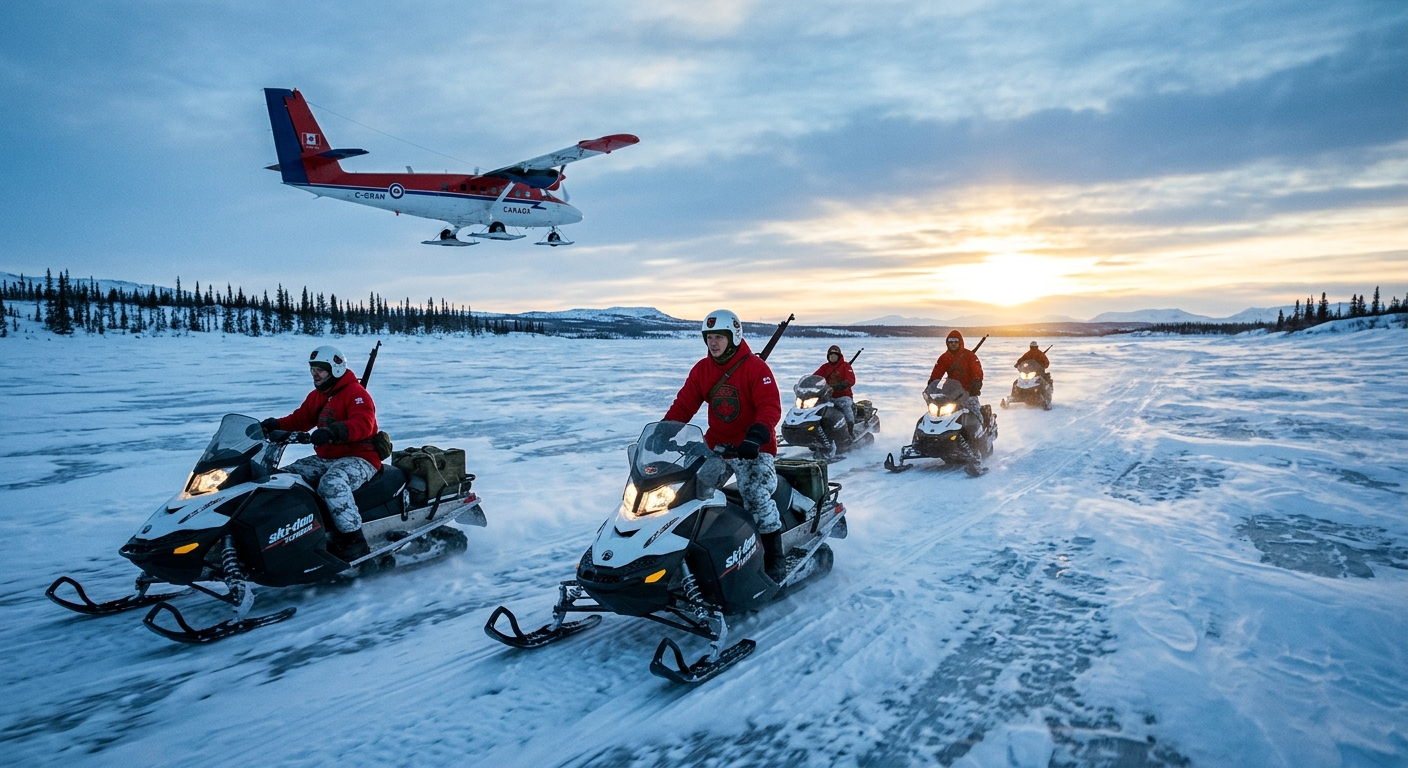
Canada's largest-ever northern military patrol did not end at a Russian tripwire. It ended, on April 10, 2026, at a row of spruce trees outside Churchill, Manitoba, after 1,300 personnel had spent two months crossing 5,200 kilometres of ice by snowmobile along a route not attempted in 80 years, as the BBC reported from the finish line. The thesis of this year's Arctic sovereignty patrols is not deterrence of Moscow — Russia is a defensive concern, not an offensive one — but signalling to Washington. Prime Minister Mark Carney's government has folded a legal claim (the Northwest Passage as internal waters), a spending pledge (2% of GDP now, 5% by 2035), and a political message (that Canada, not the United States, will police its Arctic) into a single, choreographed year of operations. The audience is the Trump White House, and the cost is roughly C$81.8 billion over five years.
The 2026 operations, in specifics
The Department of National Defence has front-loaded 2026 with a rolling series of Arctic exercises. According to a February 19, 2026 release from National Defence, the year opened with Operation NANOOK-NUNALIVUT — long-range sustainment along the Northwest Passage — and continues with five further NANOOK "serials": NUNAKPUT (all-domain activity along the Passage), TUUGAALIK (maritime interoperability with NATO), TAKUNIQ (air-land integration with Ranger patrols), TATIGIIT (crisis response) and QIMAAVIVUT (engineering). Layered underneath are three standing operations the CAF describes in the same release: LIMPID, a continuous all-domain surveillance mission; BOXTOP, the annual resupply of Canadian Forces Station Alert; and LATITUDE, a maritime deterrence mission in the western Arctic.
The operational tempo is deliberately visible. Operation NA-NU 26, a Joint Task Force (North) exercise, runs concurrently across Yellowknife, Behchokǫ̀, Inuvik, Cambridge Bay and Whitehorse, with the main effort in the Amundsen Gulf near Cambridge Bay, per National Defence. The
Canada.ca sovereignty-operations page notes that the Rangers alone conduct 179 sovereignty and surveillance patrols in a typical year, each with a minimum of eight members. That footprint — thousands of small, dispersed movements — is the actual mechanism of Canadian presence.
Who the audience really is
Read the on-record language and the audience becomes obvious. Brig-Gen. Daniel Rivière, commander of the task force running NANOOK-NUNALIVUT, told the BBC that Russia remains "a formidable force" but framed the immediate concern as adversaries "getting smarter about Arctic waters," not massing on Canada's flank. NPR's Arctic reporting in January 2026 was blunter: analysts told
NPR that the bulk of Russian and Chinese activity sits near Alaska and the Bering Sea, not the Canadian archipelago, and that Trump's claim Greenland is "surrounded" is simply not supported by the data.
So why the acceleration? Because in April 2025, the Trump administration signed an executive order emphasising "American domination in the Arctic waterways," and continues to press for Greenland — a message Ottawa has read as a warning that under-defended Arctic waters will be policed by someone else. Michael Byers of the University of British Columbia told the BBC that American pressure, more than Russian probing, is what has "prompted Canada's government to re-focus on the Arctic." The patrols are, in effect, a receipt.
The Rangers are the story
Behind the acronyms sits an unusual force. The Canadian Rangers — roughly 5,000 lightly armed reservists across five patrol groups, according to a SIPRI background paper — are the CAF's only permanent northern presence. The
Canadian Global Affairs Institute notes that 1 Canadian Ranger Patrol Group, which covers Yukon, the Northwest Territories and Nunavut, fields 1,850 members across 60 community patrols. They are majority-Indigenous, they work on their own land, and they are the reason Ottawa can plausibly claim continuous presence across 4.4 million square kilometres.
The 2026 patrol exposed both their indispensability and the CAF's dependence on them. Along the Northwest Passage route, Rangers on cracked ribs and food poisoning kept the column moving; a dozen Inuit hamlets housed the troops; Inuk Rangers navigated for regular-force soldiers on unfamiliar ice, as CBC News documented in its ride-along. The military's equipment struggled — batteries froze, comms failed — while Ranger knowledge did not. That inversion of the usual regular-reserve hierarchy is the operational lesson of NANOOK-NUNALIVUT 2026: without the Rangers, there is no Canadian Arctic presence to speak of.
The money and the doctrine
The patrols are the visible tip of a doctrinal reversal. Ottawa's Our North, Strong and Free defence policy update, released in 2024, identified Arctic sovereignty as the CAF's most urgent task and locked in NORAD-modernisation spending. It was followed in December 2024 by Canada's first standalone
Arctic Foreign Policy, which then-foreign minister Mélanie Joly built around four pillars, the first of which is "asserting Canada's sovereignty."
The federal budget puts numbers behind the rhetoric. According to the BBC's budget takeaways, Ottawa has committed C$81.8 billion in additional defence spending over five years, including C$1 billion over four years for dual-use Arctic infrastructure — airstrips, roads, ports that civilians and soldiers can share. Carney announced in March 2026 that Canada had hit NATO's 2% target for the first time since the late 1980s, at more than C$63 billion in a single year, per
BBC reporting, and has pledged to hit 5% by 2035. Recruitment has followed: the CAF enrolled more than 7,000 new members in the last fiscal year, its best result in three decades, with plans for 85,500 regulars and up to 300,000 reservists.
Procurement is a diplomatic message
The kit Canada is buying tells you which alliance geometry Ottawa is betting on. In May 2026, Carney chose Sweden's Saab GlobalEye — built on a Bombardier Global 6500 airframe — over Boeing's E-7 Wedgetail for the CAF's early-warning fleet, Al Jazeera reported, with Carney describing the platform as "a key resource… to detect and deter threats across the Arctic." Weeks earlier, Ottawa handed Germany's TKMS the largest defence procurement in Canadian history — a conventional, under-ice-capable submarine fleet — with the
BBC noting the bid was structured with Norwegian partnership and pitched as "NATO-aligned." And in the Icebreaker Collaboration Effort — the trilateral memorandum signed with Finland and the United States in November 2024 — Canada has locked itself into a shared production base that
CSIS estimates could supply the 70–90 icebreakers Western allies will require, at a moment when Russia already fields 41.
The pattern is unmistakable. Sweden, Germany, Norway, Finland — every marquee Arctic contract Ottawa has signed since the second Trump administration took office has gone to a European partner or been structured to hedge against a US supplier. As RAND's June 2025 commentary argued, Ottawa's resistance to NATO involvement in its Arctic is "thawing," with Carney courting the EU's ReArm initiative and the UK-led Joint Expeditionary Force as insurance policies against unreliable Washington.
The legal chessboard beneath the ice
There is a second, quieter game running under the patrols. Canada claims the Northwest Passage as internal waters; the United States considers it an international strait. That dispute has been dormant for a generation. It is not dormant now. A Harvard Law Review analysis noted that under Article 37 of the UN Convention on the Law of the Sea, the Passage passes both the geographic and functional tests for an international strait — a view Washington has long held and that Trump's April 2025 executive order on "freedom of navigation" pointedly echoed.
Sovereignty in international law is built on effective occupation — presence, administration, patrols. That is exactly what a 5,200 km snowmobile column, 179 annual Ranger patrols and a rolling NANOOK calendar produce: state practice, documented and public, that Canada can cite the next time an American icebreaker or a Chinese research vessel asks permission to transit. The patrols are, in the most literal sense, evidence for a future case.
Diplomat View
The forecast: Canada will not fight Russia in the Arctic this decade, and it will not surrender the Northwest Passage. But Ottawa's real strategic problem is not Moscow — it is a US administration that has openly questioned Canadian competence in the north and used tariff leverage as a pressure tool. Carney's answer is to industrialise Arctic presence: more patrols, more Rangers, more European kit, more visible sovereignty. It buys Canada political cover inside NATO and legal ballast under UNCLOS, and it reduces the pretext for any future US "assistance" that Canada does not invite.
What would revise this call? Three triggers: (1) a US Navy freedom-of-navigation transit through the Northwest Passage without Canadian consent; (2) a Chinese naval or dual-use vessel escorted through the Passage under Russian cover; (3) a Carney budget that misses the 5% GDP glide-path. Any of those breaks the current signalling logic and turns the patrols from receipts into a test.
What to watch next
- NATO summit follow-through in Turkey (late 2026): whether Canada's spending trajectory is validated by allies or flagged as still short.
- NANOOK-TUUGAALIK (summer 2026): the first maritime serial to formally exercise Coast Guard–NATO interoperability along the Passage.
- First GlobalEye delivery timeline and TKMS submarine construction milestones (2027–2028): the moment procurement rhetoric meets industrial reality.
The Bottom Line
Canada's 2026 Arctic sovereignty patrols are the operational face of a strategic pivot: Ottawa is spending C$81.8 billion over five years, tilting its procurement toward European partners, and mobilising 1,300-person Ranger-led columns not primarily to deter Russia, but to demonstrate to Washington that Canada can police its own north. The Rangers — Indigenous, community-based, chronically under-equipped — remain the load-bearing element of a sovereignty case that is as much legal as military. If the presence holds and the budget glide-path holds with it, Canada will emerge from this decade with a stronger claim to the Northwest Passage than at any point since 1985.
Related: Global Politics.
*
Discover more

Global Politics
US Seizes Iranian Ship, Tensions Surge
The US seizure of the Iranian ship Touska highlights a shift in control over the Strait of Hormuz, favoring Iran's strategic position.

Conflict & Security
Drone Warfare Killing Aid Workers at Unprec
Over 1,000 humanitarian workers killed in three years as cheap armed drones collapse legal protections. Gaza, Sudan, Ukraine, and DRC see deliberate targeting of aid convoys and hospitals with zero prosecutions.

Global
World Normalises Taliban as Afghan Women Eras
UN data shows Afghan women erased from public life as Russia recognises the Taliban, EU hosts officials in Brussels, and ICC warrants for gender persecution go unenforced.
Conflict & Security
West Africa Food Crisis: Three Shocks in 2026
Conflict, climate extremes, and the Strait of Hormuz closure drive a severe food crisis in West and Central Africa, with fertilizer prices surging 80% and millions displaced.