Why Trump's ICC War Endangers US War-Crimes
Trump's ICC campaign backfires on US-backed probes
Model Diplomat8 min readGlobal
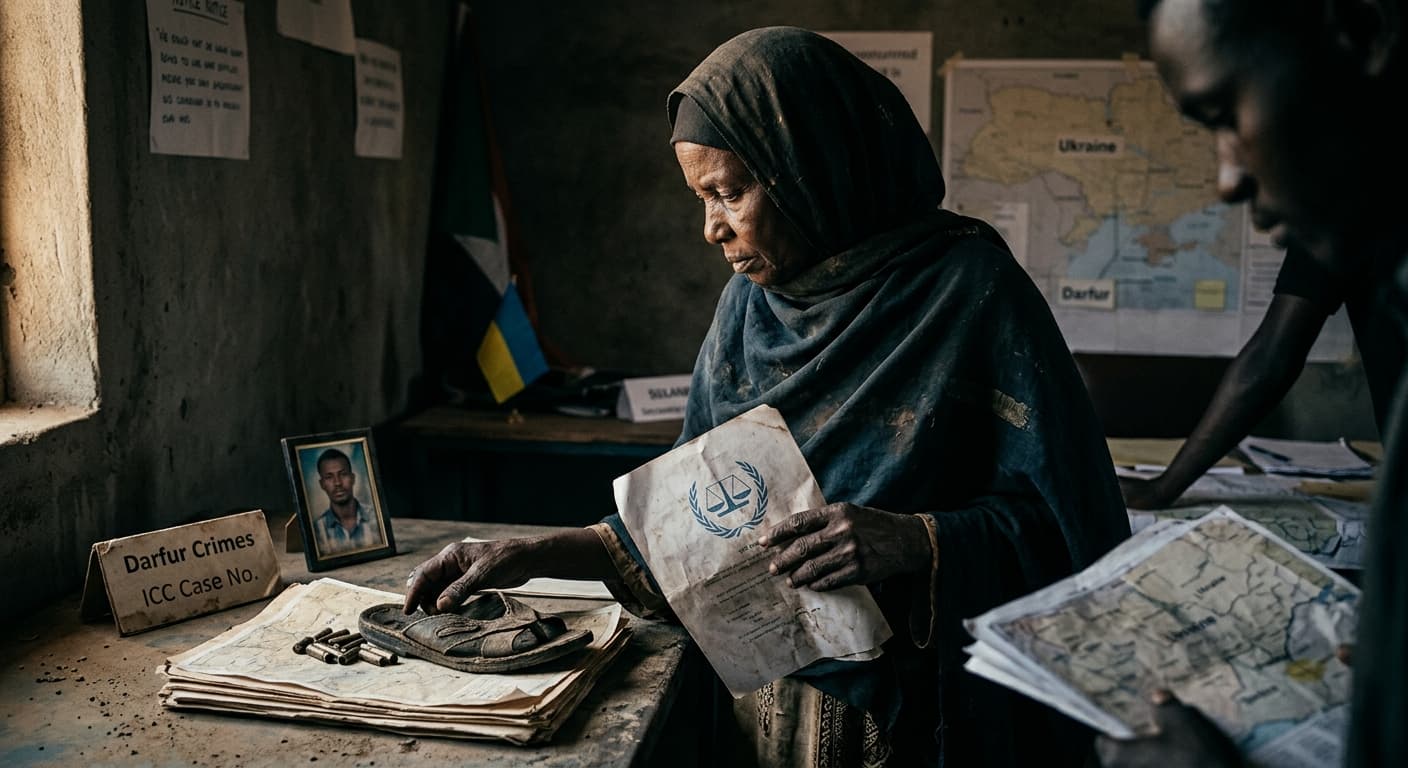
Why Trump's War on the ICC Endangers His Own War-Crimes Cases
The Trump administration's July 2026 campaign to "dismantle" the International Criminal Court is a preemptive strike against a court that has not acted against the US since Trump took office — and its primary casualties are US-backed investigations in Darfur and Ukraine, while Russia and Sudan's RSF gain.
On July 13, 2026, Secretary of State Marco Rubio published a Wall Street Journal op-ed vowing to use "all the tools at our government's disposal" to "dismantle the ICC, brick by brick, if necessary," accompanied by a State Department press release declaring a "whole-of-government response to systematically disable" the court's ability to operate (Al Jazeera). The announcement escalated a sanctions campaign begun 17 months earlier, when President Trump signed Executive Order 14203 on February 6, 2025, imposing financial restrictions and travel bans on ICC personnel under the International Emergency Economic Powers Act (IEEPA). Since then, the administration has designated nine ICC officials — Prosecutor Karim Khan and eight judges — plus three Palestinian human rights organizations and UN Special Rapporteur Francesca Albanese (
Carnegie Endowment). The campaign's logic is preemptive, its legal foundation is under siege in federal court, and its collateral damage includes the very investigations the United States has spent two decades championing.
The Escalation: From Targeted Sanctions to Systematic Dismantlement
Rubio's rhetoric marked a clear departure from prior administrations' posture. He accused the ICC of "waging a war against our country, not with bullets or missiles, but with statutes, compacts, and the force of so-called international law" (Al Jazeera). The State Department's campaign document listed actions under consideration: an appeal to US military and law-enforcement partners to "reject the ICC's purported authority," "increased scrutiny of nations that refuse to reject the ICC's false authority while relying on US assistance," and additional sanctions and travel bans for ICC personnel and affiliated organizations (
Al Jazeera).
The sanctions began on February 6, 2025, the same week Israeli Prime Minister Benjamin Netanyahu became the first foreign leader to visit the White House during Trump's second term (Al Jazeera). The trigger was the ICC's November 2024 issuance of arrest warrants for Netanyahu and former Defense Minister Yoav Gallant for alleged war crimes in Gaza. On June 5, 2025, Rubio sanctioned four ICC judges — two linked to the Afghanistan investigation and two tied to the Netanyahu warrants (
CourtListener). By December 2025, two more judges were added after the ICC rejected Israel's attempt to pause its Gaza investigation (
Al Jazeera).
Yet the timing is "perplexing," as William Schabas, a professor of international law at Middlesex University London, noted — the ICC has not taken any action related to the US or its allies since Trump took office in January 2025 (Al Jazeera). The administration may be "speculating on where the court might investigate," given that its own actions — including strikes on alleged drug-smuggling boats in the Caribbean and the abduction of Venezuelan leader Nicolás Maduro — could eventually attract ICC scrutiny (
Al Jazeera).
The Preemptive Logic and the Broader War on Multilateralism
The Carnegie Endowment's Stewart Patrick frames the campaign as "an escalation of its war on multilateralism," noting that the defense of US sovereignty from "smug globalists," as Rubio describes ICC defenders, is "a recurring theme in Trump administration policy" and "red meat for the president's base" (Carnegie Endowment). The administration's stated concern is that the ICC retains territorial jurisdiction to investigate US citizens for crimes committed on the territory of ICC member states — a claim the administration rejects. The ICC previously launched an investigation of alleged crimes by US soldiers in Afghanistan (
Carnegie Endowment).
The United States has never ratified the Rome Statute. It has signed more than 100 bilateral agreements with ICC member states not to surrender US nationals to the court, and in 2002, President George W. Bush signed the American Servicemembers' Protection Act — dubbed the "Hague Invasion Act" — authorizing "all means necessary" to protect US military personnel from ICC jurisdiction (Carnegie Endowment). At his January 2025 confirmation hearing, Rubio called the ICC's prosecution of Israel "a test run" to see whether the court could go after a head of state from a non-member nation, arguing that "they will apply that to the United States at some point" (
Congress.gov).
The difference between this administration and its predecessors is the absence of any off-ramp. Previous administrations, including the first Trump administration, sanctioned specific ICC officials in response to specific actions — but maintained quiet support for ICC investigations of US adversaries, including former Syrian president Bashar al-Assad and Russian President Vladimir Putin (Carnegie Endowment). The current campaign seeks to eliminate the court entirely and to penalize countries that continue to cooperate with it (
Al Jazeera).
The Collateral Damage: Darfur and Ukraine
The sanctions' most paradoxical consequence is their impact on investigations the United States itself has supported. Eric Iverson, a US citizen, Army veteran, and lead prosecutor of the ICC's Darfur Unified Team, was forced to halt his investigation of genocide in Darfur — a case directly supported by the United States diplomatically and financially since 2005 — because Executive Order 14203 threatened him with civil and criminal penalties for working with the sanctioned ICC Prosecutor (CourtListener). The Darfur genocide has claimed an estimated 300,000 civilian lives and displaced nearly 3,000,000 people (
CourtListener).
Iverson's complaint argued that his work constituted expression protected by the First Amendment and that the executive order was "overbroad and ultra vires" — exceeding the statutory limits Congress imposed on the President's use of sanctions (CourtListener). His case was voluntarily dismissed on May 13, 2025, after OFAC issued a license permitting his work (
Civil Rights Litigation Clearinghouse) — but the episode demonstrated the sanctions' capacity to halt US-backed accountability even when no American interest is at stake.
The risk extends to the ICC's Ukraine investigation, which enjoyed bipartisan US support. In 2022, then-Senator Rubio co-sponsored Senate Resolution 546 with the late Senator Lindsey Graham, endorsing the ICC as "an international tribunal that seeks to uphold the rule of law" and urging member states to petition the court to investigate Russian war crimes (CFR). The Council on Foreign Relations observed that the administration declared "an all-out war on the court without proposing an alternative mechanism for ensuring accountability for international crimes, such as those committed by Russia in Ukraine" (
CFR).
Alex Whiting, former Investigations and Prosecutions Coordinator at the ICC and now a professor at Harvard Law School, warned:
"Ultimately, these measures will undermine U.S. interests, emboldening the perpetrators of grave international crimes and further distancing the United States from its important allies in the world" (
Just Security).
The Legal Vise: Courts Push Back
Six federal lawsuits now challenge Executive Order 14203 on First Amendment and statutory grounds, and several have already produced preliminary injunctions.
In the Southern District of New York, three ICC judges — Kimberly Prost of Canada, Solomy Balungi Bossa of Uganda, and Reine Adelaide Sophie Alapini-Gansou of Benin — sued Trump, Rubio, and other officials on June 25, 2026, arguing the sanctions were "designed to exert extra-judicial pressure on these judges and their colleagues on the ICC bench by targeting their financial and other personal interests, with the objective of punishing them for prior judicial decisions and coercing them into prioritizing their private interests over deciding cases on the basis of the law and facts" (CourtListener). The complaint described the sanctions' effect in stark terms:
"Being subjected to such sanctions under IEEPA is tantamount to the financial death penalty. Due to the sanctions, Judges Prost, Bossa, and Alapini-Gansou are no longer able, among other things, to use credit cards; access banking services; use common online platforms, such as Amazon and Google; book travel; and in some cases, obtain health insurance" (
CourtListener).
In the District of Maine, a federal judge granted a preliminary injunction on July 18, 2025, enjoining the government from imposing penalties on two US human rights advocates for providing "speech-based services" to the ICC, finding that Executive Order 14203 restricts protected speech in violation of the First Amendment and exceeds the President's authority under IEEPA's "informational materials" exemption (CourtListener). In the District of Columbia, a preliminary injunction was granted on May 13, 2026, barring enforcement of sanctions against UN Special Rapporteur Francesca Albanese — though the administration reimposed the sanctions upon appeal (
CourtListener). On July 15, 2026, DAWN and the Taxpayers Alliance Against Genocide filed the latest challenge in New York federal court, arguing the sanctions violate IEEPA's "personal communications" exemption and the First Amendment (
BBC).
Who Benefits, Who Loses
The campaign's beneficiaries are identifiable by name. Russia, under ICC investigation for war crimes in Ukraine, gains from any weakening of the court's operational capacity. Sudan's Rapid Support Forces, under ICC scrutiny for atrocities in Darfur, benefit from the disruption of investigations the United States itself championed. The administration's July 8, 2025 statement to the ICC Assembly of States Parties, delivered by State Department Legal Adviser Reed Rubinstein, demanded that "all ICC actions against the United States and Israel" be terminated and warned that "all options remain on the table" (ICC Assembly of States Parties).
The losers include the 125 ICC member states — including every NATO member except the United States and Turkey — that rely on the court for accountability (Just Security). They include victims in Darfur, Ukraine, Libya, and the Philippines whose cases depend on ICC personnel now facing financial blockade. On July 15, 2026 — two days after Rubio's announcement — the ICC's Pre-Trial Chamber I confirmed jurisdiction in the case of a Libyan suspect charged with 17 counts of crimes against humanity and war crimes, demonstrating the court's continued operation despite US pressure (
ICC). The next day, Deputy Prosecutor Nazhat Shameem Khan told the UN Security Council that the Darfur investigation was intensifying, with new cooperation frameworks being developed with Chad and Sudan (
ICC).
The United Nations offered a pointed rebuttal to Rubio's framing. UN Spokesperson Stéphane Dujarric said the ICC "remains for us a critical cog in the international justice system," and added that international law, the UN Charter, and the Universal Declaration of Human Rights "were created by sovereign Member States" and "are, as the Secretary-General has often said, under threat and under attack" (UN News).
What to Watch
- Prost v. Trump (S.D.N.Y., filed June 25, 2026): The first lawsuit by ICC judges themselves challenging US sanctions. The government's response is the next filing; no hearing date set.
- DAWN & TAAG v. Trump (S.D.N.Y., filed July 15, 2026): Challenges EO 14203 on First Amendment and IEEPA grounds. Watch for a preliminary injunction motion.
- State Department diplomatic campaign: Rubio promised to pressure allies and aid recipients to reject the ICC's authority. The first concrete test comes when a US partner state is asked to choose between ICC cooperation and US assistance.
- ICC Assembly of States Parties: The court's 125 members may consider collective countermeasures at their next session. Watch for a European-led response.
The Bottom Line
The Trump administration's campaign to dismantle the ICC is a preemptive strike against a court that has not acted against the US since Trump took office — and its primary casualties are the US-backed investigations in Darfur and Ukraine that the administration has no alternative plan to replace. The beneficiaries are Russia and Sudan's RSF; the losers are the 125 ICC member states and the victims who depend on the court. The legal challenges, already producing injunctions, may ultimately constrain executive sanctions power more than the court's jurisdiction — but only if the courts move faster than the administration can dismantle.
Discover more
International Relations
Economist Impact Sustainability Week 2026
Economist Impact Sustainability Week 2026 spotlights the energy transition, AI in clean technology, and supply chain resilience as themes for global leaders.
US Politics
SNAP Food Assistance Faces Legal Challenges
In 2026, SNAP faces stricter eligibility rules and mounting legal challenges, threatening food assistance for the millions of Americans who rely on the program.
US Politics
House Ethics Committee Pushes Sexual Miscond.
The House Ethics Committee has shifted responsibility for sexual harassment settlement records to the Office of Congressional Workplace Rights, complicating disclosure efforts.

Economics
Fed's Amex AML order puts correspondent banking on notice
Federal Reserve's Amex AML order requires board-level controls and a 90-day plan; OCC fined the bank $350 million over enterprise-wide deficiencies.