Warsh's Fed Tilts Hawkish: June Minutes
Fed's June minutes signal a hawkish shift in policy.
Model Diplomat7 min readNorth America
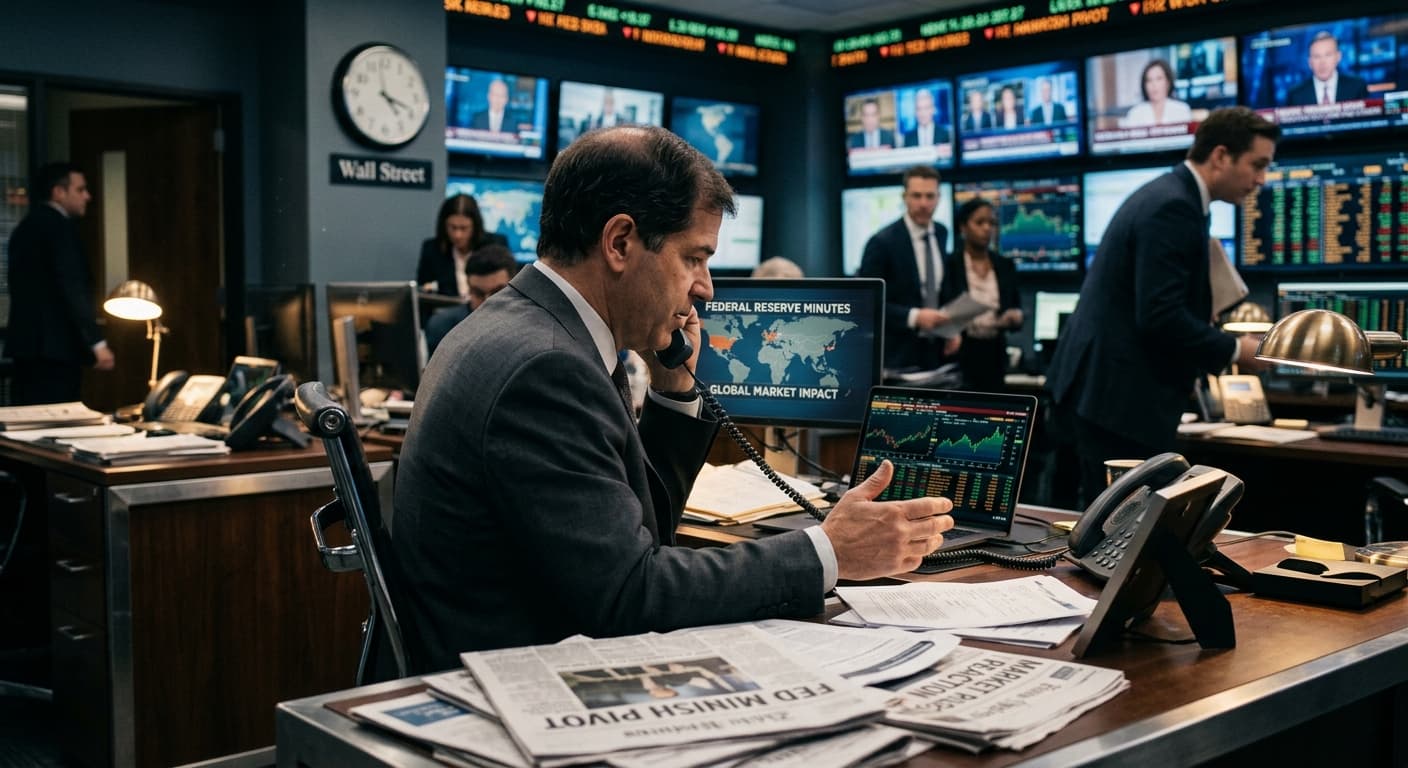
Warsh's Fed Tilts Hawkish: What the June Minutes Signal for Global Markets
The Fed's June 2026 minutes reveal an FOMC leaning toward hikes, not cuts — a hawkish pivot that will ripple through the dollar, EM currencies and global rates.
The Federal Reserve's June 16–17 minutes, released July 8, show that "some" of Kevin Warsh's colleagues wanted to raise interest rates immediately and that a broader majority — with nine of eighteen policymakers penciling a hike by year-end 2026 — believe "some policy firming would likely be warranted" if inflation does not recede on its own. That is the story, and it is bigger than a single dot on a chart: the first Fed under Warsh has quietly abandoned the easing bias Wall Street had priced in since 2024, and it did so with an above-target 4.2% CPI, an unfinished Iran war truce, and a president publicly demanding cuts. For emerging-market central banks and dollar-funded borrowers, the June minutes are the clearest signal in three years that the "Fed put" is on hiatus.
What the minutes actually say
The primary document is unusually blunt for a Warsh-era communique. According to the Federal Reserve's official minutes, the manager for domestic operations opened by noting that "expected policy rates, Treasury yields, the U.S. dollar, and domestic equity prices all rose" over the intermeeting period, even as an "optimism around a near-term resolution of the conflict in the Middle East" pulled the oil futures curve lower. Longer-run inflation expectations, the Fed noted, "remained well anchored near the Committee's 2 percent longer-run inflation objective" — a line hawks and doves will each cite for opposite conclusions.
The staff forecast is the tell. Fed economists lifted their 2026 and 2027 inflation projections, blaming "higher energy prices and other input costs due to the conflict in the Middle East, and the effects of the AI buildout on consumer prices," per the minutes text. Core inflation is now expected to "change little over the rest of the year" and only fall to about 2% in 2028 — a two-year runway that leaves no room for pre-emptive cuts.
The debate itself was sharper than the unanimous 12–0 vote suggested. The Financial Times reported that policymakers broadly agreed "some policy firming would likely be warranted" if price pressures do not fade. Warsh himself called it a "good family fight," according to
The Straits Times, which noted that officials weighing an immediate hike were held back only by uncertainty over whether the Iran truce would stick.
The Warsh imprint
Read alongside the June 17 statement, the minutes are the first evidence that the Fed's new chair is doing what he told the Senate he would do. The statement was cut to 132 words from roughly 350 in April, and the boilerplate line hinting at future easing was deleted, the BBC reported. The
Federal Reserve press release concludes with a single, load-bearing sentence: "The Committee will deliver price stability."
That is not accidental. Warsh, in his April confirmation hearing, told senators, "I don't believe in forward guidance… I don't believe that I should be previewing for you what a future decision might be," Brookings recounted at the time. The Council on Foreign Relations flagged in its
first-100-days preview that "the dot plot… could therefore become a relic of the past under his leadership." It has not disappeared yet — Warsh declined to submit his own dot but "encouraged his colleagues to go ahead with it," per the BBC — but the June Summary of Economic Projections may be the last of its kind in current form.
The political subtext is unavoidable. Donald Trump nominated Warsh after firing his rhetorical cannons at Jerome Powell for months and told reporters after June's decision that a hike would be "hard to believe… it just keeps the country down," the BBC reported. That the first FOMC under Trump's hand-picked chair has instead produced a document flagging upside inflation risks and shelving the easing bias is the single most important signal in the minutes.
The Iran war did the hawks' work
Read the minutes without the Middle East and none of this makes sense. Headline CPI ran at 4.2% year-over-year in May and core PCE, the Fed's preferred gauge, at 3.8% in April, according to reporting on the Bureau of Labor Statistics and BEA data compiled by Al Jazeera. Brent crude, which sat near $70 before the February 28 US-Israel strikes on Iran, peaked around $120 during the four-month closure of the Strait of Hormuz,
the BBC noted after the June 15 framework deal reopened the waterway.
The macro damage is quantifiable. Moody's Analytics estimated the war has cost US consumers and taxpayers roughly $132 billion, with gasoline peaking at $4.56 a gallon and 30-year mortgage rates climbing to 6.52%, NPR reported. The Pentagon comptroller told the Senate Armed Services Committee on May 12 that operational costs alone had reached $29 billion. That is the inflation the Fed staff is now writing into 2027.
The Iran deal signed June 18 in Switzerland pulls oil back — the Al Jazeera Economy desk documented a 5% drop in Brent on the announcement — but the minutes make clear the Committee does not treat the ceasefire as durable. And they cannot:
Al Jazeera reported July 8 that US-Iran strikes have resumed, with nuclear-file negotiations deferred 60 days. Any re-closure of the Strait of Hormuz would put the hawks who wanted to hike in June instantly in the majority.
The global spillover — the part nobody in Washington will price in
This is where the June minutes matter beyond the beltway. A Fed that removes its easing bias while EM currencies are already under strain does not need to hike to tighten global financial conditions — the signal itself moves money.
The mechanics are well documented. An IMF working paper by Engler, Piazza and Sher finds that a one-standard-deviation surprise US monetary tightening — roughly 5.4 basis points on the two-year Treasury — raises credit spreads on dollar-denominated EM sovereign bonds by 2.4 basis points and depreciates the average EM currency by about 1.7% per 100bp of tightening. A
World Bank Global Economic Prospects chapter went further, arguing that "reaction shocks" — moves in US yields driven by a perceived hawkish shift in the Fed's own preferences, rather than data — raise the modeled probability of an EM currency crisis by about 15 percentage points. The June minutes are, in textbook terms, a reaction shock.
Evidence of stress is already on the tape. Indonesia's rupiah broke through the psychological 18,000-per-dollar line in early June — a record low — forcing Bank Indonesia to hike its lending rate to 5.25% and tighten dollar-purchase rules for retail buyers, Al Jazeera reported. The World Bank's
June 2026 Global Economic Prospects warned that "tighter monetary policy in advanced economies could generate capital outflows, especially from vulnerable EMDEs in EAP, SAR, and MNA, putting additional pressure on currencies, inflation, and borrowing costs."
The historical parallel that reframes this is 2013. When minutes from a Fed pause hinted at tapering, the "fragile five" — Turkey, Brazil, India, South Africa, Indonesia — took the brunt of the outflows, as Ben Bernanke himself recounted for Brookings. This time, most emerging-market central banks have banked more credibility — a
Brookings paper by Kalemli-Özcan and Unsal argues that stronger inflation-targeting frameworks and lower dollar-debt loads explain why the 2022–23 cycle avoided a crisis. But that resilience assumes the Fed is disinflating on schedule and communicating clearly. Warsh's Fed is doing neither.
For the Bank of England, which held at 3.75% in June and whose governor Andrew Bailey noted "inflationary pressure in the pipeline" per the BBC, and for the ECB — which raised to 2.25% ahead of the Fed meeting, its first hike in almost three years — the June minutes remove the option of front-running a Fed cut. Bailey now has less political cover to lean dovish; Christine Lagarde has more room to hike again without triggering an unwanted euro appreciation.
Diplomat View
Our read: Warsh's Fed has quietly re-priced global risk. The minutes are not a hawkish surprise so much as the ratification of a regime change — one in which the Fed's default reaction function has shifted from "cut when uncertain" to "hold when uncertain, hike if inflation persists." That is a materially tighter setting than markets priced in April, and it will drag on any EM central bank that cannot afford to break with the dollar cycle. The specific, falsifiable call: the July 28–29 FOMC will not cut, and by the September SEP at least ten of eighteen dots will show a 2026 hike — up from nine — unless June CPI (due July 15) prints below 3.5% headline and 3.6% core. If Strait of Hormuz shipping is disrupted again before the July meeting, expect a live hike debate and, plausibly, a 25bp move. Revise the forecast if Warsh appoints a dovish vice-chair for supervision or if core PCE prints below 3% before September; either would signal the "family fight" is tilting back the other way.
What to watch next
- July 15, 2026 — June CPI release (BLS). A print above 4.0% headline hardens the hawk camp.
- July 28–29, 2026 — Next FOMC meeting. Watch whether the statement adds language flagging "additional firming" and whether there is a dissenting vote in favor of a hike.
- August 18, 2026 — 60-day expiry of the nuclear-file portion of the US-Iran framework; a collapse would repeat the oil shock the Fed just absorbed.
- September 16–17, 2026 — Next SEP and dot plot. This is the meeting at which a hawkish majority becomes a committed hiking cycle, or the Warsh Fed blinks.
The Bottom Line
The June minutes are not a data point — they are a regime change. Kevin Warsh's first FOMC has removed the easing bias, shortened the statement, tolerated a dot plot pointing to hikes, and put the burden of proof on inflation to fall rather than on the Fed to justify holding. For dollar-funded borrowers from Jakarta to Ankara, that is the most consequential signal from Washington this year — and the one Trump's public pressure has not, so far, managed to bend.
Discover more
India
Congress Accuses Modi of Stalling Women's Law
Congress accuses Modi of stalling women's reservation law by linking it to delimitation, revealing a deeper electoral strategy.
US Politics
House Ethics Committee Pushes Sexual Miscond.
The House Ethics Committee has shifted responsibility for sexual harassment settlement records to the Office of Congressional Workplace Rights, complicating disclosure efforts.

India
Delhi CM Rekha Gupta Blasts Opposition's Delm
Delhi CM Rekha Gupta's remarks on women's quota defeat reveal BJP's strategy for the 2029 Lok Sabha elections, focusing on delimitation.

Economics
Fed's Amex AML order puts correspondent banking on notice
Federal Reserve's Amex AML order requires board-level controls and a 90-day plan; OCC fined the bank $350 million over enterprise-wide deficiencies.