USTR's Forced-Labor Tariffs Impact 60 Econom
Proposed duties aim to rebuild tariff wall before expiry.
Model Diplomat8 min readNorth America
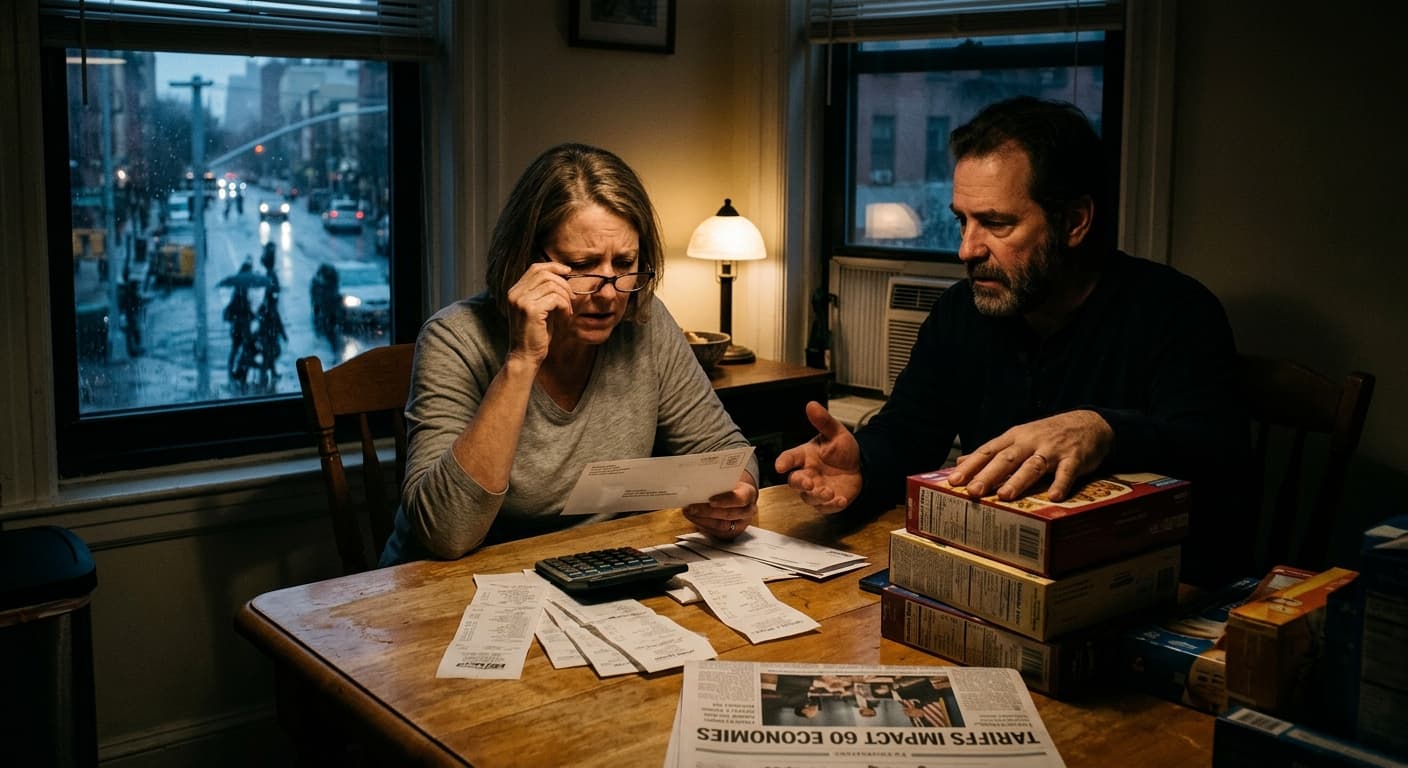
Forced-labor tariffs: USTR's post-IEEPA tariff rebuild hits 60 economies
USTR proposes 10–12.5% duties on 60 economies under Section 301 as the July 24, 2026 Section 122 tariff expiry approaches — costs, legal risk and supply-chain fallout.
The Office of the U.S. Trade Representative received roughly 980 written submissions by the July 6, 2026 deadline opposing a proposed additional tariff of 10% or 12.5% on 60 economies — a package designed less to punish forced labor than to legally rebuild the tariff wall the Supreme Court demolished in February. Ambassador Jamieson Greer's team has 17 days to convert those duties into force before the temporary Section 122 tariff expires on July 24, and the industries that testified this week at the U.S. International Trade Commission — printed-circuit-board makers, furniture importers, dairy processors, textile manufacturers — are telling the administration exactly what its own Federal Reserve economists have already found: the price will land on U.S. buyers, not on foreign governments. That is the story. The forced-labor label is the legal vehicle; the freight is a post-IEEPA tariff regime that has to survive the next round of litigation and the midterm political calendar.
What USTR actually proposed on June 2
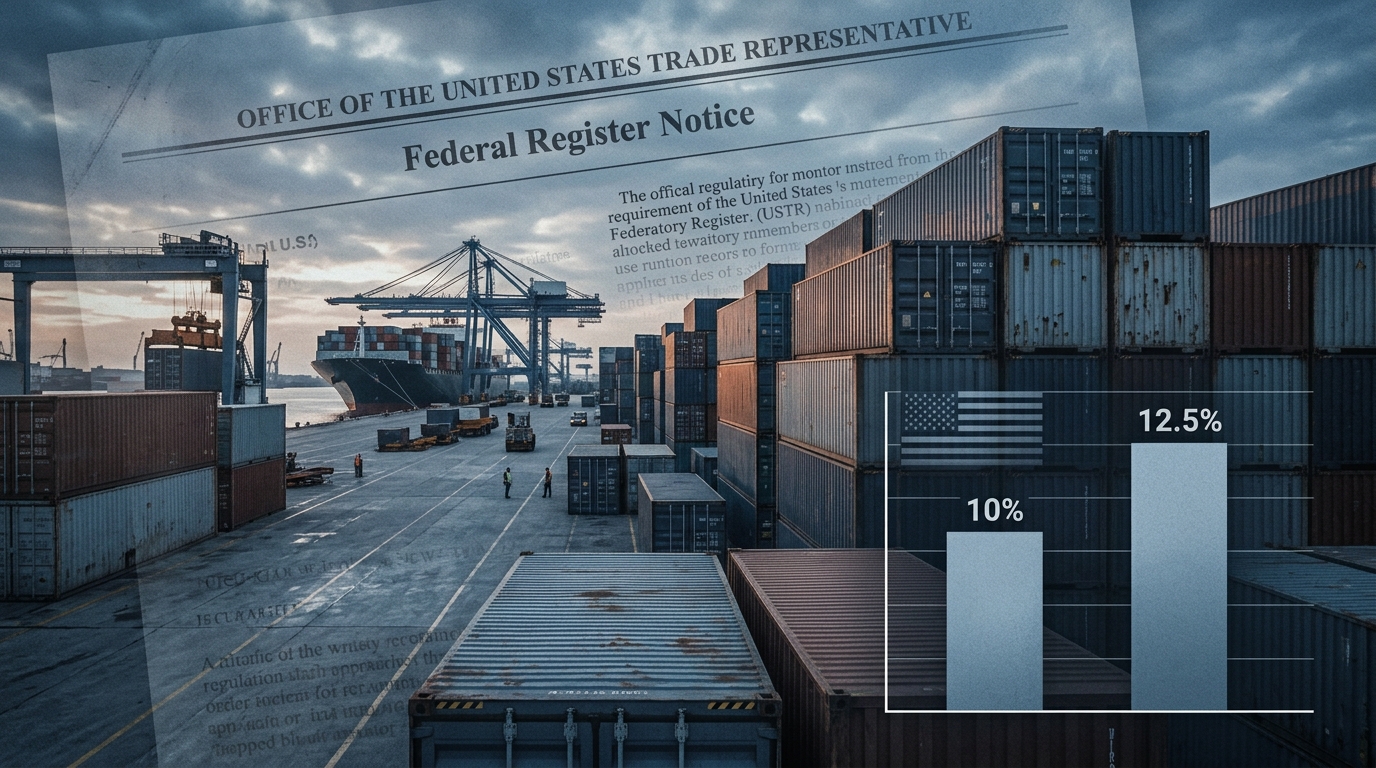
The June 2 Federal Register notice, posted by USTR, proposes "additional duties on all products of the investigated economies, except as provided in Annex A." Fourteen jurisdictions that either operate or have committed to a forced-labor import ban — Canada, the European Union, Mexico, the United Kingdom, Indonesia, Pakistan, Ecuador, Argentina, Bangladesh, Cambodia, El Salvador, Guatemala, Malaysia and Taiwan — face a 10% surcharge. The remaining 45, including China, India, Japan, South Korea, Vietnam, Australia, New Zealand and Nigeria, face 12.5%.
The 74-page Annex A is the tell. It carves out steel, aluminum, autos and copper already covered by Section 232; USMCA-compliant Canadian and Mexican goods; and, per Al Jazeera, "energy, rare earths and some other metals, beef, coffee, certain fruits and vegetables, pharmaceuticals, organic chemicals and aircraft parts." As CSIS trade analyst William Reinsch
observed, the exclusions cluster around items "where higher prices have become a political liability, like beef and tomatoes, and items not grown or made in the United States, like bananas." This is a tariff package engineered to survive both inflation optics and litigation — not one designed to change forced-labor enforcement anywhere.
The real driver: the July 24 cliff
To understand why USTR is moving at hearing-week pace, look at the calendar rather than the labor-rights record. On February 20, 2026, the Supreme Court struck down President Trump's IEEPA tariffs 6–3. In the Council on Foreign Relations' read of the ruling, Chief Justice Roberts held that IEEPA's grant of authority to "regulate importation" does not "embrace the power to impose tariffs." The administration issued an executive order the same day, imposed a Section 122 balance-of-payments tariff at 10% (later 15%), and — critically — Section 122 duties "automatically expire after 150 days unless Congress votes to extend them." That clock runs out July 24.
Section 301 is the bridge. As Brookings' Christopher Sands and Maricarmen Barron Esper explained in March, Section 301 "will likely be the principal vehicle for the current administration's effort to rebuild tariff authority and potentially restore tariff revenue." Treasury Secretary Scott Bessent has been explicit that stacking Section 122, Section 232 and Section 301 duties should yield tariff revenue "virtually unchanged" from the invalidated IEEPA regime,
per the BBC. The forced-labor probe is, by design, a legally defensible container for that revenue.
Who pays: not Beijing, not Brussels
The commercial reality is now well-documented. The Peterson Institute's real-time tracking through mid-2025 found that U.S. importers absorbed most of the cost by compressing margins, with foreign sellers barely cutting prices. That has since shifted onto consumers. A Federal Reserve analysis cited by AEI
in June 2026 concluded tariffs "have raised core goods PCE prices by 3.1 percent through February 2026, explaining the entirety of excess inflation in the core goods category." The Yale Budget Lab put full-year 2025 pass-through at around 76% by end of year, "and as high as 100 percent for many consumer durables,"
according to CFR's Liberation Day retrospective.
The industry testimony filed in USTR docket USTR-2026-0133 is the same argument in operational detail. Eve Duchene of Modules Technology in San Jose told USTR that "layering additional tariffs on products that are already subject to existing trade measures can create unnecessary cost burdens and supply chain complexity," a submission summarized in the China Daily wrap of the comment file. Ashley Furniture raised prices across most of its catalog in June on the back of earlier tariff waves,
NPR reported, and furniture-adjacent duties were already set to jump to 50% on January 1. Twenty-two state attorneys general, led by California's Rob Bonta, filed a joint objection describing the proposal as "unlawful,"
per Global Times.
The angle: allies, not adversaries, bear the political weight
The counterintuitive feature of this package is not that China faces 12.5% — Beijing already faces stacked Section 301 duties from the first Trump term and the Biden 2024 additions — but that the EU, Canada, Mexico and the UK have been dragged into a forced-labor tariff regime through language modeled on the U.S. Uyghur Forced Labor Prevention Act. Bernd Lange, chair of the European Parliament's trade committee, called the finding "utterly absurd," noting the EU adopted its own forced-labor import ban in 2024. The Commission's Olof Gill said Brussels "considers tariffs imposed on these grounds to be unjustified."
The stacking problem is the sharper one. The EU's July 2025 framework deal with Washington capped U.S. duties on European goods at 15%. If the 10% forced-labor tariff is layered on top of the 15% Section 122 baseline — or on top of what replaces it — the U.S. breaches the deal. CSIS's Reinsch is blunt: "The European Union, in particular, has been clear that it believes its agreement with the United States caps the latter's tariffs at 15 percent, and new tariffs that exceed that will be regarded as a breach of the agreement." That drags in the parallel Section 301 overcapacity investigation covering 16 economies, where "even modest additional tariffs will bring the U.S. total tariff level above the caps negotiated last year."
The second-order beneficiary is not a country. It is the domestic tariff-litigation and customs-compliance industry — the same actors who profited from the UFLPA compliance build-out, which CSIS estimates triggered Customs and Border Protection to detain nearly $3.7 billion in suspected shipments by 2025. Every additional 10% ad valorem duty stacked onto a duty already stacked onto a Section 232 base creates a new reason for importers to hire counsel, request exclusions, and litigate origin.
The legal exposure
Reinsch's core analytical point is that USTR has procedurally covered itself while substantively cutting corners. The USTR report accompanying the June 2 notice runs 98 pages, but "the findings with respect to each of the 60 countries are two or three paragraphs each, simply asserting that the country in question 'failed to impose and effectively enforce a forced labor import prohibition.'" No country-specific evidence appears. That "will open the door to lawsuits arguing that the investigations were perfunctory."
The Section 301 record still beats IEEPA on paper. As Inu Manak of CFR detailed, Section 301 "offers a broad range of remedies and does not cap tariff levels, but it requires a formal investigative process and findings before action can be taken." USTR held two days of hearings in April, took 455 initial and 43 rebuttal comments, published a Federal Register notice, and ran a second comment cycle plus this week's three-day hearing. That is the process the Court of International Trade will look for. Whether it holds depends on which plaintiff and which country a judge sees first. The EU, with its own 2024 forced-labor regulation in force, is the case USTR least wants to defend.
The Diplomat View
The forced-labor Section 301 package is a legal-engineering exercise dressed as a labor-rights initiative. USTR will almost certainly impose the 10% and 12.5% duties on or around July 24 to bridge the Section 122 expiry, because letting the tariff wall drop even for a week creates refund liability and negotiating collapse across the framework deals struck in 2025. The forecast: duties enter into force in late July, the EU protests but does not retaliate before the December 2026 mid-term review of the transatlantic deal, and a targeted lawsuit — most likely brought by an EU-facing importer of a good not on Annex A — reaches the Court of International Trade by Q4. Consumer pass-through peaks between April and October 2026, per the CFR-cited economist consensus, putting maximum inflation pressure on the administration just as the midterms hit.
What would change the forecast: (a) a court injunction against the June 2 notice before July 24, which would force the White House to reinvoke Section 122 or Section 338 and reopen the constitutional fight; (b) an EU decision to treat any stacking above 15% as a breach and impose the retaliatory tariff list already prepared by DG Trade; or (c) a decision by Greer to narrow the Annex A carve-outs to raise revenue at the cost of political optics — a move Treasury wants but the White House political shop will resist through November.
What to watch:
- July 9, 2026 — final day of USITC hearings; USTR post-hearing rebuttal window opens.
- July 24, 2026 — Section 122 tariffs expire; expect an executive proclamation implementing Section 301 duties on or before that date.
- Q3–Q4 2026 — first Section 301 forced-labor lawsuit filed at the Court of International Trade; conclusion of the parallel 16-country overcapacity investigation, which will test whether the U.S. breaches the EU's 15% cap.
The Bottom Line
The June 2 forced-labor tariff proposal is not primarily about forced labor; it is the Trump administration's legally defensible replacement for the IEEPA tariffs the Supreme Court struck down, timed to enter force before the Section 122 bridge expires on July 24, 2026. Every serious economic estimate — from the Federal Reserve to the Yale Budget Lab to the Peterson Institute — now attributes the bulk of the pass-through to U.S. importers and, increasingly, U.S. households, meaning the political cost lands in Washington rather than Beijing or Brussels. Whether the package survives the courts depends less on the merits of the forced-labor findings than on which plaintiff, from which of the 60 economies, gets in front of a judge first.
Discover more
US Politics
House Ethics Committee Pushes Sexual Miscond.
The House Ethics Committee has shifted responsibility for sexual harassment settlement records to the Office of Congressional Workplace Rights, complicating disclosure efforts.
India
Congress Accuses Modi of Stalling Women's Law
Congress accuses Modi of stalling women's reservation law by linking it to delimitation, revealing a deeper electoral strategy.
India
700 Activists Accuse PM Modi of MCC Breach
Over 700 activists allege PM Modi breached election code with a televised address attacking opposition parties just before state elections.

Conflict & Security
Drone Warfare Killing Aid Workers at Unprec
Over 1,000 humanitarian workers killed in three years as cheap armed drones collapse legal protections. Gaza, Sudan, Ukraine, and DRC see deliberate targeting of aid convoys and hospitals with zero prosecutions.