US Trade War Hits Europe's Auto Industry
Trump's 25% tariff targets German luxury car brands.
Model Diplomat7 min readEurope
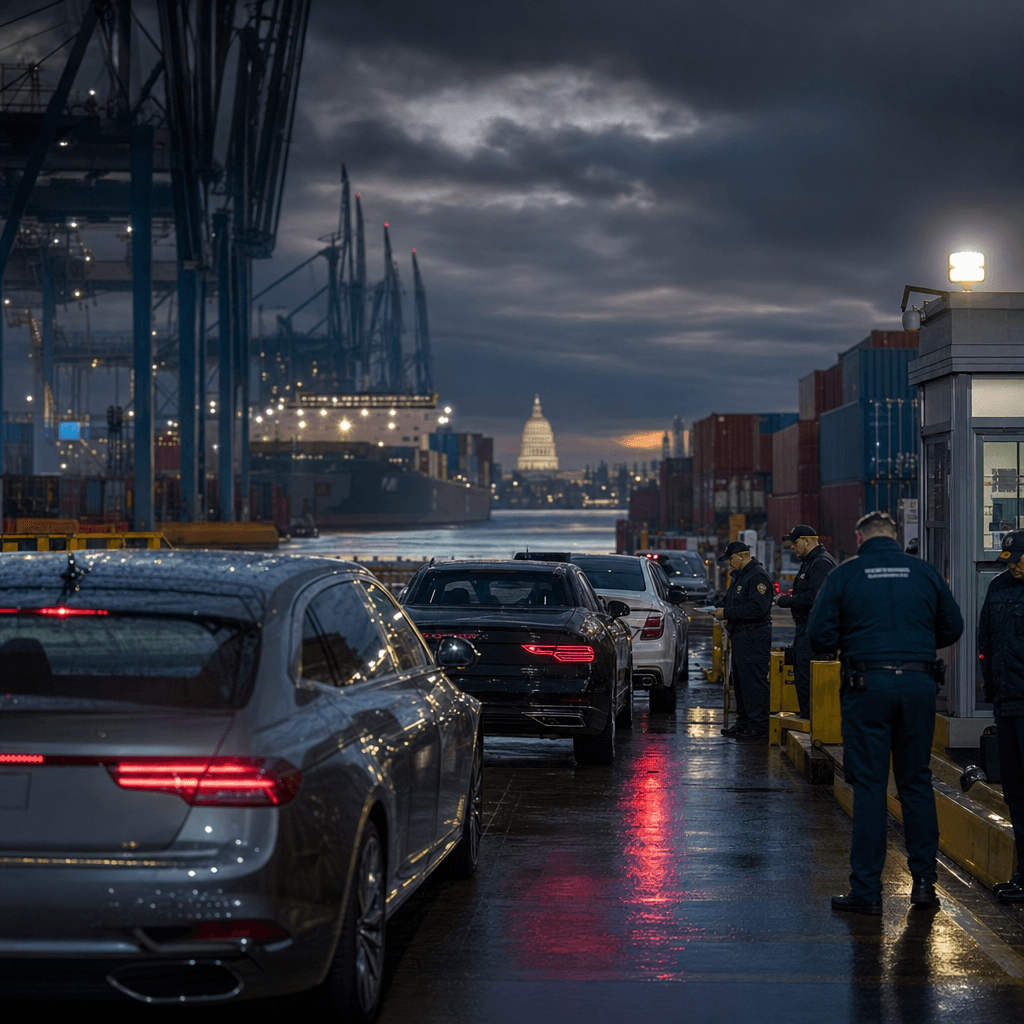
US Trade War Hits Europe's Auto Industry as Tariff Snaps Back to 25%
Trump's May 1, 2026 tariff hike from 15% to 25% on EU cars breaks the Turnberry deal — and lands hardest on German luxury brands with no US plants.
The White House's decision to reimpose a 25% tariff on European cars and trucks on May 1, 2026 — nine months after Donald Trump and Ursula von der Leyen shook hands on a 15% ceiling at Turnberry — has already cost Europe's biggest automakers more than €8 billion in cumulative losses and shrunk their US-bound car and parts exports by 20.4% over the past year. The real story is not the tariff itself, but which producers cannot escape it: the German luxury brands that build in Germany, sell to Americans, and now have nowhere to go. Volkswagen's Porsche and Audi units — with zero US factories — are being reshaped by a trade policy their own government cannot deflect, while BMW's Spartanburg plant and Mercedes' Alabama plant give those firms a partial hedge. The tariff is a policy weapon aimed with unusual precision.
What snapped back, and why now
Trump announced the hike on Friday, May 1, 2026, via Truth Social, telling reporters the EU had "not been adhering" to the deal struck the previous July, according to the BBC. The Turnberry framework — formalised in the
White House joint statement of August 21, 2025 — had capped duties on EU cars and parts at a combined 15%, down from the 27.5% imposed in April 2025 under Section 232 of the Trade Expansion Act. That ceiling was the single biggest commercial win Brussels extracted from the summer standoff.
The stated pretext is EU foot-dragging on ratification. The European Parliament's trade committee twice postponed its vote — on January 21, 2026 after Trump threatened Greenland-related tariffs and again on February 23 after the Supreme Court ruled against IEEPA tariffs, according to a European Parliament press release. Rachel Ziemba, adjunct senior fellow at CNAS, told
Al Jazeera the actual trigger was different: European capitals declined to send navies to help the US reopen the Strait of Hormuz. Bernd Lange, chair of the European Parliament's International Trade Committee, put it more bluntly to
Euronews: "There are no legal or no economic reasons for those tariffs. This is really politically against Germany."
The legal architecture matters. The Supreme Court's February 20, 2026 decision in Learning Resources, Inc. v. Trump stripped the President of IEEPA authority to impose tariffs — but the Court explicitly distinguished Section 232, whose "adjust the imports" language it deemed textually broad enough to authorise duties. A May 11, 2026
Congressional Research Service memo confirms the auto tariffs sit on Section 232 findings from a 2019 Commerce investigation, insulating them from the IEEPA ruling. Trump's leverage over the EU has narrowed everywhere except on cars.
The hit already booked
The damage is not hypothetical. According to a Financial Times tally compiled by Newsorga, Volkswagen, BMW, Mercedes-Benz, Stellantis and Volvo Cars have absorbed more than €8 billion in tariff-related losses since the April 3, 2025 hike to 27.5%. Volkswagen alone reported $1.5 billion in first-half 2025 losses;
Stellantis reported $2.7 billion over the same period.
The distribution is stark. Porsche's Q2 2025 operating result plunged more than 90% to €154 million; Audi's fell 64% to €550 million — both brands produce zero vehicles in the United States. Mercedes-Benz and Volvo suspended forward guidance. Volkswagen's finance chief Arno Antlitz has since announced 50,000 job cuts across Germany by 2030, with the BBC reporting that post-tax profits at Europe's largest carmaker fell 44% in 2025.
Bernstein Research estimated in May that a snapback to 25% would add roughly €2.6 billion in incremental cost across the top five European producers on top of the €8 billion already absorbed. The trade-flow evidence corroborates the accounting. According to Eurostat data released May 28, 2026, EU exports to the United States fell 30.4% year-on-year in Q1 2026 — the single largest drop to any partner. A
German Economic Institute study cited by EU Today shows EU car and parts shipments to America fell 20.4% in 2025, with Germany down 18.9%. Total EU–US goods trade still hit a record €875 billion in 2025, but that headline masks a concentrated collapse in one politically decisive sector.
Who wins, who loses
The unadvertised beneficiaries are not American. A CEPR modelling study by Head, Mayer, Vicard and Wibaux, using S&P Global sales data, finds that under a full EU–US auto trade war, production in Sweden falls 13%, Italy 7%, and Germany 6%. The clearest gainers are Toyota and Nissan — Japanese producers whose US plants serve the American market while their home plants keep European market share unmolested by the transatlantic fight. Hyundai and Kia, protected by a 15% Japan-style rate, sit in the same sweet spot. Jaguar Land Rover, benefiting from the UK's 10% ceiling, gets a competitive gift.
Inside Europe, the split runs along production geography. BMW's Spartanburg complex in South Carolina — the largest single BMW plant on earth — insulates the group's X-series. Mercedes' Tuscaloosa plant covers most SUV volume. Volkswagen's Chattanooga facility builds the Atlas and ID.4. What sits exposed is precisely the high-margin luxury segment that pays for the R&D on the mass-market rest: Porsche 911s, Audi A6s, Mercedes S-Classes, Ferraris, Lamborghinis, Bentleys.
Georgetown's Gregory Shaffer, quoted by Al Jazeera, captured the political calculation: "Europe so far has yet to push back on Trump's tariffs, in large part because of security concerns." Berlin needs Washington on Ukraine and NATO burden-sharing more than it needs a trade war it would lose. That asymmetry is why the tariff works.
Brussels's narrow counter-move
The European response is now codified. On June 25, 2026, the Council and Parliament published Regulation (EU) 2026/1455, implementing the EU's Turnberry commitments — zero tariffs on US industrial goods, expanded quotas for US seafood and agri-food. Crucially, MEPs added a suspension clause. If Washington keeps tariffs above 15% on EU steel and aluminium derivatives past December 31, 2026, or fails to address the auto snapback, the Commission is empowered to yank the concessions. Parliament approved the package 440–151 on June 16, 2026,
per the European Parliament.
That gives Trade Commissioner Maroš Šefčovič a lever, but a delicate one. Pulling it would trigger retaliation against US Boeing aircraft, bourbon, motorcycles and agricultural exports — the political map Brussels drew up before Turnberry. The European Parliament's March 2026 briefing identifies Germany, Slovakia, Austria, Italy and Sweden as the member states with the highest effective tariff rates on US-bound exports. Slovakia, the Czech Republic and Hungary — the German auto supply chain's second belt — face the sharpest indirect exposure. Retaliation risks turning a targeted German problem into a bloc-wide one.
Meanwhile the industrial response is already visible on the ground. Porsche is studying a first US production line. Volkswagen is throttling German output. Peacock Tariff Consulting told Al Jazeera that European carmakers have grown more hesitant to source parts from US suppliers concentrated in swing states — a quiet counter-pressure that will not show up in Commerce Department data for months.
Diplomat View
The Turnberry deal is not dead; it is now a live example of what a Trump-era trade agreement is worth when the political price of enforcement rises. Our call: the 25% rate holds through at least Q4 2026, and Brussels will not trigger its suspension clause before the December 31 steel derivative deadline. The reason is asymmetry — Germany's coalition under Friedrich Merz cannot afford a full trade war while relying on US security guarantees on Ukraine, and Šefčovič knows retaliation empowers Trump's domestic narrative more than it hurts his economics. Expect instead a negotiated partial climbdown: modest EU concessions on digital rules or LNG offtake in exchange for a Section 232 auto quota. The forecast breaks if Berlin's SPD wing forces retaliation after the next VW earnings shock, or if a Section 232 challenge succeeds in the DC Circuit. Watch both.
What to watch next:
- July 24–25, 2026 — Volkswagen Q2 earnings; the first full quarter under the 25% rate.
- September 2026 — Section 232 review window on EU auto imports; Commerce Secretary can adjust quotas without new legislation.
- December 1, 2026 — European Commission report to Parliament on US steel/aluminium derivative tariffs; the trigger date for the suspension clause is December 31.
- G7 trade ministerial follow-up — Šefčovič–Greer bilateral track, next scheduled round on the sidelines of the UN General Assembly.
The Bottom Line
Trump's 25% tariff on EU cars is not an economic tool but a political one, aimed with surgical accuracy at German luxury brands that cannot relocate fast enough — and Berlin cannot retaliate without endangering the security relationship it depends on. The Turnberry deal survives on paper; in practice it has become a template for how Washington will renegotiate every trade agreement it signs, one crisis at a time. The winners are the Japanese and Korean producers who quietly kept their US plants humming while Europe fought the last war.
Discover more

Global Politics
US Seizes Iranian Ship, Tensions Surge
The US seizure of the Iranian ship Touska highlights a shift in control over the Strait of Hormuz, favoring Iran's strategic position.

Conflict & Security
Drone Warfare Killing Aid Workers at Unprec
Over 1,000 humanitarian workers killed in three years as cheap armed drones collapse legal protections. Gaza, Sudan, Ukraine, and DRC see deliberate targeting of aid convoys and hospitals with zero prosecutions.

Global
World Normalises Taliban as Afghan Women Eras
UN data shows Afghan women erased from public life as Russia recognises the Taliban, EU hosts officials in Brussels, and ICC warrants for gender persecution go unenforced.

Conflict & Security
West Africa Food Crisis: Three Shocks in 2026
Conflict, climate extremes, and the Strait of Hormuz closure drive a severe food crisis in West and Central Africa, with fertilizer prices surging 80% and millions displaced.