US Tariffs on 60 Economies: Geopolitical Play
Exploring the implications of new tariffs on global trade.
Model Diplomat8 min readNorth America
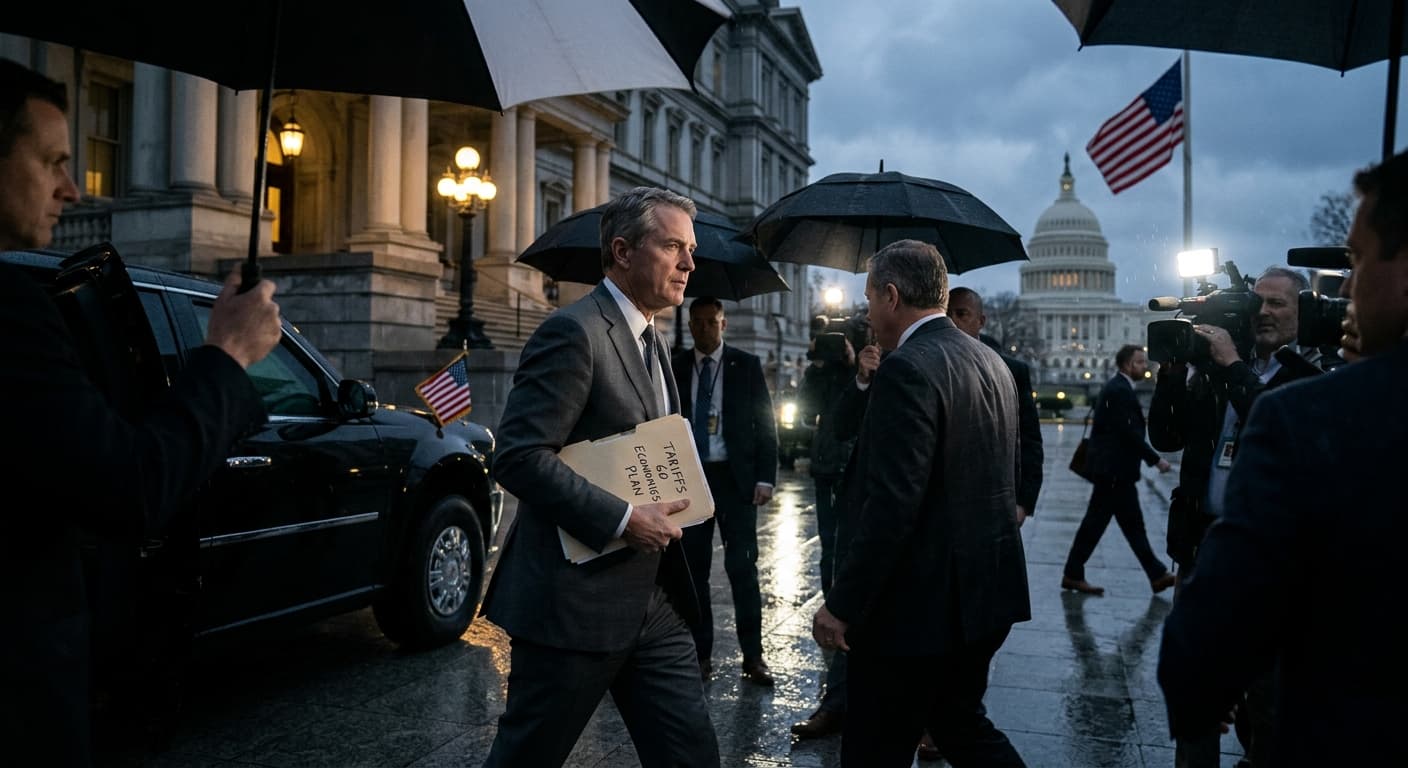
US tariffs on 60 economies over forced labor: the real geopolitical play
USTR's proposed 10-12.5% Section 301 tariffs on 60 economies covering 99% of US imports are less a labor policy than a legal scaffold to rebuild Trump's tariff wall after the Supreme Court struck it down in February 2026.
The Trump administration's Section 301 forced-labor tariffs cover 99.40% of U.S. imports — 10% on 15 economies, 12.5% on the other 45 — and the June 2, 2026 USTR determination that triggered them is less a labor-standards ruling than a legal chassis built to replace the tariff wall the Supreme Court demolished in February. The finding is the sharp end of a strategy that began the day the Supreme Court struck down President Donald Trump's emergency-powers tariffs on February 20: the administration is not defending forced-labor policy, it is defending its tariff wall by dressing it in the one statute the courts have consistently upheld. That reframing — from national-emergency logic to unfair-trade logic — will reshape supply-chain compliance for a decade even if courts trim the rates.
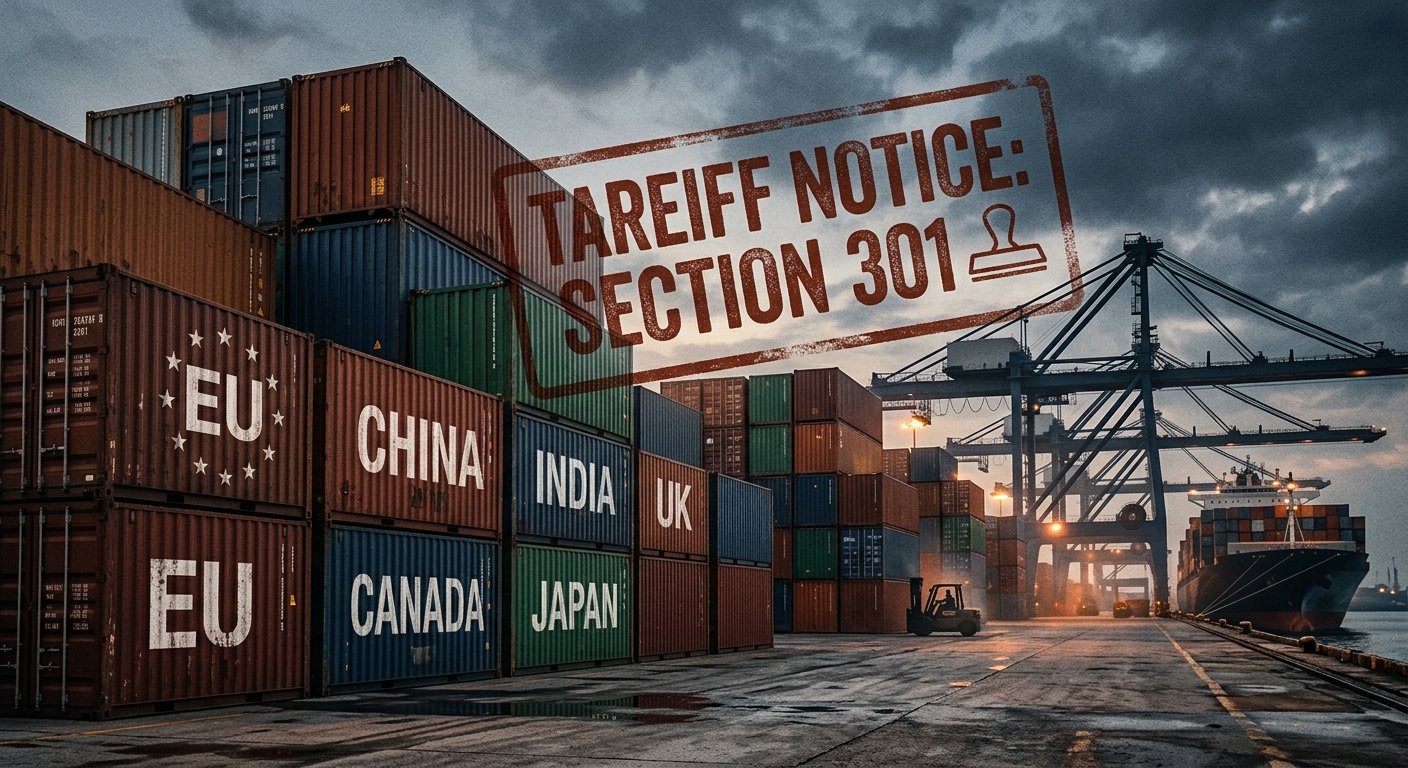
The legal pivot the market missed
The Section 301 push is a direct response to Learning Resources, Inc. v. Trump. On February 20, 2026, Chief Justice John Roberts wrote for a 6-3 majority that the International Emergency Economic Powers Act's authority to "regulate . importation" does not include the power to impose tariffs, holding that "IEEPA contains no reference to tariffs or duties," per the Supreme Court opinion. The Court left Section 232 and Section 301 authorities untouched. A
Congressional Research Service legal sidebar issued three days later flagged the obvious workaround: the president could rebuild the wall through statutes with clear tariff authority, provided he ran the required administrative process.
He did. Within hours of the ruling, Trump invoked Section 122 of the Trade Act of 1974 to impose a stopgap 10% tariff for 150 days — expiring July 24, 2026, per a Council on Foreign Relations analysis by Jennifer Hillman. On March 11 and 12, USTR opened two Section 301 tracks: a 16-economy structural-overcapacity investigation and, per the
USTR announcement, a 60-economy forced-labor investigation. Section 301 requires a record, hearings, and a legal determination — everything IEEPA skipped. As Maricarmen Barron Esper and Christopher Sands write in a
Brookings analysis, the pivot means that "the record — shaped by public comment — will define what counts as an 'unfair' trade practice … and how far tariff authority can extend in the post-IEEPA environment."
What the record actually says — and doesn't
The USTR's June 2 Federal Register notice determined that 54 economies had failed to impose a forced-labor import ban and that six others — Canada, Ecuador, the European Union, Indonesia, Mexico, and Pakistan — had bans on the books but did not enforce them adequately. The proposal quotes the statute cleanly:
"The acts, policies, and practices of each of the 60 economies covered in the investigations are unreasonable and burden or restrict U.S. commerce, and thus are actionable under section 301(b)(1) of the Trade Act."
But the underlying report is thin where it needs to be thick. William Reinsch of the Center for Strategic and International Studies, a former Commerce undersecretary, notes in CSIS analysis that of 98 pages, most argue in the abstract that forced labor is unfair; the individual findings for each of the 60 economies "are two or three paragraphs each, simply asserting that the country in question 'failed to impose and effectively enforce a forced labor import prohibition.'" That thinness is the litigation vulnerability. As the
Peterson Institute for International Economics put it, the courts will inevitably ask whether Congress delegated "nearly all of its tariff authority to the president under Section 301."
The International Labour Organization's 2021 estimate — cited by USTR itself — was that 28 million people were in forced labor globally, generating some $236 billion in illicit profits, per the ILO's Global Estimates. Nobody disputes the underlying problem. The dispute is over the remedy: a flat 12.5% duty on Japanese cars, Israeli chips, Norwegian salmon, and Australian iron ore on the theory that Tokyo, Jerusalem, Oslo, and Canberra have insufficient import-ban regimes to police goods not made in their jurisdictions in the first place.
The angle: Section 307, exported
The load-bearing move here is not the tariff rate. It is what the Peterson Institute's Kimberly Elliott calls the "extension of the US forced-labor enforcement perimeter." In PIIE research on the administration's reciprocal trade agreements, the mechanism is spelled out: partner countries must "prohibit imports of goods made with forced or compulsory labor" and, in most cases, "link partner-country enforcement to US determinations under Section 307 of the Tariff Act of 1930" — the same statute that undergirds the Uyghur Forced Labor Prevention Act (UFLPA). The Section 301 findings put the same demand on 60 economies at once.
The consequence is that Washington is quietly globalising its Xinjiang-focused enforcement architecture. The Congressional Research Service notes that "few countries implement import bans similar to Sec. 307," and that USTR under Ambassador Jamieson Greer had already flagged in December 2025 that "improving implementation" of Canadian and Mexican import bans would be a priority for the 2026 USMCA review. The Section 301 process converts that bilateral pressure into a global compliance regime. Every economy that wants to keep US market access at the 10% band rather than the 12.5% band has an incentive to stand up UFLPA-style withhold-release orders, rebuttable-presumption lists, and traceability requirements — and to point them at Chinese-origin inputs, which is where CBP's enforcement has been overwhelmingly targeted. That is the geopolitical prize: the forced-labor tariff is a mechanism to extend US decoupling from Chinese supply chains through third-country legal systems, with forced-labor compliance as the legal solvent.
The winners, the losers, and the numbers
Beijing understands this. China's foreign ministry spokesperson He Yongqian denounced the move as a "unilateral restrictive measure" taken under "the pretext of 'forced labour,'" per Al Jazeera. But China's 12.5% rate is barely differentiated from Japan's or South Korea's. The
Atlantic Council's Geoeconomics Center estimates the full Section 301 architecture could generate up to $169 billion in annual revenue at 2025 import levels, close to the $166 billion IEEPA delivered before the Supreme Court struck it down.
The EU is the second flashpoint. Brussels notes that its own Forced Labour Regulation entered into force in December 2024, with full application in 2027. European Commission trade spokesperson Olof Gill called the US findings "unjustified." CSIS's Reinsch warns that if the parallel excess-capacity tariffs stack on top of the 10% forced-labor duty, Washington will breach the 15% cap negotiated in the Turnberry framework and "face stronger foreign opposition." Larger developing economies without deals — Turkey, Chile, South Africa, Nigeria, Australia — sit in the worst position: the flat 12.5% rate with no negotiated relief.
Inside the US, the opposition is thick. A Reuters-syndicated report notes 1,512 comments submitted by early July. Twenty-two Democratic state attorneys general — led by California's Rob Bonta and New York's Letitia James — filed a parallel challenge to the Section 122 stopgap in the Court of International Trade, per the
BBC, calling the layered tariff strategy "the same illegal power-grab under a different statute." Small importers testify that no domestic alternatives exist for products like specialty textiles. The National Bureau of Economic Research working paper by Gita Gopinath and Brent Neiman documents that
tariff pass-through to US import prices is running at "almost 100 percent" in 2025 — meaning US importers, not foreign exporters, absorb the duty.
Why the opposition probably loses in the short run
Section 301 is not IEEPA. It has statutory text authorising tariffs, a Federal Circuit precedent upholding the 2018-era China 301 duties as recently as September 2025, and a "persistent pattern of conduct that … permits any form of forced or compulsory labor" clause in Section 301(d)(3)(B)(iii)(III) that is nearly tailor-made for USTR's finding. The WTO defence is weaker — a 2020 panel found the earlier 301 tariffs on China violated most-favoured-nation obligations under GATT Articles I and II, per a
CRS legal sidebar — but with the Appellate Body still paralysed, there is no enforceable remedy. Domestic litigation is more likely to bite on the individual country findings than on the statutory authority itself.
That means the base case for July through September 2026 is not tariff repeal. It is negotiation. Countries with framework deals — the UK, Ecuador, Guatemala, Argentina, El Salvador — likely have their 10% duty absorbed inside pre-existing 10% negotiated rates, per the Atlantic Council model. Countries without deals face 12.5% stacked on Section 232 and any residual 122 duties. Everyone else races to sign, and each new deal is expected to include a forced-labor prohibition that extends the perimeter further.
What to watch next
- July 7-9, 2026: USTR holds public hearings at the U.S. International Trade Commission on the proposed action, per the
USTR announcement. Written comments closed July 6.
- July 24, 2026: Section 122 tariff authority lapses. If Section 301 duties are not in force by then, the 10% baseline drops — a scenario CSIS's Reinsch judges "unlikely" because Congress will not extend Section 122.
- Late July 2026: USTR expected to publish findings on the parallel 16-economy structural excess-capacity investigation. If those tariffs stack on top of the forced-labor duties for the EU, Japan, and Korea, expect the Turnberry framework to fracture and retaliatory action from Brussels.
- Fall 2026: First Section 301 lawsuits expected in the Court of International Trade, most likely from importers picking countries where USTR's individual findings are weakest — Norway, New Zealand, Israel — to establish arbitrary-and-capricious grounds.
Diplomat View
The forced-labor tariff will not be litigated to death; it will be negotiated to compliance. Section 301's process record, though thin, is defensible enough that courts will trim rather than kill it, and USTR knows it — the six-country enforcement finding (Canada, Ecuador, EU, Indonesia, Mexico, Pakistan) is a template partners will be pressed to adopt in reciprocal deals throughout the second half of 2026. The forecast: by December 2026, at least a dozen more economies will have adopted UFLPA-style import-ban legislation in exchange for tariff carveouts, and China's isolation from Western supply chains will be structurally deeper than in 2024, regardless of the underlying US-China truce holding. This forecast would revise if the Court of International Trade issues a preliminary injunction against the Section 301 tariffs before October 1, 2026, or if the EU formally invokes its Anti-Coercion Instrument — either would signal that the coalition of the willing has become a coalition of the unwilling, and Washington's leverage collapses.
The Bottom Line
The Section 301 forced-labor tariffs are not a labor-standards initiative. They are the legal chassis on which the Trump administration is rebuilding a $170-billion-a-year tariff wall the Supreme Court dismantled in February — and their durable geopolitical achievement is extending US Section 307 enforcement logic into 60 foreign legal systems at once. The opposition is loud and legally serious, but the near-term equilibrium favours Washington: partners will pay the duty, adopt the enforcement architecture, and quietly repoint it at Chinese-origin inputs.
Discover more
US Politics
House Ethics Committee Pushes Sexual Miscond.
The House Ethics Committee has shifted responsibility for sexual harassment settlement records to the Office of Congressional Workplace Rights, complicating disclosure efforts.

US Politics
SNAP Food Assistance Faces Legal Challenges
In 2026, SNAP faces stricter eligibility rules and mounting legal challenges, threatening food assistance for the millions of Americans who rely on the program.
India
700 Activists Accuse PM Modi of MCC Breach
Over 700 activists allege PM Modi breached election code with a televised address attacking opposition parties just before state elections.

Conflict & Security
Drone Warfare Killing Aid Workers at Unprec
Over 1,000 humanitarian workers killed in three years as cheap armed drones collapse legal protections. Gaza, Sudan, Ukraine, and DRC see deliberate targeting of aid convoys and hospitals with zero prosecutions.