US Strikes Iran After Drone Attack on Ship
Tensions escalate in the Strait of Hormuz as ceasefire collapses.
Model Diplomat4 min readMiddle East
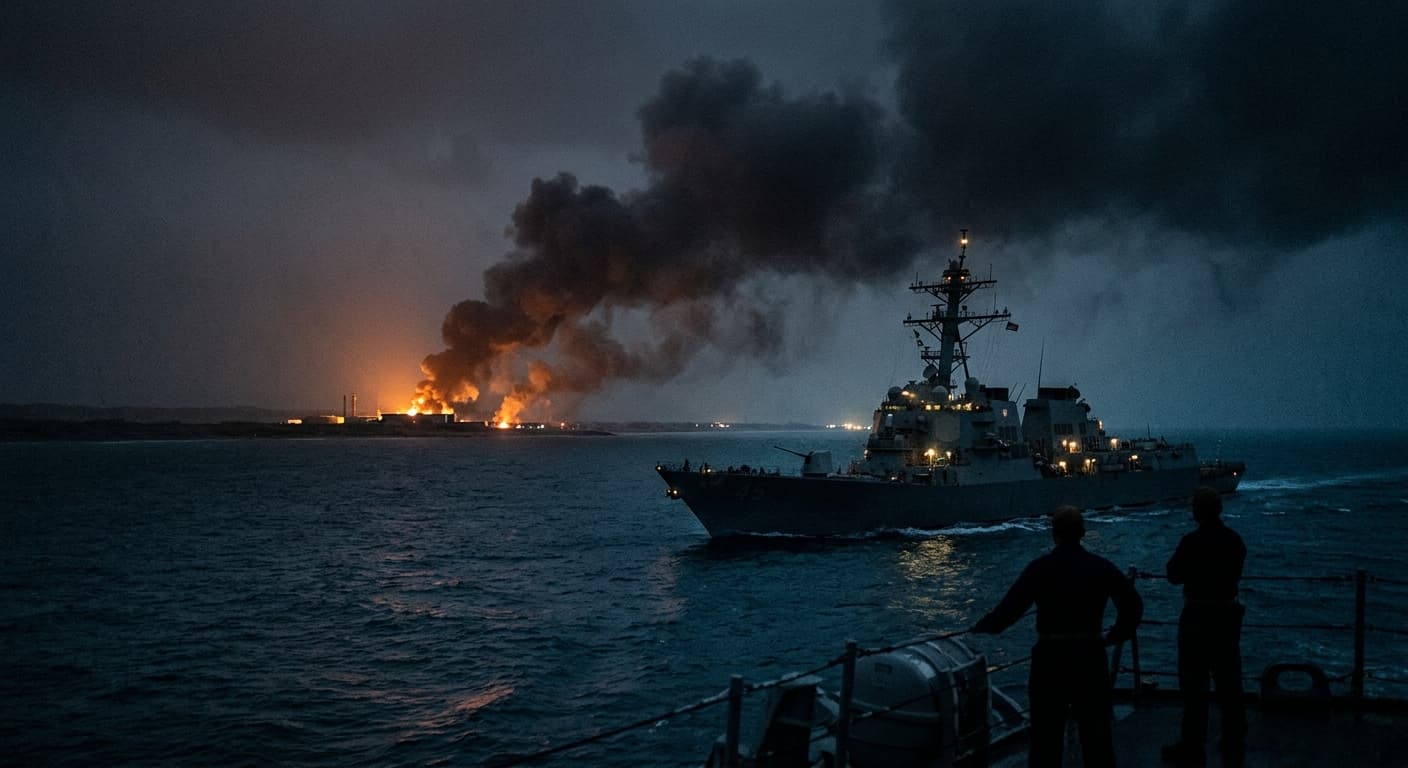
US Bombs Iranian Missile, Radar Sites After Drone Hits Cargo Ship in Hormuz
A nine-day-old ceasefire frays as Washington and Tehran resume strikes over who controls the Strait — and the IMO halts its evacuation of 11,000 stranded sailors.
The US launched airstrikes Friday on Iranian missile and drone storage facilities and coastal radar sites, retaliating for an Iranian drone attack on a Singapore-flagged container ship in the Strait of Hormuz the previous day. BBC News reported that US Central Command described the operation as "a powerful response" to what it called "unwarranted aggression against commercial shipping by Iranian forces" that "clearly violated the ceasefire."
The sequence began Thursday, June 25, when the Ever Lovely — a vessel owned by Taiwan's Evergreen Marine — was struck by a one-way attack drone 7.5 nautical miles southeast of Oman's port of Dahit. No crew were injured. Al Jazeera reported that President Trump, in a Truth Social post Friday morning, said Iran "shot at least four One Way Attack Drones at Ships transversing the Strait of Hormuz" — three intercepted, one striking the Ever Lovely's upper deck. Hours later, CENTCOM aircraft struck targets near the southern Iranian port of Sirik.
The IRGC fired back rhetorically and militarily. In a statement Friday, it blamed the US for violating commitments, reiterated that the June 17 memorandum of understanding gave Tehran control over strait traffic, and said its navy had targeted US positions in the region. Al Jazeera's live blog cited Iranian state broadcaster IRIB confirming explosions near Sirik.
The Ceasefire Was Built on a Contested Premise
What collapsed here was never stable. The US-Iran MoU signed on June 17 in Switzerland — a 14-point deal that paused hostilities after four months of war that began with US-Israeli strikes in late February — contained an ambiguity that made this clash predictable. Iran agreed to use "best efforts for the safe passage of commercial vessels with no charge for 60 days." But the IRGC and its newly created Persian Gulf Strait Authority (PGSA) interpreted the deal as giving Tehran operational control over routing through the strait.
The US rejected that interpretation flatly. Secretary of State Marco Rubio warned Tuesday that "no country is allowed to impose tolls on the Strait of Hormuz," which he called "an international waterway." BBC News
The Ever Lovely chose a southern route along the Omani coast — following UKMTO-recommended corridors — rather than the channels the PGSA had designated. Hours before the drone struck, the PGSA posted on X that transit outside its routes "will not be covered by the guarantee of safe passage."
This was not an accident. Iran was enforcing a claim of sovereignty over the strait that the MoU's text neither granted nor explicitly foreclosed. The Ever Lovely was a test case, and the US strikes were the answer.
Who Gains, Who Loses
The immediate loser is the International Maritime Organization, which had just begun evacuating roughly 600 ships and more than 11,000 seafarers stranded since February. BBC News reported that IMO Secretary-General Arsenio Dominguez paused the operation Friday, saying "the safety of the seafarers remains paramount" and the plan would stay on hold "until further clarity is obtained." The Ever Lovely itself had been stuck in the Gulf for over 100 days after loading cargo in Iraq, per
Al Jazeera.
The IRGC gains by demonstrating it can disrupt the evacuation at will and frame any US response as treaty-breaking. Oil prices, which had been falling since the MoU was signed, now face renewed uncertainty — though crude had already been moving sharply lower on the diplomatic track.
The Trump administration gains a demonstration of resolve without escalating to strikes on Iranian nuclear or leadership targets. But it also signals that the MoU's 60-day nuclear negotiation window is now hostage to daily maritime incidents neither side fully controls.
What to Watch Next
Three decision points matter. First, whether the IMO evacuation resumes — if it doesn't, the stranded sailors and backlogged vessels become a humanitarian and supply-chain crisis independent of the diplomatic track. Second, whether additional commercial vessels are hit in the coming days; the IRGC has already ordered two Panama-flagged ships to change course on Thursday, per maritime security firm Ambrey. Third, Rubio's ongoing shuttle diplomacy in the Gulf: the MoU is not formally dead, but its survival depends on whether both sides can agree on who actually controls traffic through the strait — the very question the Ever Lovely strike was designed to answer with.
Discover more

US Politics
SNAP Food Assistance Faces Legal Challenges
In 2026, SNAP faces stricter eligibility rules and mounting legal challenges, threatening food assistance for the millions of Americans who rely on the program.
US Politics
House Ethics Committee Pushes Sexual Miscond.
The House Ethics Committee has shifted responsibility for sexual harassment settlement records to the Office of Congressional Workplace Rights, complicating disclosure efforts.
India
Congress Accuses Modi of Stalling Women's Law
Congress accuses Modi of stalling women's reservation law by linking it to delimitation, revealing a deeper electoral strategy.

Economics
Fed's Amex AML order puts correspondent banking on notice
Federal Reserve's Amex AML order requires board-level controls and a 90-day plan; OCC fined the bank $350 million over enterprise-wide deficiencies.