U.S. Strikes 90 Iranian Targets; Tehran Hits
U.S. and Iran exchange strikes, ending truce.
Model Diplomat9 min readMiddle East
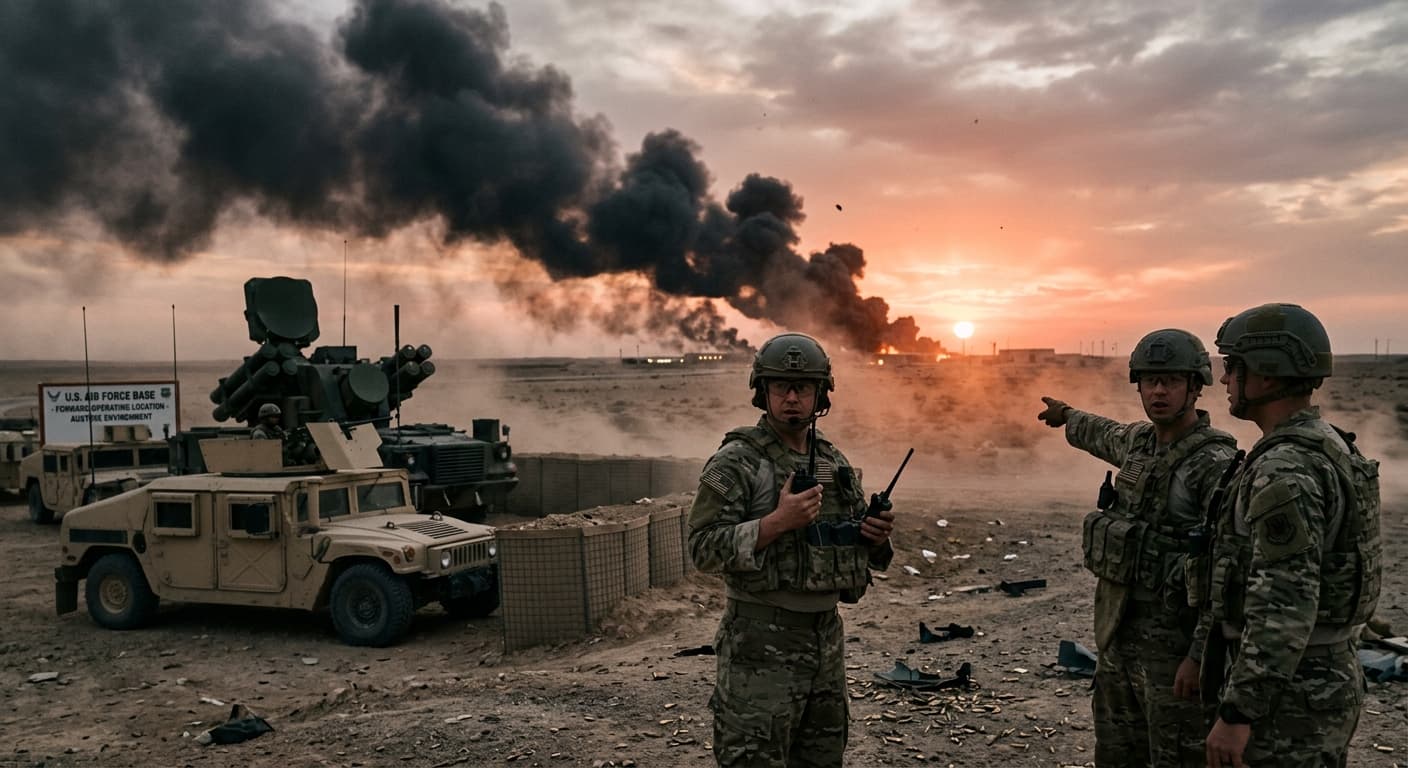
U.S. Strikes 90 Iranian Targets; Tehran Hits Gulf Bases
U.S. Central Command struck 90 sites across Iran on July 9, 2026, and Iran retaliated with drone attacks on U.S. bases in Bahrain, Kuwait, and Qatar, collapsing a three-week truce.
The United States military struck approximately 90 targets across southern Iran overnight into July 9, 2026, and Iran retaliated with drone attacks on U.S. installations in Bahrain, Kuwait, and Qatar, effectively ending the 60-day memorandum of understanding signed on June 17. The two-day exchange has now hit 170 Iranian sites and every state on the western shore of the Gulf — a pattern that suggests the June deal did not end the war so much as codify a rhythm of managed escalation, in which the Arab Gulf states have become permanent shock absorbers for an Iran unable to inflict decisive costs on the United States directly. The load-bearing question is no longer whether the ceasefire holds, but who pays the price of its collapse.
What was struck, and by whom
U.S. Central Command said in a statement carried by Al Jazeera that its overnight strikes were designed "to further degrade Iran's ability to attack commercial shipping and innocent civilian mariners in the Strait of Hormuz," and that they hit "air defense systems, coastal surveillance assets, missile and drone storage sites, naval capabilities, and military logistics infrastructure along Iran's coastline." Iranian state media reported explosions in Bushehr, Bandar Abbas, Sirik, Jask, Chabahar, Konarak, Iranshahr, and Aq Qala, according to the
BBC. CENTCOM said the two-night total across July 7–9 was roughly 170 targets and confirmed that more than 20 U.S. Navy warships continue to patrol Middle Eastern waters, per the
BBC.
Iran's Ministry of Health said the U.S. strikes across five provinces killed 14 people and wounded 78 over two days, with 47 still hospitalised, according to Al Jazeera's live coverage. One firefighter was killed at Iranshahr airport and three people died in Ahvaz; shrapnel struck a hospital in Chabahar, and a fire was reported at an IRGC barracks in Bushehr, per the
BBC.
Iran's Islamic Revolutionary Guard Corps said its overnight drone strikes were the "first phase of the punitive response against the American treaty-breakers." The IRGC named its targets as the Juffair naval base — headquarters of the U.S. Fifth Fleet — and Sheikh Isa air base in Bahrain; Camp Arifjan and Ali Al Salem air base in Kuwait; and a U.S. early-warning satellite antenna site in Qatar, according to Al Jazeera. Bahrain's Ministry of Interior said falling shrapnel from intercepted drones damaged homes and vehicles in Manama and Hamad Town and left an 11-year-old girl with a "minor injury," calling the strikes "sinful," per the
BBC. Kuwait's General Staff said its air defences were "currently intercepting hostile missile and drone attacks" and briefly closed the country's airspace before reopening it early on July 9. Qatar issued a nationwide security alert.
Why the ceasefire never held
The June 17 memorandum was always narrower than its framing suggested. It set a 60-day window in which Iran would use its "best efforts" for safe passage through the Strait of Hormuz with no charge, the U.S. would lift sanctions and its naval blockade, and Tehran and Muscat would negotiate a new administrative regime for the strait — including possible service fees, per the BBC. That last clause is the tripwire.
Iran interpreted the MoU as recognition of its sovereignty over the strait and moved unilaterally, establishing a "Persian Gulf Straits Authority" that required international captains to obtain paid transit permits, and redirecting traffic along a "northern corridor" closer to Iranian coastal batteries, Al Jazeera reported. Washington kept pushing tankers along a southern route protected by the U.S. Fifth Fleet. When three tankers — the Marshall Islands-flagged M/T Al Rekayyat, the Saudi-flagged M/T Wedyan, and the Liberian-flagged M/T Cyprus Prosperity — were hit on July 6–7 after allegedly ignoring Iranian warnings, CENTCOM's response came within hours.
The dispute is legal as much as military. Iran is not a party to the 1982 UN Convention on the Law of the Sea. At a July 2 emergency session, Iran's ambassador Amir Saeid Iravani told the Security Council:
The Strait of Hormuz lies within Iran's territorial waters. Tehran is not a party to the 1982 Convention and is not bound by its provisions. Iran has taken measures to prevent the misuse of these waterways.
That statement, recorded in the UN's meeting summary, is the doctrinal foundation of everything that has followed. UN Secretary-General António Guterres warned at the same session that disruptions since early March have "struck at global energy security, food supplies and trade" and urged respect for Security Council resolution 2817 (2026), which condemned Iran's earlier attacks on seven neighbouring states. Russia and China vetoed a stronger draft on April 7 that would have authorised "all necessary means" to restore navigation, per
UN News; a follow-on Bahrain-U.S. text was still under negotiation as of the July session,
the UN reported.
The Gulf Arab states as strategic hostages
The most consequential fact of this round is not that Iran retaliated — it always does — but where. Every GCC state except Oman has now been attacked by Iranian projectiles inside a single conflict cycle for the first time since the Islamic Republic was founded in 1979, according to the Gulf International Forum. India's
Manohar Parrikar Institute for Defence Studies and Analyses counted 1,150 Iranian projectiles fired at the UAE, 79 at Kuwait, 42 at Bahrain, and 24 at Qatar during the war's opening 40 days, alongside strikes on Jordan and northern Iraq.
That distribution is not incidental. Unable to defeat the United States on the battlefield, Iran is imposing costs on the Gulf economies that host U.S. bases and depend on the strait. The Congressional Research Service noted in its assessment for the 119th Congress that Iranian counterstrikes have "damaged airports and ports in the region" and killed civilians in Iran, Israel, Kuwait, the UAE, and Syria, and that some U.S. service members have been killed or wounded. Qatar's LNG output at Ras Laffan and Mesaieed was interrupted earlier in the war after Iranian drone strikes; the UAE suspended trading on its major stock exchanges for two days, per the
Gulf International Forum.
The economic price is measurable. Brent crude climbed 4.2% to $77.24 a barrel on July 8 as Trump declared the MoU dead, reversing a downtrend from the April peak of $126, according to Al Jazeera. U.S. retail petrol has swung from $2.98 per gallon on February 28 (the day of the first U.S.–Israeli strikes) to $4.48 in May, and back to $3.79 as of last week; analysts told Al Jazeera the recent cut is now at risk. War-risk insurance premiums for a single Hormuz transit — historically about 0.25% of hull value — are quoted in a range of 2.5% to 5%, meaning a $100 million tanker pays as much as $5 million per crossing,
Al Jazeera reported. Kpler counted 108 verified strait crossings across July 3–5, a fraction of the pre-war average of 120–140 per day, per
Al Jazeera; more than 550 ships remained stranded on either side of the strait as of mid-June.
The GCC's dilemma: bound to Washington, exposed by Tehran
Gulf capitals are being pushed into a strategic position they explicitly designed their foreign policy to avoid. The Italian Institute for International Political Studies argues the war has split the GCC into three camps. The UAE and Bahrain — the two hardest-hit — want the strait reopened "by all necessary means" and drafted the U.S.-backed Security Council text; the UAE withdrew its ambassador from Iran and became the first state to label Islamic Republic officials "terrorists." Qatar and Oman, which retain warmer bilateral channels with Tehran, are pushing for negotiations even after Iran struck Qatari energy infrastructure and marginally hit Omani ports at Duqm and Salalah. Saudi Arabia and Kuwait oscillate: Riyadh called its patience "not unlimited" on March 19 and expelled Iran's military attaché three days later, but the Saudi foreign minister was on the phone with his Iranian counterpart within 24 hours of the April 9 temporary ceasefire.
That fracture is why the GCC's 2000 Joint Defence Agreement — "an attack on any one is an attack on all" — has produced no unified military response even as every member state has been hit. The bloc issued statements but did not retaliate; the Manohar Parrikar Institute concluded the GCC has been "unable to formulate a unified military and security policy" and that "significant differences remain" in how members read the Iranian threat.
The deeper problem is technical. Gulf air-defence systems still operate on national tracks, with no unified command-and-control and limited real-time data sharing, per the Gulf International Forum. When an Iranian drone flies over Qatar en route to Bahrain, neither Doha nor Manama can share tracking data with Riyadh in real time. The response so far has been to buy more hardware — from the United States, from Turkey, and, in a striking new development, low-cost interceptor drones from Ukraine, according to the
Gulf International Forum — rather than to integrate what already exists.
Iran's strategy exploits precisely that gap. Tehran cannot win a conventional war against the United States, so it is redefining victory as survival with deterrence intact — imposing "strategic fatigue" on Washington by inflicting it on the Gulf hosts, as the Gulf International Forum argues. Every U.S. strike that generates an Iranian response on Bahraini soil validates that theory, and every Iranian projectile hardens the case in Abu Dhabi and Manama for a defence posture that no longer trusts the U.S. security umbrella to hold — the Gulf International Forum notes that even Kuwait, historically the most reconciliation-minded Gulf state after its 1990 occupation, is publicly debating whether U.S. bases have become a liability.
The Trump escalation calculus
Trump's public messaging is doing two things at once. He told reporters, per Al Jazeera, that the U.S. will strike Iran at a "20 to one" ratio while insisting Tehran wants to "make a deal so badly." A
White House video release on July 8 said U.S. forces have been "annihilating Iran's military capacity" for 27 days. The Treasury also revoked the sanctions waiver that permitted Iranian oil exports under the MoU, per the
BBC.
That combination — escalate militarily, tighten economically, keep the negotiating channel open — is the same pressure architecture that produced Operation Epic Fury on February 28, 2026, and it rests on a bet that Iran's transitional leadership, installed after Ayatollah Ali Khamenei was killed on the first day of the U.S.–Israeli campaign, will trade Hormuz control for regime survival, per the Congressional Research Service. The historical parallel that reframes the question is not 1988's Operation Praying Mantis, when U.S. forces sank half the Iranian navy in a day and forced Tehran to accept the end of the Iran–Iraq war, but the 2019 Abqaiq attack, when Iran-backed strikes on Saudi oil facilities exposed the limits of U.S. willingness to retaliate on behalf of Gulf partners. This time Washington is striking — but the Gulf is still absorbing the return fire.
Congress retains some appetite to push back: war powers resolutions H.Con.Res. 38 in the House and S.J.Res. 104 in the Senate remain pending, per the Congressional Research Service, though a similar measure (S.J.Res. 59) failed in June 2025. Parliament Speaker Mohammad Bagher Ghalibaf, among the most prominent voices in Iran's transitional leadership, told state media on July 9, per the
Indian Express, that "bullying and breaking promises are no longer without cost." The IRGC promised a second phase.
What to watch
- Iran–Oman Hormuz administration talks. The MoU required Tehran and Muscat to define the strait's future management, including possible transit fees, in coordination with other Gulf states. No new date has been set; a July 1 technical session in Qatar produced no breakthrough.
- UN Security Council follow-up to resolution 2817 (2026). Bahrain and the United States have tabled a stronger draft; Russia and China vetoed the April 7 version, and any new "all necessary means" language will face the same block.
- Congressional war powers votes. H.Con.Res. 38 and S.J.Res. 104 are the two vehicles that could formally constrain the President's ability to expand the campaign inside Iran.
- Insurance and shipping data. Kpler's daily strait-crossing counts and Lloyd's war-risk premium quotes are the cleanest real-time indicators of whether the corridor is functioning. A sustained drop below 30 crossings per day, or premiums back above 5% of hull value, would signal the corridor is closing again.
- The next tanker attack. Trump's July 8 warning that things "could get much worse" leaves him room to escalate further. The next hit on a commercial vessel is the most likely trigger for a third wave.
The Bottom Line
The June 17 memorandum did not end the U.S.–Iran war; it converted it into a controlled-escalation regime in which the Gulf Arab monarchies are the permanent shock absorbers. Iran cannot defeat the United States militarily, so it is imposing costs on Bahrain, Kuwait, Qatar and the UAE — the states that host the U.S. bases and depend on the strait — until Washington offers a bargain that recognises Iranian control over Hormuz transit. Until that trade is either struck or refused outright, expect more 90-target nights, more sirens in Manama, and Brent oscillating on every White House statement.
Discover more
US Politics
House Ethics Committee Pushes Sexual Miscond.
The House Ethics Committee has shifted responsibility for sexual harassment settlement records to the Office of Congressional Workplace Rights, complicating disclosure efforts.
India
Congress Accuses Modi of Stalling Women's Law
Congress accuses Modi of stalling women's reservation law by linking it to delimitation, revealing a deeper electoral strategy.
US Politics
SNAP Food Assistance Faces Legal Challenges
In 2026, SNAP faces stricter eligibility rules and mounting legal challenges, threatening food assistance for the millions of Americans who rely on the program.

Economics
Fed's Amex AML order puts correspondent banking on notice
Federal Reserve's Amex AML order requires board-level controls and a 90-day plan; OCC fined the bank $350 million over enterprise-wide deficiencies.