US Steps Back from South China Sea Talks
Washington hands over Code of Conduct negotiations to ASEAN and China.
Model Diplomat8 min readSoutheast Asia
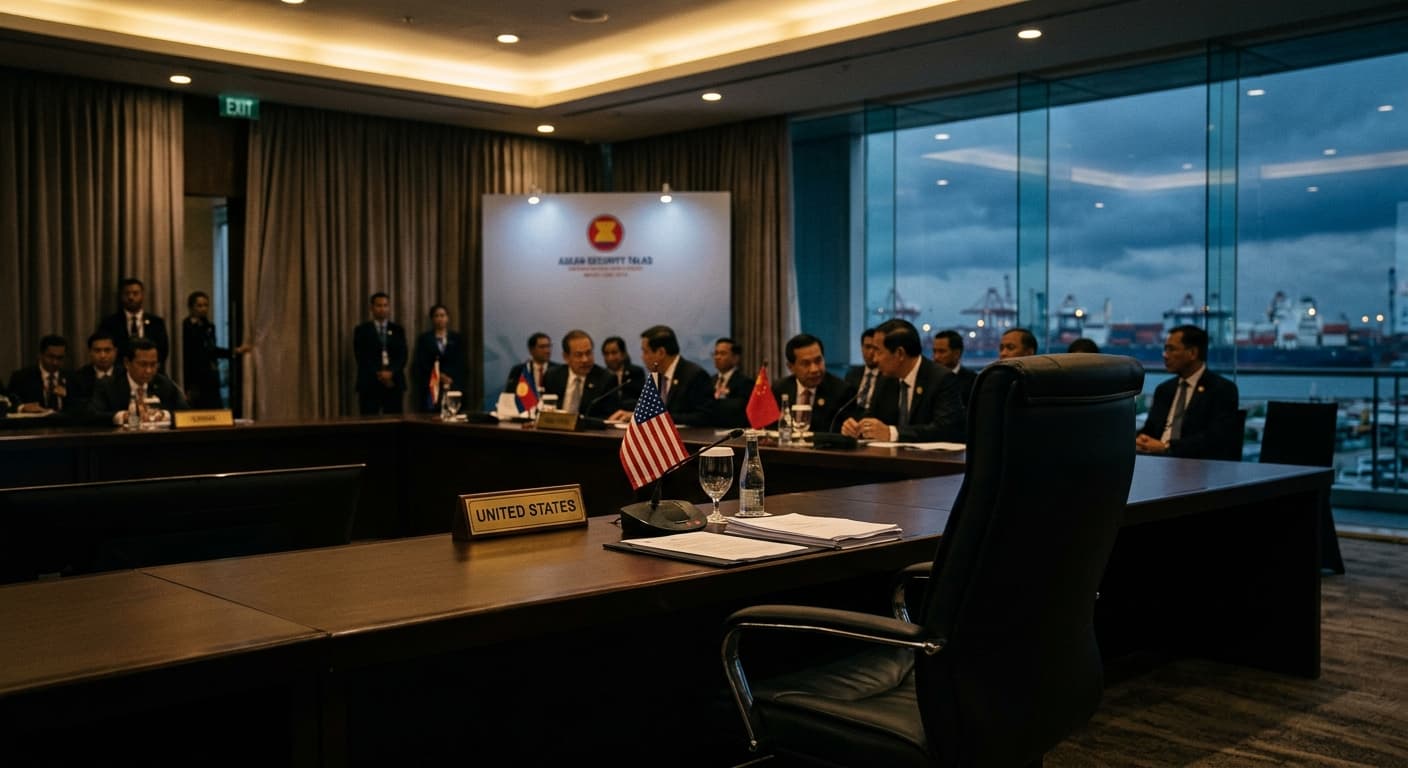
US Cedes South China Sea Code Talks to ASEAN and China
Washington will not steer the long-stalled Code of Conduct, US ASEAN envoy Kevin Kim said July 8 — a hand-off that reshapes Indo-Pacific security on the eve of the 2016 arbitration's 10th anniversary.
The United States has formally taken itself out of the driver's seat on the South China Sea Code of Conduct, telling reporters in Jakarta on July 8 that the 24-year-old negotiation is "fundamentally" a matter between ASEAN and China — a hand-off that, coming three days before the 10th anniversary of the arbitral ruling that voided most of Beijing's maritime claims, effectively lets the file drift back toward a bilateral Beijing–Manila contest that Beijing is already winning at sea. According to The Jakarta Post, US Ambassador to ASEAN Kevin Kim said Washington will "engage with ASEAN and its member states to ensure that the United States' interests are protected" but will not steer the talks. The message reached Jakarta at the exact moment the China Coast Guard is running record patrols at Scarborough Shoal and the office that used to coordinate US diplomacy on the file no longer exists.
The hand-off, and why the timing matters
Kim's language was carefully bureaucratic — respect for "ASEAN centrality," a "consensus-based approach" — but the diplomatic content is unmistakable. Where John Kerry in 2013 pressed ASEAN publicly for a "substantive" code and named the United States a "resident power" with a "national interest" in how the disputes were handled, per the BBC, the Trump-era envoy has now defined the American role down to "protecting our interests." The verb is defensive, not agenda-setting.
The Code of Conduct (COC) has been negotiated since 2002, when ASEAN and China signed the non-binding Declaration on the Conduct of Parties in the South China Sea. A single draft negotiating text was agreed only in August 2018, and in 2023 foreign ministers set a three-year deadline to finish the job by 2026 — the year Manila took the ASEAN chair. Philippine Foreign Secretary Ma. Theresa Lazaro told CSIS in June that four "milestone issues" remain open: scope, whether the accord is legally binding, its relationship to the 2002 DOC, and — after nearly a decade — the definition of "self-restraint."
That is the file Washington is walking away from. It is walking away three days before July 12, 2026, the tenth anniversary of the Permanent Court of Arbitration's award, which unanimously found under UNCLOS Annex VII that China's nine-dash line has "no legal basis" and that Beijing had violated Philippine sovereign rights. The full text of the 2016 award is the single most consequential primary document in this dispute, and it remains "final and legally binding" — the tribunal's own words — on both parties.
What "ASEAN centrality" actually delivers
The polite framing hides a hard fact: ASEAN has been unable to speak with one voice on the South China Sea for over a decade. Cambodia blocked a joint communiqué in 2012. The 30th Summit in Manila in 2017 issued a chairman's statement that avoided any mention of reclamation and militarisation, as the Asia Maritime Transparency Initiative documented. And in Kuala Lumpur last October, the bloc again failed to move the COC, with the
Council on Foreign Relations describing the meeting as another "talk shop" against the backdrop of the Iran war and a regional energy crunch.
Beijing has spent 24 years exploiting that consensus rule. Analyst Huong Le Thu, in a widely-cited AMTI essay, warned that China's actual COC strategy is to "delay, exploit and divert focus from any ASEAN consensus," lard the text with imprecise language it can later use to justify its actions, and claim the accord as a diplomatic success without altering behaviour. Chatham House concluded in December 2025 that a South China Sea agreement is
unlikely to be concluded in 2026 even with Manila in the chair. CSIS is blunter: any deal this year will be a
watered-down political agreement, not the legally binding pact ASEAN has sought for two decades.
That is the process Kim has just handed back to ASEAN and China. The strong reading: Washington concluded the COC is unrescuable and would rather not co-own a bad outcome. The weak reading: Washington doesn't have the diplomatic bench to shape it anymore.
Why the "weak reading" is the accurate one
On July 11, 2025, the State Department fired 1,353 people — 1,107 civil-service and 246 foreign-service officers — in what Al Jazeera called the biggest diplomatic shake-up in decades. Among 132 offices eliminated by Secretary Marco Rubio's reorganisation was the Office of Multilateral Affairs in the Bureau of East Asian and Pacific Affairs — the team that ran US work on ASEAN, the Mekong River and the South China Sea. NPR reported that the
entire South China Sea team was let go, with civil servants who held years of institutional memory and outstanding performance reviews given six hours to clear their desks.
The layoffs happened while Rubio was in Kuala Lumpur for the ASEAN Regional Forum. As CSIS noted drily, the team eliminated on July 11 was the same team that had organised his trip. Gregory Poling of CSIS called the cut "really harmful." Senator Cory Booker in Senate hearings called it "the largest brain drain in the State Department's modern history."
That is the operational reality behind Ambassador Kim's July 8 remarks. There is no longer a US inter-agency machine calibrated to shape the COC text line by line. Kim, an attorney and former New York City small-business commissioner confirmed by the Senate under the 119th Congress's executive calendar, is running a mission whose backroom analytic muscle was severed a year ago. Deferring to "ASEAN centrality" is what a diplomat says when the alternative is admitting he has no staff.
Who benefits — and who is left carrying the file
Beijing benefits first and most obviously. China's preferred outcome has always been a bilateral or minilateral process in which Southeast Asian claimants negotiate one-by-one with an economy 20 times their size, without external referees. The Foreign Affairs essay by Poling published this spring argues that China's core play is to make a favourable COC "supersede" UNCLOS as the operative law of the sea in the region — and to circumscribe the rights of third parties like the US Navy. Washington's step back removes the loudest voice against precisely that outcome.
Manila loses next. President Ferdinand Marcos Jr. staked his ASEAN chairmanship on the COC and on the anniversary of a legal victory the tribunal ruled his country won. But the Philippines is simultaneously absorbing the most sustained coercion in the region. AMTI's Scarborough analysis found China Coast Guard patrols at the shoal hit 933 ship-days in the first half of 2026 alone — versus 1,099 for all of 2025 and 516 for all of 2024. There were 112 days of direct interactions with Philippine ships in six months. On May 25, Manila filed a diplomatic protest after Chinese personnel installed a six-by-six-metre "temporary research" platform inside the shoal's lagoon. Beijing removed it on June 17, but two buoys and other floating objects placed since October remain.
Vietnam and Indonesia are the quiet losers. Hanoi has consistently pushed for UNCLOS-consistent language and a real dispute-settlement mechanism; Jakarta has watched Chinese coast-guard incursions off the Natuna Islands for a decade. Both counted on US ballast to keep the text honest.
The real, non-obvious beneficiary is Malaysia's and Cambodia's preferred style of ASEAN diplomacy — quiet, deferential to Beijing, allergic to naming the arbitral ruling. With the United States self-demoted to observer, the internal ASEAN balance tilts toward those capitals.
The escape hatch nobody in Washington is naming
There is a strategy sitting on the shelf that Kim's remarks implicitly, and probably unintentionally, endorse: minilateralism among the claimants. Richard Heydarian, writing for AMTI, argues Manila should push for a COC among ASEAN claimant states first — the Philippines, Vietnam, Malaysia, Brunei, and Indonesia as an interested party — before negotiating with China under the ASEAN umbrella. Vu Hai Dang has proposed a parallel "Code of Conduct for Maritime Engagements in Southeast Asia" negotiated first among ASEAN states in the model of the 1967 Treaty of Amity, then opened to outside powers.
Bilaterally, Washington has already begun to route around ASEAN. The US and Philippines have created Task Force Ayungin, a joint alliance readiness unit focused on the South China Sea, under a US three-star general. Secretary of War Pete Hegseth's March 2026 visit locked in new mid-range missile deployments on Luzon and the reopening of Subic Bay facilities, per Chatham House. Marcos was the first ASEAN leader hosted at the Trump White House in July 2025.
That is the American theory of the case, whether it is stated openly or not: harden the alliance with Manila, let the ASEAN talk-shop process run to whatever mediocre document it produces, and rely on deterrence at sea rather than paper at the table. The COC becomes a diplomatic sideshow to a hard-power contest.
Diplomat View
The withdrawal is not neutral. Kim's July 8 remarks will be read in Beijing as a green light to press harder on the text and on the water, and in Hanoi and Jakarta as confirmation that ASEAN centrality is now a euphemism for American absence. Our call: the Philippines–China talks over Scarborough and the COC text will produce, within 18 months, a political declaration marketed as a "framework" that neither binds China's coast guard nor references the 2016 award — a diplomatic loss dressed as consensus. The trigger for revision would be a US Navy freedom-of-navigation operation coordinated with a claimant state that explicitly cites the 2016 ruling, or a Philippine second arbitration filing against China at UNCLOS or the ICJ. Absent either, the trend line is Chinese normalisation of control at Scarborough and Second Thomas Shoal by 2028. The COC, if signed, will be Beijing's document — regardless of who holds the ASEAN gavel.
What to watch next
- July 12, 2026 — 10th anniversary of the arbitral award. Watch whether Manila declares "West Philippine Sea Victory Day" and whether the anniversary joint statement with Washington cites the ruling by name.
- August 2026 — ASEAN Foreign Ministers' meetings in Manila. The Philippine chair aims to table a "milestone" text; the language on UNCLOS and legally-binding character is the tell.
- October–November 2026 — ASEAN Summit and East Asia Summit in Manila. Whether Xi Jinping or Premier Li Qiang attends, and whether Trump appears, will set the ceiling for any COC "announcement."
- UN General Assembly, September 2026 — watch for a Philippine resolution seeking an ICJ advisory opinion on Chinese conduct at Scarborough. CSIS counts at least 44 likely yes-votes on day one.
The bottom line: the United States has not abandoned the South China Sea — it has abandoned the negotiating table, betting that alliances and deterrence at sea will do the work that a 24-year-old text never will. That is a defensible bet, but only if Washington has the diplomats to sustain it. Right now, Southeast Asia is discovering it does not.
Discover more

US Politics
SNAP Food Assistance Faces Legal Challenges
In 2026, SNAP faces stricter eligibility rules and mounting legal challenges, threatening food assistance for the millions of Americans who rely on the program.
Global Politics
Trump's Conflicting Messages on Iran War
Trump's mixed messages on Iran reflect a strategy of audience management, benefiting Tehran amid a complex geopolitical landscape.

US Politics
House Ethics Committee Pushes Sexual Miscond.
The House Ethics Committee has shifted responsibility for sexual harassment settlement records to the Office of Congressional Workplace Rights, complicating disclosure efforts.

Economics
Fed's Amex AML order puts correspondent banking on notice
Federal Reserve's Amex AML order requires board-level controls and a 90-day plan; OCC fined the bank $350 million over enterprise-wide deficiencies.