US Section 301 Tariffs Replace IEEPA Duties
New tariffs set to replace emergency duties by July 24, 2026.
Model Diplomat8 min readNorth America
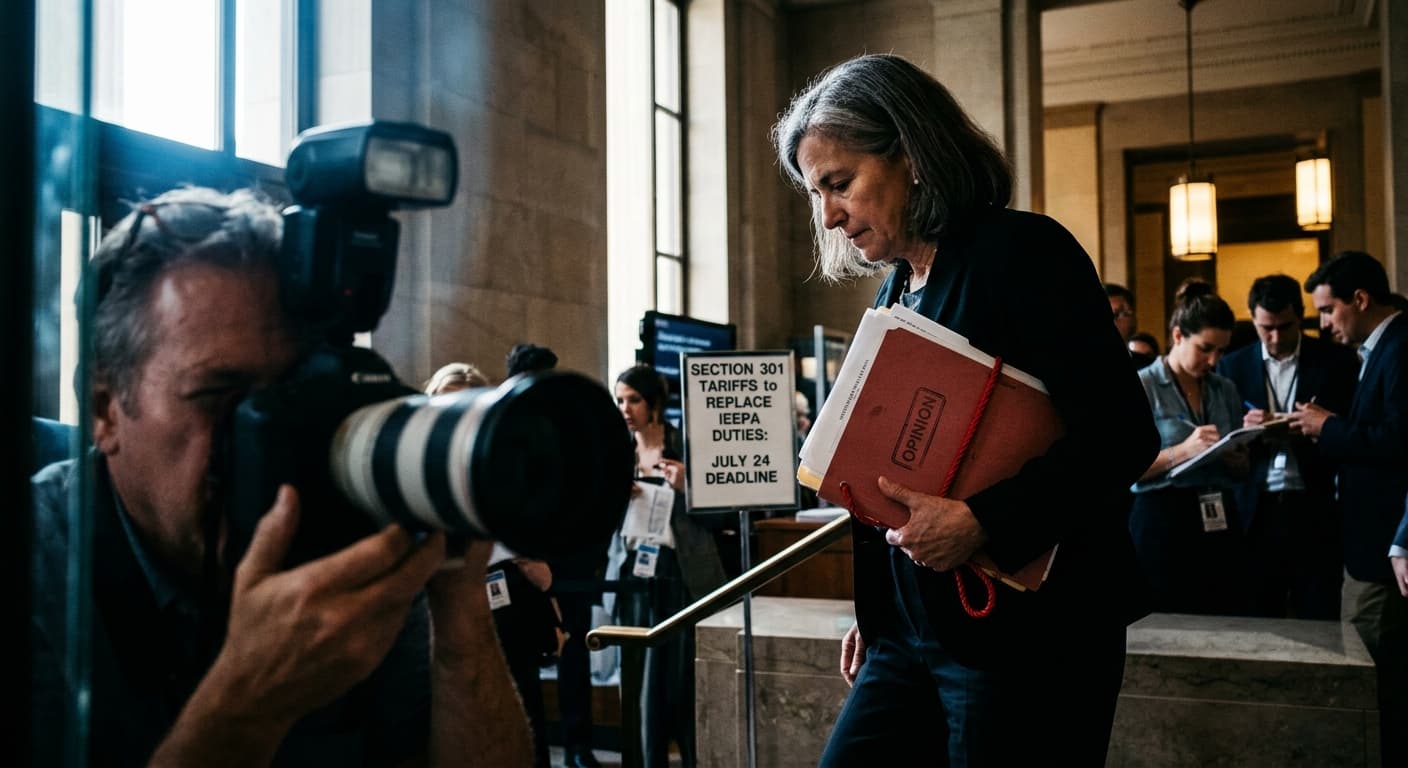
US Section 301 Tariffs Replace Struck-Down IEEPA Duties by July 24
The Supreme Court killed Trump's emergency tariffs in February 2026. The Section 301 regime replacing them by July 24 is slower, narrower — and far harder for the next president to unwind.
The Supreme Court's February 20, 2026 decision striking down President Donald Trump's global tariffs did not end the trade war — it re-tooled it. Under a 6-3 opinion by Chief Justice John Roberts, the emergency-powers duties that had raised an estimated $175 billion since 2025 became refundable overnight, according to Al Jazeera. Four months later, the US Trade Representative has proposed replacement tariffs of 10% to 12.5% on 60 economies covering roughly 99% of US imports — and the legal architecture underneath them is sturdier than anything Trump had before. The tariff wall is not coming down; it is being poured in concrete just as global supply chains had priced in relief.
What the Court did — and what it did not do
The Supreme Court's ruling in the consolidated IEEPA cases held that Trump's 2025 "Liberation Day" tariffs exceeded the authority Congress delegated in the 1977 International Emergency Economic Powers Act. Roberts, quoting the major-questions doctrine, wrote that the president "must 'point to clear congressional authorization' to justify his extraordinary assertion of the power to impose tariffs," according to NPR. The dissent — Justices Alito, Thomas and Kavanaugh — accepted the tariffs as lawful under text and history.
The Court left every other statutory tariff channel intact. Within hours, Trump signed a proclamation under Section 122 of the 1974 Trade Act, a never-before-used provision authorizing temporary duties of up to 15% for 150 days to address balance-of-payments deficits. On February 24 the rate hit 10% globally; by early March, Treasury Secretary Scott Bessent had announced a move to 15%, according to the BBC. Those Section 122 duties expire on July 24, 2026 — the pivot date the entire policy calendar now turns on.
Meanwhile, the Court of International Trade in Manhattan ordered US Customs and Border Protection to begin refunding IEEPA collections with interest. Judge Richard Eaton was blunt: "The duties were unlawful from the moment they were imposed. And that means that every single cent must be returned to the importer," NPR reported. By early April, more than 56,000 of roughly 330,000 eligible importers had filed refund claims worth $127 billion, per the
BBC. The refunds are a fiscal wound, but they are also a distraction: while Customs processes checks, USTR is building the tariff regime that replaces the one being refunded.
The Section 301 pivot — and why it sticks
On May 12, USTR opened Section 301 investigations into 60 economies for "failure to impose and effectively enforce" a prohibition on goods produced with forced labor. The official USTR determination, issued June 2, 2026, found every one of the 60 economies actionable and proposed additional tariffs of 10% or 12.5%.
The USTR Federal Register notice is explicit:
"For forced labor goods, the Trade Representative proposes 10% as the rate of additional duty… a textile mechanism to allow for a certain volume of apparel and textile imports from certain economies to enter the United States at a reduced Section 301 tariff rate."
The target list — China, the EU, UK, Canada, Mexico, India, Japan, Brazil, Australia, Cambodia, New Zealand — is functionally the entire US import base, the BBC reported. Public hearings run through July.
The strategic point is procedural. Section 301, the same statute Trump used against China in 2018, requires investigation, public comment, hearings and a written determination — but courts have repeatedly upheld it. As Brookings analysts Maricarmen Barron Esper and Christopher Sands noted in a March 2026 assessment, the shift from emergency to statutory tariffs converts trade policy from a Trump signature into an institutional apparatus that outlasts a single administration.
That is the buried lede for supply-chain planners. The IEEPA regime was fragile — one court challenge from collapse. The Section 301 regime is not. William Alan Reinsch of CSIS wrote on July 1 that USTR "has been fairly meticulous in observing the various process requirements," and that the 10-12.5% forced-labor tariffs "have not been met with much foreign opposition because they are at or below the levels agreed to in the trade agreements negotiated last year." Translation: the new duties fit inside the ceilings already conceded by Brussels, Tokyo and Seoul in 2025. Foreign capitals cannot easily litigate a wall they already agreed to build.
Where the ceiling cracks: the EU, USMCA and the digital services tax
The stability holds only if Washington honors the caps. On June 26, Trump threatened 100% tariffs on any country implementing a digital services tax on US tech firms — regardless of existing trade agreements, per Al Jazeera. The European Parliament's conditional approval of the July 2025 EU-US deal — which caps US tariffs on EU goods at 15% — included a suspension clause triggered if Washington exceeds that ceiling, according to
Al Jazeera. A separate USTR overcapacity investigation covering 16 countries, if it produces tariffs stacked on the forced-labor duties, would breach that cap by construction.
The second fracture is USMCA. On July 1, 2026, the Trump administration declined to renew the pact under its six-year review mechanism, triggering instead the 10-year annual review process — the diplomatic equivalent of putting Canada and Mexico on probation. Reinsch's CSIS commentary flags an unresolved question that will define the outcome: whether any revised deal must go to Congress, because Trade Promotion Authority expired in 2021 and no fast-track procedure now exists.
The third fracture is a June US Court of International Trade ruling that Section 122 itself was misapplied to the balance-of-payments justification Trump cited, per the BBC. The judgment applies narrowly for now but opens a second legal front just weeks before the statute expires.

The supply-chain physics
The World Trade Organization has recalibrated. Its March 2026 Global Trade Outlook projects global merchandise trade growth of just 1.9% in 2026, down from 4.6% in 2025, "as trade is expected to normalize following a surge in AI-related products and the frontloading of imports to avoid new tariffs." Director-General Ngozi Okonjo-Iweala credited resilience to "the avoidance of tit-for-tat retaliation on tariffs."
That resilience is thinner than the headline suggests. WTO analysis in the same report finds that the share of world trade conducted on a most-favored-nation basis has fallen from 80% in 2024 to 72% by early 2026 — a structural erosion of the non-discrimination principle that underpins the postwar system. UNCTAD projects a 25% drop in foreign direct investment in tariff-exposed sectors including textiles, electronics and machinery in 2025.
Freight markets are pricing the churn. The Containerized Freight Index rose more than 10% in a single month and 35% year-on-year through April, Al Jazeera reported, driven by a combination of Strait of Hormuz disruptions and pre-tariff import surges. Learning Resources, the Illinois toymaker whose lawsuit produced the Supreme Court ruling, has already relocated 16% of its manufacturing from China to Vietnam and India — a shift its founder told the
BBC was "devastating" but structural.
Who wins the new regime
The Section 301 architecture reallocates leverage in three concrete ways:
Winners. Large importers with legal and compliance budgets — Costco, Walmart, FedEx, Amazon — will absorb the compliance load and, in some cases, recover refunds. The Liberty Justice Center's Sara Albrecht told NPR that Justice Department assurances during litigation leave the government little room to argue against payment. Vietnam and India gain further factory-floor share as multinationals decouple from Chinese sourcing at a 10-12.5% additional cost differential — modest, but persistent. Container carriers, per
The Economist, continue to profit from volatility.
Losers. Small importers unable to litigate refunds — Al Jazeera cited Georgetown law professor Greg Shaffer estimating many will "shrug their shoulders" rather than pursue claims. Canadian and Mexican exporters facing simultaneous USMCA uncertainty and forced-labor tariffs. European automakers, already staring at a potential 25% rate reimposition on cars if the EU deal collapses. And US consumers, who the Treasury has effectively told will not see refund pass-through: Bessent said in February, "I got a feeling the American people won't see it," per the BBC.
The quiet beneficiary. The next administration. A Section 301 regime that survives its June 2 hearings and July 24 imposition will function as durable trade infrastructure — sanctions authority in tariff clothing. Whoever wins in 2028 inherits leverage over 60 trading partners without needing new legislation.
What to watch
- July 24, 2026 — Section 122 tariffs expire. USTR is expected to impose Section 301 forced-labor duties the same day. Any gap invites litigation; any stacking above 15% breaches the EU agreement.
- Q3 2026 — USTR determination on the parallel 16-country overcapacity investigation. If findings mirror the forced-labor probe, cumulative US tariffs cross the 15% ceiling and Brussels' suspension clause activates.
- October 2026 — Next WTO trade forecast update, first data point on whether 1.9% growth holds or slips toward the 1.4% high-energy-price scenario.
Diplomat View
The Supreme Court's February ruling was widely read as a defeat for Trump's trade agenda. On the evidence, it was a forced upgrade. IEEPA tariffs were a wrecking ball with a short warranty; the Section 301 forced-labor regime being finalized before July 24 is a load-bearing wall — statutorily grounded, procedurally clean, and calibrated to sit just under the ceilings foreign governments already accepted in 2025. That is why Brussels is negotiating rather than retaliating, and why the WTO's Okonjo-Iweala is emphasizing "predictable trade policies" rather than dispute settlement. The forecast changes if two things happen: the 16-country overcapacity determination stacks tariffs above the 15% EU cap, triggering the European Parliament's suspension clause; or the Court of International Trade's June Section 122 ruling metastasizes into a broader challenge to Section 301 forced-labor methodology. Absent either, the tariff wall Trump built via emergency decree is being rebuilt in statute — and it will outlast him. Supply-chain planners should stop pricing in a return to 2024. That world is gone.
The Bottom Line
The Supreme Court did not end the tariff war; it professionalized it. By July 24, 2026, the US will replace struck-down emergency tariffs with a Section 301 forced-labor regime covering 99% of imports at 10-12.5% — narrower, slower, and legally durable enough to survive a change of president. The winners are large importers, Vietnam and India; the losers are small businesses, Canada and any EU capital that thought a 15% ceiling was a ceiling.
Discover more
US Politics
House Ethics Committee Pushes Sexual Miscond.
The House Ethics Committee has shifted responsibility for sexual harassment settlement records to the Office of Congressional Workplace Rights, complicating disclosure efforts.

US Politics
SNAP Food Assistance Faces Legal Challenges
In 2026, SNAP faces stricter eligibility rules and mounting legal challenges, threatening food assistance for the millions of Americans who rely on the program.
India
700 Activists Accuse PM Modi of MCC Breach
Over 700 activists allege PM Modi breached election code with a televised address attacking opposition parties just before state elections.

Conflict & Security
Drone Warfare Killing Aid Workers at Unprec
Over 1,000 humanitarian workers killed in three years as cheap armed drones collapse legal protections. Gaza, Sudan, Ukraine, and DRC see deliberate targeting of aid convoys and hospitals with zero prosecutions.