U.S. Revokes Iran Oil License, Hormuz Deal
Treasury's action ends Iran oil waiver, impacts Asian markets.
Model Diplomat8 min readMiddle East
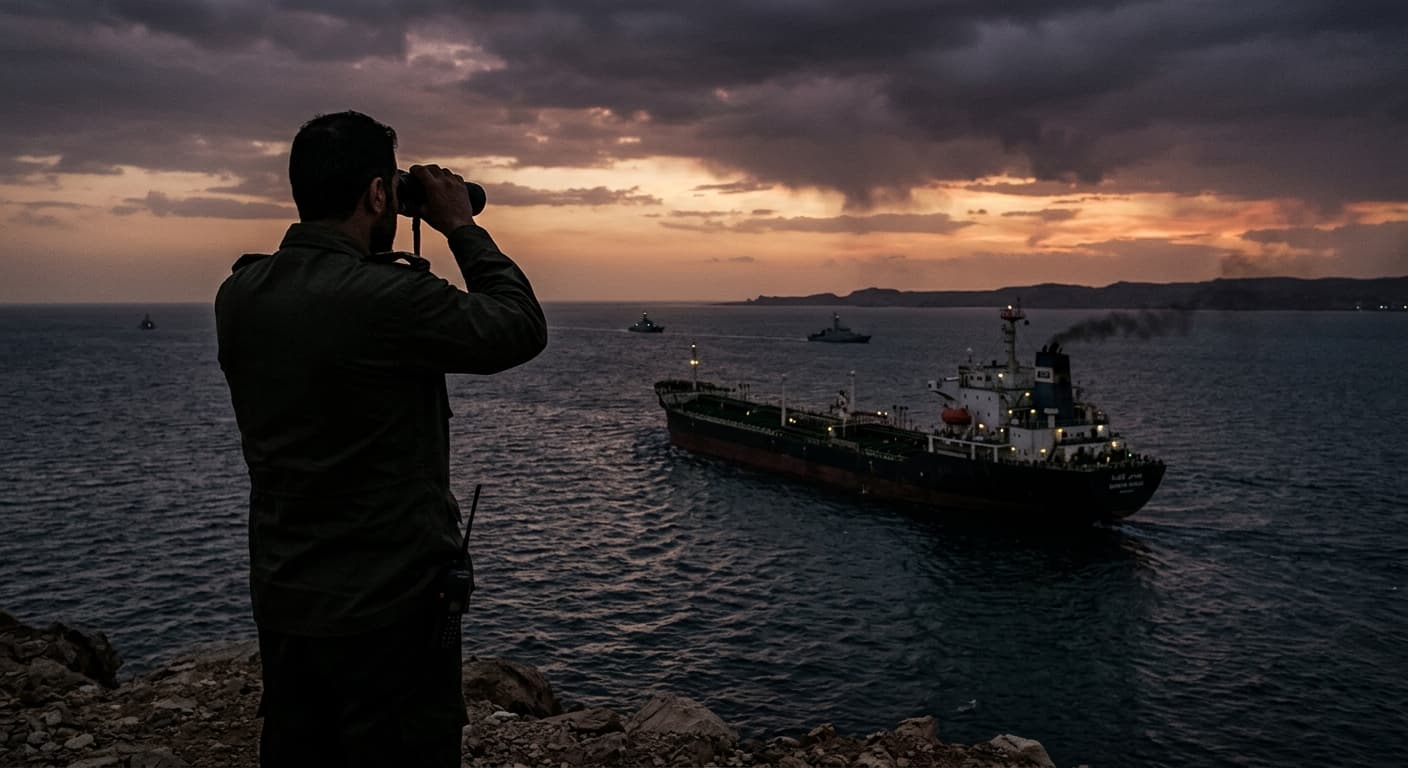
U.S. Revokes Iran Oil License, Gutting the Hormuz Bargain
Treasury's July 7 revocation of General License X ends a 20-day-old Iran oil waiver, reimposes sanctions on Tehran's crude, and hands the discount back to China's teapot refineries.
The U.S. Treasury revoked General License X on July 7, 2026 — 20 days after issuing it — after Iran's Revolutionary Guard struck three tankers in the Strait of Hormuz. The move collapses the operative core of the Trump–Pezeshkian Memorandum of Understanding signed at Versailles on June 17: sanctions relief in exchange for safe passage. The immediate loser is not Iran, which will resume selling to China at a wider discount via the same shadow fleet it never dismantled — it is the Asian importer base that briefly saw legitimized barrels, and the price stability that Brent's 6% jump to $78 just erased. What remains of the MoU is a 60-day nuclear timeline with no economic scaffolding to hold it up.
The revocation, in precise terms
Treasury replaced the June 21 authorization with Iran General License X1, per the Office of Foreign Assets Control, — a "Revocation and Wind Down" order dated July 7, 2026. The original license had authorized "the Production, Delivery and Sale of Crude Oil and Petroleum Products of Iranian Origin" through August 21, along with the banking, insurance, shipping and petrochemical services that make oil exports commercially executable. GL X1 bans new contracts as of July 7 and requires existing deals to be wound down by July 17. The
BBC confirmed the Treasury action was announced hours before U.S. Central Command struck more than 80 targets in southern Iran, including air-defense systems and IRGC fast boats at Bandar Abbas and Bushehr.
The trigger was operational, not political. On the night of July 6–7, projectiles from IRGC assets hit a Saudi-flagged crude tanker and two other commercial vessels transiting the strait, according to Al Jazeera citing UK Maritime Trade Operations and two U.S. officials speaking to Axios. Tehran's parliamentary speaker and lead negotiator, Mohammad Bagher Ghalibaf, accused Washington of breaching the MoU; Iran's foreign ministry called the license revocation proof of American "bad faith, inconsistency, and unreliability." President Trump, at the NATO summit in Ankara on July 8, told reporters "to me, I think it's over" and promised further strikes — comments that the
Council on Foreign Relations noted marked the worst U.S.–Iran exchange since the ceasefire took effect.
The June 17 MoU is a page-and-a-half document whose economic clauses are more specific than its nuclear ones. Its tenth point, quoted verbatim by the BBC, commits Treasury to issue "waivers for the export of Iranian crude oil, petroleum products and derivatives and all associated services including banking, transactions, insurances, transportation." GL X was the delivery mechanism. GL X1 is its unwind.
What the market actually priced
The oil market's reaction was calibrated, not panicked. Brent rose more than 3% to $76 on the initial Treasury announcement and climbed to $78 — a 6% two-week high — after Trump's comments in Ankara, according to Al Jazeera. That is a fraction of the roughly $120 spike during the strait's full closure earlier this year, which the
BBC documented via U.S. Energy Information Administration data showing 20 million barrels per day normally transit Hormuz. Traders are betting the revocation is a diplomatic signal, not a return to blockade: Kpler shipping data cited by
Al Jazeera counted 108 verified crossings over the first weekend of July, well above the war's lows.
That relative calm masks a structural point CFR's Edward Fishman made explicit on July 8. The MoU was never a nuclear deal — it was a Hormuz deal. Iran's calculation, per Fishman's analysis, is that the strait is now a monetizable asset worth up to $40 billion a year — roughly equal to its recent annual oil export revenue. Revoking GL X does not change that math; it only tells Tehran that Washington will not pay in sanctions relief for a chokepoint it can no longer force closed by military means alone. Brookings' Bruce Jones reached a similar conclusion in a June 25
analysis, noting that Iran has already stood up a "Persian Gulf Strait Authority" and moved insurance requirements through its national insurer — infrastructure designed to survive whether GL X exists or not.
Who benefits from the revocation
Follow the barrels. Before the war, China bought more than 80% of Iran's shipped crude — about 1.4 million barrels per day, or 13% of Chinese imports — according to Kpler data reproduced by Bruegel. Under GL X, Iran had, for the first time in years, the option to sell openly in U.S. dollars to a broader Asian client base including India. The
Atlantic Council noted last week that Indian private refiners had begun testing the waters, though statutory sanctions and enforcement risk kept most buyers cautious even under the waiver.
Revocation snaps that door shut: Iranian crude reverts to the shadow economy — ship-to-ship transfers, false flags, renminbi settlement via China's Cross-border Interbank Payment System, destination laundering into Malaysian or Omani blends — with one dominant customer: China's Shandong-province "teapot" refineries, which the International Crisis Group describes as Beijing's structural hedge against U.S. sanctions. Treasury sanctioned Hengli Petrochemical, China's second-largest teapot, in April for buying "hundreds of millions of dollars" of Iranian crude, per
Al Jazeera, and named about 40 shipping firms and vessels operating in Iran's shadow fleet at the same time. The paradox Crisis Group flagged still holds: U.S. sanctions widen the discount Iran must offer China, and China is the only buyer large enough to absorb the volume.
Beijing's buffers are formidable. A U.S. House Select Committee report cited by Al Jazeera put China's strategic petroleum reserve at roughly 1.2 billion barrels by early 2026 — approximately 109 days of seaborne import cover, assembled largely from sanctioned Russian, Iranian and Venezuelan barrels. Bruegel's estimate is closer to 1.3–1.4 billion barrels. That is not a stockpile that fears a revoked OFAC license.
The India problem the revocation quietly reopens
The under-discussed second-order effect is on India. When Hormuz was effectively closed, the Bruegel analysis noted, OFAC issued a March 5 waiver permitting India to import Russian crude to substitute for lost Gulf barrels — a move that indirectly tightened Russia's spare capacity available to China. Under GL X, Indian refiners had begun exploring Iranian barrels as a further diversification. GL X1 erases that optionality overnight.
The result: India is pushed harder onto Russian crude, at prices no longer capped by a functioning G7 enforcement regime — precisely the outcome the Atlantic Council warned against when it argued for restricted payment mechanisms and an Iranian oil price cap rather than a binary lift-or-revoke posture. Washington's sanctions toolkit is currently operating in binary mode. That helps enforcement clarity and hurts price management.
The legal architecture — and Congress's shadow
The revocation is not politically contested inside Washington the way the original license was. On the day GL X issued, Rep. Claudia Tenney introduced H.R. 8220 to nullify an earlier Iran-related general license (GL U, from March 20, 2026) authorizing sale of Iranian oil already loaded on vessels — and to bar Treasury from authorizing "any transactions otherwise prohibited by law that are ordinarily incident and necessary to the sale, delivery, or offloading of crude oil or petroleum products of Iran." The bill also demands 60-day reports to the Foreign Affairs and Energy committees on "the premium earned on Iranian oil as a result of the closure of the Strait of Hormuz." The revocation of GL X preempts much of that congressional pressure.
The underlying authority is Executive Order 13902 of January 10, 2020 — "Imposing Sanctions With Respect to Additional Sectors of Iran" — under which OFAC has cycled through general licenses S, T, U, V and X in the seven months since December 2025, according to the Federal Register. Each was a narrow, time-limited authorization to move blocked cargo, protect crews, or clear stranded vessels. GL X was the first that authorized commercial production and sale. Its revocation restores the pre-MoU baseline: statutory sanctions under 31 CFR Part 560, primary and secondary, enforceable against any non-U.S. person who "knowingly engages" in the trade.
The historical parallel
The pattern is not new: in May 2018, the first Trump administration withdrew from the JCPOA and reimposed sanctions Iran had traded verifiable nuclear constraints to remove. The OSW Centre for Eastern Studies notes Iranian negotiators cite that unilateral U.S. withdrawal, together with the June 2025 "Twelve-Day War" and the current conflict, as the reason for their reciprocal, hair-trigger posture. Ghalibaf's public accusation that Washington has breached the MoU within three weeks is not rhetorical excess — it is a Tehran negotiating posture explicitly modeled on 2018.
The difference this time is that Iran holds a chokepoint it did not hold in 2018. The BBC summarized the asymmetry cleanly: Iran's MoU obligations are limited — safe passage, non-weapons pledge, uranium down-blending talks — while U.S. commitments span sanctions termination, unfreezing of assets and a $300 billion reconstruction fund. Revoking GL X compresses only one lever on the U.S. side. Iran's leverage — the strait, the shadow fleet, the enriched stockpile — is intact.
What to watch next
- July 17, 2026: GL X1 wind-down deadline. Any tanker still loading Iranian crude for a "previously concluded" contract after this date operates without OFAC cover, and secondary sanctions exposure returns for foreign banks, insurers and port operators.
- Mid-August 2026: The 60-day MoU clock, which began on June 17, expires around August 16. Trump has already said publicly, per the
BBC, that "if it doesn't get done in 60 days, it's all right — we go back to bombing."
- Congressional action on H.R. 8220: A markup or floor vote would signal whether Congress moves to statutorily bar any future Iran oil general license, removing the executive branch's discretion to trade sanctions relief for Hormuz access in a follow-on deal.
- Chinese teapot import data for July–August: Kpler and vessel-tracking figures will show within weeks whether Iranian volumes into Shandong rebound to their pre-MoU 1.4 million bpd baseline, or whether U.S. secondary sanctions on Hengli-tier refiners have created lasting deterrence.
Diplomat View
The revocation of General License X is an admission that the Versailles bargain was structurally unbalanced — not a punishment of Iran. Iran got sanctions relief in exchange for behavior — safe passage — it could withdraw at will, and did within three weeks. Washington's response has been to withdraw the reciprocal concession, but not to alter the underlying leverage map. The forecast: Iran resumes shadow-fleet exports to China at a slightly wider discount within four to six weeks, Brent settles in a $75–85 band absent a full Hormuz reclosure, and the nuclear track quietly slips past its August deadline into an "extension by mutual consent." The forecast breaks if either (a) Iran mines the strait a second time and enforces its Persian Gulf Strait Authority fees on non-Chinese vessels, triggering a coordinated U.S.–Gulf naval response; or (b) Congress passes H.R. 8220 or a successor bill, removing Trump's authority to reissue any GL X-equivalent and killing the MoU's economic clauses by statute. Absent one of those two triggers, the pre-June baseline reasserts itself: sanctioned Iranian oil, priced in renminbi, moving to Shandong on dark tankers, while Washington claims enforcement wins that Beijing quietly monetizes.
Discover more
Global Politics
Xi Jinping Calls China-Russia Ties 'Precious'
Xi Jinping's description of China-Russia ties as 'precious' reflects a strategic imbalance, with Beijing dictating terms in the partnership.

India
Women's Reservation Bill 2026: A Political Sh
India's Lok Sabha rejected the Women's Reservation Bill, exposing a political maneuver to redraw electoral maps favoring the north over the south.
US Politics
Virginia's Redistricting Referendum
Virginia's redistricting referendum is drawing a flood of dark money, shaping future elections and the fight for congressional control amid party stakes.
Global
US Reinstates Iran Blockade, Splits Hormuz
US reinstates naval blockade of Iran on July 14, ending 26-day ceasefire. Strait of Hormuz splits into competing toll lanes as traffic collapses to 23 ships daily. 60-day war-powers clock ticks toward Congress.