US Reinstates Iran Oil Sanctions After Attaks
Treasury revokes Iran's oil waiver amid tanker strikes.
Model Diplomat7 min readMiddle East
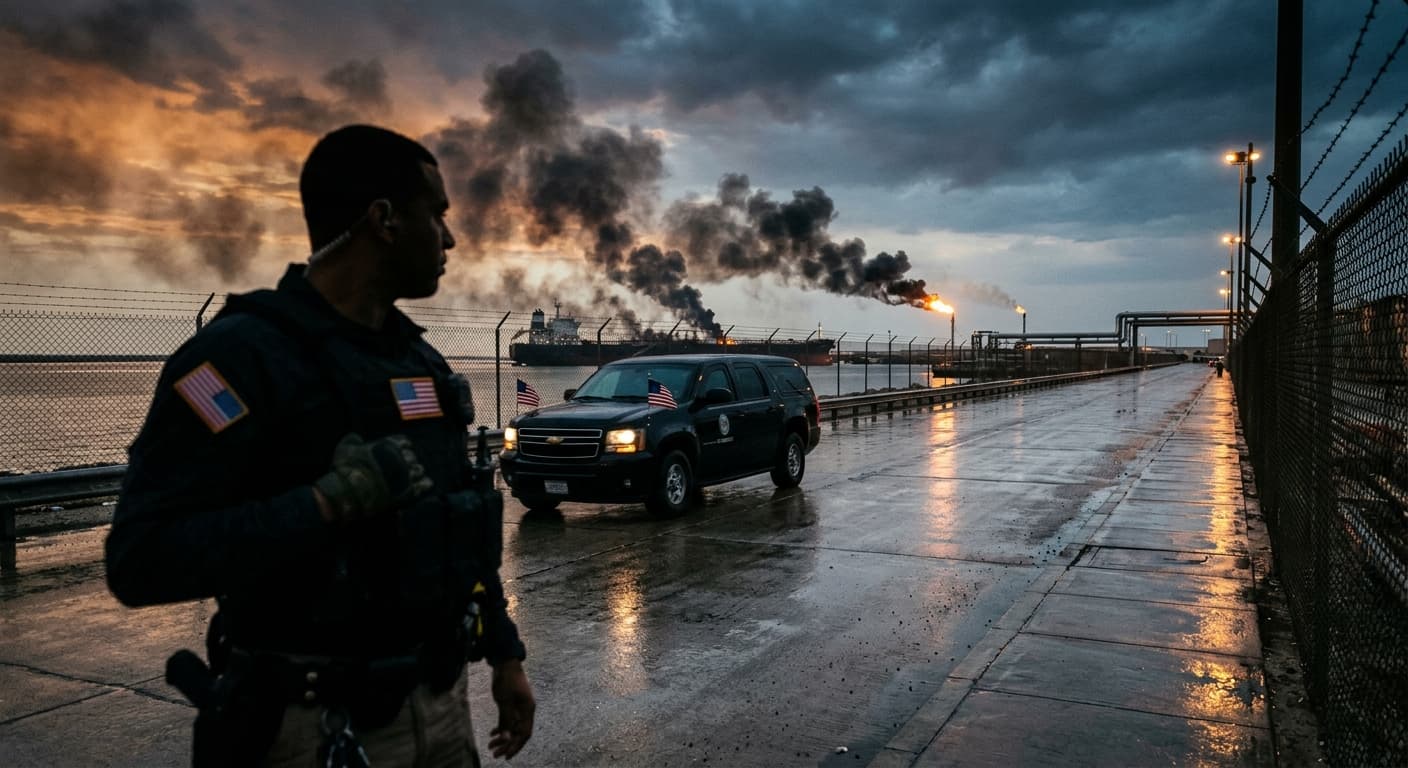
US Reinstates Iran Oil Sanctions After Hormuz Tanker Attacks
The Treasury pulled Iran's oil waiver on July 7 after three tankers were hit in 24 hours — reopening a sanctions crisis that had briefly closed and reshaping a $72 Brent market that no longer believes the ceasefire.
The US Treasury revoked the general license authorising Iranian crude sales on July 7, 2026, hours after three commercial tankers were struck in and near the Strait of Hormuz — a move that formally kills the economic core of the 20-day-old Trump-Pezeshkian memorandum and hands the next price shock to a market whose consensus had, until Monday night, priced the war as over. The ripple effect is asymmetric: Brent snapped back to $72 last week on the belief that Iran's 1.3 million-barrel-per-day export machine was restarting, and every subsequent US-Iran off-ramp assumed that oil, not enrichment, was the working leverage. That trade is now unwound. The party gaining the most is not Washington; it is Beijing, which spent April writing the playbook for exactly this collision.
What Treasury actually did — and did not do
The revoked instrument is the 60-day general license OFAC issued on June 22 to implement the MoU signed at Versailles on June 17. That waiver, described by Treasury Secretary Scott Bessent on the day of issuance, authorised "the production, delivery and sale of Iranian oil" through August 21 and lifted the payment prohibitions that had defined the maximum-pressure architecture since 2018, according to Al Jazeera. It sat atop the underlying primary authorities — Executive Order 13902 and 31 CFR part 560 — which OFAC's
Iran Sanctions program page confirms remain in force and now snap back into effect for any new lifting.
Treasury did not sanction new entities on Tuesday. It pulled the permission slip. That distinction matters: the 260 million barrels of Iranian crude Bessent had described in March as "the Iranian barrels against the Iranians to keep the price down" — a formulation the Council on Foreign Relations documented — are now cargoes whose buyers face secondary sanctions risk. Roughly 50 million of those barrels have already cleared markets since the US naval blockade lifted on June 17, according to TankerTrackers data cited by
OilPrice.com. The revocation therefore hits the next barrel, not the last one — a design choice that maximises Iranian revenue loss without immediately tightening physical supply.
CENTCOM followed within hours. It announced "powerful" strikes on Iranian targets, saying the tanker attacks were "a clear violation of the ceasefire," according to the BBC. No CENTCOM press release or .mil statement has been linked; the BBC attribution stands but a direct
CENTCOM release should be substituted when available. Two of the three damaged vessels have been identified by Reuters sources as the Qatari LNG carrier Al Rekayyat and a Saudi-flagged crude tanker, per
Al Jazeera — a Doha-Riyadh combination that will define the diplomatic escalation, not Washington's alone.
The market signal is the mine field, not the missile
Brent September futures settled at $72 on July 6, below the pre-war $72.48 of February 27, per Al Jazeera. That was the trade the tanker attacks blew up. Iran's post-war exports had recovered from a six-year low of 209,000 barrels per day in May, according to Vortexa figures reported by
OilPrice.com, and OPEC+ announced on July 5 that seven members would add 188,000 bpd from August — the fifth consecutive monthly increase. The market, in other words, had priced in normalisation, not just ceasefire.
The Al Rekayyat was struck 8 nautical miles off Limah, Oman, on the southern shipping lane, not Iran's April-designated "safe route" hugging the Iranian coast. A Tehran-based analyst told Al Jazeera the tanker may have wandered into an active Iranian mine-clearing operation. Whether that is true or a face-saving cover story, the operational fact is that four months into the war, Iran has still not confirmed mine locations in the strait, and shipping insurers are pricing that ambiguity. Kpler recorded 108 verified crossings across the July 4 weekend — recovering, but roughly a third of the pre-war 120–140 per day baseline noted in the same Al Jazeera reporting. The revoked waiver removes the last political incentive for that number to climb.
Neil Crosby of Sparta Commodities warned on July 2 that "it is too early to conclude that prices will stay at pre-war levels." He was right within five days.
The primary document that reframes this
The economic terms Trump gave Iran are not opaque. The full text of the memorandum, published by NPR on June 18, commits the United States to "terminate all types of sanctions" against Iran on an agreed schedule, with immediate waivers authorising "the export of Iranian crude oil, petroleum products and derivatives and all associated services including banking, transactions, insurances, transportation." A companion clause commits the US and "regional partners" to fund at least $300 billion in reconstruction. Iran's obligations under paragraphs 4 and 5 are naval: end the blockade in 30 days, best-efforts free passage for 60 days, then negotiate future strait administration jointly with Oman, as
Al Jazeera parsed at signing.
That is the trade. Sanctions relief for shipping normalcy. The MoU is a one-and-a-half-page document that former US diplomat Alan Eyre described to Al Jazeera as one where "ambiguity was the feature and not the bug." Congress had already flagged the political risk: H.R. 8220, the NOPE Act introduced April 9 by Rep. George Latimer (D-NY), would have nullified General License U outright and barred any future oil waiver. The bill has not moved, but its constituency in the House Foreign Affairs Committee now has a live incident to weaponise.

Who wins: Beijing writes the counterfactual
The unexpected beneficiary of the revocation is China — precisely because it spent April preparing for it. On May 1, OFAC sanctioned Chinese teapot refiners for processing Iranian crude. On May 4, Beijing responded by formally invoking its 2021 Blocking Rules for the first time, instructing Hengli Petrochemical and four Shandong-based refiners to ignore the US designations, according to OilPrice.com.
Energy Intelligence reported MOFCOM extended the block ahead of Trump's planned meeting with Xi in Beijing.
The effect is a two-tier Iranian oil market. Chinese teapots buy Iranian barrels at a widened discount, protected by Beijing's blocking statute. Everyone else — Indian refiners, European majors, Japanese and Korean utilities — is once again exposed to secondary sanctions and steps back. Iran loses hard-currency revenue on paper but preserves its most reliable customer, and the discount transfers straight to Chinese refining margins. This is the mirror image of the 2018–2020 sanctions regime, only sharper: China now has a domestic legal framework that makes compliance with US measures a Chinese-law violation.
The other quiet winner is Saudi Arabia. Riyadh's East-West Pipeline and Abu Dhabi's Habshan-Fujairah line, the only two routes that bypass Hormuz entirely, carry a scarcity premium every time a tanker is hit. Saudi Aramco has more than doubled shipping volume through Hormuz since June 17, per figures cited in Al Jazeera, but the strategic lesson from July 7 is that its pipeline capacity is undervalued. Expect the next Gulf pipeline expansion announcement within 90 days.
What breaks next
The MoU is not dead on paper, but the working assumption behind it is. Iran agreed to "best efforts" on Hormuz passage; three tankers hit inside 24 hours is not a best effort under any plausible reading, and CENTCOM's retaliatory strikes make continued Iranian oil sales politically indefensible in Washington regardless of who fired the missiles. Iranian Supreme Leader Mojtaba Khamenei's directive that enriched uranium remain in country — reported by Al Jazeera in mid-June — was already the harder sticking point. Oil was supposed to be the easy one.
The specific question a policymaker should ask now is not "will the ceasefire hold" but "does Treasury re-list the shadow fleet." OFAC's May 1 action targeted Iranian shadow-banking networks and the vessels named in the January 23, 2026 designation package: LPG and crude tankers flagged in Palau, Panama, and Comoros. Those SDN listings were paused, not dissolved. If Treasury re-designates them this week, insurance rates for any hull touching Iranian crude spike and the export recovery to 50 million post-blockade barrels stalls immediately. If it holds off, the revocation is diplomatic theatre and Bessent is keeping a door open.
Diplomat View
The revocation is not the end of the deal — it is the price Trump is charging Iran to keep negotiating, and the market is under-reacting because it has been trained on 90 days of on-again-off-again headlines. The falsifiable call: Brent trades in a $75–95 range through August 21 (the original waiver's expiry date), not because supply tightens materially — OPEC+'s 188,000 bpd add and China's inventory cushion absorb the loss — but because insurance markets, not fundamentals, will reprice Hormuz risk. Watch the war-risk premium on VLCCs transiting the strait; it, not spot Brent, is the real-time sanctions gauge.
The forecast revises if two conditions trigger. First, if Treasury re-lists the shadow fleet this week rather than pausing at revocation, the export choke is real and Brent breaks $95. Second, if Iran responds by formally charging transit fees on non-approved routes — a move Ambassador Mohsen Milani flagged to Al Jazeera as the "sovereignty-into-influence" play — the MoU is over and the question becomes whether Riyadh and Doha, not Washington, force Tehran back to the table. Under any other combination, this is a shot across the bow, not the reopening of the war.
What to watch
- August 21, 2026: original waiver expiry and end of the 60-day MoU negotiation window; the deal is either extended, replaced, or dead.
- Next OFAC action: whether Treasury re-designates the January 23 tanker list and any Chinese teapot refiners, testing Beijing's May 4 blocking rules directly.
- Trump–Xi meeting: any Beijing summit calendar movement is a leading indicator of whether the US treats Chinese purchases of Iranian crude as a live enforcement priority or a bargaining chip.
Discover more
India
Romanian Coalition Party Demands PM Resign
Romania's Social Democrats withdrew from coalition, joining far-right AUR to topple PM Bolojan, risking €10 billion in EU funds by August 2026.
US Politics
House Ethics Committee Pushes Sexual Miscond.
The House Ethics Committee has shifted responsibility for sexual harassment settlement records to the Office of Congressional Workplace Rights, complicating disclosure efforts.
Global Politics
Trump's Conflicting Messages on Iran War
Trump's mixed messages on Iran reflect a strategy of audience management, benefiting Tehran amid a complex geopolitical landscape.

Economics
Fed's Amex AML order puts correspondent banking on notice
Federal Reserve's Amex AML order requires board-level controls and a 90-day plan; OCC fined the bank $350 million over enterprise-wide deficiencies.