US Reimposes Iran Oil Sanctions, Strikes
Impact of renewed sanctions on Iran and oil markets
Model Diplomat9 min readMiddle East
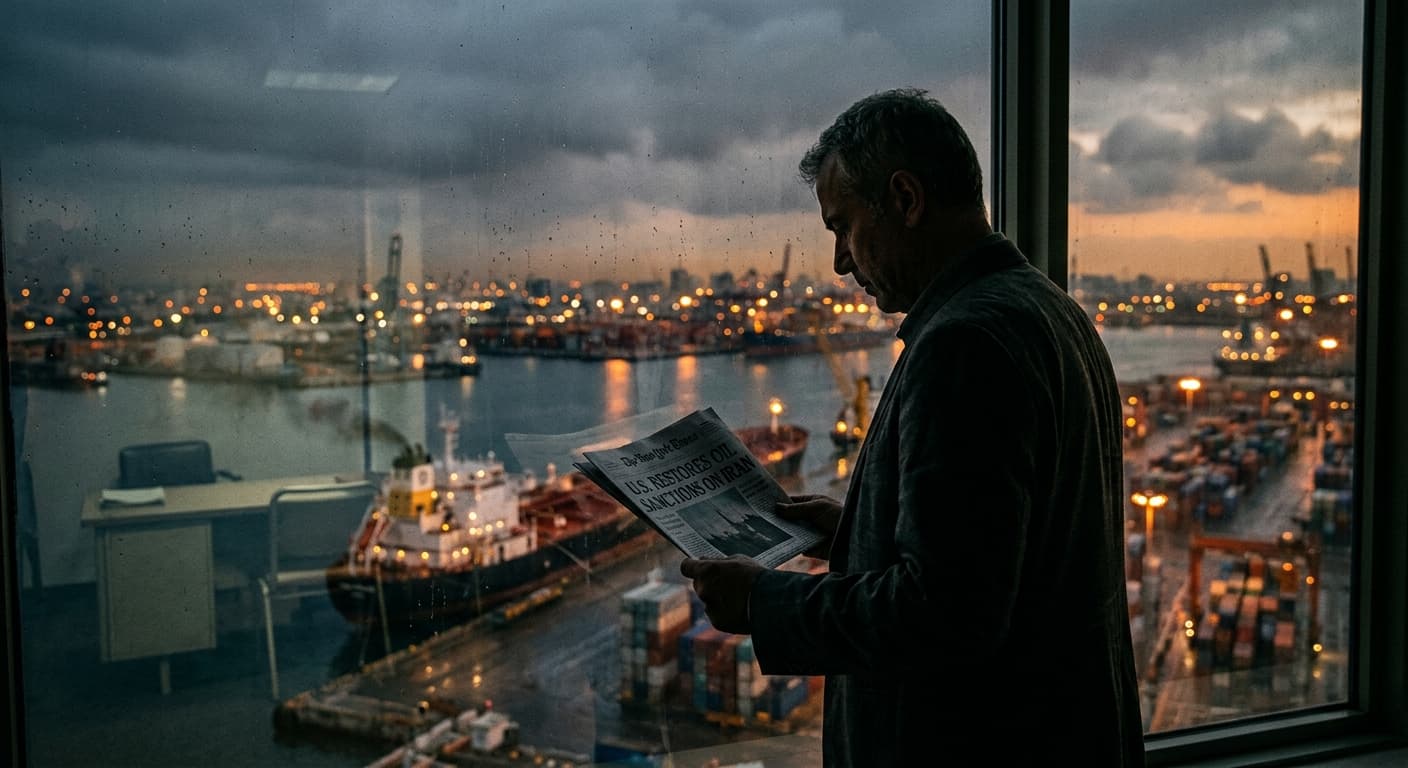
Washington Reimposes Iran Oil Sanctions, Bombs 80 Sites: What Breaks Next
Brent jumped to $76 on July 8, 2026, after OFAC pulled Iran's oil waiver and CENTCOM struck 80 targets. The US-Iran MoU is dead at 21 days; here is what that means for oil, sanctions and the ceasefire.
The US Treasury revoked Iran's 60-day oil-sales licence on July 7, 2026 — hours before CENTCOM hit more than 80 targets in southern Iran — and the sequencing is the story. Washington used the sanctions lever first and the missiles second, killing the only concrete concession Tehran received in the June 17 Memorandum of Understanding before a single Tomahawk flew. That ordering signals a doctrine shift: after four months of war and three weeks of fragile peace, the White House now treats the oil waiver, not military escalation, as its decisive instrument — and the immediate beneficiaries are the same Chinese "teapot" refiners the previous sanctions were designed to squeeze.
Brent crude rose more than 5% in post-market trade to near $76 a barrel, according to Al Jazeera, reversing a slide toward pre-war levels. The Joint Maritime Information Center raised its Strait of Hormuz threat rating to "severe" for the first time since June 15. Iran's parliament speaker Mohammad Bagher Ghalibaf called the licence revocation a "major MoU violation" and the Foreign Ministry cited "the terrorist US military['s]… clear violation of Article 2, Paragraph 4 of the United Nations Charter," per
Al Jazeera's live coverage. Twenty-one days after signing, the deal that was meant to end a five-month war is a dead letter.
What happened, in order
At approximately 21:30 GMT on July 6, three commercial tankers were struck in or near the Strait of Hormuz. A Qatari LNG carrier caught fire off Oman after being hit by an "unknown projectile," per UKMTO; a Saudi-flagged crude tanker operated by Bahri was damaged by missiles that Reuters sources attributed to the IRGC; a third vessel took a strike but continued transit. Iranian state television reported the LNG carrier had "ignored warnings."
Within hours, the US Treasury's Office of Foreign Assets Control (OFAC) cancelled the general licence issued on June 22, 2026, that had authorised "the production, delivery and sale of Iranian oil" through August 21, according to the original OFAC framework that governed the wind-down. Treasury Secretary Scott Bessent had, three weeks earlier, described the waiver as the reciprocal for Iran's commitment "to free and open transit in the Strait of Hormuz and to permit IAEA inspectors."
CENTCOM strikes followed at dawn on July 7. The command said in a statement carried by BBC News that it hit "more than 80 targets," including air defence systems, coastal radar, surface-to-air and anti-ship missile batteries, drone-launch sites and "over 60" IRGC small boats at Sirik, Qeshm Island and Bandar Abbas. Iran said two military bases in Bushehr and drone sites at Bandar Mahshahr were also struck; an IRGC Navy member was killed, per Tasnim. The IRGC responded by launching missiles and drones at "85 key US military facilities" in Bahrain and Kuwait, including Sheikh Isa airbase — the fourth round of Iranian air-defence sirens in Manama in a single dawn, per Bahraini media adviser Nabil al-Ahmar.
President Donald Trump declared the MoU "over" and a "waste of time," per Al Jazeera. Iranian chief negotiator Ghalibaf did not formally withdraw.
The waiver was the whole deal
Read the June 17 MoU by what it actually delivered, not by what it promised. Iran got exactly one durable, monetisable concession: the OFAC general licence permitting oil sales through August 21. Washington got a diplomatic reopening of Hormuz — but shipping data showed the reopening barely happened. Kpler recorded 108 crossings over the July 3–5 weekend against a pre-war baseline of 120–140 per day, per Al Jazeera. Even at "resilience" levels, Hormuz was running at roughly a quarter of normal traffic three weeks into the ceasefire.
That asymmetry — a paper concession from Iran, a hard-currency concession from the US — is why the waiver became the single point of failure. Brett Erickson of Obsidian Risk Advisors called the revocation "a complete destruction of the Memorandum of Understanding" because "the oil sanction waivers were the only notable up front concession that Iran received," in comments cited by Al Jazeera.
The waiver's economic weight explains why. Iran exported 1.66 million barrels per day of crude and condensate in 2025, the highest since 2018, per Energy Intelligence. The US naval blockade imposed at the start of the war collapsed those flows to 209,000 barrels per day in May, according to Vortexa data reported by
OilPrice.com — the lowest since 2019 and a level that leaves the Islamic Republic's fiscal position untenable within months. Kpler's Homayoun Falakshahi warned in the same report that, if the blockade held two more months, Iran could "effectively run out of available oil to ship to China." The June licence was the pressure valve. Washington has now shut it.
Who wins from re-imposition — the non-obvious answer
The intuitive read is that Iran loses and US hawks win. Both are true. But the marginal beneficiary of every round of Iran sanctions since 2019 has been the same actor: the Chinese independent refiner buying discounted barrels through the shadow fleet. That pattern is about to intensify.
Chinese customs data officially show zero Iranian crude imports since 2022; unofficially, China buys roughly 90% of Iran's crude via multi-stage transfers on blacklisted tankers, per OilPrice.com. When OFAC sanctioned five "teapot" refineries in April 2026, Beijing's response was not compliance but an anti-sanctions law injunction, per
Al Jazeera, ordering Chinese firms not to comply. On July 5, Iran's ambassador to Beijing publicly promised "special" Hormuz treatment for "friendly" countries. The re-imposition therefore does not close Iran's export channel; it deepens the discount Chinese buyers extract from it — Iranian Light already flipped from a premium to a discount versus Brent in May, per OilPrice — while giving Beijing a fresh political grievance to weaponise.
The concrete loser is the Gulf sovereign. Saudi and Emirati barrels remain the marginal supplier to Asia, but their exports still transit Hormuz. On paper, OPEC holds roughly 4 million barrels per day of adjusted spare capacity, per Energy Intelligence — but "nearly all this is concentrated in four countries — Saudi Arabia, the United Arab Emirates, Kuwait and Iraq — whose exports through the Strait of Hormuz are currently severely restricted." The Congressional Research Service estimates the Saudi East-West and Abu Dhabi bypass pipelines have "approximately 2.6 million barrels per day of available capacity" combined — a fraction of the 20 million bpd that transited Hormuz in calendar 2024, per
CRS Report R45281.
Saudi Aramco has already cut its August formula prices to Asia by a record $11 per barrel, per Energy Intelligence, in an attempt to hold market share against Iranian and Russian discounted grades. Riyadh is paying twice: once in lost transit through Hormuz, once in the discounts required to compete with barrels Beijing buys sanctioned.
The market is pricing in a partial disruption, not a closure
Brent at $76 is not a Hormuz-closure price. Wood Mackenzie's Alan Gelder, writing on July 2, 2026, framed the current market as a Hormuz "shock" in which "reopening the Strait of Hormuz is the only" durable fix — even after the IEA's coordinated release of 400 million barrels earlier in the war, described by
BloombergNEF as "more than double the 183 million barrels unlocked after Russia invaded Ukraine." That drawdown bought time; it did not restore flows.
The market's implicit forecast: Iran will keep the Strait open enough for a majority of Gulf oil to move, and will keep striking selective tankers to preserve leverage without triggering full US–Gulf naval war. Michael Wahid Hanna of the International Crisis Group summarised the Iranian posture in Al Jazeera: Tehran wants "to re-emphasise" its claim over the strait "while not shutting down navigation completely." Mohsen Milani of the University of South Florida described Iran's push for transit "environmental or service fees," possibly with Oman, as an effort "to convert its sovereignty over half of the strait into lasting influence."
The bounded scenario prices at roughly $70–$85 Brent. Full closure — the tail risk — historically implies triple-digit prices within days, and the Congressional Research Service warns that "how long prices might remain elevated" would depend on when insurers and tanker owners regain confidence, not on the shooting stopping.
The legal architecture Trump is dismantling
The revoked instrument was the successor to Iran-related General Licence U, issued March 20, 2026, and reissued in modified form on June 22 to codify the MoU. The Treasury document specified authorisation only for "transactions… ordinarily incident and necessary to the sale, delivery, or offloading of crude oil or petroleum products of Iranian origin," and expressly excluded any transactions involving North Korea, Cuba or occupied Ukrainian territory, per the OFAC text.
Congress had already tried to strip the executive of this discretion. H.R. 8220, introduced April 9, 2026, would have nullified General Licence U outright and barred the Treasury Secretary from authorising "any transactions… ordinarily incident and necessary to the sale, delivery, or offloading of crude oil or petroleum products of Iran," per the bill text. The bill also required a report every 60 days for three years on "the premium earned on Iranian oil as a result of the closure of the Strait of Hormuz." H.R. 8220 has not passed — but its revocation-by-executive-action equivalent is now in force. Trump has, in effect, adopted the hawks' policy without needing the votes.
Iran cited Article 2(4) of the UN Charter — the prohibition on the "threat or use of force" against another state's territorial integrity. That framing matters less for compliance than for the diplomatic sequencing at the UN General Assembly in September, where Tehran will attempt to reframe the strikes as US aggression against a state party to an active MoU.
Diplomat View
The MoU is functionally dead, and the market has 30 days to reprice a longer war. Our base case: Brent trades in a $72–$88 range through September while Iran and the US alternate calibrated strikes and Chinese teapot refiners continue absorbing discounted Iranian barrels, keeping Tehran solvent at reduced volumes. The August 21 waiver expiry, which would have been the natural renegotiation moment, is now moot; Washington's move to revoke early strips Tehran of the deadline leverage it was banking on. The forecast breaks in two directions. It breaks lower — toward $65 — if Iran quietly resumes Hormuz transit within two weeks and Trump reissues a modified licence, because both sides face domestic pressure to avoid a full winter war. It breaks higher — toward $110–$130 — if a US or Gulf vessel takes casualties, or if OFAC extends secondary sanctions to a top-tier Chinese refiner rather than a teapot, forcing Beijing to choose between Iran and its dollar clearing access. Watch for the OFAC designation list, not the CENTCOM press release; the sanctions channel is now the decisive one.
What to watch next
- July 15, 2026: JMIC threat-level review. A downgrade from "severe" would signal Iran is easing tanker attacks and open the door to a face-saving licence reinstatement.
- August 21, 2026: Original waiver expiry — now the deadline by which Iran must show it can either force renegotiation or accept the pre-June sanctions baseline as permanent.
- September 2026: UN General Assembly. Iran will seek Security Council language on US "aggression"; watch Russian and Chinese vote framing for signals on how far Beijing will go to shield Tehran diplomatically.
- Next OFAC action: A designation targeting a state-owned Chinese refiner — as opposed to another teapot — would mark the real escalation and is the single catalyst most likely to move Brent above $90.
The Bottom Line
The bottom line: Washington's decision to revoke Iran's oil licence before firing the missiles marks a doctrinal shift — sanctions, not strikes, are now the primary instrument, and the ceasefire architecture built in June was too thin to survive one bad week in Hormuz. The story to watch is not the next CENTCOM strike but the next OFAC designation: if it hits a major Chinese refiner rather than a teapot, the Iran conflict becomes a US-China oil war, and $76 Brent will look cheap.
Discover more

US Politics
House Ethics Committee Pushes Sexual Miscond.
The House Ethics Committee has shifted responsibility for sexual harassment settlement records to the Office of Congressional Workplace Rights, complicating disclosure efforts.
India
Romanian Coalition Party Demands PM Resign
Romania's Social Democrats withdrew from coalition, joining far-right AUR to topple PM Bolojan, risking €10 billion in EU funds by August 2026.
Global Politics
Trump's Conflicting Messages on Iran War
Trump's mixed messages on Iran reflect a strategy of audience management, benefiting Tehran amid a complex geopolitical landscape.

Economics
Fed's Amex AML order puts correspondent banking on notice
Federal Reserve's Amex AML order requires board-level controls and a 90-day plan; OCC fined the bank $350 million over enterprise-wide deficiencies.