US-Iran Naval Clashes in Hormuz
Ceasefire exposes Iran's control over Hormuz Strait.
Model Diplomat8 min readMiddle East
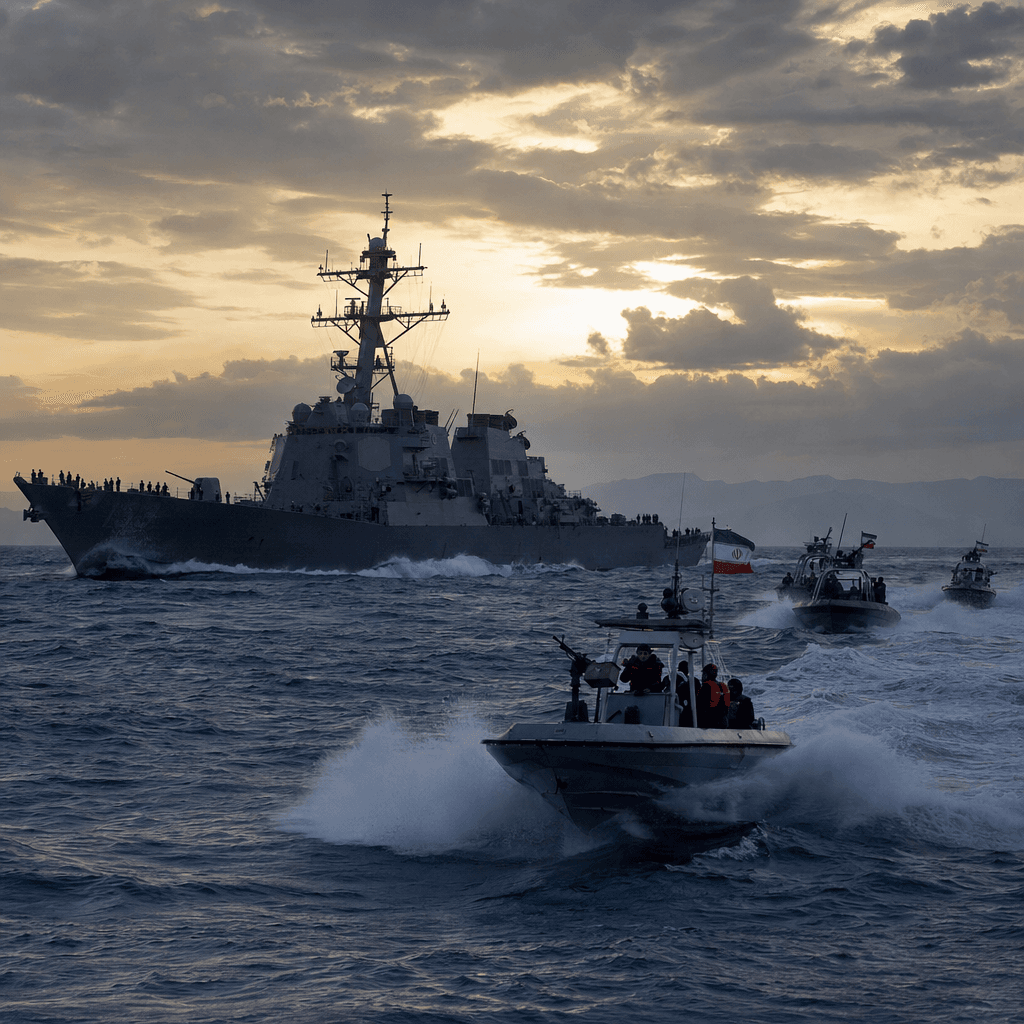
US-Iran Naval Clashes in Hormuz: The Ceasefire That Isn't
The May 7 destroyer battle in the Strait of Hormuz did not break the US-Iran truce — it revealed the deal's price: Tehran's toll on the world's oil chokepoint.
Three US Navy destroyers came under sustained missile, drone and fast-boat attack in the Strait of Hormuz on May 7, 2026 — a month after Washington and Tehran declared a ceasefire, and six weeks before their presidents signed a memorandum of understanding in Versailles. The clash was not the truce collapsing. It was Iran collecting on it. Buried in paragraph five of the June 17 Islamabad Memorandum is a US concession that lets Tehran co-administer the strait with Oman and levy fees after the 60-day grace period. The naval clashes are the enforcement mechanism of a deal Washington signed but publicly refuses to acknowledge.
That is the story of Hormuz in 2026: not war, not peace, but a managed condominium in which one-fifth of the world's oil moves at Iran's discretion and, increasingly, in China's currency.
What actually happened at sea
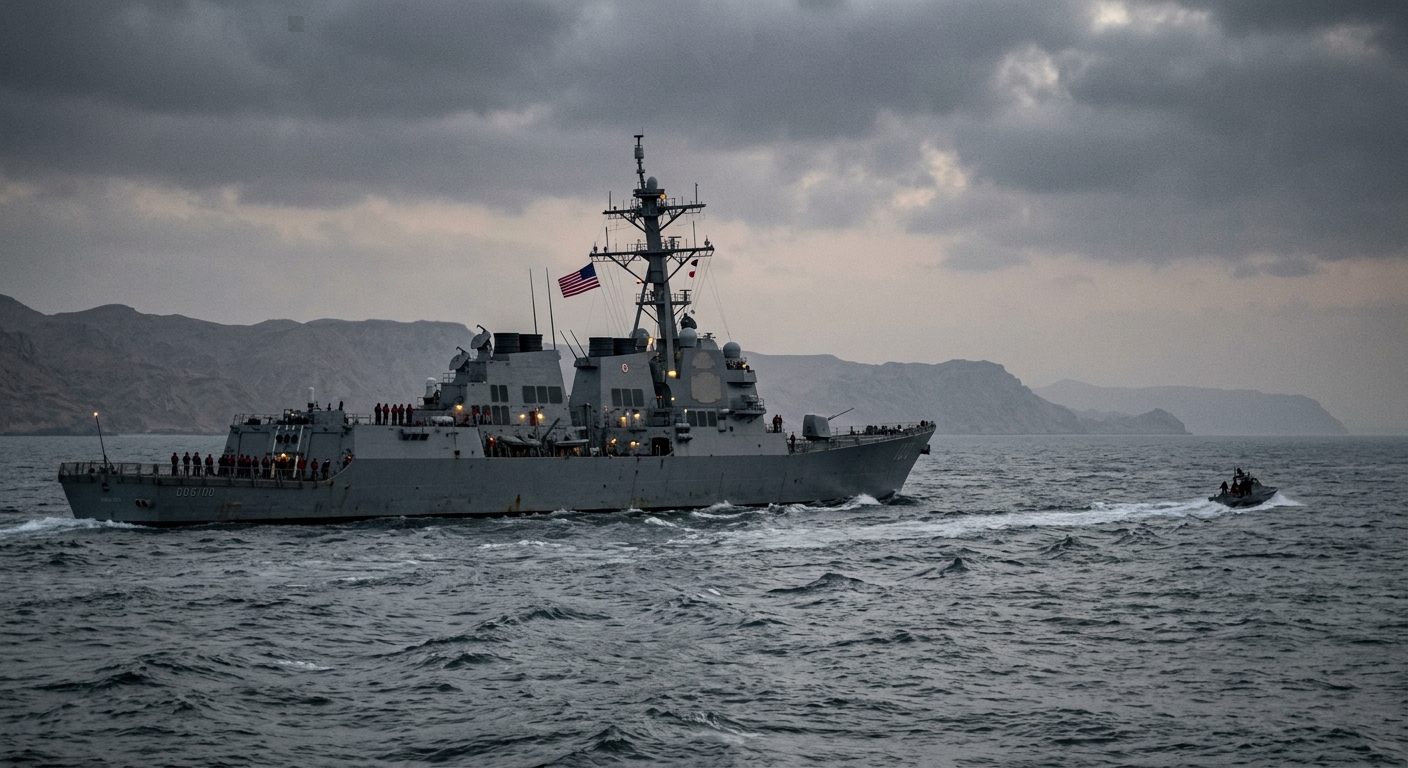
US Central Command confirmed on May 8 that its destroyers had been engaged the previous day by Iranian missiles, drones and small boats while transiting toward the Gulf of Oman, according to WANA. Tehran did not deny it. In a rare public claim of authorship, the IRGC Navy said it had launched a "large-scale" attack in retaliation for a US strike on an Iranian oil tanker off the port of Jask, according to
Iran International.
The clash was the sharpest of a running series. Speaking on May 5, US Secretary of War Pete Hegseth told reporters that since the ceasefire took effect Iran had fired at commercial vessels nine times, seized two container ships and attacked US forces more than ten times — all, he said, kept "below the threshold of restarting major combat operations." That threshold matters. Hegseth used the briefing to unveil Project Freedom, a defensive convoy operation that CENTCOM said had destroyed six IRGC small boats and intercepted cruise missiles and drones over 48 hours, per the Department of War transcript.
Asked directly whether the ceasefire was over, Hegseth was categorical:
"No, the ceasefire is not over… This is about the straits. This is about freedom of navigation. This is about international waterways… right now, the ceasefire certainly holds, but we're going to be watching very, very closely."
President Donald Trump echoed the line the same week, telling reporters — as BBC News reported — that the truce was intact despite the exchange of fire. Neither side wants to own the collapse. Both have reasons to keep calling this something other than combat.
The MoU that gave Iran the strait
The pattern makes more sense once the June 17 memorandum is read carefully. The full 14-point text, first disclosed by a US official and published in verbatim form by NPR and
the BBC, commits the two governments to reaching a final deal within 60 days and locks in three interim concessions.
Point 4 obliges Washington to end its naval blockade of Iranian ports within 30 days and pull US forces from Iran's near-abroad within 30 days of the final deal. Point 5 commits Iran to "best efforts" on safe passage of commercial vessels — free of charge, but only for 60 days — and, crucially, tasks Tehran with conducting "dialogue with the Sultanate of Oman to define the future administration and maritime services in the Strait of Hormuz." Point 8 reaffirms Iran will not build a nuclear weapon and provides for its 60%-enriched stockpile — estimated at roughly 440kg by Al Jazeera — to be down-blended on site under IAEA supervision rather than shipped out, as the US had originally demanded.
Read plainly, the MoU codifies what Iran achieved by force. Iranian parliamentary speaker Mohammad Baqer Ghalibaf, Tehran's lead negotiator, told state television on signing day that the Strait of Hormuz "will not return to pre-war conditions" and that Iran would collect "a fee for services" from vessels transiting the waterway. Trump officials denied any tolls had been agreed. Both are technically right — and that ambiguity is the deal.
Who benefits: Iran, China, and the yuan
The concrete winners are visible in ship-tracking data. According to Al Jazeera, commercial ship movements through the strait rose more than 50% in the week of June 22–28 compared with the previous week, based on Kpler figures — but the volumes remain a fraction of the pre-war average of roughly 138 transits per day, which
BBC Verify documented from Kpler and MarineTraffic. Iran, in other words, is turning the tap slowly enough to keep leverage.
More striking is who is going through. In the weeks before the MoU, as the Brookings Institution documented, Iran vetted vessels case-by-case, favouring flags and owners tied to China, Russia, India and Pakistan and requiring operators to submit crew nationalities, ownership, cargo and destination to IRGC-linked intermediaries. Lloyd's List first reported the "toll booth" system in March; at least two transits so far have been paid for in Chinese yuan, according to reporting synthesised by
Al Jazeera. China already buys roughly 80% of Iran's crude exports in yuan; Hormuz transit fees now extend that arrangement to third-country shipping.
On July 5, Iran's ambassador to Beijing made the alignment explicit, telling Chinese media that "friendly countries" would receive "special" treatment at the strait, per Al Jazeera. The signal is aimed less at Washington than at Seoul, Tokyo, New Delhi and Athens — the shipping capitals whose vessels dominate the traffic — offering a discriminatory access regime as a template.
That is the second-order shift the wire coverage has largely missed. Samantha Gross and Ryan Beane of Brookings argue that Iran has "introduced a potentially significant precedent: access to key maritime chokepoints may be conditioned on political relationships rather than established norms of open transit." The Red Sea already shows a version of it, with Houthi forces filtering vessels by owner and flag. If Hormuz normalises the practice, the operational read-across runs to Bab el-Mandeb, Malacca and eventually the Taiwan Strait — all waterways where a coastal power might one day want to reward friends and punish rivals.
Who loses: the Gulf, the norm, and Washington's line
The clearest losers are the Gulf monarchies. Qatar had to halt LNG exports for weeks; Bahrain, the UAE, Saudi Arabia, Kuwait and Jordan co-sponsored the original April 7 UN Security Council resolution demanding the strait's reopening "by all necessary means." Russia and China vetoed it, as Al Jazeera reported, hours before the ceasefire was announced. A second Bahrain-US draft, avoiding explicit force authorisation but retaining Chapter VII cover, has drawn 112 co-sponsors — two-thirds of the UN membership, per
Al Jazeera — but no vote date. ADNOC chief executive Sultan al-Jaber has publicly called Iran's regime "economic terrorism." Neither the diplomatic isolation of Iran on paper nor the concentration of Gulf hydrocarbons opinion has moved the water.
The other loser is Washington's stated position. On July 2, at an emergency UNSC session called by Bahrain, US envoy Mike Waltz warned Iran that "the closure of international waterways is unacceptable and is not considered self-defence," per Al Jazeera's live coverage. Yet the US signed a document tasking Iran and Oman with defining the strait's "future administration" — a phrase that presupposes an administrator. Vice President JD Vance told reporters he could not guarantee that Washington would not return to combat before the MoU deadline, saying "I can't commit to anything, because, obviously, it depends on what the Iranians are ultimately going to do."
Mines are the physical proof of leverage. The Joint Maritime Information Center, a US-led multinational body, has confirmed at least two sea mines in the central shipping lane and is running active clearance operations. Experts told the BBC that de-mining could take between 30 days and six months. Until it is complete, only the narrow southern corridor along Oman's coast — the same corridor where a cargo ship was hit by an "unknown projectile" on June 25 — is usable at commercial scale.
The historical parallel that reframes it
The closest analogue is not the 1988 "Tanker War," in which US destroyers escorted Kuwaiti tankers and sank half the Iranian navy in a single afternoon at Bandar-e Farsi. It is the 1936 Montreux Convention, which handed Turkey administrative control of the Turkish Straits in exchange for demilitarisation guarantees. Ankara has parlayed that document into strategic leverage for 90 years, most recently invoking it in 2022 to block Russian warships from entering the Black Sea.
Point 5 of the Islamabad MoU does not go that far. But it moves the strait a long step in the same direction: from open waterway under the customary international-law rule of transit passage, toward a jointly administered corridor where a coastal state has a written role in "maritime services." Iran's parliament has already begun drafting the toll legislation, according to Al Jazeera. Once such a regime is codified, unwinding it becomes another war.
What to watch
- The 60-day clock: The MoU's negotiation window runs until roughly August 16, 2026. Vance has hinted Trump would extend it. Ghalibaf's fee regime kicks in the moment it lapses without a final deal.
- The next UNSC vote: The Bahrain-US draft with 112 co-sponsors has no vote date; a Russia-China counter-text is under discussion. A Chinese veto of the second resolution would confirm Beijing as the strait's diplomatic guarantor.
- Mine clearance: The JMIC has confirmed two mines and warned of more. Full clearance of the central shipping lane — the technical precondition for pre-war traffic volumes — is the single most important data point analysts should track.
- The $6bn tranche: Iranian President Masoud Pezeshkian has publicly said Tehran expects $6bn of its frozen funds released as a first step. Movement, or its absence, will tell you whether the MoU has any implementation momentum at all.
The Bottom Line
The May 7 destroyer clash was not the ceasefire breaking — it was the ceasefire working as designed. Tehran established, in kinetic fashion, the leverage it needed Washington to write into paragraph five of the Islamabad Memorandum: joint administration of the world's most important oil chokepoint, and the option to charge for passage in a currency of its choice. The clearest beneficiary is not Iran but China, whose yuan has quietly become the pricing unit at the door to the Gulf. Unless the August negotiating window produces a genuine final deal, freedom of navigation through Hormuz will have been renegotiated by force — and the norm that protects every other maritime chokepoint will have been renegotiated with it.
Discover more

Global Politics
US Seizes Iranian Ship, Tensions Surge
The US seizure of the Iranian ship Touska highlights a shift in control over the Strait of Hormuz, favoring Iran's strategic position.

Conflict & Security
Drone Warfare Killing Aid Workers at Unprec
Over 1,000 humanitarian workers killed in three years as cheap armed drones collapse legal protections. Gaza, Sudan, Ukraine, and DRC see deliberate targeting of aid convoys and hospitals with zero prosecutions.

Global
World Normalises Taliban as Afghan Women Eras
UN data shows Afghan women erased from public life as Russia recognises the Taliban, EU hosts officials in Brussels, and ICC warrants for gender persecution go unenforced.
Conflict & Security
West Africa Food Crisis: Three Shocks in 2026
Conflict, climate extremes, and the Strait of Hormuz closure drive a severe food crisis in West and Central Africa, with fertilizer prices surging 80% and millions displaced.