US bombs empty Iran nuclear site, setting NPT
US bombs empty IAEA-safeguarded site, setting a dangerous precedent
Model Diplomat10 min readMiddle East
The US Just Bombed an Empty Nuclear Construction Site in Iran — and That Changes Everything
The IAEA is investigating a US strike on Iran's Darkhovin nuclear plant construction site, which contained no nuclear material. It is the first time a state has bombed a non-operational, IAEA-safeguarded civilian nuclear facility under construction in the NPT era — a precedent with consequences for every non-nuclear-weapon state now watching.
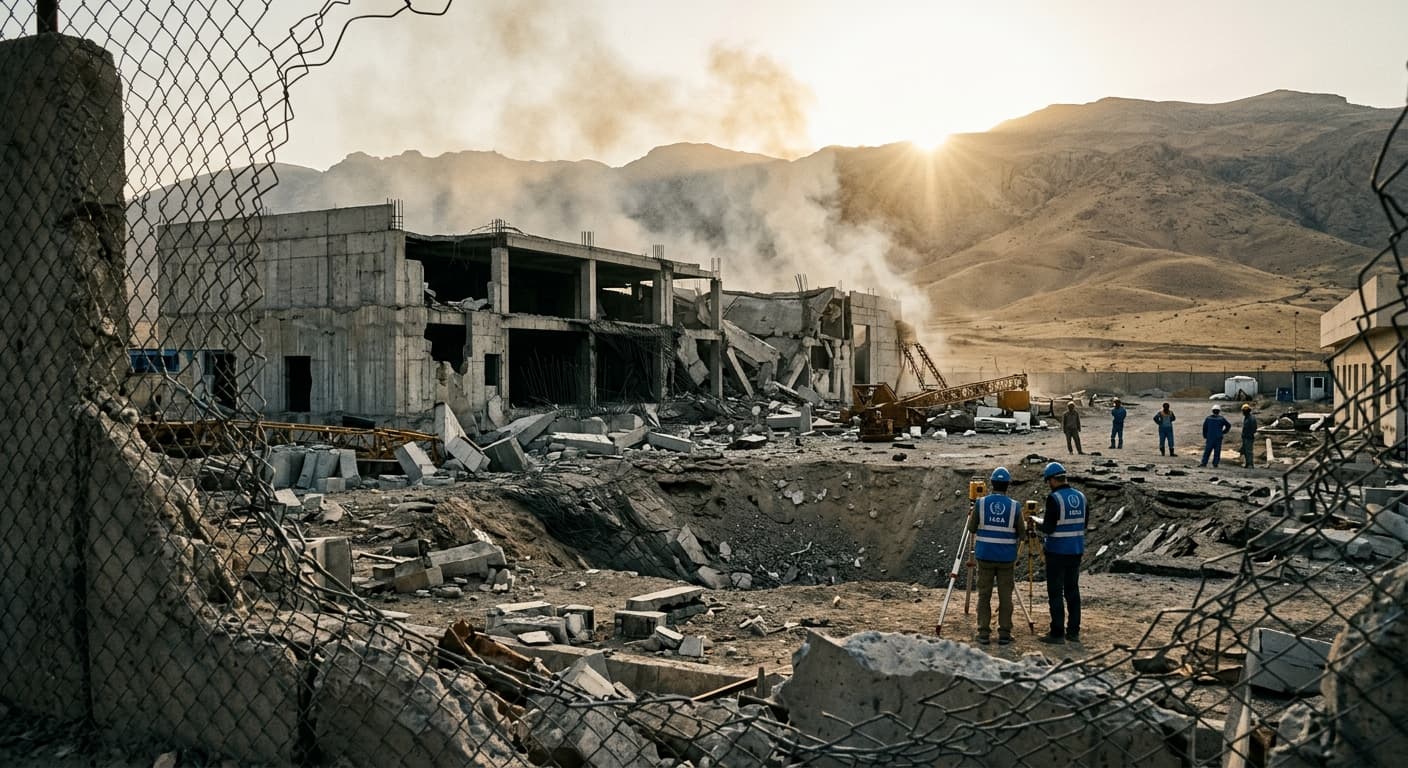
On the night of July 19, 2026, during the ninth consecutive night of US strikes on Iran, multiple projectiles hit a patch of land on the Karun River in Khuzestan province where Iran has been trying, on and off for half a century, to build a nuclear power plant. The International Atomic Energy Agency confirmed within hours that the Darkhovin site "was in the very early stages of construction and contained no nuclear material when last visited." There was no radiological release, no threat to civilians — and that is precisely why the strike matters.
For 14 months, the US and Israel have bombed Iran's nuclear infrastructure in a campaign marketed as counter-proliferation. Operation Midnight Hammer in June 2025 struck Natanz, Fordow, and Isfahan — enrichment and conversion sites where the IAEA had verified the presence of uranium, centrifuges, and fuel-cycle activity. The legal and political case for those strikes, contested as it was, rested on a claim that the US was degrading weapons-relevant capabilities. Darkhovin had none. By hitting an empty civilian construction project, the United States has crossed a threshold that redefines what counts as a legitimate target — and the NPT regime is the quiet casualty.
What Darkhovin Actually Is
Darkhovin is not a secret. It has been on the IAEA's books for decades and in the Western imagination even longer.
The site traces its origins to the 1970s, when the Shah's Iran signed a $2 billion agreement with the French firm Framatome to build two 900-megawatt pressurized water reactors near Ahvaz, on the banks of the Karun River, according to the Carnegie Endowment for International Peace. France was even prepared to build eight additional plants if Washington continued blocking American firms from the market. The 1979 revolution killed the project. Framatome withdrew. The components meant for Darkhovin were diverted to France's Gravelines reactors.
For two decades the site lay dormant. Then, beginning in the late 1990s, Iran revived it as part of a broader claim to an indigenous civilian nuclear program. The Atomic Energy Organization of Iran announced plans for a domestically designed 360-megawatt reactor — the IR-360, sometimes called Karun. By 2016, AEOI head Ali Akbar Salehi declared Iran was "almost about to sign a contract for designing" the reactor, though he acknowledged "it will take a rather long time," according to the Congressional Research Service.
It took so long it never happened. As of July 2026, Darkhovin remained exactly what the IAEA described: a site in "the very early stages of construction."
The site does, however, have an IAEA compliance history worth noting. In March 2007, Iran suspended its adherence to the modified Code 3.1 of its safeguards subsidiary arrangements — a provision requiring Tehran to notify the agency of design information for new nuclear facilities "as soon as the decision to construct" is taken, according to CRS reports. When the IAEA requested design information for Darkhovin in December 2007, Iran refused to provide it until September 2009, and even then submitted only "preliminary design information" that the agency deemed insufficient. Then-Director General Yukiya Amano reported in 2010 that Iran had furnished "only limited design information" on the reactor. A 2024 PISM report noted the IAEA still had "no information on the construction plans and core design of the new 360 MW IR-360 reactor to be built at Darkhovin."
This is not a clean record. But a compliance dispute over design paperwork for a reactor that remains a hole in the ground is not a nuclear weapons program.
The Difference Between Midnight Hammer and Darkhovin
To understand why Darkhovin is a departure, it is necessary to understand what came before it.
On June 22, 2025, the United States launched Operation Midnight Hammer: 125 military aircraft, including seven B-2 Spirit bombers carrying 30,000-pound GBU-57 Massive Ordnance Penetrators, struck three Iranian nuclear sites — Natanz, Fordow, and Isfahan. The targets were enrichment halls, uranium conversion facilities, and centrifuge cascades. The IAEA had verified all three sites contained nuclear material. Assessments of the damage varied from "set back by months" (a leaked Defense Intelligence Agency report, according to BBC News) to "obliterated" (President Trump's characterization), but the legal architecture of the strikes was at least anchored in a counter-proliferation rationale.
Those sites contained approximately 440 kilograms of uranium enriched to 60 percent — close to weapons-grade, enough for roughly 10 nuclear devices if further enriched, as estimated by the IAEA. Fordow was buried 260 feet inside a mountain. Natanz housed thousands of operating centrifuges. Isfahan converted uranium into metal — a step toward weaponization.
Darkhovin has none of this. It is a construction site — an aspirational civilian power reactor that has been on Iranian drawing boards since before the Islamic Republic existed.
The IAEA Board of Governors resolution passed in June 2026, backed by the US, UK, France, and Germany, demanded Iran provide "complete information" on its enriched uranium and grant inspectors access "without delay." It passed 21-3 with 10 abstentions, according to Al Jazeera. That resolution was about the unaccounted 440 kilograms of near-weapons-grade uranium — not about an empty construction pit in Khuzestan.
By striking Darkhovin, the US has expanded the target set from sites that house nuclear material to sites that merely represent the idea of civilian nuclear infrastructure.
The IAEA's Dilemma
Rafael Grossi, the IAEA Director General, is now in a position without precedent.
His agency issued a statement on July 19 confirming it was "looking into reports of an overnight attack" on Darkhovin. It noted the facility was in "very early stages of construction," contained no nuclear material, and posed no radiological risk. But Grossi also reiterated a call for "military restraint in the vicinity of all nuclear-related sites," according to The Peninsula Qatar.
The careful language reflects a structural problem. The IAEA's mandate is to verify the peaceful use of nuclear material and technology — not to adjudicate the legality of military strikes. But if safeguarded facilities can be bombed with impunity when they contain no nuclear material, the entire framework of civilian nuclear protection loses credibility.
This is not a hypothetical concern. The IAEA has already recorded multiple projectile strikes on or near Iran's Bushehr nuclear power plant — a fully operational Russian-built reactor containing thousands of kilograms of nuclear material — on March 17, March 24, March 27, and April 4, 2026, as reported by Al Jazeera. Satellite imagery from July 7-12 showed new impact scars inside the Bushehr complex. In each case, Iranian authorities said the reactor continued operating normally — but the pattern of escalating proximity to active nuclear material is unmistakable.
The Darkhovin strike lands in the middle of an IAEA verification crisis that has been deepening for over a year. Since the June 2025 strikes, the agency has not had access to Fordow, Natanz, or Isfahan. The whereabouts of Iran's 440 kilograms of 60 percent enriched uranium is unknown. As the Quad statement at the June 2026 Board of Governors said: "The Agency cannot draw a safeguards conclusion for 2025 in respect of Iran's previously declared nuclear material," according to the UK Government.
Now add to this the fact that a state — the United States — has bombed a safeguarded facility that contained zero nuclear material. The signal to other non-nuclear-weapon states considering civilian nuclear programs is unambiguous: IAEA safeguards do not immunize you.
The War the Strike Sits Inside
The Darkhovin strike did not happen in isolation. It was part of the ninth consecutive night of US bombardment of Iran, a campaign that reignited after the US-Iran memorandum of understanding signed in June 2026 effectively collapsed.
Here is the arc: The US and Israel launched a full-scale war on Iran on February 28, 2026, killing Supreme Leader Ali Khamenei on the first day and striking military, nuclear, and leadership targets across the country. A ceasefire was reached in April, followed by the June 17 MoU — a 14-point preliminary agreement that committed both sides to a 60-day negotiation period and mandated IAEA supervision of nuclear activities, according to BBC News.
The MoU unraveled in late June after an Iranian drone hit a cargo ship in the Strait of Hormuz. Iran blamed the US for facilitating an alternative shipping route it considered a violation of the deal. The US reimposed a naval blockade. By July 12, President Trump declared the ceasefire "over." The Strait of Hormuz — which in peacetime carried roughly one-fifth of global oil consumption — was effectively shut.
Since then, the US has struck Iranian targets across the southern coast and expanded into the northwest. CENTCOM has described the strikes as targeting "Iranian military command centres, air defence and coastal surveillance sites, maritime capabilities, missile and drone launch sites, and communications networks," according to Al Jazeera. Iranian retaliatory strikes have hit Kuwait, Bahrain, Jordan, Qatar, and Oman. Two US soldiers were killed in Jordan on July 18, bringing the American death toll to 17 since February 28, with more than 430 wounded.
Iran's response to the Darkhovin strike was calibrated. Deputy Foreign Minister Kazem Gharibabadi called it "a dangerous assault on Iran's peaceful infrastructure" and said he "fully implicates the US government in the consequences stemming from heightened insecurity and instability," according to Al Jazeera. Iran's Atomic Energy Organization said multiple projectiles hit the site and condemned it as a breach of international law.
Notice the framing: Iran is emphasizing the civilian, peaceful nature of Darkhovin — and the absence of nuclear material. This is not a rhetorical accident. It is a legal argument.
Why Iran Wants the IAEA Watching
Iran's play at the IAEA Board of Governors in June 2026 was revealing. When the US, UK, France, and Germany introduced a resolution demanding access to bombed sites and accounting of enriched uranium, Iran's mission warned that "coercion and confrontation do not lead to cooperation" and that the board "must not be instrumentalised to relieve those who carried out these attacks of their responsibility," as reported by Al Jazeera.
This is the core of Iran's legal strategy: paint the US and Israel as the aggressors who destroyed the verification architecture, then position the IAEA's demands for access as a form of victim-blaming. Gharibabadi put it plainly: "They target facilities under safeguards, disrupt nuclear safety and verification possibilities, and then use the Board of Governors to pressure Iran."
The Darkhovin strike gives this argument new force. The site was under IAEA safeguards, however imperfectly. It contained no nuclear material. The IAEA itself confirmed this. If the US bombs it anyway — and faces no meaningful consequence — what is the point of safeguards?
That question will not be lost on Riyadh, Cairo, Ankara, Jakarta, Brasília, or any other capital that has contemplated a civilian nuclear program with IAEA oversight. The signal is that safeguards protect the IAEA's ability to monitor — but they do not protect the facility.
Diplomat View
The Darkhovin strike is not about Darkhovin. It is about the erasure of the distinction between weapons-relevant nuclear infrastructure and civilian nuclear ambition — and that erasure is a strategic choice, not collateral damage.
The US military has the targeting intelligence to distinguish an empty construction site from an enrichment hall. CENTCOM's own statements describe strikes on "command centres, air defence sites, maritime capabilities." Darkhovin — a site with no nuclear material, no operational reactor, and no weapons-relevant activity — does not fit that profile unless the definition of a legitimate target has been expanded to include the idea of civilian nuclear infrastructure.
This has three consequences. First, it hands Iran a diplomatic weapon. Tehran can now argue, with the IAEA's own facts on its side, that the US is bombing safeguarded civilian sites — and that the verification regime whose absence the West laments was destroyed not by Iranian obstruction but by American bombs. That argument will resonate in the Global South, where 10 IAEA Board members already abstained on the June 2026 resolution.
Second, it accelerates the hollowing-out of the NPT's civilian-protection pillar. The 1968 treaty rests on a grand bargain: non-nuclear-weapon states forswear nuclear weapons in exchange for access to peaceful nuclear technology and a promise that their facilities will not be attacked. If the US — a nuclear-weapon state and NPT depositary — bombs a safeguarded civilian construction site, that bargain loses credibility. The states most likely to draw conclusions from this are not Iran's adversaries but its neighbors: Saudi Arabia, Turkey, Egypt — all of which have civilian nuclear ambitions and none of which will now be fully confident that IAEA safeguards confer meaningful protection.
Third, it complicates any eventual return to verification. The 60-day MoU negotiation window still technically has weeks to run, though both sides acknowledge it has effectively collapsed. Even if talks resume, the IAEA's return to Iran will now require inspections of a site the US has already bombed — a site that had no nuclear material before the strike and has none after. Iran will ask, reasonably: why grant access to a facility Washington has already rendered useless?
The forecast: Iran will use the Darkhovin strike at the next IAEA Board of Governors meeting to demand a formal condemnation of attacks on safeguarded civilian nuclear sites. It will not get one — the US, UK, France, and Germany will block it. But the vote tally will be the narrowest yet, and the abstaining bloc will grow. The NPT's 2027 Review Conference now has a live case study in what happens when a nuclear-weapon state decides that safeguards are not a shield.
What to watch:
- IAEA Board of Governors, September 2026: The next quarterly meeting will almost certainly feature a debate on the Darkhovin strike. Watch the size of the abstention bloc — if it grows beyond the 10 who abstained in June, the diplomatic isolation of the US position deepens.
- Iran's MoU negotiating track: The 60-day window expires in mid-August. If Iran ties any resumption of IAEA access to a US commitment not to strike safeguarded civilian sites, the verification deadlock becomes structural.
- NPT PrepCom, 2027: Non-nuclear-weapon states will use Darkhovin as the Exhibit A in arguments that the nuclear-weapon states are violating Article IV's guarantee of peaceful nuclear cooperation. A coalition of developing states could push for an interpretive statement requiring explicit protection for safeguarded facilities — something the P5 will resist.
Discover more
India
Congress Accuses Modi of Stalling Women's Law
Congress accuses Modi of stalling women's reservation law by linking it to delimitation, revealing a deeper electoral strategy.

India
Delhi CM Rekha Gupta Blasts Opposition's Delm
Delhi CM Rekha Gupta's remarks on women's quota defeat reveal BJP's strategy for the 2029 Lok Sabha elections, focusing on delimitation.

US Politics
House Ethics Committee Pushes Sexual Miscond.
The House Ethics Committee has shifted responsibility for sexual harassment settlement records to the Office of Congressional Workplace Rights, complicating disclosure efforts.

Conflict & Security
Drone Warfare Killing Aid Workers at Unprec
Over 1,000 humanitarian workers killed in three years as cheap armed drones collapse legal protections. Gaza, Sudan, Ukraine, and DRC see deliberate targeting of aid convoys and hospitals with zero prosecutions.