UN Urges Funding as 2.9M Afghans Return
UN agencies call for multi-year investment in Afghanistan's recovery.
Model Diplomat8 min readAsia
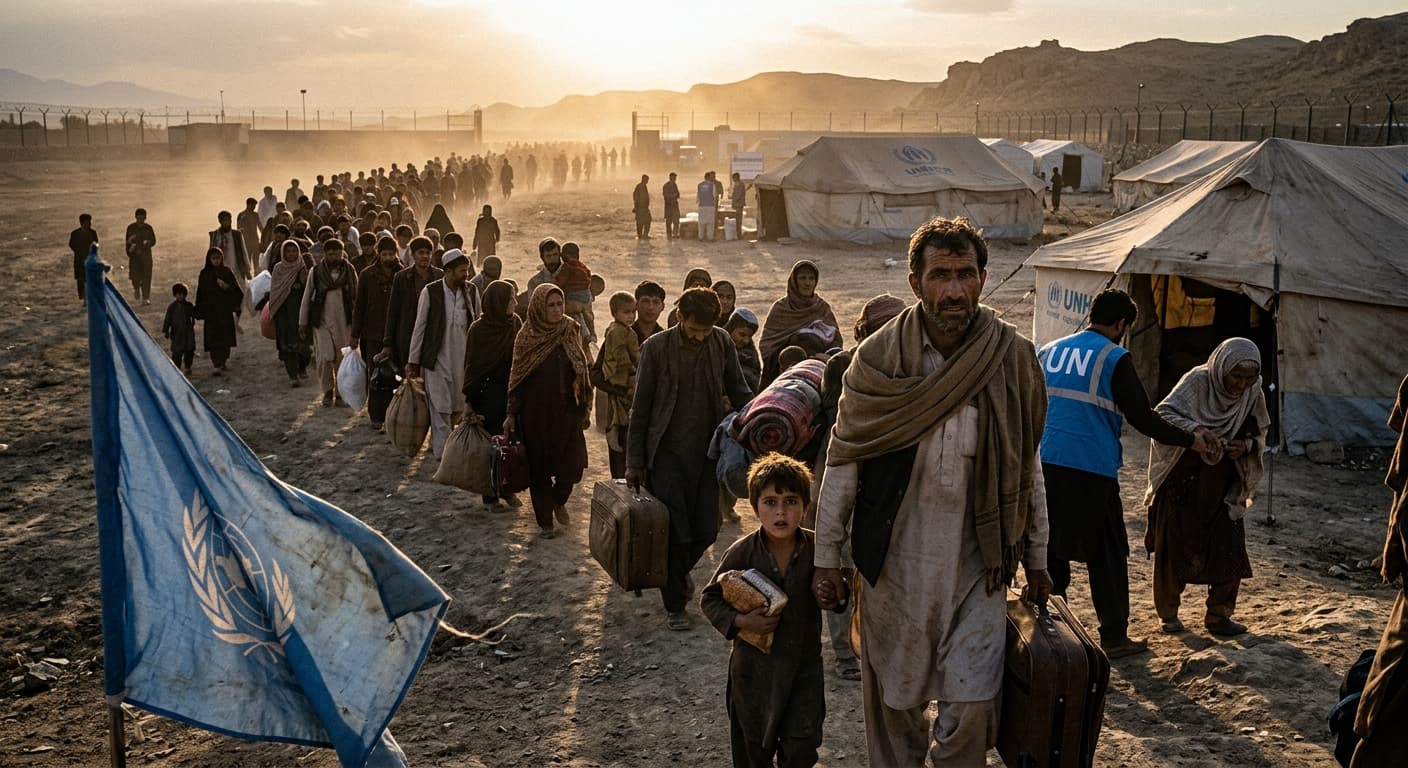
Afghanistan: UN Presses Donors as 2.9 Million Return Home
UNHCR and UNDP demand sustained, multi-year investment as Afghanistan absorbs the largest single-country refugee return ever recorded — 2.9 million in 2025 alone.
The UN's two flagship agencies for displacement and development are betting the same card, at the same time, for the same reason: without a decisive shift from emergency cash grants to multi-year reintegration financing, the 2.9 million Afghans pushed home from Iran and Pakistan in 2025 — the largest annual return to any country ever recorded — will destabilise the region rather than fuel any domestic recovery. UNDP Administrator Alexander De Croo and UN High Commissioner for Refugees Filippo Grandi wrapped a joint mission to Kabul on July 6, 2026 with a single message to capitals: the money currently pledged does not match the demographic shock already inside Afghanistan's borders, and the border-response model that has absorbed most donor attention since 2023 is the wrong instrument for the next phase.
The scale nobody planned for
The numerical baseline is unlike anything UNHCR has managed before. Speaking to reporters in Geneva on February 13, 2026, UNHCR Representative in Afghanistan Arafat Jamal said 5.5 million people had returned to Afghanistan since October 2023, with 2.9 million in 2025 alone — a figure he described as "the largest number of returns to any country ever recorded." The cumulative inflow now equals roughly 12 percent of Afghanistan's total population.
Two policy triggers explain the surge. Pakistan's Illegal Foreigners Repatriation Plan, launched in September 2023, has continued through 2026, with Islamabad maintaining daily returns of around 2,500 people and moving to invalidate Proof of Registration cards for 1.4 million Afghans. In Iran, headcount slips for an estimated 2 million Afghans expired on March 20, 2025, unlocking a state-run "regularisation and return" scheme; by early May 2026,
79 percent of returns from Iran were deportations, not voluntary movements.
The peak was extraordinary. According to the World Bank's Spring 2026 Afghanistan Development Update, approximately 800,000 individuals — primarily from Iran — re-entered Afghanistan in July 2025 alone, and 3.7 million returned across the Afghan fiscal year ending March 20, 2026. Jamal's UNHCR team reported daily arrivals surging to 50,000 at Islam Qala on July 4, 2025 — a border checkpoint built to process a fraction of that.
The macroeconomic trap
This is where De Croo and Salih's joint framing does its real work. Afghanistan's economy is not shrinking under the return wave; it is growing while its people get poorer. The World Bank projects growth around 4 percent in FY2026, but per-capita income is falling because population growth — driven almost entirely by returnees — is outpacing capital accumulation. Public investment contributed just 0.3 percentage points to GDP growth in FY2025, leaving the economy, in the Bank's phrase, "locked in a low-productivity equilibrium."
The remittance loss compounds the trap. An IMF working paper published in September 2025 estimates that overseas Afghans sent around US$465 million in formal remittances in 2023, plus an estimated US$1.5 billion through informal money service providers — equivalent to roughly 12 percent of GDP when combined. As those workers are pushed back, household purchasing power collapses on both sides of the ledger: fewer earners abroad, more mouths at home. The UN in Afghanistan calculates the country lost approximately US$1 billion in remittances during the 2025 returns wave alone.
The IMF's macroeconomic modelling reaches a conclusion that reads like an indictment of the current donor posture. Isolated measures — forced repatriation by host countries, emergency cash at borders by aid agencies — can bring fiscal relief for Iran and Pakistan while further undermining Afghanistan's already fragile economy. Simultaneous efforts to stabilise Afghanistan and improve refugee integration in host countries generate "mutually beneficial outcomes" — but only with adequate international support.
The funding gap that defines the ask
The gap between what UN agencies have requested and what donors have paid is not a rounding error. It is the story.
- The 2026 Response Plan for Afghan Returnees (RPAR), launched in Kabul on May 19, 2026, seeks
US$529.2 million to reach 2.7 million projected returnees between April and December — with US$428.5 million of that earmarked for medium-term reintegration in 35 priority districts, not border cash.
- The broader UN Humanitarian Needs and Response Plan for 2026, targeting nearly 22 million people,
was 14 percent funded as of late June 2026, according to OCHA.
- UNHCR's own 2026 Afghanistan appeal of US$216 million was
only 8 percent funded by mid-February, Jamal told the Geneva press corps.
That last number is the one to bold in a briefing memo. UNHCR is now operating at levels that force what Jamal called "heartbreaking, soul-destroying decisions" between blankets and meals. Cash assistance per family has fallen from a peak of US$2,000 to just US$150, a level Jamal explicitly said "can help someone to survive, but not to thrive." A 2024 World Bank quasi-experimental study is the primary document that makes this cut consequential: households that received US$350 per returnee (versus US$150) during a brief 2016–17 policy window were
17 percentage points more likely to own a house 16 months later, and significantly more likely to hold legal documentation. The evidence base for larger, front-loaded cash is unusually strong; the money simply is not there.
Who benefits, who loses
Name the actors. Iran and Pakistan are the immediate fiscal winners — Iran alone estimates its annual hosting cost at US$10 billion, and Tehran has publicly linked accelerated deportations to a claimed 30 percent crime reduction, per the UN's January 2026 Returnees Overview. Islamabad has folded expulsions into a domestic security frame around the Illegal Foreigners Repatriation Plan.
The de facto authorities in Kabul are trying to convert the demographic shock into a legitimacy asset. The Ministry of Refugees and Repatriation reported 3.2 million returnee arrivals during 2025 and 60 newly inaugurated "Townships" intended to house them — approximately 700,000 more than IOM and UNHCR headcount figures, an inflation the UN has flagged. The UN Country Team endorsed a critical Briefing Paper on Townships in September 2025 warning that land-allocation schemes under Decrees 190 and 6 repeat structural failings of earlier decrees issued under the Republic. That is the political minefield De Croo and Salih walked into.
The clearest losers are Afghan women and girls. UN Women, together with CARE International, warned in an August 2025 Gender Alert that female returnees — roughly a third of arrivals from Iran and about half from Pakistan — face compounded risks of early marriage, exploitation and denied education. Funding cuts have eroded the mahram support that female humanitarian workers require to move in Kandahar and Nangarhar, meaning the aid architecture designed to reach women returnees is itself contracting as demand explodes.
Historical parallel: the 2002 problem, inverted
The last time UNHCR ran a return operation of this magnitude in Afghanistan was after the fall of the Taliban in 2001–2002, when more than 1.8 million refugees came home in a single year under a voluntary repatriation programme underwritten by a coalition that included USAID, the EU and Gulf donors. That operation had two things the current one does not: a functioning aid architecture linked to a recognised government, and donor political will to invest in reconstruction. The 2026 operation has neither. USAID cut nearly all humanitarian programming to Afghanistan in April 2025, and other donors followed, according to the UK Home Office's April 2026 country policy note; at least 422 primary health facilities closed during 2025 as a direct consequence.
The inversion matters analytically. In 2002 the returns curve tracked hope; in 2026 it tracks coercion. That is why the De Croo–Salih joint framing insists this "is not a short-term border event" but a "profound demographic and development challenge" — language that UN Resident Coordinator Tajudeen Oyewale used explicitly when launching the RPAR in Kabul, warning that without medium-term investment in livelihoods, housing, clean water, health and protection, the UN expects "secondary displacement, deepening poverty, and social tensions" affecting both returnees and host communities.
Second-order effects
Three follow from the current trajectory.
First, onward migration. UNHCR has warned that pressuring Afghans to return risks further instability and "onward movement towards Europe", a channel Jamal reiterated in his July 2025 briefing when he asked whether returnees would "bounce back to Iran, to Turkey and on to Europe." European interior ministries watching the Balkan and eastern Mediterranean routes should treat the RPAR funding gap as a proximate variable.
Second, labour-market absorption. According to IOM analysis cited in Al Jazeera's September 2025 report, an estimated 1.7 million additional young Afghans will enter the labour market by 2030, on top of the returnee surge. Without skills investment, the demographic dividend becomes a recruitment pool for armed groups — a risk Special Representative Roza Otunbayeva named directly when she visited Islam Qala in July 2025, warning that inaction would be "measured in lives lost and conflicts reignited."
Third, regional trade. The Afghanistan–Pakistan border has been closed or partially closed since October 2025; the World Bank's Spring 2026 update flagged that the closure compounded the returns shock by disrupting exports, remittances channels, and pharmaceutical imports. Reintegration financing without a diplomatic track on border reopening is pulling the wrong lever.
What to watch
- July 6, 2026 press briefing. De Croo and Salih's readout from Kabul is the political test of whether major donors — Japan, Germany, the EU institutions, and Gulf states — will translate rhetorical concern into pledges. JICA President Tanaka
met De Croo on April 20, 2026 and Salih on May 19, 2026; a Japan-led donor round is the most plausible near-term catalyst for new pledges.
- RPAR funding trajectory. Watch whether the US$428.5 million reintegration tranche crosses 30 percent funded before the winter cycle begins in November 2026. Below that threshold, the UN's "two-tier" model collapses into pure border triage.
- Pakistan PoR card enforcement. Islamabad's next escalation against the remaining 2–3 million Afghans in Pakistan would push the RPAR caseload above its 2.7 million projection and force a mid-year appeal revision.
The Bottom Line
The Afghan returns crisis has already surpassed every historical benchmark UNHCR has recorded — 2.9 million in 2025 alone — but the international response is still calibrated as if this were a border emergency rather than a demographic transformation. De Croo and Salih's joint mission is a bet that reframing the ask as sustained development investment, not humanitarian charity, can unlock the multi-year financing that emergency appeals no longer attract. If it fails, the arithmetic of falling per-capita income, collapsed remittances and shuttered clinics will do what every UN forecast now predicts: push Afghans back onto the migration routes that Iran, Pakistan and European interior ministries spent 2025 trying to close.
Discover more
US Politics
SNAP Food Assistance Faces Legal Challenges
In 2026, SNAP faces stricter eligibility rules and mounting legal challenges, threatening food assistance for the millions of Americans who rely on the program.
US Politics
House Ethics Committee Pushes Sexual Miscond.
The House Ethics Committee has shifted responsibility for sexual harassment settlement records to the Office of Congressional Workplace Rights, complicating disclosure efforts.
US Politics
Virginia's Redistricting Referendum
Virginia's redistricting referendum is drawing a flood of dark money, shaping future elections and the fight for congressional control amid party stakes.

Economics
Fed's Amex AML order puts correspondent banking on notice
Federal Reserve's Amex AML order requires board-level controls and a 90-day plan; OCC fined the bank $350 million over enterprise-wide deficiencies.