UN Security Council's Sahel Peacekeeping Vote
UN Security Council authorizes peacekeeping force amid significant obstacles.
Model Diplomat8 min readAfrica
Sahel Peacekeeping Vote: The Mission With No Country to Enter
The UN Security Council's 10–4–2 vote authorising a Sahel peacekeeping force lacks host-state consent, funding, and a battlefield partner — here's what the mandate actually does.
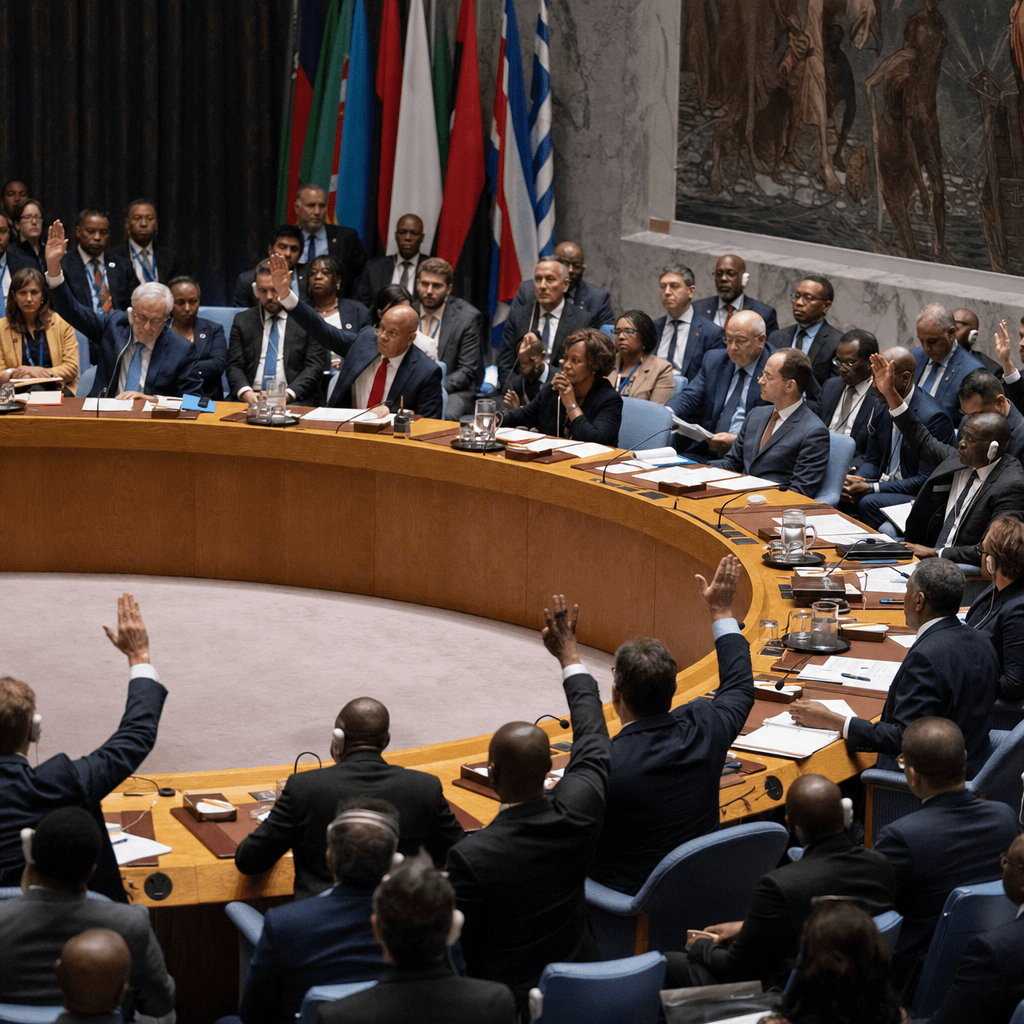
The United Nations Security Council on May 5, 2026 authorised a new multinational peacekeeping mission for the Sudano-Sahelian region by a vote of 10 in favour, four abstentions — Russia, China, Algeria, Mozambique — and two votes against from North Korea and Venezuela, according to Model Diplomat's contemporaneous record. The mandate is a diplomatic artefact more than an operational plan: the three states at the epicentre of the crisis — Mali, Burkina Faso, Niger — do not consent to the force, no troop-contributing country has pledged personnel, and the Council has not activated Resolution 2719 to fund it. The real winner of the vote is not the mission but Russia's Africa Corps, which now becomes the only external military actor with a functioning presence in the central Sahel while a Western-drafted resolution collides with a wall of sovereignty vetoes on the ground.
A vote that inverts the 2017 template
The 2017 precedent is the one to read against. Resolution 2359, welcoming the G5 Sahel Joint Force of Burkina Faso, Chad, Mali, Mauritania and Niger, was adopted unanimously nine years ago in June 2017, drafted by France and stripped of Chapter VII funding language to satisfy Washington, per Deutsche Welle's account of the negotiations. That resolution had host-state consent from all five sponsors and still failed operationally because the US refused UN-assessed contributions.
The May 2026 vote inverts every one of those variables. There is no host consent — Mali expelled MINUSMA in 2023 after Foreign Minister Abdoulaye Diop invoked a "crisis of confidence" between UN peacekeepers and the junta, as Al Jazeera reported at the time. The three central Sahel states withdrew from ECOWAS in January 2025 and stood up their own 6,000-strong Alliance of Sahel States Unified Force headquartered in Niamey in December 2025, as
the Institute for Security Studies documents. And the resolution passed with four abstentions rather than unanimous acclamation — the diplomatic equivalent of a mission taking off with the doors half open.
Secretary-General António Guterres flagged the underlying problem in a Council briefing months before the vote, telling members on November 18, 2025 that he recalled "with deep regret the lack of consensus as far back as 2017 on providing predictable and sustainable financing for the G5-Sahel initiative, namely through UN assessed contributions", per his official remarks. Nothing about the 2026 mandate resolves that fight; it re-runs it in worse conditions.
Who leveraged the vote — and against whom
The penholders here were Washington, Paris and London. The stated rationale is state collapse and jihadist expansion; the immediate trigger was the coordinated JNIM–Azawad Liberation Front offensive of April 25–26, 2026, which killed Malian Defence Minister Sadio Camara, drove Russian Africa Corps troops out of Kidal, and blockaded Bamako's western supply axis. Al Jazeera's reporting on the April attacks shows JNIM fighters storming the Kenieroba prison 60 kilometres from Bamako and controlling roads to Kayes and Kita. The
BBC has verified footage of Russian attack helicopters escorting fuel tankers through the blockade ahead of Eid al-Adha — a picture of Africa Corps not defeating the insurgency but managing its logistics.
The abstentions tell the second story. Algeria's vote is the analytically loudest: Algiers has been a diplomatic backchannel to the AES juntas, and abstaining alongside Russia and China signals it will not endorse a Western-led deployment on its southern border. Mozambique's abstention completes an emerging pattern in which the Council's African "A3+1" caucus refuses to legitimise Sahel intervention it did not shape — the same instinct that produced Russia and China's 2022 block of a French-drafted Council statement backing ECOWAS sanctions on Mali. North Korea and Venezuela's opposing votes are theatre. The abstentions are the leverage.

The mission has no battlefield partner
A UN peacekeeping mandate is worth what the host state and the regional force multiplier will make of it. Neither exists here.
The Alliance of Sahel States institutionalises rejection of exactly this kind of Western-authored deployment. The AES founding architecture explicitly frames ECOWAS and its Western partners as "threats to the sovereignty and national security of its member states", as an Al Jazeera analysis of the militarisation of the region puts it. The three AES capitals have signed a mutual-defence pact; a UN blue-helmet mission crossing into Mali, Burkina Faso or Niger without invitation would, in the terms the AES itself set, be treated as aggression.
ECOWAS, the notional West African partner, is not a viable operational alternative either. The Institute for Security Studies reports that a plan announced in August 2025 for a 260,000-strong ECOWAS counter-terrorism force — with a proposed annual budget of $2.5 billion — was quietly downsized in February 2026 to a 1,650-soldier brigade based in home countries. That is roughly a 99% reduction in ambition inside six months. Al Jazeera's
Shola Lawal reported in March that ECOWAS was targeting an initial mobilisation of just 2,000 troops by year-end. There is no army waiting to accept a UN mandate on the AES's behalf.
The financing gap is structural. Resolution 2719, adopted unanimously in December 2023 to fund up to 75% of AU-led peace operations from UN-assessed contributions, remains unimplemented two years on — the US blocked its activation for the AU Support and Stabilization Mission in Somalia in December 2024, according to a Stimson Center workshop report. By late 2025 unpaid UN peacekeeping dues had climbed to nearly $1.6 billion, prompting Guterres to propose a 15% cut to the 2026 peacekeeping budget, as the
ISS notes in its assessment of 2719's stalled implementation. A mission authorised in this fiscal environment, without 2719 triggered, will be paid for by voluntary Western contributions or not at all.
The Africa Corps dividend
The paradoxical beneficiary of a Council resolution ostensibly designed to check Russian influence is Russia. Moscow's Africa Corps replaced Wagner in the Sahel as a formal Ministry of Defence unit under Deputy Defence Minister Yunus-Bek Yevkurov and senior GRU officer Andrei Averyanov, an Elcano Royal Institute analysis published on July 1, 2026 concludes. About 2,000 Russian personnel are already deployed across the three AES states, per Al Jazeera's
regional-army briefing. The Council's vote does two things for Moscow at once: it validates the AES's narrative that the UN system is a Western instrument, and it leaves Africa Corps as the only external military actor with troops on the ground and a signed protocol with the host governments.
Elcano's authors are careful to note the model's fragility. The Kidal reversal of late April 2026 — when Tuareg FLA fighters allied with JNIM reportedly used FPV drones against Malian troops and Africa Corps, retaking a town Wagner had helped capture in 2023 — "exposed the fragility of the Malian junta's gains". Fragile is not the same as absent. It is the difference between a partner in retreat and a mandate that never crosses the border.
The historical parallel that reframes the vote
The story to keep in mind is not MINUSMA. It is Resolution 2359 (2017). That resolution, welcoming the G5 Sahel Joint Force, was the template for the current one — a French-led attempt to internationalise a security architecture the region had already improvised, with the US blocking predictable financing. The G5 collapsed. Its three central members formed the AES. Its former Sahel headquarters became a talking point at Council meetings about "restructuring the Accra Initiative", to borrow Guterres's phrase from November 2025.
The May 2026 mandate re-enacts the 2017 template with three critical differences that make it harder, not easier. First, the host states have withdrawn consent by treaty and by coup. Second, the regional counter-terrorism partner — ECOWAS — has fractured and downsized. Third, the strategic backdrop is not merely great-power competition but active Russian institutional presence: Africa Corps is not Wagner, and it now sits at ministerial level in Moscow's chain of command.
If Resolution 2359 was a mandate in search of financing, Resolution 2026 (as it will be numbered in due course) is a mandate in search of a country to enter.
What to watch
- Troop-contributor announcements before September 2026. The Model Diplomat readout of the vote flagged "late summer 2026" for initial deployment; if no non-Western state pledges by then, the mission becomes a NATO-adjacent operation in fact if not in name. That is politically toxic for the AU and for the abstaining African Council members.
- The 2719 activation question. The Secretary-General's second implementation report is due to the Council in December 2026, per Stimson. If Washington maintains its objection, the resolution's funding architecture reverts to voluntary contributions — the same mechanism that killed the G5 Joint Force.
- The December 2026 mission review. Model Diplomat reports the first formal Council review of mission progress is scheduled for December. If no troops are on the ground by then, Moscow and Beijing will move to fold the mandate. Watch whether the penholders concede a Chapter VI reframing to keep the mission alive on paper.
- AES–ECOWAS backchannel. The Conseil de l'Entente, dormant but structurally neutral, is the only regional platform in which AES states still hold formal standing alongside coastal neighbours,
the ISS argues. Any softening of AES posture will show up there before it shows up in Turtle Bay.
Diplomat View
The Sahel mandate is a resolution designed to signal Western resolve to a Council audience while accepting that it will not be executed on Sahelian territory. That is a defensible bet only if the goal is to preserve legal ground for a future mission — one activated after a change of government in Bamako, Ouagadougou or Niamey, or after a JNIM advance forces the AES to request outside help. Absent one of those triggers, the mandate expires in political relevance well before it expires in law. The forecast to revise: if a troop-contributing country from the Gulf or South Asia commits a battalion by September 2026 and Algeria drops its abstention posture, the mission has a corridor into the region via Mauritania or coastal states. Neither is likely on current evidence. What is likely is that Africa Corps ends 2026 with more territory under its indirect control than the UN has under mandate — and that the Council's next Sahel debate will be about whether Resolution 2719 can be salvaged before AUSSOM's funding gap swallows the continent's remaining peace operations.
The bottom line: the May 5, 2026 vote created a peacekeeping mission that cannot enter its area of operations, cannot fund itself under existing UN mechanisms, and cannot secure the consent of the three governments whose territory it is nominally intended to stabilise. It is a placeholder for a Western strategy that no longer exists on the ground — and, by default, a gift to the only foreign force that does.
Discover more

Global Politics
US Seizes Iranian Ship, Tensions Surge
The US seizure of the Iranian ship Touska highlights a shift in control over the Strait of Hormuz, favoring Iran's strategic position.

Conflict & Security
Drone Warfare Killing Aid Workers at Unprec
Over 1,000 humanitarian workers killed in three years as cheap armed drones collapse legal protections. Gaza, Sudan, Ukraine, and DRC see deliberate targeting of aid convoys and hospitals with zero prosecutions.

Global
World Normalises Taliban as Afghan Women Eras
UN data shows Afghan women erased from public life as Russia recognises the Taliban, EU hosts officials in Brussels, and ICC warrants for gender persecution go unenforced.
Conflict & Security
West Africa Food Crisis: Three Shocks in 2026
Conflict, climate extremes, and the Strait of Hormuz closure drive a severe food crisis in West and Central Africa, with fertilizer prices surging 80% and millions displaced.