UN Minerals Plea Challenges US and China
Guterres's voluntary framework challenges US and China mineral blocs
Model Diplomat10 min readAfrica
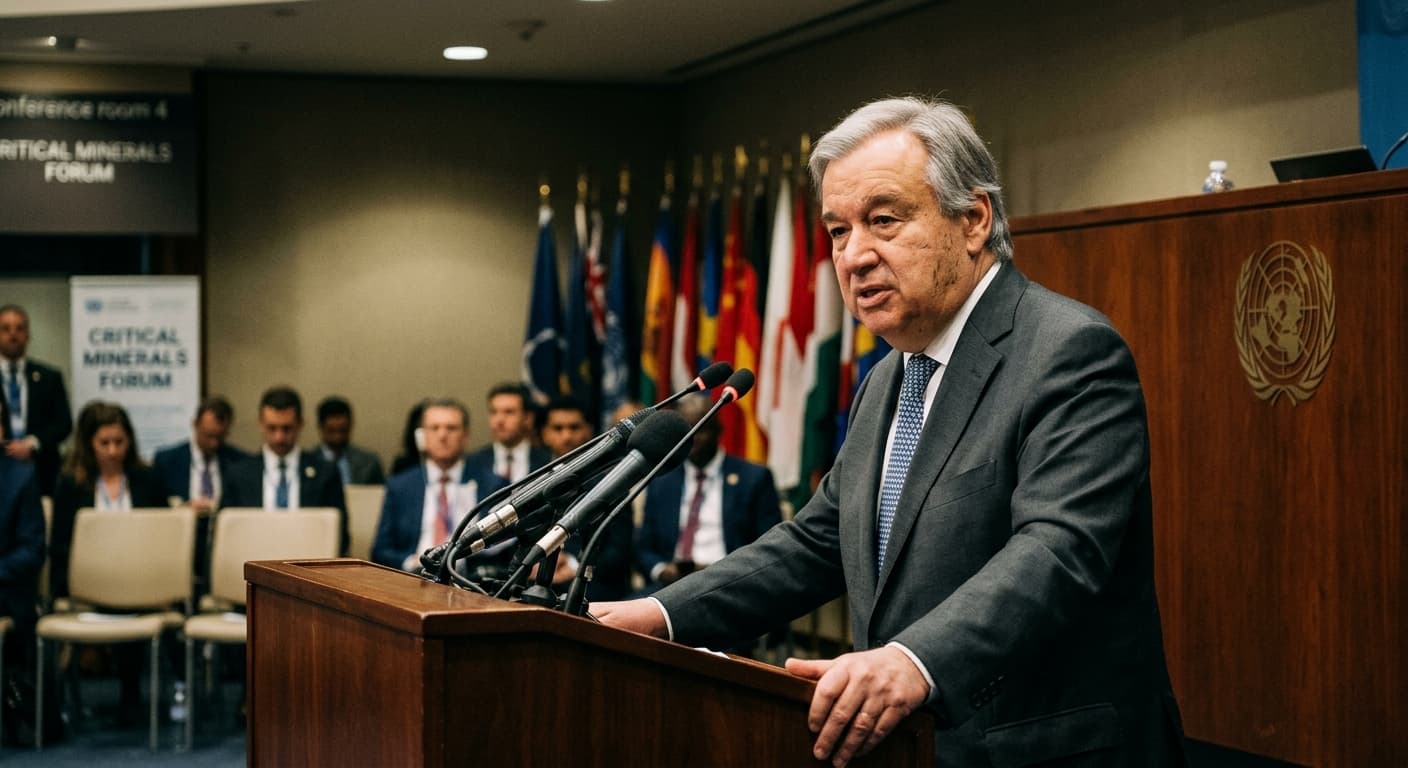
The UN's Minerals Plea Is a Veiled Challenge to Washington and Beijing
UN Secretary-General António Guterres used the first-ever High-Level Meeting on Critical Energy Transition Minerals on July 14, 2026, to push a voluntary rules framework that quietly rebukes both the Trump administration's FORGE trading bloc and China's refining monopoly — but the leverage lies with producer countries neither power can yet discipline.
On July 14, 2026, at UN Headquarters in New York, Secretary-General António Guterres told governments, industry and Indigenous representatives that the clean energy transition risks reproducing the extractive economies of the past unless countries adopt a "rules-based approach" to critical minerals. The headline was fairness. The subtext was power: Guterres's framework is a deliberate counterweight to the two blocs now carving up the trade — Washington's Forum on Resource Geostrategic Engagement (FORGE) and Beijing's refining stranglehold — and it rests on a bet that producer countries, above all in Africa, will demand more than raw-export deals allow. His sharpest line, aimed squarely at the bilateral deal-making accelerating on both sides, warned that "bilateral deals that trade access for security, or resources for infrastructure, can risk exploitation, increase competition, and undermine sovereignty" (The Tribune). That is not abstract counsel. It is a direct, if diplomatic, critique of the resources-for-security model the Trump administration has operationalized in the Democratic Republic of the Congo and that China has run for a decade across the continent.
The numbers behind the rhetoric
The economic stakes are what give Guterres's appeal its bite. The International Energy Agency estimates demand for critical energy transition minerals will triple by 2030 and quadruple by 2040 (UN Secretary-General's Panel report). Guterres went further on July 14, warning that with artificial intelligence and data-centre expansion "growing at breakneck speed, this real demand is expected to be much higher" (
The Tribune). The IMF's own modelling reinforces the magnitude: it projects the production value of just four transition metals — copper, nickel, cobalt and lithium — could rise roughly fourfold to about $11 trillion accumulated over 2021–2040, rivaling the total value of crude oil production over the same period (
IMF Working Paper 21/243). World Bank scenario analysis finds graphite, lithium and cobalt output must each ramp up by more than 450 percent by 2050 to meet demand from energy storage alone (
World Bank, "Minerals for Climate Action").
The distribution of that windfall is the crux. Africa holds about 30 percent of global critical mineral reserves — including over 50 percent of the world's cobalt, 96 percent of platinum-group metals and 77 percent of phosphate — but captures just 2 percent of global clean energy investment (The Tribune). The IMF independently confirms the 30-percent reserve share and estimates the region could reap nearly $2 trillion of cumulative revenues from just four minerals through 2050 — but only if it moves up the value chain rather than exporting raw ore (
IMF Regional Economic Outlook, April 2024). Brookings puts the revenue capture gap even more bluntly: Africa holds 30 percent of reserves but takes only 10 percent of global critical-minerals revenue (
Brookings).
That gap is not an accident of geology. It is the predictable outcome of a trade architecture in which raw ores leave the continent for refining in Asia — overwhelmingly in China, which controls about 60 percent of global mining output and roughly 91 percent of separation and refining capacity (Brookings). The Democratic Republic of the Congo alone supplies over 70 percent of the world's mined cobalt; South Africa is the largest platinum producer; Zimbabwe leads the continent on lithium. The value is captured elsewhere. The price differential is stark: in May 2025, a metric ton of raw bauxite traded at $32 to $79, while processed aluminum fetched over $2,400 (
Brookings). This is the structural inequality the UN framework is designed to name — and pressure.
Seven principles, two targets
The Panel's seven Guiding Principles, published in September 2024, are voluntary and non-binding. But they are not generic. Principle 5 — "Investments, finance and trade must be responsible and fair" — and Principle 7 — "Multilateral and international cooperation must underpin global action and promote peace and security" — are written to address two specific failures: China's state-capitalist refining monopoly and Washington's emerging preferential trading bloc (European Commission). The five Actionable Recommendations include a global traceability and transparency framework "along the entire mineral value chain — from mining to recycling" and a Global Mining Legacy Fund for derelict and abandoned mines. The traceability framework, the Panel noted, "should not be used as a unilateral trade barrier" — a line that reads as a warning to both the US Inflation Reduction Act's domestic-content rules and the EU's Critical Raw Materials Act, both of which have been criticized by developing countries as "green protectionism" (
World Bank).
The UN Department of Economic and Social Affairs reinforced this in a December 2024 policy brief, noting that trade restrictions on critical minerals — "affecting both raw and processed materials" — have surged, with developed economies accounting for most of the measures, many of which "negatively impact developing countries" by limiting their ability to move up the value chain (UN DESA Policy Brief 169). This fragmentation, DESA warned, risks "significant global economic and efficiency losses." Guterres's July 14 meeting was, in effect, the political rollout of that diagnosis.
The scramble: FORGE versus the refining monopoly
The backdrop is a genuine geopolitical race. On February 4, 2026, Vice President JD Vance announced FORGE at the State Department's inaugural Critical Minerals Ministerial, describing it as "a preferential trade zone for critical minerals protected from external disruptions through enforceable price floors" (Al Jazeera). Fifty-five foreign delegations attended. The initiative was paired with Project Vault — a domestic stockpile backed by a $10 billion loan from the Export-Import Bank, more than double the largest financing in its history — and 13 new bilateral critical minerals frameworks (
CSIS). A January 15, 2026 executive order directed the Secretary of Commerce to negotiate bilateral agreements with foreign partners for processed minerals, explicitly contemplating tariffs or import restrictions if talks fail (
CSIS).
China's position is no less entrenched. It maintains roughly 70 percent of global rare-earth mining and 87 percent of refined rare-earth production, and invests between 37 and 46 percent of its $21.7 billion in African investments specifically in critical minerals (Brookings). By contrast, the United States directed only 4 percent — $300 million — of its Africa investment to critical minerals, though the Trump administration has moved aggressively to close that gap through bilateral deals with Ukraine, Saudi Arabia, Thailand, Malaysia, Japan and the DRC (
CSIS;
Brookings). The result is a market split between two blocs — each offering producer countries a version of the same bargain: raw access in exchange for infrastructure, security guarantees or financing.
The DRC test case: resources for security
Nowhere is the bilateral model more visible — or more contested — than the Democratic Republic of the Congo. In June 2025, the Trump administration brokered a peace deal between the DRC and Rwanda. Alongside it, Washington signed a strategic partnership giving US-aligned firms the right of first bid on certain critical minerals projects. The day after the deal was signed, the Congolese mining parastatal Gécamines and the Swiss-based trader Mercuria announced a joint venture — backed by the US International Development Finance Corporation — to market cobalt, copper and other minerals to the United States (Foreign Affairs). Trump was blunt: "We're getting, for the United States, a lot of the mineral rights from the Congo as part of it" (
BBC).
Congolese civil society and legal scholars see it differently. Professor Hanri Mostert of the University of Cape Town warned that the DRC "risked compromising sovereignty over its minerals" and could find itself "locked into deals for years, in exchange for vague guarantees of security" (BBC). Congolese commentator Koko Buroko Gloire called the arrangement a continuation of "structurally unbalanced partnerships in which the DRC remains a mere supplier of strategic raw materials for the benefit of Western powers" (
Al Jazeera). Environmental activist John Katikomo said the deal was "opaque" and that authorities in Kinshasa had not disclosed details to citizens (
Al Jazeera). The State Department estimates the DRC's mineral reserves at $25 trillion (
BBC).
This is the arrangement Guterres's July 14 remarks targeted most precisely. His warning that bilateral deals "trade access for security, or resources for infrastructure" and thereby "undermine sovereignty" is a near-exact description of the DRC model — and of China's infrastructure-for-resources playbook across the continent. The UN framework gives producer-country governments and civil-society organizations a normative benchmark to demand transparency, value addition and technology transfer that neither the FORGE architecture nor China's bilateral lending provides.
The new resource curse
The historical parallel is not lost on the analysts who study this. Foreign Affairs argued in a recent essay that critical minerals could produce "entirely new forms of volatility" beyond the familiar oil-curse pattern, because "collapses in demand for specific minerals will not restabilize" if the technologies that drove demand move on — what economist Frank Knight called "uncertainty proper" (Foreign Affairs). The article's prescription mirrors the UN's: producer countries should "negotiate a new generation of partnerships" that include "long-term demand guarantees, price floors, and financing for domestic projects" rather than accepting raw-export dependence (
Foreign Affairs).
The difference is that the UN is now the vehicle for that prescription. The Task Force on Critical Energy Transition Minerals, launched on December 10, 2025, is co-chaired by UNEP, UNCTAD and UNDP and has convened close to 350 experts from more than 25 countries across five technical clusters covering value addition, traceability, mining legacies, artisanal mining and circularity (UNCTAD). Two knowledge products — a global assessment of trade policies affecting critical mineral value chains and a study on circularity approaches — are due by the end of 2026 (
UNCTAD). A Country Support Mechanism is moving from design into first-cohort delivery, offering producer governments technical assistance on contract negotiation, regulatory frameworks and downstream investment — the precise capacity deficit that has allowed asymmetric deals to persist (
UN DSG remarks).
The multilateral development banks have aligned. On April 17, 2026, a joint statement committed the MDBs — including the World Bank — to "build diversified, resilient, and responsible critical minerals to manufacturing value chains" through co-financing, shared diagnostics and infrastructure corridors that "link mining activities with processing hubs" and "contribute to broader economic transformation in client countries" (World Bank). The African Development Bank has identified local processing of rare-earth concentrates as a feasible entry point for African investors, with the IEA estimating that Africa's mineral market value could increase by almost three-quarters from its current $120 billion if the continent captures more downstream activity (
Brookings). The African Union's Green Minerals Strategy, finalized in December 2024, provides a continental framework for translating that ambition into policy (
Brookings).
Who holds the leverage
The irony of Guterres's position is that the UN's framework is voluntary and non-binding — it carries no sanctions, no enforcement, no dispute mechanism. Its power is normative. It gives producer-country governments a reference point — a set of principles they can cite when negotiating with Beijing or Washington — and it gives civil-society organizations a standard against which to measure opaque deals. The DRC case shows the gap between principle and practice: Tshisekedi promised the minerals would be sold "in a sovereign manner" ensuring "a more equitable distribution of economic benefits," yet the deal's terms remain undisclosed and fighting continues in mineral-rich eastern provinces (Al Jazeera).
The leverage, ultimately, sits with the geology. The DRC holds an estimated 50 percent of the world's proven cobalt reserves and produces over 70 percent of global output (IMF). South Africa, Gabon and Ghana collectively account for over 60 percent of global manganese production. Zimbabwe and Mali hold substantial lithium deposits. These countries are not without options — China, the United States and the EU are all competing for access, and the African Continental Free Trade Area offers a framework for regional value chains where one country extracts, another processes and a third manufactures (
Brookings). The question is whether producer governments will use that leverage to demand value addition and technology transfer — or accept the old bargain in new packaging.
Diplomat View
The UN's voluntary framework will not bind Washington or Beijing. Its real function is to shift the normative terrain: to give producer governments — and the civil societies that hold them accountable — a benchmark against which to judge bilateral deals. The DRC is the test case. If the Tshisekedi government's opaque minerals-for-security arrangement with the Trump administration proceeds without meaningful local value addition or transparent contract disclosure, the UN's seven principles will have been exposed as aspirational rhetoric. If, conversely, producer countries use the framework to demand processing investment and technology transfer — backed by the MDB financing now coming online — the balance of power in the critical minerals trade will begin to shift, marginally but measurably, away from the consuming powers. The forecast turns on two variables: whether the Country Support Mechanism delivers real contract-negotiation capacity before the next wave of bilateral deals closes, and whether African regional integration under the AfCFTA produces a collective bargaining bloc rather than a race to the bottom among individual producers.
What to watch
- End of 2026: UN Task Force releases its global assessment of trade policies affecting critical mineral value chains — the first systematic, multilateral diagnostic of the protectionist measures now fragmenting the market.
- End of 2026: UN Task Force releases its study on circularity approaches in critical mineral value chains — a potential reference point for downstream investment policy.
- 2027–2028: First-cohort delivery of the Country Support Mechanism — the test of whether the UN can provide real contract-negotiation capacity to producer governments before the next bilateral deals close.
- DRC election cycle, 2028: Tshisekedi's mandate ends; whether the minerals-for-security deal survives a political transition will determine its durability as a model — or a cautionary tale.
Discover more
US Politics
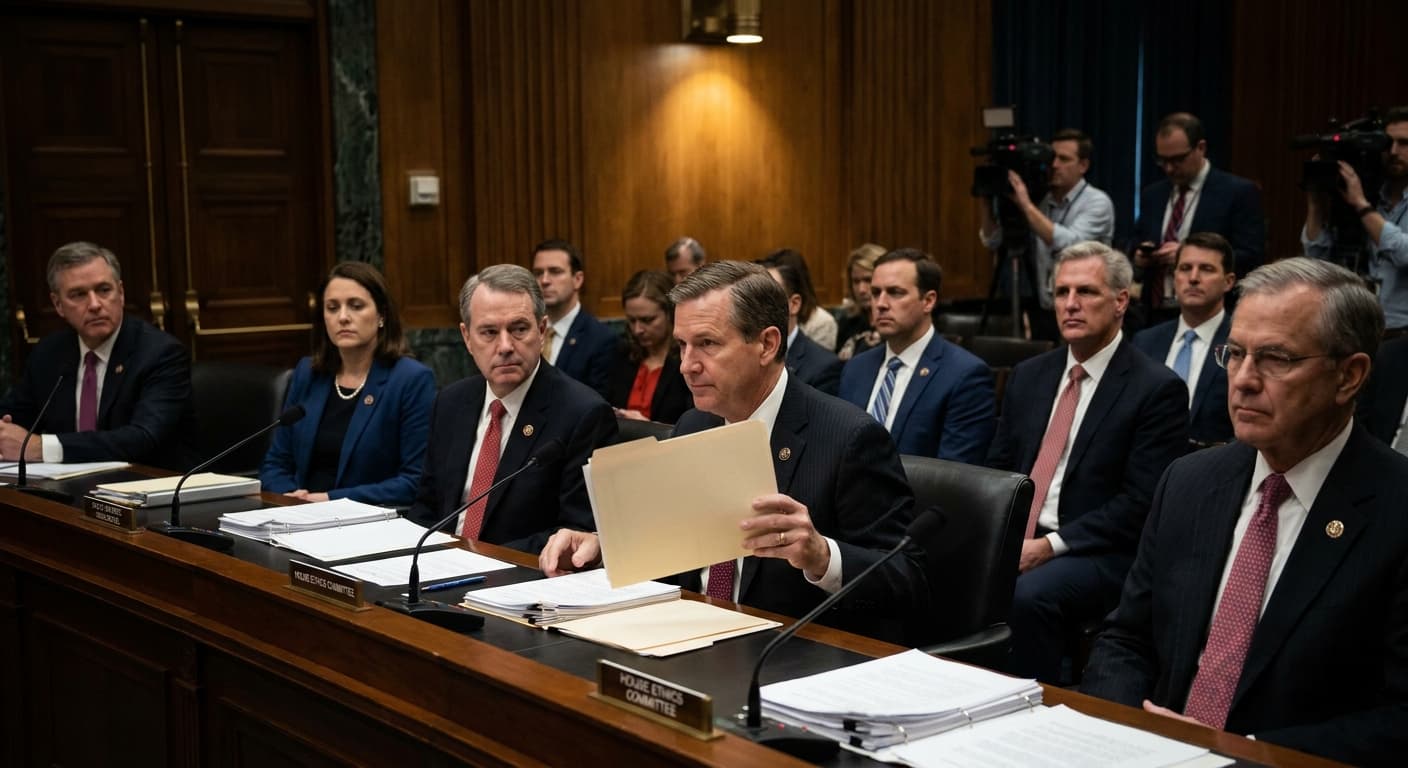
House Ethics Committee Pushes Sexual Miscond.
The House Ethics Committee has shifted responsibility for sexual harassment settlement records to the Office of Congressional Workplace Rights, complicating disclosure efforts.
India
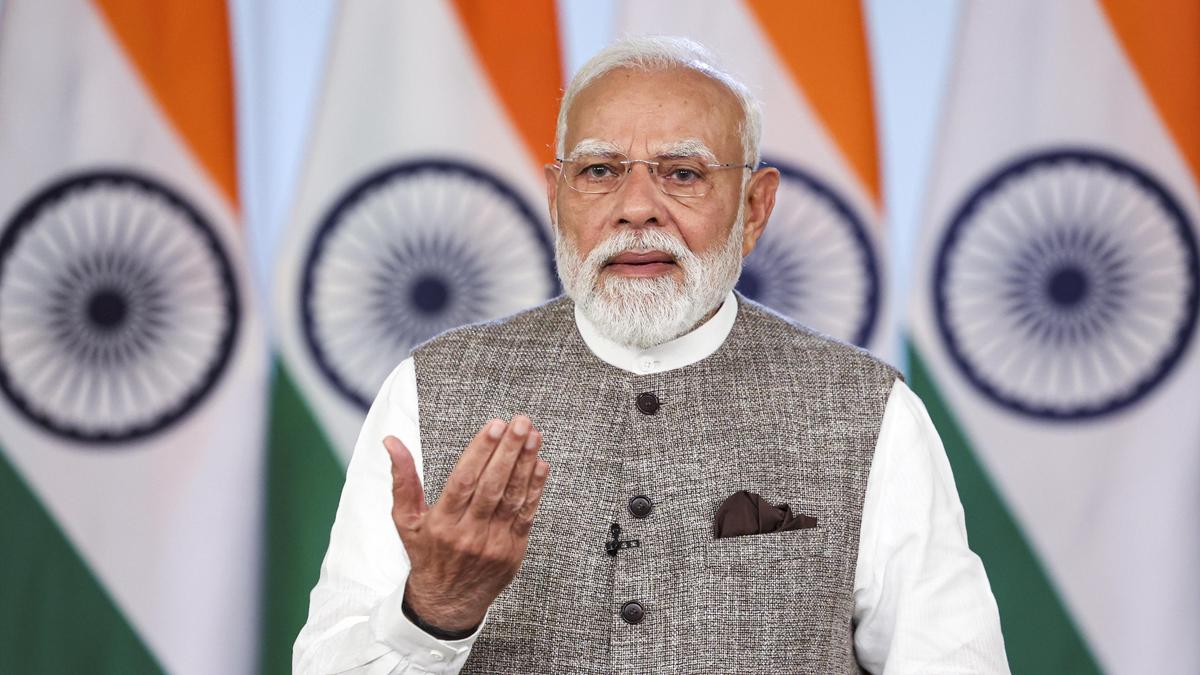
700 Activists Accuse PM Modi of MCC Breach
Over 700 activists allege PM Modi breached election code with a televised address attacking opposition parties just before state elections.

US Politics
SNAP Food Assistance Faces Legal Challenges
In 2026, SNAP faces stricter eligibility rules and mounting legal challenges, threatening food assistance for the millions of Americans who rely on the program.

Economics
Fed's Amex AML order puts correspondent banking on notice
Federal Reserve's Amex AML order requires board-level controls and a 90-day plan; OCC fined the bank $350 million over enterprise-wide deficiencies.