St Helena Hantavirus Outbreak Sparks Global T
Cruise-ship outbreak turns St Helena into a global tracing hub.
Model Diplomat3 min readGlobal
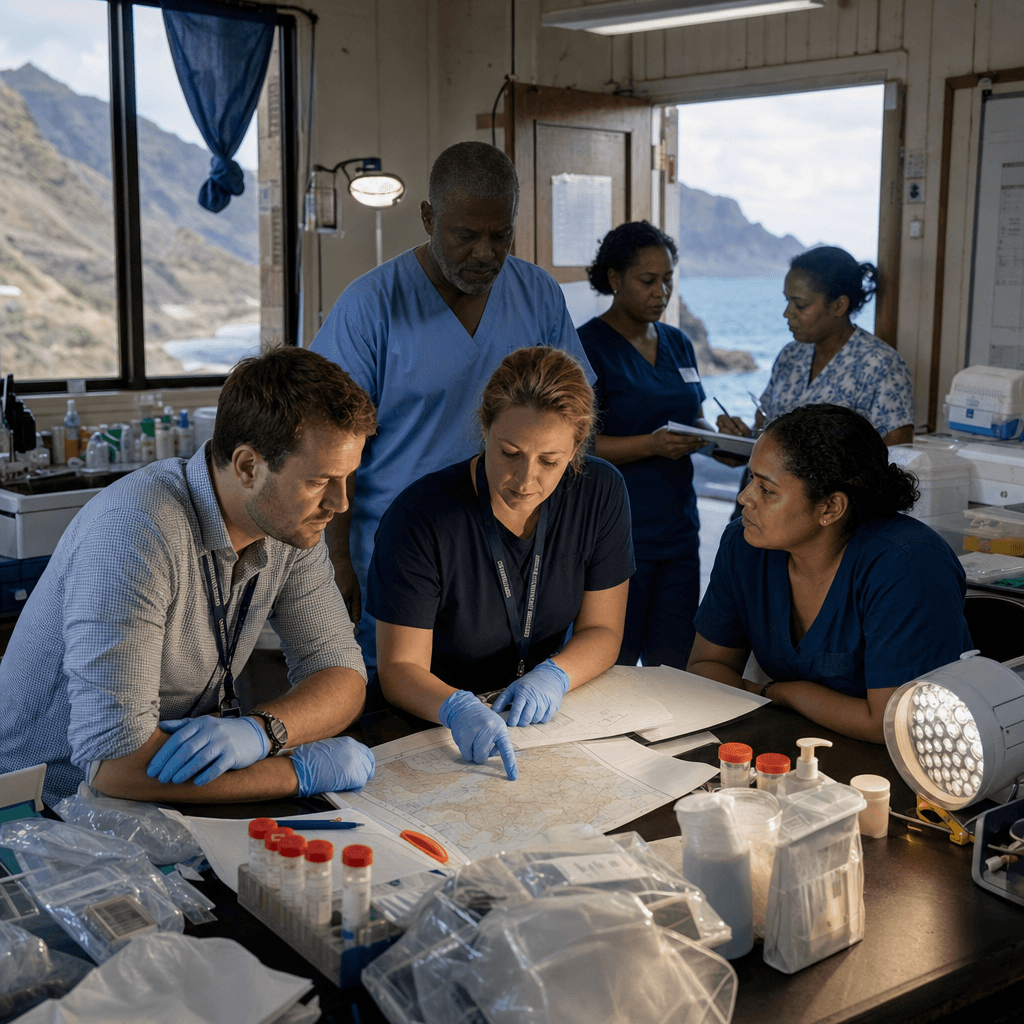
UK’s St Helena Hantavirus Case Shows Island Leverage
The cruise-ship outbreak has turned a British overseas territory into a global tracing hub, with London, WHO and Spain racing to stop secondary spread.
The leverage now sits with public-health agencies, not the cruise operator. The UK Health Security Agency is tracking British nationals who disembarked on St Helena before hantavirus was confirmed, after a cluster on the Dutch-flagged MV Hondius forced authorities to trace passengers across several countries (Health officials track dozens who left hantavirus-stricken ship after 1st fatality;
BBC News). The World Health Organization says five cases have been confirmed and three more are suspected, but it also says the public risk remains low (
Al Jazeera;
BBC News).
St Helena became the bottleneck
This is the key political point: a remote island stop has become the operational weak link. AP reports that around 30 passengers left the ship at St Helena on 24 April, before the first confirmed case was reported on 4 May; BBC says two Britons are now self-isolating in the UK, while other disembarked passengers are still being tracked (NPR/AP;
BBC News). That matters because once passengers dispersed, the problem stopped being maritime and became diplomatic, consular and epidemiological at the same time — exactly the kind of cross-border coordination that sits at the intersection of
Global Politics and
International.
The island’s role is not accidental. St Helena is isolated enough that one disembarkation decision can either contain a case or export it. AP says authorities there are already advising higher-risk contacts to isolate for 45 days, a sign they are treating exposure windows, not just symptoms, as the main threat vector (NPR/AP). That is a costly posture for a small territory, but it is also the only rational one when an outbreak is detected after people have already flown on.
Why this outbreak is harder than a normal rodent case
The strain matters. WHO and Al Jazeera say the cases involve the Andes virus, the only hantavirus known for limited human-to-human transmission, which raises the stakes beyond a simple rodent-exposure story (Al Jazeera;
BBC News). That gives health officials a narrow but urgent task: stop any chain that may have moved from the ship to flights, hospitals or household contacts.
The winners, so far, are the agencies that can force quarantine and tracing. The losers are the cruise line, Oceanwide Expeditions, which has lost control over passenger movement, and the ship’s remaining passengers, who are now subject to medical screening before any onward travel (BBC News;
NPR/AP). Spain also has leverage: the Canary Islands are the next controlled disembarkation point, and Madrid can decide whether the ship is a quarantine problem, a repatriation problem or both (
BBC News;
BBC News).
What to watch next
The next decision point is the ship’s arrival in the Canary Islands, expected around the weekend, and whether additional cases emerge among people who left St Helena before the outbreak was understood (BBC News;
NPR/AP). If new positives appear inside the incubation window, this stops being a cruise-ship incident and becomes a multi-country containment test for Britain, South Africa, the Netherlands and Spain.
Discover more

US Politics
House Ethics Committee Pushes Sexual Miscond.
The House Ethics Committee has shifted responsibility for sexual harassment settlement records to the Office of Congressional Workplace Rights, complicating disclosure efforts.

Conflict & Security
Drone Warfare Killing Aid Workers at Unprec
Over 1,000 humanitarian workers killed in three years as cheap armed drones collapse legal protections. Gaza, Sudan, Ukraine, and DRC see deliberate targeting of aid convoys and hospitals with zero prosecutions.
Global
World Normalises Taliban as Afghan Women Eras
UN data shows Afghan women erased from public life as Russia recognises the Taliban, EU hosts officials in Brussels, and ICC warrants for gender persecution go unenforced.
Conflict & Security
West Africa Food Crisis: Three Shocks in 2026
Conflict, climate extremes, and the Strait of Hormuz closure drive a severe food crisis in West and Central Africa, with fertilizer prices surging 80% and millions displaced.