Ukrainian Missiles Hit Belgorod Airport
Missile strikes disrupt power in Belgorod region
Model Diplomat9 min readEurope
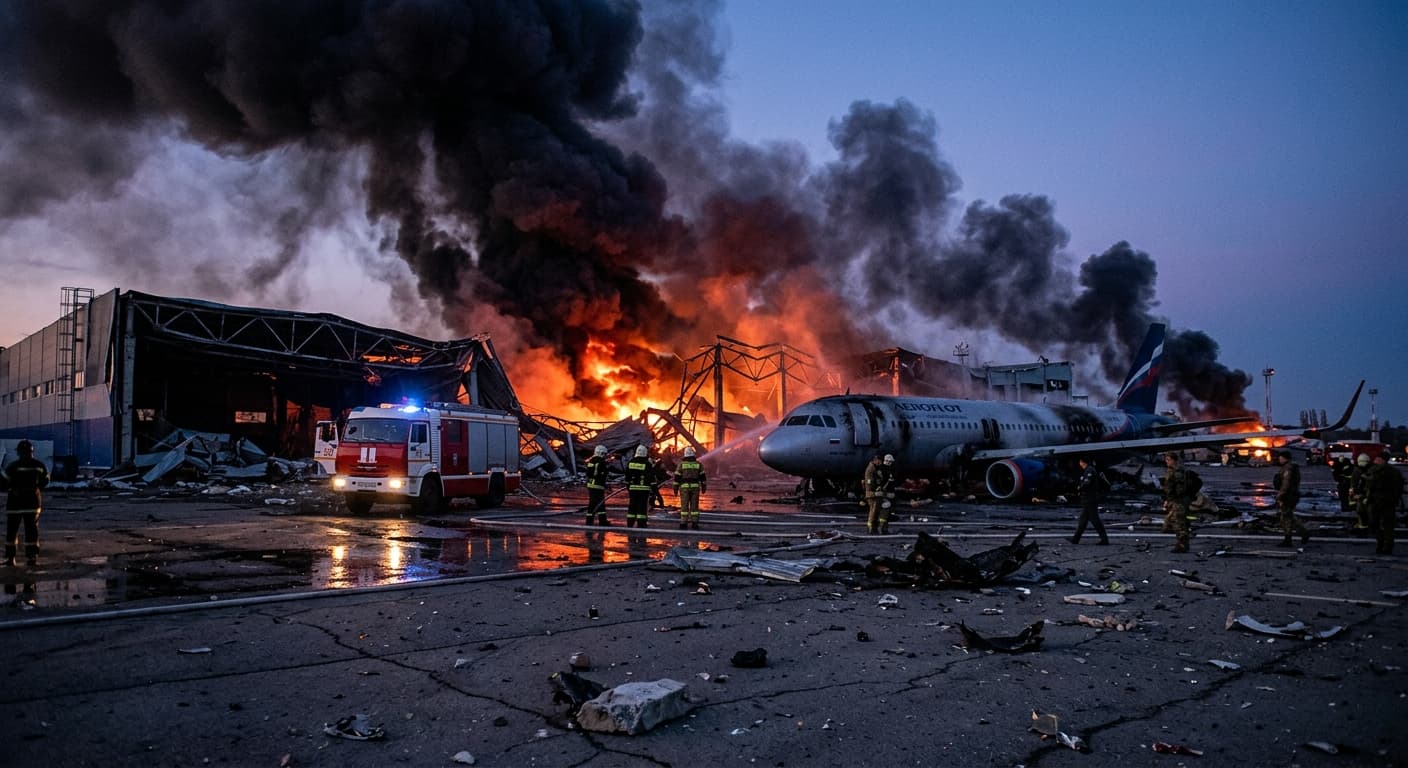
Ukrainian missiles strike Belgorod airport as blackout hits border region
Ukrainian missiles hit Belgorod airport and a gas pipeline hub overnight on July 7, 2026, cutting power across the border region as Kyiv's deep-strike campaign against Russian logistics accelerates.
Ukrainian missiles struck Belgorod Airport, a natural-gas pipeline operations facility and multiple energy substations in Russia's Belgorod Oblast in the early hours of July 7, 2026, killing one person, injuring three and knocking out electricity across parts of the border region, regional governor Alexander Shuvaev confirmed in a Telegram statement cited by the Kyiv Independent. The strike is the near-border edge of a broader Ukrainian campaign that, according to Ukraine's General Staff, has now disabled roughly 42% of Russia's oil-refining capacity and forced fuel rationing in more than 40 Russian regions — a war-economy squeeze that came within 24 hours of Kyiv's longest-range strike of the war, on the Omsk refinery 2,500 km east of the front. What Belgorod's blackout signals is not tactical retaliation but a Ukrainian bet that pressure on Russian logistics and household energy can shift the political ledger inside Russia before Ukraine's own grid buckles this winter.
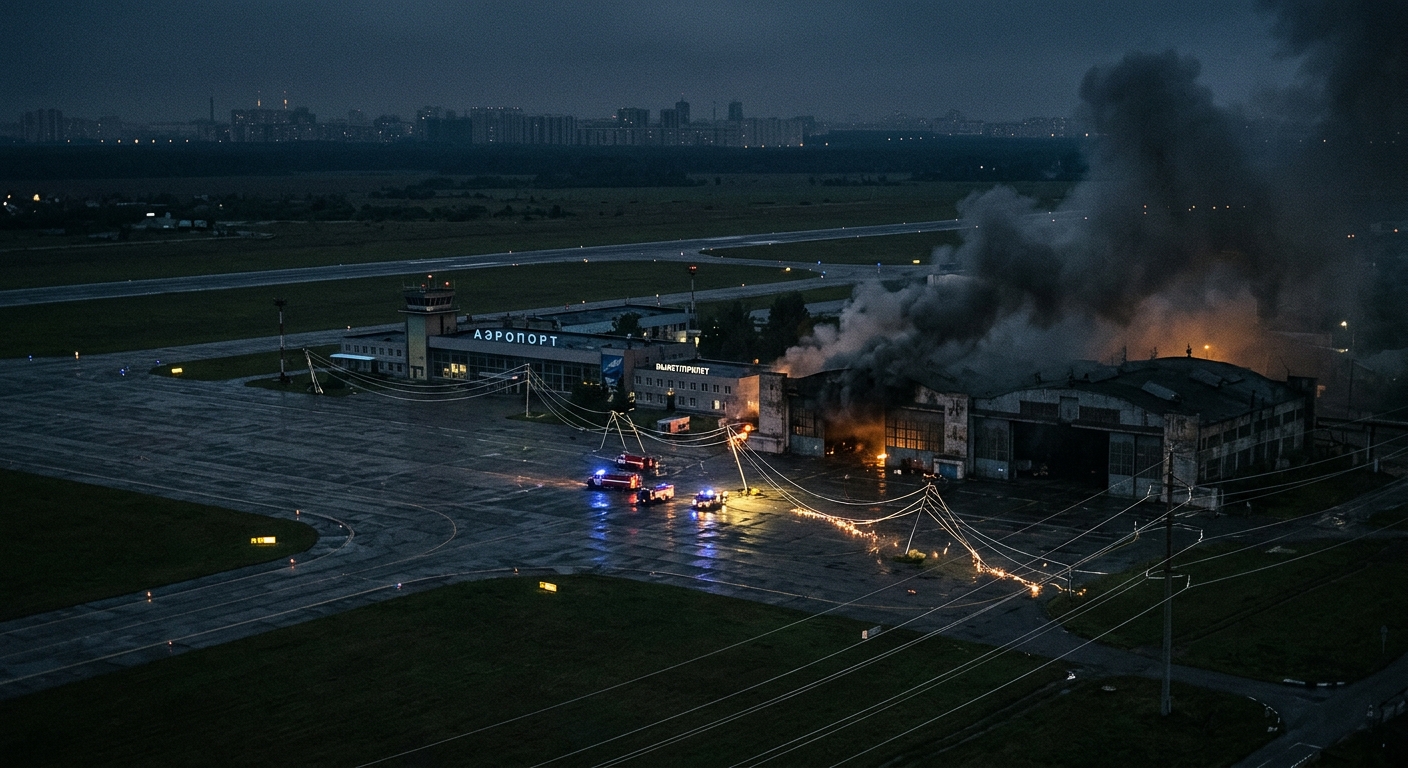
What happened overnight
According to Shuvaev's Telegram post relayed by the Kyiv Independent, "Belgorod and the Belgorod district were subjected to a massive missile attack by Ukraine's Armed Forces last night." A fire broke out at Belgorod Airport, which lies roughly 40 km north of the Ukrainian border and has served, per prior
Al Jazeera reporting, as a staging site for Russian forces since the February 2022 invasion. The Belgorod Linear Production Management of Main Gas Pipelines was also set ablaze, independent Russian outlet Astra reported. Shuvaev said one civilian was killed and three injured in the village of Belovskoe, with a building in Pushkarnoe on fire. "Once again, energy infrastructure has been damaged, so there are power and water supply disruptions in some areas of Belgorod and several municipalities," he wrote.
The choice of targets is not incidental. Belgorod city sits atop what the BBC calls "a key logistics corridor and staging hub for Russian forces near the border with Ukraine" and "a regular point of origin for artillery and short-range drone strikes." The airport, the pipeline management office, the heat-and-power plant and substations hit across autumn 2025 form the connective tissue of Russia's northern grouping opposite Kharkiv and Sumy. When Kyiv strikes them, Russian troops within artillery range of Ukrainian territory lose fuel, heat and communications — and Russian civilians within the same border zone experience the war the way Ukrainians in Kharkiv have for four years.
The Belgorod attack came less than 12 hours after Ukraine's Special Operations Forces claimed to have struck the Omsk oil refinery in Siberia — a Gazprom Neft facility with more than 21 million tonnes of annual capacity — in what the Kyiv Independent noted was the last of Russia's 11 largest gasoline producers still untouched since the campaign began. President Volodymyr Zelensky's July 6 evening address on the
official presidency website framed the tempo in general terms:
"The daily combat results of the Ukrainian army, our special forces, and our deep strikes — these are all proof that Ukraine can defend its interests… It is not Ukraine that must be pressured for peace, but Russia — the sole reason this war drags on."
The campaign, quantified
Ukraine's targeting has shifted decisively. Belgorod has become the closest, most-hit theatre of a nationwide effort against Russian energy. According to a BBC News Russian analysis of local-authority data, the number of Ukrainian drones recorded over Belgorod Oblast rose from roughly 1,100 in January 2025 to more than 4,000 in September — a nearly fourfold increase — with missile use also climbing through the summer. One recent strike involved more than 260 drones in a single night, according to the same source. Poland's Centre for Eastern Studies (OSW)
documented 158 Ukrainian strikes on Russian refineries since February 2022, with 88 in 2025 alone and 33 in the first five months of 2026 — hitting 24 of the 33 Russian refineries with annual capacity above one million tonnes. Ryazan and Saratov, OSW notes, have each been struck 15 times; the only large refineries in European Russia not yet hit are Omsk and Angarsk beyond the Urals, and Omsk fell overnight.
The Carnegie Russia Eurasia Center's Sergey Vakulenko assessed on June 22, 2026 that Russia's daily refined-oil output fell by up to 700,000 barrels — around 13% — in April and May, with the loss potentially reaching 28% below previous years if damaged facilities cannot be repaired. Ukraine's General Staff, cited by
Al Jazeera, put cumulative Russian oil-sector losses at $13.5 billion since August 2025, with eight refineries hit over the past month and more than 60 storage tanks destroyed or damaged. Independent energy analysts quoted in the same report estimate the functional disruption closer to one-third of capacity. OSW's earlier
analysis put the range between 15% and 30% — the discrepancy reflects how one counts partial outages against ongoing repairs.
The second-order effects: fuel, forex and Moscow's political economy
Refinery damage is only the first-order effect. The second-order consequences are already visible in Russian macroeconomics. Because damaged refineries push crude that would have been processed domestically out to export markets, OSW reported that Russia's western-port crude exports jumped roughly 25% — 500,000 barrels per day — in September 2025 versus August, hitting their highest level since May 2024. That sounds like an export windfall; it is the opposite. Higher crude flow depresses the global price, which is the basis for Russia's mineral-extraction tax, and Moscow simultaneously has to import refined fuel to plug the domestic gap. The Kremlin is paying twice: lower tax receipts on crude, higher subsidies to hide the price of imported petrol from consumers.
The distributional consequences are political. Russian independent outlet The Bell, cited by Al Jazeera, reported rationing in 53 Russian regions and occupied Ukraine by mid-June, with Tatneft petrol stations in Moscow and St Petersburg capping customers at 20 litres of petrol and 40 litres of diesel per fill. Rosneft and Bashneft banned sales in canisters. In annexed Crimea, per the
BBC, drivers now queue up to 10 hours and are limited to 20 litres via prepaid vouchers; the Moscow-installed regional head Sergei Aksyonov admitted on June 5 that "it does not appear possible to fully satisfy the demand for fuel at the current moment." That is the fuel crisis reaching Russian voters and Russian tourists — a category the Kremlin has spent four years shielding from consequences of its own war.
Putin's admission and Kyiv's political bet
The non-obvious feature of the Belgorod-Omsk one-two is that Kyiv is now openly targeting Russian domestic politics. On June 29, 2026, President Vladimir Putin gave what the BBC called his first explicit public acknowledgement of the shortages. "You're well aware that problems persist for both motorists and businesses," Putin told a Kremlin meeting. "Unfortunately, there are still queues at petrol stations, and finding the right grade of petrol isn't always easy." In a state-television interview the same weekend he added that Ukraine's attacks were "obviously creating problems": "We are currently seeing a certain shortage, but it's not critical."
That admission is the metric Ukrainian planners were pursuing. Carnegie's Andrei Kolesnikov noted that on June 18 Zelensky told Ukrainians the images of the Moscow Refinery burning would force Russians to "sober up" and realise that "if Ukraine is going to burn, your Moscow will burn too." Previously, Kolesnikov argued, Kyiv's aims in striking Russia were economic, external and morale-related; now the objective is Russian domestic politics.
Two independent think-tank verdicts converge on caution. Kolesnikov himself warned that Russians historically rally around the state under attack: the Iran precedent under Israeli and U.S. bombing showed the same pattern, and Ukraine's own population did not fold through the 2022–24 winters despite systematic Russian energy attacks. The Center for Strategic and International Studies (CSIS) reached a similar operational verdict in an earlier assessment: refinery attacks alone will not "move the needle on Putin's grip on power," but combined with U.S. sanctions and tariffs on Russia's oil customers they contribute to "a cumulative ratcheting of pressure." That is the coalition math behind Ukraine's July 6 disclosure, via the
Kyiv Independent, that Zelensky and U.S. President Donald Trump will discuss strategy to push Russia to talks.
The offset: Ukraine's diminishing shield
Ukraine's leverage is not free, and the arithmetic of asymmetric attrition is turning against Kyiv in one crucial category — air defence. On the eve of the NATO summit, a Russian missile-and-drone barrage on Kyiv killed at least 26 people on July 6, per Al Jazeera — the second mass strike on the capital in four days, following a July 2 attack that killed 31. The
Kyiv Independent reported that Ukrainian officials now say Kyiv is "currently defenceless" against Russia's ballistic missiles, with interceptor stocks depleted. Sweden's Gripen discussions and a domestic anti-ballistic project — flagged by the
Cabinet of Ministers of Ukraine on July 1 — are years, not months, from operational scale.
That is the strategic asymmetry to hold in mind. Ukraine trades refineries for interceptors; Russia trades fuel queues for ballistic salvos. According to OSW, Ukraine is deploying an average of 400 strike drones per day against Russian rear areas versus 150 for Russia — but Russian mass attacks average 600, and OSW's analysts conclude that "the results of the attacks on both sides confirm that Russia remains significantly more effective." Ukraine's Firepoint, manufacturer of the FP-1 drones used in the Moscow strike, produces about 100 units per day at roughly a 10% hit rate, per Vakulenko's
Carnegie assessment. Sustaining the campaign depends on scaling that production before Russian air defences and repair crews catch up.
Named winners and losers
Concrete beneficiaries and casualties are already sortable. Gazprom Neft and Rosneft are the corporate losers: their Kapotnya, Ryazan, Novokuibyshevsk, TANECO and now Omsk facilities carry the direct financial hit. Lukoil's Nizhny Novgorod refinery near Kstovo and Lukoil-Permnefteorgsintez are named victims in Ukrainian SBU claims; Transneft is losing pipeline throughput.
The regional-elite loser is Belgorod Governor Alexander Shuvaev, who inherits blackouts, water outages and civilian casualties that his predecessor Vyacheslav Gladkov managed under lighter volume. Federal losers include Russia's finance ministry, which now confronts a widened wedge between global crude prices and domestic petrol prices it must subsidise, and the Russian consumer, particularly the roughly 14% of the country's 53 million passenger cars registered in the Moscow region — the Carnegie analysis notes that all three refineries supplying Moscow by pipeline (Yaroslavl, Ryazan, Kstovo) have now been damaged.
The winners are narrower. Ukrainian domestic drone makers — Firepoint, Fire Point and the SBU's in-house programmes — are the industrial beneficiaries, along with the argument in Washington and European capitals that Ukraine can inflict strategic pain independent of Western long-range weapons. Belarus, per Carnegie, is quietly a beneficiary of leverage: the same analysis notes the damage inflicted on Russia has made Minsk "surprisingly amenable to Kyiv's demands." The Kremlin's Duma-election campaign is the political loser: rising anger and mounting desire to end the conflict are recorded by both state and independent pollsters, though not yet at protest scale.
What to watch
- Trump–Zelensky call on strategy toward Russia. The
Kyiv Independent reported on July 6 that President Trump and President Zelensky are set to discuss pressuring Moscow into peace talks; any announcement on additional long-range weapons or sanctions on Russian oil customers would materially shape Ukraine's ability to sustain the campaign.
- Omsk damage assessment. Ukraine's General Staff has named the ELOU-AVT-11 primary refining unit — designed capacity 8.4 million tonnes of crude per year — as the target of the July 6 Omsk strike; independent satellite verification and Gazprom Neft's operating updates over the next two weeks will indicate whether Russia's easternmost large refinery follows Ryazan and TANECO offline.
- Duma-election timing. Carnegie flags the September State Duma vote as the political horizon Kyiv is calibrating against; watch for extensions of Russia's petrol export ban (currently covering more than 40 regions) and any move toward formal rationing coupons.
The Bottom Line
The bottom line: the Belgorod airport strike and the Omsk refinery hit within 24 hours are not two events but one — the near and far ends of a Ukrainian campaign that has now compelled the Kremlin to publicly acknowledge a fuel crisis for the first time in the war. What Kyiv is buying with each drone and cruise missile is not battlefield ground but Russian domestic friction, priced against Ukraine's own diminishing air-defence stocks. The winter of 2026–27 will test which side runs out of ammunition first — Ukrainian interceptors, or Russian patience at the pump.
Discover more

US Politics
SNAP Food Assistance Faces Legal Challenges
In 2026, SNAP faces stricter eligibility rules and mounting legal challenges, threatening food assistance for the millions of Americans who rely on the program.

India
BJP's Misunderstanding of Women's Quota Needs
The BJP's linking of the Women Reservation Bill to delimitation risks delaying women's empowerment in India, misreading the aspirations of female voters.

US Politics
House Ethics Committee Pushes Sexual Miscond.
The House Ethics Committee has shifted responsibility for sexual harassment settlement records to the Office of Congressional Workplace Rights, complicating disclosure efforts.

Conflict & Security
Drone Warfare Killing Aid Workers at Unprec
Over 1,000 humanitarian workers killed in three years as cheap armed drones collapse legal protections. Gaza, Sudan, Ukraine, and DRC see deliberate targeting of aid convoys and hospitals with zero prosecutions.