Ukraine's UN Security Council Strategy
Kyiv's push for Global South support falters
Model Diplomat9 min readGlobal
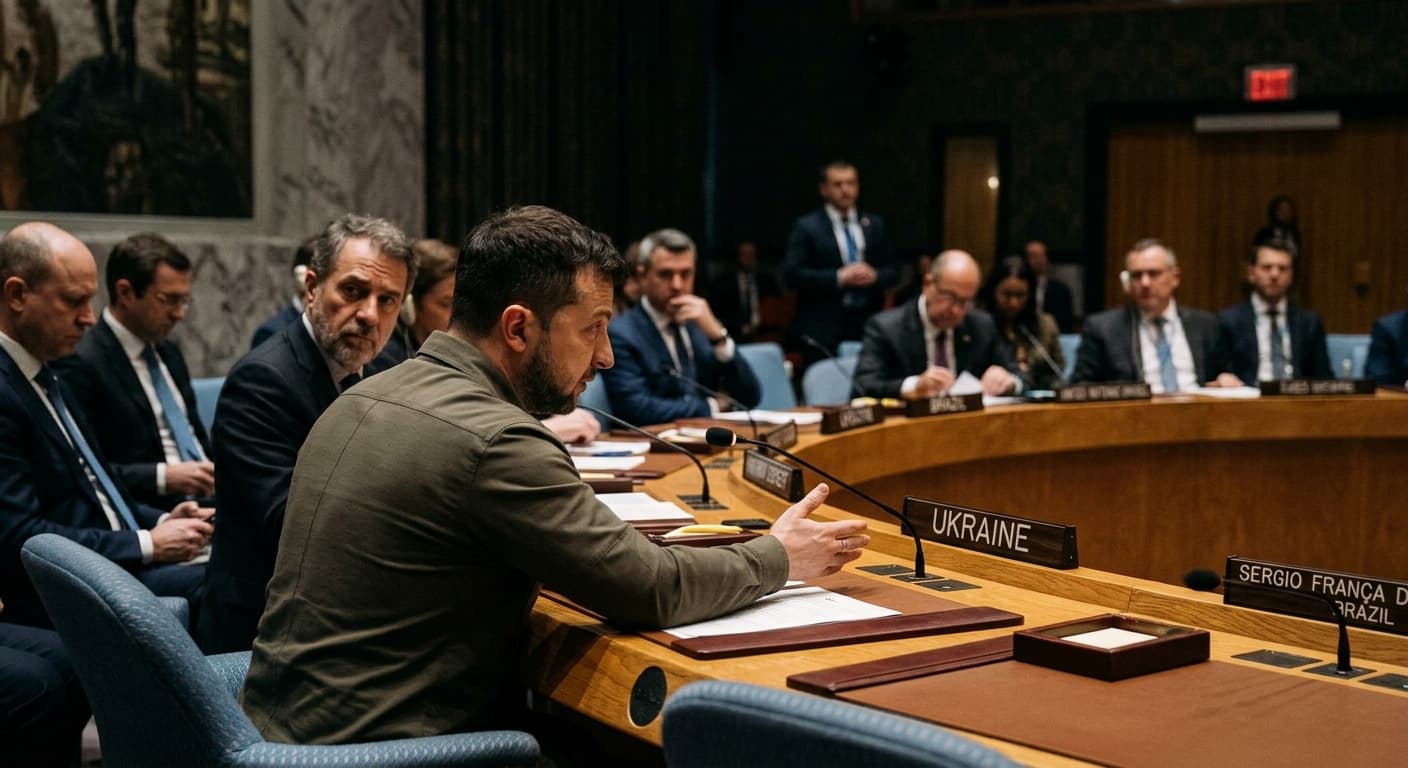
UN Security Council Meets July 9 as Russia's Kyiv Barrage Tests Global South
Ukraine calls a July 9 UN Security Council session on Russia's shelling — but with UN votes for Kyiv shrinking, the real battleground is the Global South.
Ukraine will walk into the UN Security Council chamber at 10 a.m. on July 9, 2026, knowing the meeting it demanded cannot bind Russia, cannot force a ceasefire, and cannot even produce a resolution — Moscow will veto anything hard. The real fight is elsewhere. According to Ukraine's permanent representative Andriy Melnyk, quoted by UA.NEWS, Kyiv is using the session to press its allies to extend Russia's isolation "into the countries of the Global South" — a tacit admission that four years of overwhelming Western condemnation have not moved the 51 states that abstained on February's General Assembly resolution, and that the July 2026 Council presidency, held by the Democratic Republic of the Congo, is the diplomatic hinge Kyiv is trying to swing.
What triggered the meeting
Ukraine requested the emergency session on July 8 after Russia's second mass strike in under a week. On the night of July 3–4, Russia launched 496 drones and 74 missiles at Kyiv, killing at least 30 civilians, in what Al Jazeera called the deadliest single-night attack on the capital this year. A second wave hit Kyiv, Kharkiv and Kherson on July 6–8 while NATO leaders were gathered in Ankara, killing another 22 and wounding dozens more, according to
NPR. UN Secretary-General António Guterres condemned the strikes in a July 6 briefing published by the
UN spokesperson's office, calling them "a clear violation of international humanitarian law" and repeating his call for "a full, immediate and unconditional ceasefire."
Foreign Minister Andrii Sybiha routed the meeting request through Kinshasa. According to the UN Web TV programme-of-work briefing on July 1, DRC Ambassador Zénon Mukongo Ngay took the July 2026 presidency with a chosen theme of governance of natural resources — not Ukraine. Kyiv is forcing Ukraine back onto the agenda through the DRC gavel, and doing so publicly. The BBC's
Ukraine coverage noted that more than 50 civilians have been killed in Kyiv alone across the two attacks, with Ukraine's air-force failure rate against ballistic missiles now "glaringly obvious" — the political weight of the July 9 meeting rests on that failure.
The number Kyiv cannot ignore: 107
The reason Melnyk is talking about the Global South, not the Council, is arithmetic. On February 24, 2026, the General Assembly adopted resolution A/RES/ES-11/10 — "Support for lasting peace in Ukraine" — by 107 in favour, 12 against, 51 abstentions, and 23 not voting, per the UN press release covering the session. That is a rebound from the eight preceding Ukraine resolutions in 2023–2025, which drew only 78–99 yes votes, but still 34 fewer than the 141 that backed the first anniversary resolution in February 2023, as documented by
Valdai Club analyst Oleg Barabanov.
The composition of the "no" and "abstain" columns is what matters. Iran, Cuba, North Korea, Nicaragua, Belarus, Burkina Faso, Burundi, Mali, Niger, Sudan and Eritrea joined Russia in voting against. China, India, South Africa, Brazil, Ethiopia and Pakistan abstained — a bloc representing roughly 3.4 billion people. Egypt, Malaysia, Thailand, Nigeria and Bolivia — all BRICS members or partners — did vote in favour, an outcome the Hudson Institute had earlier flagged as evidence that Russia's diplomatic base in the developing world is narrower than Moscow advertises.
Two shifts stand out. First, the United States abstained — the second such abstention in 2026, and the fourth non-yes since Donald Trump's return to office, according to Valdai's tally. Second, Hungary and Serbia moved from support to abstention. The Western column that once functioned as a monolith is now leaking on both flanks.
Why the Global South actually abstains
The standard Western reading — that Global South governments are pro-Russian, corrupt, or blackmailed by Moscow — is analytically wrong, and it is why Kyiv's isolation strategy keeps failing. A Bruegel analysis of UN voting patterns found that abstentions correlate less with sympathy for Moscow than with three concrete variables: defence dependence on Russia, participation in China's Belt and Road Initiative, and past Russian state aid. India, for instance, still sources roughly 70% of its military equipment from Russia and has seen bilateral trade grow 400% since 2022 — an economic reality no amount of missile-attack footage will override.
The African picture is even more counter-intuitive. A Danish Institute for International Studies breakdown of six ES-11 resolutions found 140 African votes in favour, 18 against, and 166 abstentions or absences. But African backing spiked to 30 states — with zero opposition — for ES-11/4, the resolution declaring Russia's 2022 annexation of four Ukrainian regions illegal. The reason is post-colonial: African governments defend the territorial-integrity norm ferociously, but reject punitive measures that could set precedent for their own use. That distinction, DIIS argues, is precisely what Western diplomacy has failed to exploit.
Melnyk's line about pushing "isolation to the Global South" therefore misdiagnoses the problem. As a South African Institute of International Affairs study notes, Pretoria, New Delhi and Brasília have moved from reflexive abstention toward selective endorsement — but only of language that preserves diplomatic optionality. Every additional demand for "toughest possible measures" against Russia costs Ukraine votes in exactly the constituency it needs.
Trump changes the calculus
The July 9 meeting arrives at a moment when the diplomatic frame has quietly inverted. Two days earlier, at the NATO summit in Ankara, allies pledged €70 billion ($80 billion) in military assistance to Ukraine for 2026 with equivalent commitments for 2027, according to Al Jazeera. Donald Trump, standing beside Volodymyr Zelensky, said Washington would license Patriot missile production to Ukraine — a striking reversal reported by the
BBC, and one Zelensky has sought since May.
Yet the same Trump administration abstained on February's General Assembly resolution and, per the UN General Assembly's summary of veto debate, voted with Russia in the Security Council in February 2025 to strip references to Russia as aggressor from resolution 2774 (2025) — the first Ukraine-related Council resolution adopted since 2022. The result: European Council members (Denmark, France, Greece, Slovenia, UK) abstained on the final text in protest. Washington is now simultaneously arming Ukraine and running diplomatic cover for Moscow at the UN. That contradiction is what makes the July 9 meeting matter.
Peace talks are stalled. A RAND analysis published this spring judged the Trump-Witkoff-Kushner formula — Ukrainian territory for Western security guarantees — structurally flawed because it ignores what political scientists call the credible commitment problem. Abu Dhabi trilateral talks in January and February produced only a prisoner exchange, per
Al Jazeera's mediation timeline, and the front line has "frozen," a senior US official told Al Jazeera on July 5. Russia has responded to stalemate by escalating strikes — a pattern that pre-emptively answers whether the July 9 session will change anything.
The DRC dimension nobody is discussing
The choice of pen-holder matters more than Kyiv is saying. The DRC is an African state whose own security architecture depends on the Council — MONUSCO's mandate was renewed by resolution 2808 (2025) in December, and the sanctions regime on eastern DRC was extended June 29 by
resolution 2825 (2026). Kinshasa is, in other words, an African state that has direct, ongoing experience of what happens when Council permanent members withhold pressure. Sybiha's calculation is that a DRC presidency willing to convene the meeting on 24-hour notice signals that African diplomacy on Russia is more fluid than the abstention count suggests.
But the ceiling is low. Russia has cast at least four vetoes on Ukraine-related texts since 2022 — including the February 25, 2022 resolution demanding withdrawal, and the
September 2022 draft rejecting annexation of the four Ukrainian regions. Any July 9 draft that names Russia will be vetoed; any draft weak enough to survive will not satisfy Ukraine's demand for "toughest possible measures." That is the trap Melnyk walked into voluntarily, and it is why Sybiha's language has shifted from Council action to Global South alignment.
The historical parallel
The Uniting for Peace mechanism — the procedural tool Ukraine has used to push resolutions from the deadlocked Council to the General Assembly — was invented in 1950 to bypass a Soviet veto on Korea. It has been invoked eleven times since, most notably against Soviet aggression in Hungary (1956) and Afghanistan (1980), according to the Polish Institute of International Affairs. In each case, General Assembly resolutions failed to reverse the invasion but shaped the diplomatic terrain for a generation. The 141 votes in 2022 exceeded the totals for both Hungary and Afghanistan; the 107 votes in 2026 are closer to Afghanistan's isolation ceiling in 1980. The pattern is stability, not surrender — but also not the mounting pressure Kyiv's rhetoric implies.
Who benefits, who loses
Russia benefits from every meeting that produces no resolution — Deputy Permanent Representative Dmitry Polyanskiy has spent the last year using Council sessions to reframe Ukrainian strikes on Belgorod and Bryansk as terrorism, a rhetorical inversion the ORF's analysis of the July 2025 BRICS chair statement showed had already begun to bleed into the Global South's diplomatic vocabulary. The July 2025 BRICS Rio declaration mentioned Ukraine only to condemn Ukrainian strikes on Russian infrastructure, per
Al Jazeera — a diplomatic win for Moscow that arrived without Russia having to persuade anyone of anything.
The losers are less obvious than they appear. Ukraine's Western supporters — Estonia's Kaja Kallas, France, the UK — are locked into a maximalist frame that no longer commands automatic majorities. European ministers "travelled in droves" to speak at UN debates while representatives of Global South states "stayed away," the International Crisis Group observed. That asymmetry has hardened into structure. Ukraine's diplomatic tempo — request meeting, demand action, denounce inaction — is now legible, predictable, and increasingly ignored.
The quiet winner is China. Beijing abstained on ES-11/10 in February 2026, as it has on every Ukraine resolution, and paid no cost. It supplied Russia with the dual-use goods that kept the war economy running, extracted trade concessions from a Moscow with no other buyers, and watched the West's diplomatic monopoly at the UN erode without lifting a finger. Every July 9 that produces no Council text is a July 9 that ratifies the Chinese theory of the case.
What to watch
- July 9, 10 a.m. New York: whether the DRC presidency allows Melnyk (or Sybiha, if he travels) a Rule 37 speaking slot at the top, or forces Ukraine to wait — a procedural signal of Kinshasa's alignment.
- Late July: whether any Council member tables a draft, or whether the meeting ends without paper. No draft means Ukraine could not muster the nine votes needed to force a Russian veto.
- September 2026 UNGA high-level week: whether Sybiha secures new Global South endorsements or whether the 107-vote threshold slips. A drop below 100 would confirm the erosion.
Diplomat View
The July 9 session will produce no ceasefire, no resolution, and no shift in Russia's targeting calculus. Its real function is a stress test of Ukraine's Global South strategy at a moment when that strategy is visibly failing. Kyiv's demand for "toughest possible measures" is calibrated for Western audiences; the DRC's willingness to convene at 24 hours' notice is calibrated for Kinshasa's own Council file. Neither maps onto the actual voting behaviour of the 51 states that abstained in February — behaviour driven, per Bruegel and DIIS, by military dependence, BRI ties, and post-colonial norm defence rather than sympathy for Moscow. Our forecast: the yes-vote count on the next Ukraine-sponsored UNGA resolution falls below 105, unless Sybiha reframes the ask away from isolation and toward territorial-integrity language that African states already reflexively support. What would change the call: a visible Trump pivot to naming Russia in a Council text, or a Chinese abstention that flips to a yes. Neither is likely before year-end.
The Bottom Line
Ukraine's July 9 Security Council meeting is theatre with a purpose — not to punish Russia, which cannot be punished in that chamber, but to test whether the DRC presidency and the wider Global South can be nudged from abstention toward alignment. The evidence says they cannot, not on Kyiv's current terms. The war's diplomatic center of gravity has moved from Turtle Bay to capitals where military dependence on Moscow and economic dependence on Beijing outweigh any moral case Melnyk can make from a podium in New York.
Discover more
US Politics
SNAP Food Assistance Faces Legal Challenges
In 2026, SNAP faces stricter eligibility rules and mounting legal challenges, threatening food assistance for the millions of Americans who rely on the program.
India
700 Activists Accuse PM Modi of MCC Breach
Over 700 activists allege PM Modi breached election code with a televised address attacking opposition parties just before state elections.

India
India-South Korea $50B Trade Expansion Plan
India and South Korea target $50 billion in bilateral trade by 2030, focusing on industrial cooperation and strategic alignment amid US pressures.

Economics
Fed's Amex AML order puts correspondent banking on notice
Federal Reserve's Amex AML order requires board-level controls and a 90-day plan; OCC fined the bank $350 million over enterprise-wide deficiencies.