Ukraine's UN Security Council Gambit
A diplomatic move aimed at NATO, not a resolution.
Model Diplomat8 min readEurope
Ukraine's UN Security Council Gambit Is Aimed at Ankara, Not New York
Ukraine requested an emergency UN Security Council meeting on July 6, 2026 after Russia fired 419 missiles and drones at Kyiv. The real audience is NATO — and Patriot interceptor stocks.
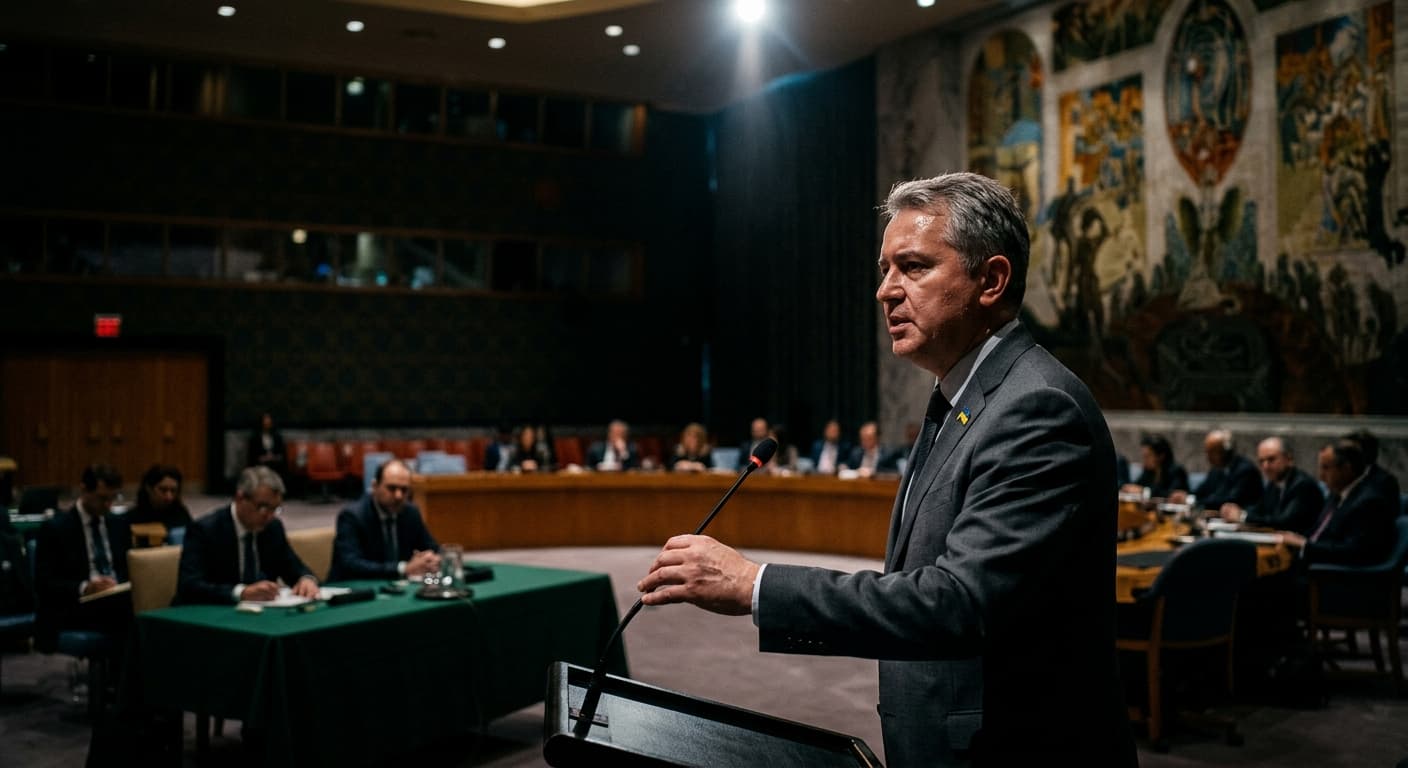
Foreign Minister Andrii Sybiha's call on July 6, 2026 for an emergency UN Security Council session — hours after Russia launched 419 aerial weapons at Kyiv and killed at least 11 people — is a diplomatic manoeuvre with a domestic-industrial payoff, not a serious bid for a resolution. The Council will not condemn Moscow, and Kyiv knows it. The gambit is timed to land 24 hours before NATO leaders convene in Ankara on July 7–8, where President Volodymyr Zelenskyy needs one specific deliverable from Donald Trump: a US license to co-produce Patriot interceptor missiles on Ukrainian soil. The UN request is the pressure play; the Ankara summit is the transaction. Everything else — the Congolese Security Council presidency, the Guterres statement, the ritual European condemnations — is stagecraft engineered to make Trump's refusal of the Patriot license politically expensive.
The strike, by the numbers
According to RBC-Ukraine, Russia fired 68 missiles and 351 attack drones overnight into July 6. Ukrainian air defences neutralised 363 of the 419 incoming weapons — an interception rate near 87% overall — but not a single one of Russia's ballistic missiles was shot down. The
BBC reported Ukrainian Air Force officials publicly attributing the failure to a "shortage" of Patriot interceptor missiles. Fifty-six people were injured in the capital, including seven children. Residential blocks in Podilskyi and Darnytskyi districts were destroyed. In the suburb of Vyshneve, more than 500 residents were evacuated from a fire zone with secondary-explosion risk.
This was the second strike on Kyiv in less than a week. On the night of July 2, Al Jazeera reported that a Russian barrage killed at least 22 people; the death toll climbed to 30 by July 3, making it the deadliest single assault on the capital this year. Sybiha framed the July 6 request in absolute terms. "Every Russian missile launched against Ukraine carries a message far beyond our borders. It seeks to convince the world that violence can replace law, that fear is stronger than solidarity, and that brutality comes without consequence," he said in the statement circulated through the
Ukrainian Foreign Ministry. The formal request is directed at the Democratic Republic of the Congo, which took the Council's rotating presidency on July 1. Ambassador Zénon Mukongo Ngay outlined July's programme of work at a
UN press conference that day.
What the UN meeting cannot do
The mechanical arithmetic of the Security Council makes a binding condemnation impossible. Russia holds a permanent seat and a veto. It has used both consistently on Ukraine files since February 2022. The one exception — Resolution 2774 (2025), adopted on February 24, 2025 — was engineered by the United States over European objections. That resolution, according to the Security Council's own special report filed under General Assembly resolution 76/262, passed only because Russia twice vetoed European amendments naming it as the aggressor. Nine votes carried the first amendment; eleven carried the second; both died on Moscow's veto under Article 27(3) of the Charter.
That episode remains the diplomatic reference point for what Ukraine now faces. The BBC's Nada Tawfik reported that on February 24, 2025 the United States "worked against its closest allies and sided with Russia, Belarus and North Korea" to strip aggressor language from the resolution — the first time a Ukraine text passed the Council in three years, and it did so as a stripped-down neutral text. Richard Gowan of the International Crisis Group told the BBC the sight of Washington and Moscow "coordinating to embarrass Europe was pretty stunning." Since then, the Council has held recurring open briefings on Ukraine — most recently the 10179th meeting on June 22, 2026, according to
UN Meetings Coverage, where Assistant Secretary-General Mohamed Khaled Khiari called for concerted diplomatic efforts toward a ceasefire — but has produced no operative text. Guterres's spokesman Stéphane Dujarric issued a
Note to Correspondents on July 2 condemning the earlier strikes, noting civilian casualties across Ukraine had risen 40% between December 2025 and May 2026 compared with the previous year. It changed nothing on the ground.
The DRC presidency compounds the constraint. Kinshasa is in the final stages of implementing a US- and Qatar-brokered peace with Rwanda and the M23 rebel movement, signed in Washington in June 2025 and reinforced by a Doha declaration welcomed by the Secretary-General. President Félix Tshisekedi's diplomatic capital is tied to that process. He will not spend it picking a fight with Moscow — or, more consequentially, with the Trump administration whose sanctions on Rwandan-linked mineral traders,
Al Jazeera reported, landed the same day as the Kyiv strike.
Why the timing is the message
Read against the calendar, the request stops looking like a legal step and starts looking like an information operation. The NATO summit opens in Ankara on July 7, with heads of state from 32 countries in attendance. Trump departs Washington on the evening of July 6, hours after Sybiha's statement. The White House has confirmed a Trump–Zelenskyy bilateral on Wednesday, July 8. And Trump has just spent 90 minutes on the phone with Vladimir Putin, described by Kremlin aide Yury Ushakov and reported by Al Jazeera as "businesslike and quite constructive," in which the US president "confirmed his readiness to work towards a rapid end to the fighting." Zelenskyy spoke with Trump the same day.
Zelenskyy's specific ask is not more Patriots — it is the license to make them. As the Financial Times reported, Zelenskyy has said "we now have all the technical capabilities needed to begin producing missiles for Patriot systems." What is missing is Washington's approval.
NPR's summit preview notes Trump's mission in Ankara is to enforce last year's 5%-of-GDP defence spending pledge — a summit in which he arrives as the aggrieved creditor, not the supplicant. The
Council on Foreign Relations framed the meeting as one where Europeans "hope to make progress on Ukraine support and Kyiv's air defense needs, especially Ukraine's push to receive a U.S. license for Patriot missile production inside Ukraine." That single sentence is Ukraine's entire war of the next twelve months.
The industrial math is unforgiving. Al Jazeera's Mansur Mirovalev reported in March 2026 that Patriot interceptor production has never exceeded 900 units a year worldwide, each costs several million dollars, and Israel and the Gulf burned roughly 800 in the first three days of Iran's June 2025 strikes. Ukraine has fewer than a dozen batteries against the 25 it says it needs. Volodymyr Fesenko of the Kyiv-based Penta think tank told Al Jazeera that Russia's rational move is to "bleed Ukraine's stock of Patriot missiles dry" through massive strikes precisely like the one on July 6. That is not a bug in Moscow's strategy; it is the strategy.
The unspoken beneficiary: Raytheon, and the leverage it gives Kyiv
Two second-order effects deserve naming. First, if Trump grants the co-production license, the immediate corporate winner is RTX (formerly Raytheon), which controls the PAC-3 supply chain jointly with Lockheed Martin. Ukrainian assembly under license would expand global production capacity, ease the Israel–Ukraine–Gulf allocation squeeze the Pentagon has been managing since June 2025, and preserve US primacy in air-defence exports as European rivals push the French-Italian SAMP/T system into the gap. That is a rare deal in which Kyiv's survival and the US industrial base align. The Trump team has room to say yes.
Second, the losers are the Europeans, and they know it. Chatham House warned on the eve of the summit that Ankara would surface accumulated US–European tensions rather than resolve them. The Council on Foreign Relations reports Defense Secretary Pete Hegseth announced a six-month review of US force posture in Europe, with media reports suggesting the Pentagon could cut F-16 and F-15 jets assigned to NATO by a third and strategic bombers by half. Some 5,000 US troops are being pulled from Germany over six to twelve months. In that context, Zelenskyy's UN move works as a lever on Trump precisely because it forces him to answer a question he would rather duck at Ankara: does "NATO 3.0" include air defence for Ukraine, or not?
The German-led E5 grouping — Berlin, London, Paris, Rome, Warsaw — met in Berlin on June 24 and pledged, according to Al Jazeera, to "further substantially support Ukraine in its defence against Russian aggression." Ursula von der Leyen has said Ukraine's "urgent" air-defence needs will be raised in Ankara. The EU has already renewed sectoral sanctions on Russia through July 2027 via
Council Decision (CFSP) 2026/1437, adopted June 25, 2026, and added nine individuals and 45 entities to its designations list under
Decision (CFSP) 2026/1364 on June 15. But sanctions do not intercept ballistic missiles. Only interceptors do.
The historical parallel that should worry Kyiv
There is a precedent for a Council request that produced sympathy but no shield: the July 2024 emergency meeting Ukraine called after Russia's strike on the Okhmatdyt children's hospital in Kyiv. As Al Jazeera reported at the time, Zelenskyy explicitly framed it as an accountability move — "we must hold Russia accountable for its acts of terror" — and Biden condemned the strike as "a horrific reminder of Russia's brutality." No resolution followed. Russia vetoed. The strikes continued.
The July 2026 request may fare no better on paper. What has changed is the context around it. Then, Kyiv had a Democratic White House committed to open-ended support. Now, it has a Republican White House openly negotiating with Putin, a NATO summit dominated by burden-sharing acrimony, and a Patriot supply chain rationed across three theatres. That is why the UN meeting is not the story. It is the megaphone Kyiv is using to make sure the story in Ankara is air defence — not, as Trump would prefer, European spending shortfalls.
What to watch
- July 8, Ankara: Trump–Zelenskyy bilateral. Watch for any US statement on Patriot co-production licensing; anything short of that is a loss for Kyiv.
- Second week of July, New York: Whether the DRC presidency schedules the requested Ukraine meeting, and at what level (ministerial or ambassadorial). A briefing without a vote is the default.
- Autumn 2026: Pentagon's six-month force-posture review concludes. If it lands with deeper NATO drawdowns, the Ukrainian air-defence deficit compounds structurally.
Diplomat View
Kyiv's UN request will not produce a resolution and was never designed to. It is a forcing function on Trump's Ankara calendar — a way to make the political cost of denying the Patriot license higher than the cost of granting it. The forecast: Ukraine gets a partial win — a co-production framework agreement in principle, with delivery timelines and export-control caveats that push meaningful volume to 2027 or later. That would be enough for Zelenskyy to declare victory and enough for Trump to claim he ended the crisis without writing a fresh cheque. The forecast breaks if Trump chooses instead to lean into his Putin channel and offer Ukraine a ceasefire framework in exchange for territorial concessions — in which case the UN request becomes retroactively irrelevant, and the July 6 strike becomes leverage in Moscow's hands, not Kyiv's. Watch for the joint communiqué language on Ukraine on the evening of July 8. If it names Russia as aggressor, Europe held the line. If it does not, the February 2025 pattern has hardened into doctrine.
Read today's full | | Country: Ukraine
Discover more
US Politics
SNAP Food Assistance Faces Legal Challenges
In 2026, SNAP faces stricter eligibility rules and mounting legal challenges, threatening food assistance for the millions of Americans who rely on the program.
India
BJP's Misunderstanding of Women's Quota Needs
The BJP's linking of the Women Reservation Bill to delimitation risks delaying women's empowerment in India, misreading the aspirations of female voters.
India
700 Activists Accuse PM Modi of MCC Breach
Over 700 activists allege PM Modi breached election code with a televised address attacking opposition parties just before state elections.

Economics
Fed's Amex AML order puts correspondent banking on notice
Federal Reserve's Amex AML order requires board-level controls and a 90-day plan; OCC fined the bank $350 million over enterprise-wide deficiencies.