Ukraine's Omsk Strike Threatens Russian Refug
A record drone strike puts all Russian refineries at risk.
Model Diplomat7 min readEurasia
Ukraine's 3,000 km Omsk Strike Puts Every Russian Refinery in Range
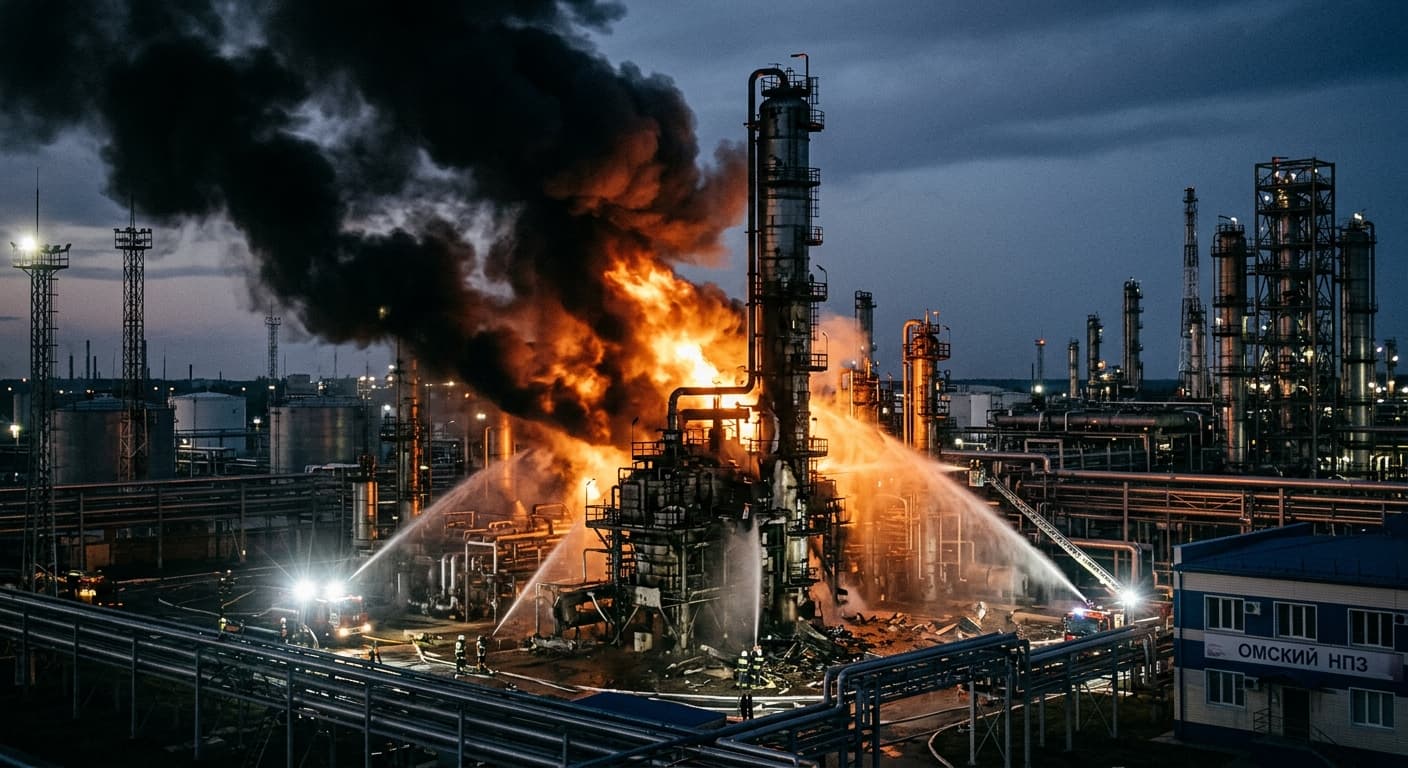
Ukraine's Special Operations Forces hit the Omsk refinery — Russia's largest — on July 6, 2026, in a record 3,000 km drone strike ahead of the Ankara NATO summit.
Ukraine's Special Operations Forces (SSO) struck the Omsk Oil Refinery in Siberia in the early hours of July 6, 2026, in what Kyiv called the deepest long-range strike of the war — roughly 2,500 to 3,000 kilometres from Ukrainian-held territory. The tactical event is a fire at one crude unit; the strategic event is that no Russian refinery is now geographically safe. That collapses the last piece of Vladimir Putin's home-front bargain — that ordinary Russians east of the Urals need not feel the war — 24 hours before the NATO summit opens in Ankara.
The SSO said its drones hit the ELOU‑AVT‑11 primary crude processing unit, describing it in a Telegram statement quoted by the Kyiv Post as the plant's "most important installation." Ukraine's General Staff put the unit's design capacity at 8.4 million tons of crude a year. Gazprom Neft's Omsk plant, employing more than 3,300 people, processes about 21 million tons of oil annually — roughly a tenth of all Russian refining capacity — and supplies more than half of the Siberian Federal District's motor fuel, according to the Ukrainian monitoring channel Exilenova+ cited by Kyiv Post.
Why Omsk changes the map, not just the ledger
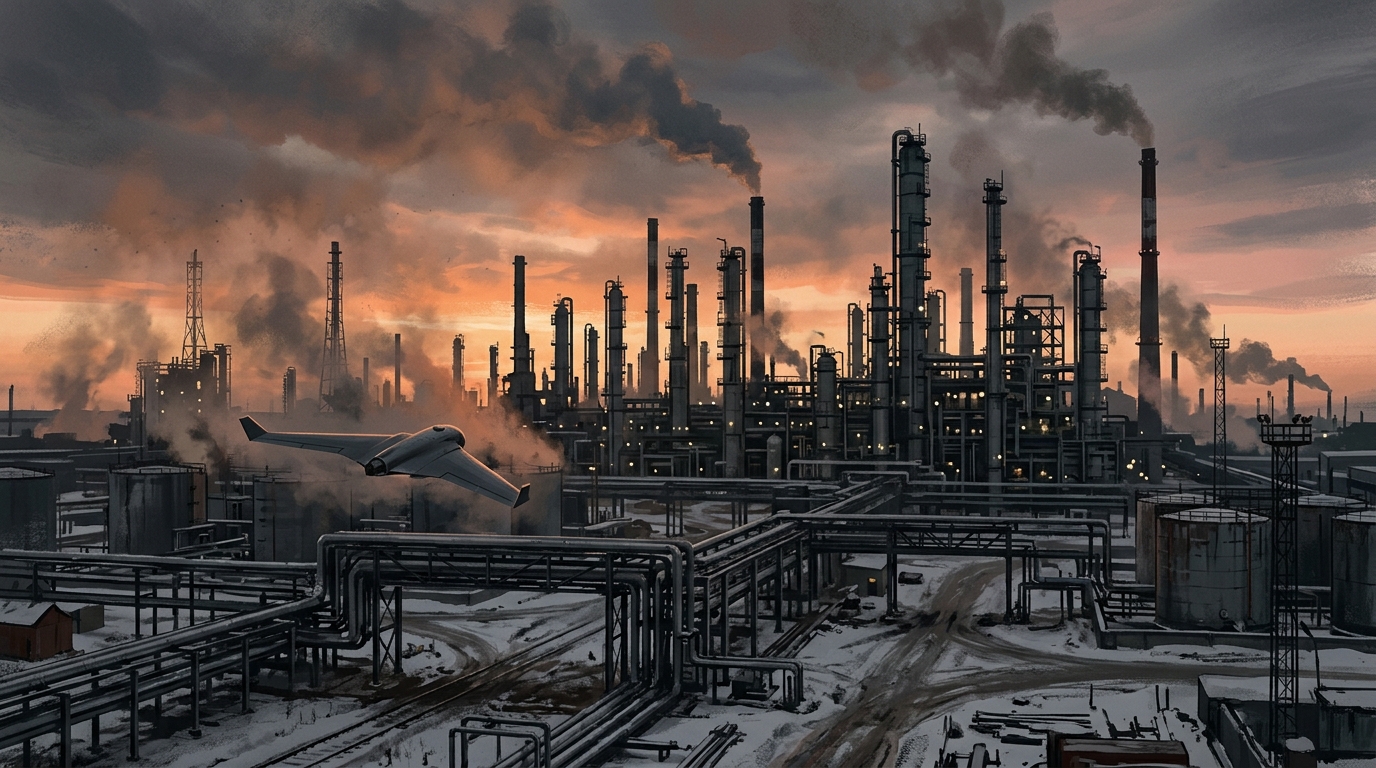
Ukraine has hit further before — SBU-smuggled FPV drones destroyed strategic bombers at Belaya airbase in Irkutsk during Operation Spider's Web on June 1, 2026, more than 4,000 km from the border, as the Center for Strategic and International Studies documented. But those drones were pre-positioned inside Russia in commercial trucks. Omsk is different: the weapon flew from Ukrainian territory. Ukrainian OSINT researchers quoted by Kyiv Post identified the airframe as a modernised FP‑1 built by Fire Point, the same manufacturer Al Jazeera notes has developed the
Flamingo FP‑5 missile with an advertised 3,000 km range.
The military implication is straightforward. Until this week, Russian refiners had been moving high-value cracking, hydrotreating and catalytic units east on the assumption that anything beyond the Urals sat outside Ukraine's reach. The Carnegie Endowment noted in June that Moscow was already struggling to protect refineries on the European side of the country — Ryazan alone has been hit 15 times. If FP‑1s can reach Omsk, then TANECO in Tatarstan, Salavat in Bashkortostan and the Achinsk plant in Krasnoyarsk Krai are all inside the envelope. There is no interior line to retreat to.
The economic mechanism Kyiv is exploiting
Ukraine's General Staff claimed on July 4 that its campaign has "disabled" 42.74% of Russian refining capacity and caused $13.5 billion in cumulative industry losses since August 2025, according to Al Jazeera. Independent energy analysts put the functional disruption closer to one-third. Either figure is decisive. Carnegie's Sergey Vakulenko wrote in June that Russian refined-oil output fell by up to 700,000 barrels per day in April and May — a 13% decline — with the Kapotnya and TANECO strikes alone taking out roughly 600,000 barrels of daily throughput mid-June.
The pain is visible on Russian forecourts. Independent Russian outlet Mediazona counted 56 regions enforcing fuel rationing, the BBC reported after Putin's July admission that "there are still queues at petrol stations." Rosneft capped canister sales; Tatneft limited motorists in Moscow and St Petersburg to 20 litres of petrol per fill, according to
Al Jazeera. Crimea is down to "a few days' supply," Putin conceded on state television — an extraordinary admission from a president who has spent four years insulating the domestic audience from war costs.
The mechanism Kyiv is exploiting is architectural. As Ukrainian energy analyst Volodymyr Omelchenko wrote for the Razumkov Centre, the ELOU‑AVT primary distillation column is the choke point of any refinery: 12 storeys tall, impossible to hide, costing roughly $1 billion and taking more than 14 months to replace under sanctions that block Western equipment supply. Norwegian Institute of International Affairs energy chief Indra Overland told
Al Jazeera that Kyiv also targets fluid catalytic cracking units — "the 'hearts' of the refineries" — precisely because Russia cannot import replacement parts.
Who benefits, who loses
The obvious loser is Gazprom Neft, whose Omsk plant supplies aviation kerosene, diesel and gasoline nationwide and reached near-100% processing depth only in 2025. The less obvious loser is Rosatom's fuel logistics for the summer harvest. Overland warned that shortages threaten Russia's July–August wheat campaign — the world's largest — because tractors, pumps and long-haul lorries all draw from the same rationed pool.
The counter-intuitive beneficiary is Beijing. Reuters reporting cited by Al Jazeera showed Russia is now importing refined petroleum products from Asia to plug the gap; Chinese and Indian buyers are simultaneously getting discounted Russian crude that can no longer be processed at home. The Kremlin's response — a bill Putin signed on July 4 to boost domestic supply, per the BBC — reroutes rents from refiners to traders. That is a domestic wealth transfer, not extra capacity.
There is a second-order winner inside Ukraine: Fire Point. The company was producing roughly 100 FP‑1 drones a day in June with a 10% success rate, per Aviation Week data cited by Carnegie. Omsk demonstrates a materially improved airframe and validates Kyiv's argument to Western financiers that domestic long-range production — not scarce Storm Shadow or ATACMS munitions — is the decisive weapon. Ukraine's Unmanned Systems Forces commander Robert "Madiar" Brovdi told the BBC in April that his forces already account for a third of all Russian targets destroyed, at less than 1% annual casualties, while making up only 2% of Ukraine's military.
The Ankara timing is not coincidence
President Volodymyr Zelensky flies to Ankara on July 7 to address NATO's Defence Industry Forum and meet Donald Trump on the sidelines, per the alliance's official summit programme. He arrives carrying a demonstrated 3,000-km strike capability produced domestically at drone prices. That reframes his ask. The
Council on Foreign Relations reports that the summit's central Ukraine-related deliverable is a US licence for Patriot missile production inside Ukraine — an air-defence request, not a strike-weapon request. Zelensky's message to Trump is now legible: fund what already works.
The Kremlin's problem is more acute. Russia launched what its Defence Ministry described as 625 long-range drones at Ukraine overnight, of which its air defences claim to have downed 613, per Sputnik India. Even if that count is accepted at face value, it means 12 drones — plus a barrage of 68 missiles and 351 strike drones the same night, per Ukrainian Air Force data reported by the
BBC — got through to hit Kyiv, killing at least 20. Russia can still overwhelm Ukraine's diminishing interceptor stocks. But it cannot defend everywhere at once, and Omsk proves it.
Putin's rare July concession that "problems persist" for motorists is the clearest signal that Kremlin messaging discipline is cracking. His statement to state television — that shortages exist but are "not critical" — is worth quoting in full for what it does not say:
"Unfortunately, there are still queues at petrol stations, and finding the right grade of petrol isn't always easy… we are currently seeing a certain shortage, but it's not critical."
That is a leader confirming a domestic economic problem he had, for three and a half years, refused to acknowledge existed. The Atlantic Council argued in early 2025 that undermining Putin's "business-as-usual climate" was itself a strategic objective. Omsk closes that argument.
What to watch
- July 7–8, Ankara. Zelensky's bilateral with Trump and any language on Patriot production licensing, plus whether allies commit to co-financing Ukrainian long-range drone production — the
NATO summit programme has him addressing the Defence Industry Forum at 14:00 TRT on July 7.
- Omsk damage assessment. Whether the ELOU‑AVT‑11 unit is repairable in weeks or written off for the 14-month replacement cycle Razumkov's analysis implies. NASA FIRMS thermal imagery, tracked by Carnegie, will show it within 72 hours.
- Russian retaliation vector. CSIS notes Ukrainian strikes on Russian nuclear-capable infrastructure meet doctrinal thresholds for a nuclear response Moscow has so far declined to invoke. Watch for a demonstrative Oreshnik launch or escalated strikes on Ukrainian gas storage before the winter heating season, which Overland flags as Ukraine's own vulnerability.
- Fuel prices at Russian pumps in mid-July. Kommersant and The Bell tracking will show whether the 40-plus-region rationing regime tightens further after Omsk goes offline.
The Bottom Line
Ukraine's Omsk strike is not another entry in a target list — it is the collapse of Russia's geographic sanctuary. With a modernised FP‑1 drone reaching 3,000 km, every large Russian refinery, from Ryazan to Achinsk, is now inside Kyiv's envelope, and Putin's four-year effort to keep the domestic economy insulated from the war he started is over. The question the Ankara NATO summit must answer this week is no longer whether Ukraine can strike Russia's oil complex, but whether the West will fund the drones fast enough to finish the campaign before the winter heating season shifts the leverage back to Moscow.
Discover more

US Politics
SNAP Food Assistance Faces Legal Challenges
In 2026, SNAP faces stricter eligibility rules and mounting legal challenges, threatening food assistance for the millions of Americans who rely on the program.
US Politics
House Ethics Committee Pushes Sexual Miscond.
The House Ethics Committee has shifted responsibility for sexual harassment settlement records to the Office of Congressional Workplace Rights, complicating disclosure efforts.
India
Congress Accuses Modi of Stalling Women's Law
Congress accuses Modi of stalling women's reservation law by linking it to delimitation, revealing a deeper electoral strategy.
Global
Zimbabwe's 2030 Gambit: Mnangagwa's Rule
Zimbabwe's Constitutional Amendment No. 3 ends direct presidential elections, extending Mnangagwa's rule to 2030 and raising concerns over democratic integrity.