Ukraine's AI Sovereignty: A New Doctrine
Kyiv mandates self-hosted AI models for sovereignty.
Model Diplomat8 min readEurope
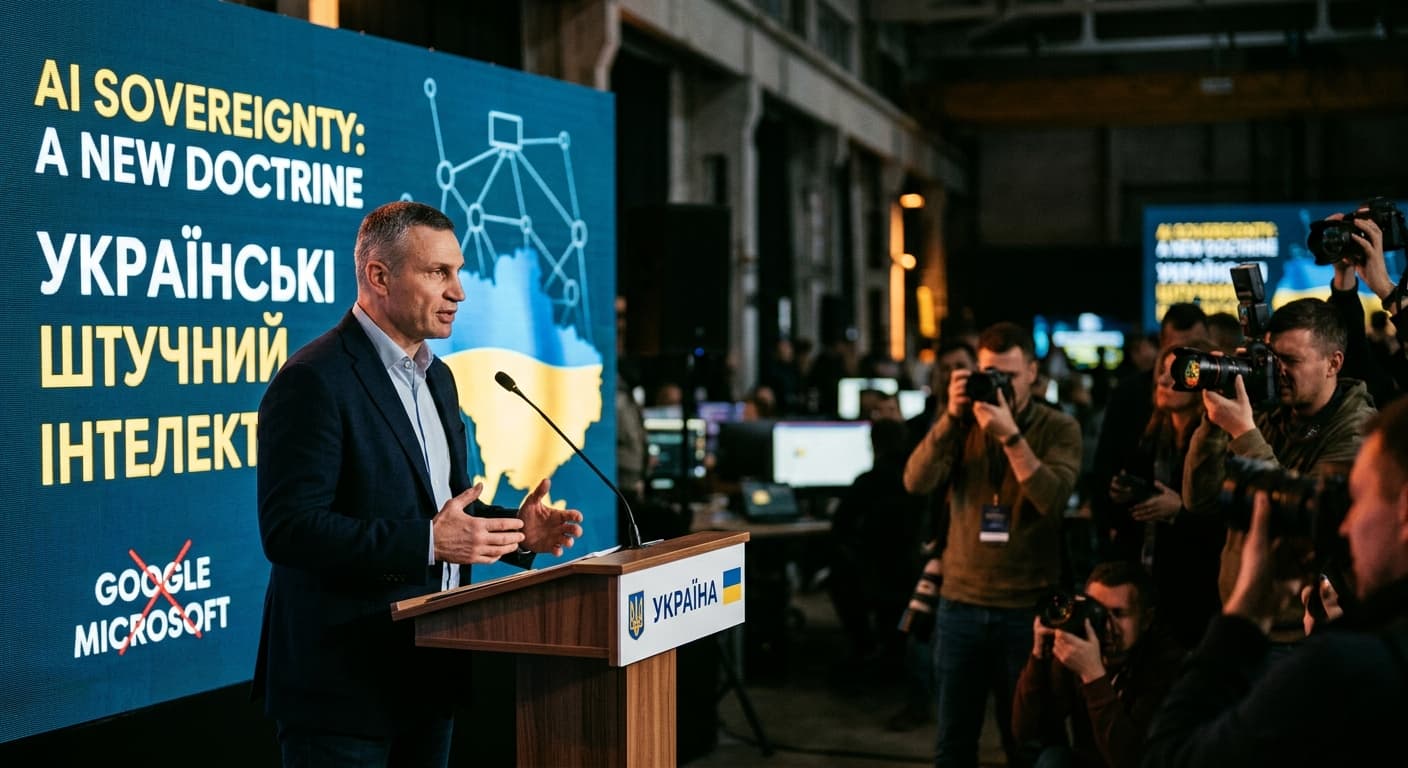
Ukraine bars provider-controlled AI, picks self-hosted models
Kyiv will only deploy AI models it can run on its own servers, Chief AI Officer Roman Kyslyi told Reuters on July 7, 2026 — a doctrine that excludes flagship Anthropic and OpenAI systems and reframes AI sovereignty as an export-control problem.
Ukraine has become the first government at war to codify a hard rule that its AI stack must be operable without the provider's permission — a policy that quietly disqualifies Anthropic's Claude and OpenAI's flagship models by design, and turns Google's open-weight Gemma into the most valuable American AI export to Kyiv. The trigger was not Russia. It was Washington. After the US Commerce Department ordered Anthropic on June 12 to cut foreign access to its two most capable models, Kyiv concluded that any system a US agency can switch off is a system a wartime state cannot own.
Roman Kyslyi, Chief AI Officer at Ukraine's Ministry of Digital Transformation, told Reuters via the Economic Times that the decisive test is not the model's country of origin but its deployability: "If the vendor will provide it to run on our on-premise infrastructure, there are no restrictions." He framed the shift bluntly: "AI sovereignty isn't just a defensive talking point, it's a necessity."

What Kyiv is actually deciding
The policy is procurement, not legislation — and that is what gives it force. Government services delivered through the Diia app currently rely on Google's remote-only Gemini, accessed through EU-hosted servers, with personal data stripped before each query because, in Kyslyi's phrasing, Ukraine does "not control those models." Gemini is now labelled explicitly as an "interim" solution.
The permanent solution is a Kyivstar-built national large language model based on Google's open-weight Gemma, chosen after the ministry benchmarked it against Mistral and OpenAI's GPT-OSS. The Ukrainian model is due for release in autumn and is intended for government, private-sector and military use, according to Intelligent CIO Europe, which reported the January partnership between telecoms operator Kyivstar's WINWIN AI Center of Excellence and the Ministry of Digital Transformation. Ukraine's ministry has separately confirmed drafting a stand-alone AI law aligned with the EU AI Act, according to
The Public.
Diia is not a boutique pilot. The app has 22.7 million users and sits on roughly 70% of Ukrainian smartphones, the BBC reported, delivering 40 services in-app and 130 through its web portal. Diia.AI, launched in autumn 2025 by Kyiv IT firm Kitsoft on Gemini Flash 2.0, was the first national AI agent to deliver bureaucratic services — tax documents, benefit filings — through a conversational interface,
the Atlantic Council's Peter Dickinson notes. Replacing that engine is not a hobby project.
The Anthropic order that reframed the risk
On June 12, 2026, the Bureau of Industry and Security sent Anthropic a letter requiring an export license for any foreign-person access to Claude Fable 5 and Mythos 5 — including Anthropic's own foreign-national employees. Because the company cannot verify user citizenship at the API layer, it disabled both models globally within hours. CSIS's analysis of the order called the legal basis "contested," noting that BIS invoked Section 734.13 of the Export Administration Regulations — the same section Commerce had previously cited to argue that remote model access is not subject to the EAR.
The ban lasted eighteen days. The BBC reported that Commerce Secretary Howard Lutnick lifted restrictions on June 30 after Anthropic agreed to "proactively detect and address security risks" and coordinate future model releases with the government. Commerce reserved the right to reimpose controls at any time. That reservation is the entire point for Kyiv: an ally's frontier AI can be switched off on a Friday afternoon on a "verbal" jailbreak concern, as
Al Jazeera documented from Anthropic's own blog post.
The GAO has since ruled that even the Trump administration's May 2025 press release rescinding the Biden-era AI Diffusion Rule was itself a rule requiring congressional submission under the Congressional Review Act, according to the Government Accountability Office. Translation: US model-weight export policy is now being made through press releases and letters, not statute. For a foreign customer, that is not a supply chain — it is weather.
Ukraine reads the same signal as Paris and Brussels
The doctrine Kyslyi articulated is not unique. It is, however, the sharpest formulation of a European posture crystallising in real time. French Interior Minister Bruno Retailleau responded to the Anthropic order by writing on X, as reported by Al Jazeera, that "we must treat AI the way we treated nuclear power: we must think of it as part of our sovereignty. Master it or suffer it: there is no other path." European Commission tech-sovereignty spokesperson Thomas Regnier called AI security a "shared challenge, not one confined to a single jurisdiction."
The Peterson Institute for International Economics warned that the ad-hoc controls are likely to backfire in exactly the direction Kyiv is now moving. Chinese firms release their frontier models as open-weight, and once downloaded "the provider cannot shut off access — a feature that just became a greater selling point," PIIE argued in a July commentary. CSIS estimates the current US lead over China at roughly seven months; every abrupt cutoff narrows the price of switching.
Ukraine's decision to build on Gemma rather than DeepSeek or Qwen is therefore not neutral. It is a bet that Google's open-weight family will remain releasable, and that Beijing's models — while technically deployable on Ukrainian iron — carry political and provenance risks Kyiv will not run. The Council on Foreign Relations noted in its assessment of DeepSeek V4 that Chinese frontier models still trail US systems by three to six months and are dogged by unresolved US allegations of "industrial-scale" distillation from Claude.
The compute problem nobody is solving
The policy is coherent. The infrastructure is not. Ukraine's grid is under sustained Russian attack, and the Atlantic Council's Cate Hansberry warns of a "strategic trap" in which Russian strikes on power shrink Ukraine's domestic compute capacity, forcing more reliance on external cloud services, which in turn erode the sovereignty the on-premise doctrine is meant to protect. Kyivstar's plan for domestic AI compute capacity, announced at the Ukraine Reconstruction Conference in Gdańsk, remains — as
Brandsit put it — "primarily a declaration requiring huge investment and time."
Brookings, in a February 2026 report, argued that full-stack AI sovereignty is "structurally infeasible" for almost any country because AI is a transnational stack with concentrated choke points in minerals, energy, chips, networks and talent. The practical alternative it proposes — "managed interdependence" — is exactly what Kyslyi's formulation describes: work with any vendor, on any origin, provided the artefact can be deployed under Ukrainian control. Ukraine is not attempting autarky. It is attempting portability.
The academic case that the model works has hardened quickly. A February 2026 arXiv paper by researchers at NOVA University Lisbon titled "Sovereign AI-based Public Services are Viable and Affordable" demonstrates that on-premise chatbots for government services can operate effectively with modest compute — undercutting the assumption that only hyperscaler-hosted models can serve citizens at scale. A separate group of Ukrainian researchers has already shipped MamayLM, a Gemma-3 12B derivative that, according to
the UNLP 2026 shared-task paper, matches Llama 3.1 70B on Ukrainian-language benchmarks while running on a single quantised GPU.
Who wins and who loses
Google wins the round. Anthropic and OpenAI, whose closed frontier models are the point of their commercial moat, are structurally excluded from a category of customer — wartime and post-wartime European governments — that will only grow. OpenAI's GPT-OSS is the concession, and Ukraine tested it; it lost on merit. Anthropic has no open-weight offering at all. Google, by contrast, controls both the closed frontier (Gemini) and a competitive open-weight family (Gemma), meaning it can sell the interim service and license the sovereign replacement.
Mistral is the quiet European beneficiary. Ukraine benchmarked its open models against Gemma and, per Kyslyi, found performance comparable. If the Kyivstar model slips, Mistral is the fallback — and every French official pointing at the Anthropic incident is, implicitly, pointing at Mistral as the answer.
The clear loser, beyond Anthropic, is the US model-export regime itself. CSIS warned that BIS's action "risks creating an impossible bar" — that Washington will only allow public release of models that cannot be jailbroken even in theory — and that the uncertainty "is likely to broadly undermine goals for global adoption of US models." Ukraine has just written that warning into procurement policy.
Diplomat View
Ukraine has done something the EU AI Act cannot: it has made "sovereignty" operational, at contract level, in a jurisdiction that spends real money on AI for real state functions. The policy is falsifiable — either the Kyivstar-Gemma model ships this autumn and displaces Gemini inside Diia.AI, or it does not. If it ships and performs, expect Poland, the Baltics and likely France to copy the procurement clause verbatim within twelve months; the political cost of being the next Anthropic customer is now higher than the technical cost of running Gemma on-prem. If it slips or underperforms, Kyiv quietly extends its "interim" Gemini dependency and the doctrine becomes rhetoric. The forecast revises if two things happen: BIS issues a stable, published carve-out for NATO allies on frontier model access, or Google restricts future Gemma releases to closed weights the way it does Gemini. Either would collapse the current arbitrage. Neither looks imminent.
What to watch
- Autumn 2026 — Kyivstar's Gemma-based Ukrainian national LLM release; the first live test of whether an open-weight sovereign model can carry a 22.7-million-user government app.
- Q3-Q4 2026 — Whether BIS publishes a formal successor to the rescinded AI Diffusion Rule, or continues to govern frontier model exports through ad-hoc letters. GAO's B-337935 finding puts pressure on Commerce to codify.
- G7 "trusted partner" scheme — Details of the closed-door G7 discussion on tiered access to frontier models, first flagged by Al Jazeera; a formal framework would either restore or bury the "small yard, high fence" model.
- Ukraine's AI law — Draft text of the EU-aligned national AI law expected from the Ministry of Digital Transformation; the on-premise procurement doctrine will either be codified in it or remain purely administrative.
The Bottom Line
Ukraine's on-premise-only doctrine is the first coherent state answer to a question Washington created on June 12: what does an ally do when its most important AI supplier can be ordered off the field by a letter? Kyiv's answer — buy anything, from anyone, as long as it runs on our iron — turns Google's open-weight Gemma into the winner of the Anthropic export ban and makes American closed-frontier models a category risk for allied procurement. If the Kyivstar model ships this autumn and works, the Ukraine template becomes the European default, and the US AI export regime will have engineered its own displacement from the very governments it was designed to lock in.
Discover more

India
BJP's Misunderstanding of Women's Quota Needs
The BJP's linking of the Women Reservation Bill to delimitation risks delaying women's empowerment in India, misreading the aspirations of female voters.

US Politics
SNAP Food Assistance Faces Legal Challenges
In 2026, SNAP faces stricter eligibility rules and mounting legal challenges, threatening food assistance for the millions of Americans who rely on the program.

India
Congress Accuses Modi of Stalling Women's Law
Congress accuses Modi of stalling women's reservation law by linking it to delimitation, revealing a deeper electoral strategy.

Economics
Fed's Amex AML order puts correspondent banking on notice
Federal Reserve's Amex AML order requires board-level controls and a 90-day plan; OCC fined the bank $350 million over enterprise-wide deficiencies.