UAE's Chip Windfall Turns War Support Into AI
US rewards UAE with AI chip access after Iran war role and Trump crypto deal
Model Diplomat11 min readMiddle East
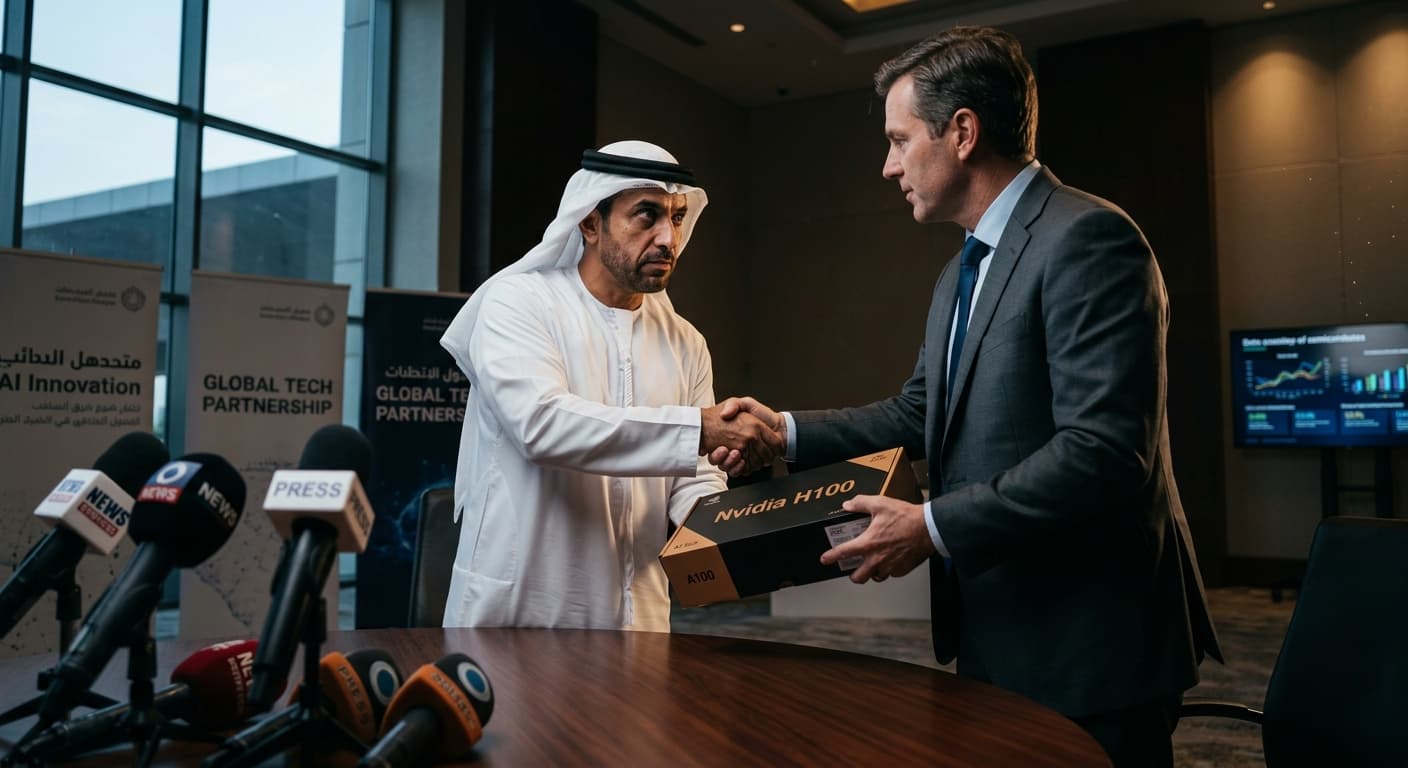
UAE's Chip Windfall Turns War Support Into Gulf AI Supremacy
The Commerce Department's July 10 tier upgrade for the UAE rewards Abu Dhabi's Iran war participation with license-free AI chip purchases — but the real story is a year-long transaction converting military alignment and a $500 million Trump family crypto investment into structural advantage over Saudi Arabia in the Gulf AI race.
On July 10, 2026, the US Commerce Department elevated the United Arab Emirates to the same export-control tier as South Korea, India, and European nations, removing the requirement that G42 — the UAE's flagship AI company — obtain individual licenses to purchase advanced Nvidia chips for at least nine months. The UAE had previously been grouped with strictly regulated countries including China and Yemen under the Commerce Control List's Country Group D:4, a classification Emirati officials had protested for years as unjust given their security cooperation with Washington, according to 
The Herald Business. The decision crystallizes a transaction that has been building since January 2025: the UAE converted military alignment, a $1.4 trillion US investment pledge, and a $500 million stake in the Trump family's cryptocurrency venture into the most significant loosening of US AI chip controls on any Gulf state — and a decisive edge over Saudi Arabia in the competition to anchor the Gulf's AI infrastructure.
The War-for-Chips Transaction
The UAE's path to the July 10 upgrade runs through three converging tracks: military participation in the Iran war, sovereign capital deployment, and personal financial ties between Abu Dhabi's leadership and the Trump family.
The UAE initially urged Washington to hold back from fighting Iran after the US-Israeli war began on February 28, 2026. That posture reversed after Iranian drone strikes hit UAE territory — including three AWS data centers that disrupted banking, payments, and consumer services across a region of 50 million people, according to CSIS. Abu Dhabi then joined dozens of US and Israeli strikes on Iran and intercepted hundreds of Iranian missiles. A US government official told the Wall Street Journal that the White House came to regard the UAE as a reliable ally for those efforts.
But the chip lobbying predated the war by more than a year. Four days before Donald Trump's January 2025 inauguration, officials representing Sheikh Tahnoon bin Zayed Al Nahyan — the UAE's national security adviser, chairman of the Emirates wealth fund, and controlling shareholder of G42 — signed a $500 million deal to purchase a 49 percent stake in World Liberty Financial, the Trump family's cryptocurrency venture, according to Center for American Progress. An initial $187 million payment flowed to Trump family entities, and $31 million went to entities connected to the family of Steve Witkoff, Trump's special envoy to the Middle East, as documented in
S. Res. 598, a Senate resolution introduced by Senator Elizabeth Warren on February 5, 2026.
Less than two weeks after the World Liberty Financial deal, the Trump administration rescinded the Biden-era AI Diffusion Rule — the framework that had placed the UAE in Tier 2 with chip allocation caps — days before it was to take effect on May 15, 2025, according to the GAO. In January 2026, the Commerce Department codified the shift, moving the licensing posture from a presumption of denial to case-by-case review, as
GAO-25-107386 documents. By May 2025, Trump announced deals to greenlight several billion dollars worth of advanced AI chips to the UAE, including 100,000 chips directly for G42, according to a
House letter requesting an investigation.
After the Iran war broke out, UAE officials visited the White House to request a tier upgrade, pointing to India as a precedent — a country that gained expanded trade benefits after becoming a US "major defense partner" in 2016. At the G7 summit in France, Trump praised UAE President Sheikh Mohamed bin Zayed Al Nahyan as "a true angel."
The Tier Upgrade: What Changed
The July 10 Commerce Department action moved the UAE from Country Group D:4 — alongside China, Saudi Arabia, Pakistan, and Yemen — to the same tier as South Korea, India, and European nations for purchases of technology, military equipment, and energy infrastructure that could be diverted to military use, according to The Herald Business.
The practical effect: G42 can now purchase AI chips from Nvidia and other US chipmakers without a separate license for at least nine months. Previously, each export required Commerce Department approval, a process that often dragged on for months. The license-free window removes the primary bottleneck for the Stargate UAE project — a 1-gigawatt data center within a planned 5-gigawatt AI campus that G42 is building with OpenAI, Oracle, Nvidia, Cisco, and SoftBank, according to IISS. The first 200-megawatt cluster is on track for delivery in 2026.
Industry observers expect the deregulation to generate billions of dollars in economic benefits. Yousef Al Otaiba, the UAE's ambassador to the United States, called the move "an opportunity to further advance the deep and trusted partnership between the UAE and the United States that has developed over decades," as reported by The Herald Business.
The Saudi Gap
The tier upgrade creates a structural divergence between the UAE and Saudi Arabia that the Gulf AI competition will run through for the next decade.
Saudi Arabia has not received an equivalent tier upgrade. Its state-backed AI company, Humain — backed by the Public Investment Fund — partnered with Nvidia, Qualcomm, AWS, and Google Cloud on deal-by-deal basis agreements during Trump's May 2025 Gulf tour, including plans for 500-megawatt AI factories and a $5.3 billion AWS investment, according to MEI. But critically, Saudi Arabia has not replicated G42's clean break with Chinese technology. Huawei's role in Saudi 5G infrastructure through STC remains intact, preserving a channel for Chinese AI integration that Abu Dhabi foreclosed, according to
IISS. Washington has pressed Riyadh on Huawei's network role since 2019, and US approval of recent Saudi AI chip exports came with security and reporting requirements — but Saudi Arabia has avoided the kind of disentanglement condition Microsoft applied to G42 in 2024, when it required G42 to divest from Huawei and other Chinese firms as a condition of its $1.5 billion investment, as detailed by
The competitive dynamic compounds the gap. Rather than pooling computational capacity or coordinating procurement to strengthen bargaining power — as they have periodically done through OPEC — the UAE and Saudi Arabia are building parallel infrastructure in competition, fragmenting regional leverage against technology providers, according to IISS. The UAE's tier upgrade gives Abu Dhabi a speed advantage: license-free chip purchases mean Stargate UAE can scale faster than Humain's facilities, which still require case-by-case Commerce Department review.
The winner is clear: Sheikh Tahnoon and G42. The loser is Saudi Arabia's Humain, which now faces a regulatory friction its Emirati competitor has shed.
The China Diversion Question
The national security concern at the heart of the chip relaxation has not disappeared. The US intelligence community has raised concerns about G42's interest in accessing advanced US AI chips, citing the risk that such technologies could be diverted for PRC military or intelligence use, according to the House investigation letter. G42's $10 billion investment arm, 42XFund, previously held stakes in Chinese firms including ByteDance, and the company partnered with Huawei until US pressure forced divestment, according to
MEI.
G42 has implemented strict controls to address these concerns. Microsoft-operated G42 data centers use military-grade encryption and are audited by US Department of Defense contractors to test for potential security breaches that could be exploited by China, according to
But the tier upgrade removes the case-by-case license review that served as the enforcement mechanism for those conditions. Senator Warren, Ranking Member of the Senate Banking Committee, stated that Commerce Secretary Howard Lutnick and Under Secretary Jeffrey Kessler "need to testify in front of the Committee to explain this corrupt deal and how it could put our national security at risk," according to the Senate Banking Committee. Warren's report documented how officials and entities affiliated with the UAE made unprecedented investments in the Trump family's cryptocurrency company and how the administration subsequently took at least 10 policy actions benefiting the UAE despite serious national security concerns.
Congressional Pushback
The political scrutiny is intensifying. Warren, Van Hollen, Kim, and Slotkin introduced S. Res. 598 on February 5, 2026, condemning and calling for the reversal of Trump's decision to allow the export of advanced AI chips to the UAE. The resolution, referred to the Senate Banking Committee, specifically cited the $500 million World Liberty Financial deal signed "four days before Donald Trump's inauguration" and the $187 million payment to Trump family entities, as recorded in the congressional resolution text.
Representative Greg Stanton confronted Secretary of State Marco Rubio over Witkoff's dual role as a financial stakeholder in World Liberty Financial and lead US negotiator on the UAE chip deal, noting that Witkoff "simultaneously participated in discussions to direct the export of America's most advanced AI chips to the UAE, with Sheikh Tahnoon present at the table," according to Stanton's office.
The GAO has already weighed in on the procedural dimension. The comptroller general concluded that the Commerce Department's press release announcing the rescission of the AI Diffusion Rule meets the definition of a rule under the Administrative Procedure Act and is therefore subject to the Congressional Review Act's submission requirements, according to GAO decision B-337935. The rule had added controls for AI model weights, revised license requirements for advanced integrated circuits, and created a Data Center Validated End User authorization system, as documented in
GAO-25-107386.
The Iran War's AI Dimension
The Iran war itself exposed the vulnerability of the Gulf AI buildout that the tier upgrade is meant to accelerate. Iranian drone strikes hit three AWS data centers — two in the UAE and one in Bahrain — disrupting banking, payments, and consumer services across the region and prompting AWS to advise clients to consider migrating workloads out of the Middle East, according to CSIS. The subsea cables connecting Gulf facilities to Africa, South Asia, and Southeast Asia pass through the Red Sea and the Strait of Hormuz, both vulnerable in the conflict.
The war also complicated the UAE's bilateral relationship with Iran. In June 2026, the UAE agreed to unlock billions of dollars in frozen Iranian funds — between $10 billion and $20 billion depending on the source — as part of a broader ceasefire push, according to Al Jazeera. Iranian Revolutionary Guard officials visited Abu Dhabi to meet Sheikh Tahnoon and stayed at his guest house, according to Reuters reporting cited by Al Jazeera. The arrangement allowed Iran to claim compensation for war damages while Washington insisted it paid nothing — a diplomatic construction that UAE officials described as easing tension and fostering peace.
The UAE also participated in a parallel diplomatic track: mediators Qatar and Pakistan hailed "encouraging progress" on US-Iran talks, with the US Treasury issuing a 60-day sanctions waiver on June 22 authorizing the production, delivery, and sale of Iranian oil, according to Al Jazeera. The waiver lasted through August 21.
But the ceasefire framework is fragile. By mid-July, the US had restarted its maritime blockade against Iran, and Trump briefly announced a 20 percent cargo fee on ships transiting the Strait of Hormuz before reversing course after Gulf leaders called to propose alternative investment deals, according to NPR. The BBC characterized Trump's Hormuz U-turn as evidence of "a president searching for unorthodox ways out of a difficult position," noting that the memorandum of understanding was "intentionally vague, leaving much up to later negotiation," as reported by
BBC News.
The Sovereignty Paradox
The tier upgrade deepens what the IISS terms the Gulf's "sovereignty paradox." G42 secured access to advanced Nvidia chips and OpenAI's models, but only after accepting conditions that made American permission a precondition for building ostensibly sovereign infrastructure, according to IISS. The July 10 upgrade loosens that permission structure — but does not eliminate it. US export controls currently target hardware; they do not restrict which AI models can run on exported chips. If Washington were to extend conditions to the model layer — requiring that chips sold to Gulf states cannot be used with Chinese open-source models — it would transform the sovereignty equation.
The UAE is already hedging. It has accepted US conditions on G42's technology relationships while also investing in France's Mistral and experimenting with Chinese Alibaba-derived model architectures, according to IISS. The DeepSeek V4 model, released in April 2026, became the first frontier-class model built around Huawei's Ascend chip architecture, demonstrating that operating a competitive model does not strictly require American-designed chips — though it appears to have relied heavily on Nvidia hardware for training.
What to Watch
- Senate Banking Committee hearings: Warren has demanded Lutnick and Kessler testify on the UAE chip deal. If hearings are scheduled, they will focus on whether the tier upgrade was a Commerce Department policy recommendation or a White House decision, and whether career staff were consulted.
- G42 license-free window expiration: The nine-month license-free purchase period for G42 will expire around April 2027. Whether the Commerce Department renews it — and on what conditions — will determine whether the UAE's structural advantage over Saudi Arabia is permanent or temporary.
- Saudi Arabia's tier request: Saudi Arabia has not received an equivalent upgrade. If Riyadh pushes for the same treatment, the Commerce Department will face a choice: extend the same terms to a country that has not severed its Huawei ties, or deepen the intra-Gulf divergence.
- Chip Security Act: Bipartisan legislation introduced by Senator Tom Cotton and Senator Warren would require chip security mechanisms and improved oversight of advanced AI chip exports, according to the
Senate Banking Committee. The bill is under consideration in the Senate Banking Committee.
Diplomat View
The UAE's tier upgrade is not a reward for war support — it is the culmination of a year-long transaction in which Abu Dhabi converted a $500 million investment in the Trump family's crypto venture, a $1.4 trillion US investment pledge, and military participation in the Iran war into a structural advantage in the Gulf AI race. The decisive actor is Sheikh Tahnoon bin Zayed Al Nahyan, who simultaneously controls G42, the UAE's national security apparatus, and the largest stake in the Trump family's cryptocurrency company. The decisive consequence is that the UAE now has a regulatory speed advantage over Saudi Arabia — whose Humain project still requires case-by-case Commerce Department review — that will compound over the next decade as Stargate UAE scales faster than its Saudi competitor. The forecast holds if three conditions persist: the nine-month license-free window is renewed in April 2027, Congress fails to pass the Chip Security Act or equivalent oversight legislation, and Saudi Arabia does not receive an equivalent tier upgrade. If any of these conditions breaks — particularly if Democrats regain committee control and force hearings — the UAE's advantage narrows. What would change the forecast entirely: evidence that G42-diverted chips reached a Chinese military end user. That would collapse the deal overnight. *
Discover more
US Politics
House Ethics Committee Pushes Sexual Miscond.
The House Ethics Committee has shifted responsibility for sexual harassment settlement records to the Office of Congressional Workplace Rights, complicating disclosure efforts.
US Politics
SNAP Food Assistance Faces Legal Challenges
In 2026, SNAP faces stricter eligibility rules and mounting legal challenges, threatening food assistance for the millions of Americans who rely on the program.
India
700 Activists Accuse PM Modi of MCC Breach
Over 700 activists allege PM Modi breached election code with a televised address attacking opposition parties just before state elections.

Conflict & Security
Drone Warfare Killing Aid Workers at Unprec
Over 1,000 humanitarian workers killed in three years as cheap armed drones collapse legal protections. Gaza, Sudan, Ukraine, and DRC see deliberate targeting of aid convoys and hospitals with zero prosecutions.