UAE Trades Combat Risk for Silicon: The Gulf’
US rewards UAE with license-free AI chips after Iran strikes
Model Diplomat6 min readMiddle East
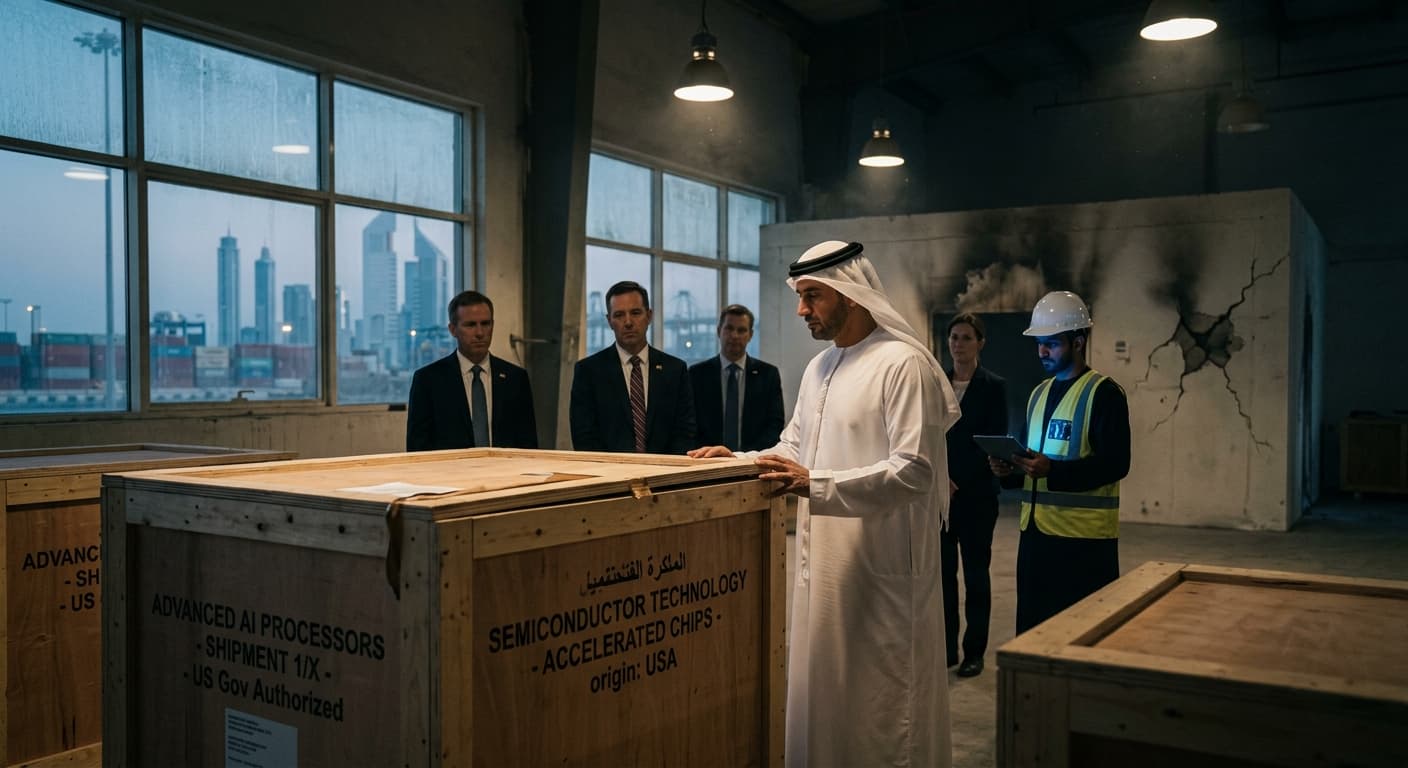
UAE Trades Combat Risk for Silicon: The Gulf's New AI Monopoly
Washington granted the UAE license-free access to advanced AI chips on July 16, 2026, after Abu Dhabi absorbed hundreds of Iranian missile strikes during Operation Epic Fury — making it the only Middle East state with unrestricted entry to America's most sensitive semiconductor technology.
The Commerce Department's reclassification of the UAE into its highest export tier converts Emirati military losses into a permanent commercial advantage, and in doing so trades the one chokepoint the United States still monopolizes in the AI race for basing rights and political loyalty. Abu Dhabi intercepted hundreds of Iranian ballistic missiles and drones and reportedly struck a refinery on Iran's Lavan Island during the US-led Operation Epic Fury, which began February 28, 2026. The reward: license-free access to advanced Nvidia chips, dual-use military equipment, and commercial satellites — a privilege no other Gulf state shares. The decision lets state-linked firms G42 and Core42 buy US semiconductors without case-by-case review, and clears the path for Amazon, Apple, Google, Meta, Microsoft, and OpenAI to build large-scale AI data centers on Emirati soil. The Defense News reported the policy change, confirmed by the Commerce Department, citing the Wall Street Journal.
The stakes extend beyond one bilateral deal. The UAE has just become the singular node through which American AI compute power flows into the Middle East — and the gatekeeper is a firm, G42, that US intelligence agencies flagged for technology ties to China's People's Liberation Army.
The military bill Abu Dhabi paid
The UAE did not merely host US bases during Operation Epic Fury. It fought. Abu Dhabi's air defenses intercepted hundreds of Iranian ballistic missiles, cruise missiles, and drones between late February and the April ceasefire. Al Jazeera reported that Iran fired more than 1,800 missiles and drones at the UAE — more than at any other Gulf state — with strikes hitting energy infrastructure, civilian areas, and commercial hubs. Emirati forces reportedly carried out dozens of airstrikes against Iranian targets, including a strike on the refinery on Iran's Lavan Island, according to the Wall Street Journal account carried by Defense News. The UAE also helped maintain commercial shipping through the Strait of Hormuz, through which roughly one-fifth of the world's oil and LNG normally transit, even as Iran mined and blockaded the waterway.
The human and economic cost was substantial. Falling debris from intercepts killed civilians in Abu Dhabi and sparked fires at the Fujairah oil hub. On April 3, 2026, debris from an intercepted attack set off blazes at the Habshan gas facility, the country's largest natural gas processing site, killing one Egyptian national and wounding four others, according to Al Jazeera. The UAE's entire airspace closed briefly amid missile warnings, and flights to Dubai and Abu Dhabi were turned back midair. By absorbing the brunt of Iran's Gulf retaliation, Abu Dhabi gave Washington something no other regional partner delivered: a forward air-defense and strike partner that stayed in the fight through the worst of it.
Commerce Department official Jeffrey Kessler called the reclassification "one of the most significant achievements of the administration." UAE Ambassador Yousef Al Otaiba welcomed the decision as strengthening "decades of close cooperation." The message from both capitals is identical: military alignment now buys technology access.
The chip bargain: what changed, and what it unlocks
The regulatory shift matters because it removes the last bureaucratic barrier between Gulf capital and American frontier silicon. Under the Biden administration's Framework for Artificial Intelligence Diffusion — published in the Federal Register on January 13, 2025 — the UAE sat in Tier 2 alongside roughly 150 other countries, subject to per-country caps of 50,000 H100-equivalent chips and mandatory validated-end-user authorizations. The rule imposed a "worldwide regional stability license requirement" for advanced computing integrated circuits, meaning every shipment of cutting-edge GPUs to Abu Dhabi required individual government review.
The Trump administration rescinded that rule in May 2025, days before it would have taken effect, according to the Council on Foreign Relations. The July 2026 reclassification goes further: it places the UAE in the same export tier as European nations, South Korea, and India, removing licensing requirements for many advanced AI chips, military equipment, and dual-use technologies outright. The UAE is now the only country in the Middle East with this level of unrestricted access.
The beneficiaries are specific. G42, the Emirati state-linked AI firm chaired by UAE National Security Advisor Sheikh Tahnoun bin Zayed Al Nahyan, and its subsidiary Core42 can now purchase advanced Nvidia semiconductors without the case-by-case licenses that previously throttled procurement. G42 is reportedly taking steps toward becoming a US-domiciled company, which would further streamline compliance. The decision also removes regulatory friction for the six American tech giants — Amazon, Apple, Google, Meta, Microsoft, and OpenAI — to proceed with large-scale AI data center projects in the UAE. The BBC reported that Abu Dhabi's Stargate data center cluster, funded by G42 and powered by Nvidia's most advanced chips, forms the centerpiece of this build-out, with Cisco, Oracle, and SoftBank also involved in the first phase.
The diversion problem Washington's own enforcers flagged
The deal's weakness is the one Washington's enforcement community has flagged for over a year. CSIS analysts noted bluntly that Saudi Arabia and the UAE are "notorious sieves" in the export-control context, with "very little confidence in the enforcement community that technology exports to them will stay there," according to CSIS. The concern is not theoretical. US intelligence agencies previously expressed concerns that G42 provided technology to China that could benefit the People's Liberation Army. G42 denied those allegations, and under US pressure in 2024 it divested from Chinese technology firms, stripped Huawei equipment from its data centers, and implemented what CSIS researchers described as military-grade encryption and Department of Defense contractor audits.
But the structural risk persists. The Congressional Research Service noted in its analysis of US export controls that the AI Diffusion Rule was specifically designed to "curtail PRC access to advanced chips and AI computing power through third countries" — precisely the scenario the UAE's new status reopens. The RAND Corporation's assessment of the diffusion framework emphasized that Tier 2 countries seeking chip access were required to meet stringent security and reporting conditions, including government-to-government assurances, before receiving validated end-user status. The UAE's elevation to the top tier effectively bypasses that gate.
The Foreign Affairs analysis framed the deeper paradox: the US government actively encouraged the Gulf AI build-out through bilateral deals and chip export approvals, then launched a war from Gulf soil that made those same data centers potential military targets. The article argued that the Pax Silica framework — a US-led effort to secure AI supply chains — "had little to say about what happens when the infrastructure itself becomes a military target," according to Foreign Affairs. Iran fired over 1,800 missiles and drones at the UAE. A direct hit on a Stargate data center housing tens of thousands of advanced GPUs would destroy billions in hardware and compromise trained model weights — a single point of failure the US just legalized.
The corruption question and the Trump family financial link
The timing of the reclassification has drawn scrutiny from members of Congress who point to a direct financial connection between UAE leadership and the Trump family. Before Trump's second inauguration, Sheikh Tahnoun bin Zayed — the UAE National Security Advisor and G42 chairman — directed a $500 million investment to acquire a 49% stake in World Liberty Financial, the cryptocurrency venture launched by the Trump family, according to Al Jazeera. Senator Elizabeth Warren said the investment generated significant financial benefits for Trump shortly before the Commerce Department approved license-free technology exports. Representative Sydney Kamlager-Dove has questioned whether the policy change represents an improper exchange of financial and political benefits.
The link is not isolated. In May 2025, a group of US senators sought to block $3.5 billion in weapons sales to the UAE and Qatar over concerns the deals would personally benefit the Trump family, citing the MGX stablecoin transaction and the World Liberty Financial investment, according to Al Jazeera. The UAE's broader $1.4 trillion investment commitment to the US over a decade, announced in March 2025, spans AI, semiconductors, energy, and manufacturing — sectors directly affected by the export-control relaxation.
The White House and the UAE have rejected any conflict of interest. The Commerce Department said the UAE has implemented strong security measures to prevent sensitive American technology from being diverted or misused. Whether those measures survive a scenario where Abu Dhabi faces simultaneous pressure from Beijing and Washington remains untested.
Discover more
India
700 Activists Accuse PM Modi of MCC Breach
Over 700 activists allege PM Modi breached election code with a televised address attacking opposition parties just before state elections.
India
CPI(M) Calls to Decouple Quota from Delimita
CPI(M) advocates for a 33% women's quota in Lok Sabha by 2029, removing the need for delimitation and census linkage.
India
Congress Accuses Modi of Stalling Women's Law
Congress accuses Modi of stalling women's reservation law by linking it to delimitation, revealing a deeper electoral strategy.

Economics
Fed's Amex AML order puts correspondent banking on notice
Federal Reserve's Amex AML order requires board-level controls and a 90-day plan; OCC fined the bank $350 million over enterprise-wide deficiencies.