Türkiye–UK Defence Partnership Deepens NATO T
A new security pact strengthens Türkiye's NATO ties.
Model Diplomat7 min readEurope
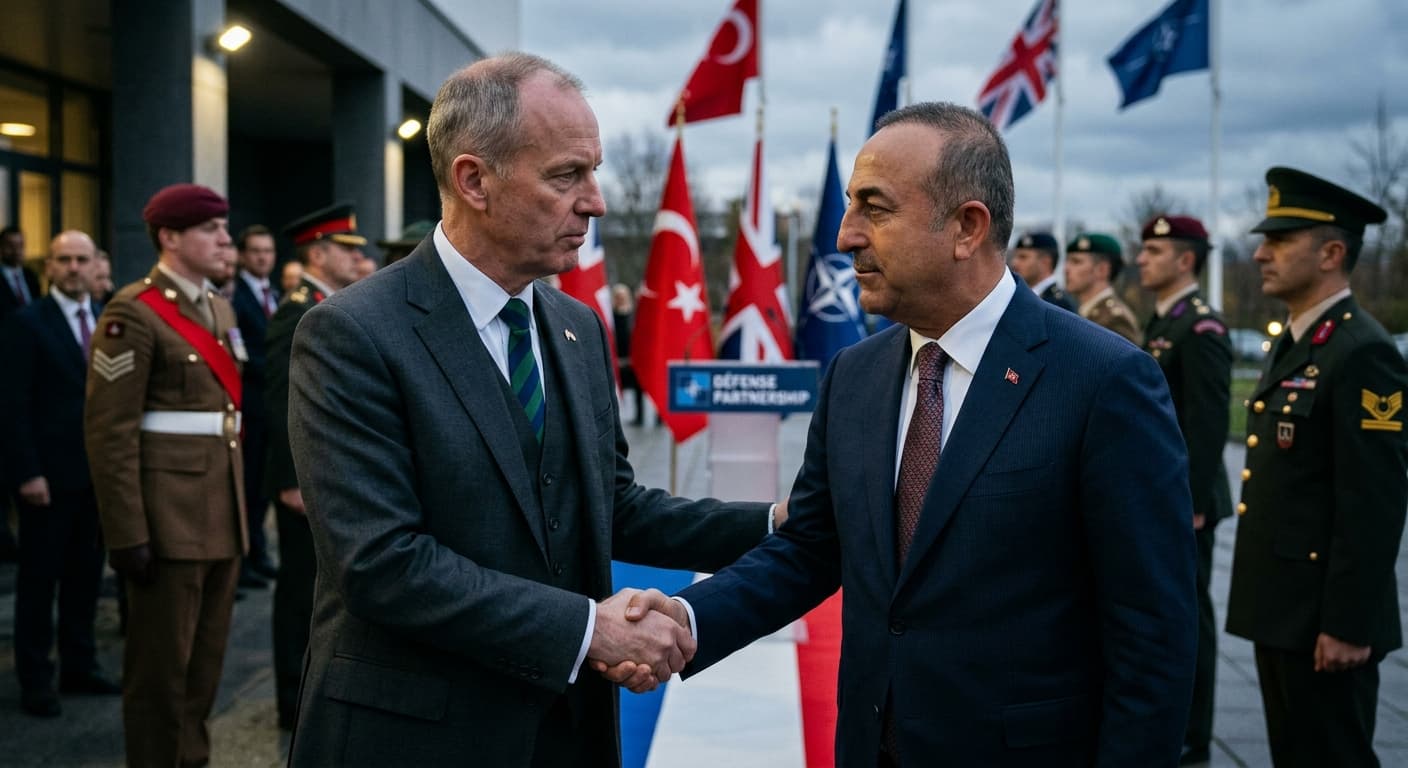
Türkiye–UK Defence Partnership Locks Ankara Deeper Into NATO
Erdoğan and Starmer signed a Security and Defence Partnership at the July 8, 2026 NATO Ankara summit — codifying Türkiye's quiet realignment toward the alliance and Britain's bid to be Europe's defence connector.
The Security and Defence Partnership signed by Recep Tayyip Erdoğan and Keir Starmer at the NATO summit in Ankara on July 8, 2026 does something more consequential than the pageant around it suggested: it institutionalises Türkiye's return to the Western defence architecture on British-brokered terms, six months after NATO-linked systems — not Ankara's Russian-made S-400s — intercepted Iranian missiles over Turkish territory. The agreement gives London a formal seat inside Türkiye's rearmament, gives Ankara political cover to bury the S-400 file, and turns the UK's post-Brexit strategy of bilateral treaty-stacking from a European exercise into a Euro-Mediterranean one. The winner is BAE Systems and the transatlantic bond Erdoğan spent a decade straining. The losers are Moscow, which loses its last major NATO customer, and Athens, whose objection to F-35 sales to Türkiye Erdoğan publicly dismissed at the summit.
What the document actually says
The published joint statement is short, deliberately so. It establishes "new mechanisms" for consultation on "deterrence and defence, military co-operation, defence industry and technology, cyber security and hybrid threats, counter-terrorism, resilience and civil preparedness and space," according to the Prime Minister's Office release on gov.uk. Ankara's Directorate of Communications confirmed the deal will underpin cooperation in "military collaboration, defence industry, cyber security, counter-terrorism, hybrid threats and space," per
Anadolu Agency. Detail beyond that is being kept classified,
Haberler reported before the signing.
The framing sentence in the UK release is the one to underline: the two sides "provide unique and irreplaceable contributions to Euro-Atlantic security" and reaffirm their commitment "to shoulder greater responsibility for building a stronger Europe in a stronger NATO … while preserving strong transatlantic bonds." That is a diplomatic sentence with three audiences: NATO's European members footing more of the bill, a Trump White House demanding they do so, and Moscow.
The BBC's security correspondent Frank Gardner, reporting from Ankara, described the agreement as one that "will pave the way for closer intelligence sharing between the countries." That is the operative language. Intelligence sharing is what the earlier UK–Türkiye instruments — a July 2025 Typhoon Memorandum of Understanding and an April 2026 Strategic Partnership Framework signed by the foreign ministers, per
gov.uk — did not formally cover.
Türkiye's quiet realignment, made public
Read the Ankara document alongside recent facts and the strategic geometry snaps into focus.
Assad's fall in late 2024 stripped Russia of leverage in Syria and removed Erdoğan's main reason to indulge Vladimir Putin. In December 2025, according to Foreign Affairs, Erdoğan asked Putin to take back the S-400 missile system whose 2019 purchase had cost Türkiye its place in the F-35 programme and triggered US sanctions under the Countering America's Adversaries Through Sanctions Act. Then, on February 28, 2026, the United States and Israel launched a three-month war on Iran. Several Iranian missiles crossed into Turkish airspace and were intercepted by NATO-linked defences in the eastern Mediterranean; the S-400s stayed idle. Germany deployed an additional Patriot battery and 150 troops to Türkiye, and previously stalled talks on the Franco-Italian SAMP/T missile defence system restarted.
That is the context in which the UK partnership landed. Aaron Stein of the Foreign Policy Research Institute argued in a Brookings analysis that Türkiye's Eurofighter purchase "marks a deliberate strategic choice by Ankara to end its path-dependence on the U.S. Air Force model." That choice is now enveloped in a broader political agreement. Ankara gets institutionalised access to a P5 nuclear power that is not the United States, without having to wait for Brussels — and without joining anything that would complicate its trade with Russia or its regional freelancing in the Caucasus.
The commercial spine of the relationship is already in place. Britain sold Türkiye 20 Eurofighter Typhoons in October 2025 for up to £8 billion, per the BBC, and a training and support contract signed in March 2026 will see 10 Turkish pilots and roughly 100 ground crew trained in the UK, according to the
Ministry of Defence. Turkish officials have said Ankara wants 120 combat aircraft in total,
Al Jazeera reported, including a further 12 second-hand Typhoons apiece from Qatar and Oman. Every one of those jets ties Turkish air power to a British-led logistics tail for two decades.
Türkiye is not arriving as a client. Its defence industry has become a NATO asset. Five Turkish arms companies feature in the SIPRI Top 100, with combined arms revenues of $10.1 billion in 2024, an 11% year-on-year rise, according to SIPRI's December 2025 release. Baykar's Bayraktar drones, exported to Ukraine and now across Europe, exemplify what NATO's supply-chain planners want more of: cheap, scalable, combat-tested. British and Turkish industry lining up under one bilateral framework is exactly the redundancy European defence ministries are chasing after the US announced a phased withdrawal of warplanes, destroyers and submarines from NATO countries, as
Al Jazeera noted before the summit.
Starmer's parting bet — treaty-stacking as strategy
The signing is also the last major foreign-policy act of a UK premier on his way out. Starmer announced his resignation in June 2026, the BBC noted, and Ankara was his final NATO summit. He leaves office having built, in twenty-four months, a dense web of bilateral security partnerships with almost every European power that matters.
Chatham House's Armida van Rij called the July 2025 Kensington Treaty with Germany the completion of an "E3 triangle" of Franco-British Lancaster House, Franco-German Élysée and now UK–German legal architecture. The Türkiye partnership extends that architecture southward. It is smaller in ambition than the German treaty — there is no mutual defence clause on top of Article 5, no counterpart to the Franco-German brigade — but it is broader in industrial scope, covering space, cyber and counter-terrorism where the Poland treaty focused on migration and the Netherlands statement on maritime infrastructure.
The strategic logic is the same each time. Poland's OSW think tank put it plainly after the Kensington signing: these documents are Europe's insurance policy against "concerns over the future of the US military presence in Europe, the Russian threat," and Brexit's institutional vacuum. Starmer's Ankara text repeats the same words — "stronger Europe in a stronger NATO" — that appear in the German, Polish and EU partnerships. It is not accident. It is doctrine.
The UK's own defence-industrial position is weaker than the rhetoric suggests. Chatham House's Ed Arnold has warned that the UK's Defence Investment Plan sets no visible trajectory toward the 3.5% of GDP target NATO members agreed to at The Hague in 2025 and contains a £1.2 billion-per-year shortfall. By 2030, Germany plans to spend €188.4 billion on defence — twice the projected UK figure of £79.1 billion. Britain compensates the way it always has: with export deals, industrial partnerships and clubbable diplomacy. Türkiye is now the largest such node on its southeastern axis.
What could break it
Three fault lines are already visible.
First, the F-35. Donald Trump told reporters after the summit that his "inclination" is to reverse the 2019 exclusion of Türkiye from the programme, though he had not "totally made up my mind," according to Al Jazeera's live coverage. Trump also floated lifting CAATSA sanctions. Benjamin Netanyahu opposes the sale; Greece opposes it; Erdoğan told the summit that these objections "have no place in my world." If the F-35 returns, the strategic argument for further UK–Türkiye combat-air integration weakens; if it does not, the Typhoon relationship becomes indispensable to Türkiye and the UK partnership deepens by default. Britain benefits from either outcome, but the direction it wants is clear.
Second, arms-export politics. Britain and Germany have agreed to harmonise arms-export laws, OSW notes, joining a 2019 Franco-German treaty framework that Spain has already signed. Berlin's caution over exports to Türkiye — long the main obstacle to Eurofighter sales — has softened but not vanished. If a Turkish operation in northern Syria or against Kurdish groups triggers a Bundestag revolt, the entire Eurofighter maintenance chain that the UK partnership underwrites could seize up.
Third, Starmer himself is leaving. Turkish leaders build partnerships with individuals, not institutions. The intelligence-sharing arrangements the partnership envisages will depend on the trust between Erdoğan and Starmer's successor — a successor not yet named as of July 9, 2026.
Diplomat View
The Ankara document is not a treaty and does not create a mutual defence obligation. Its power is that it exists at all. For a decade, Türkiye was NATO's most awkward member: buying Russian air defences, blocking Nordic accession, weaponising its veto over Sweden and Finland. Between the fall of Assad, the failure of the S-400 during the Iran war and Erdoğan's own conclusion that Putin is now a losing bet, that period is closing. The UK saw the opening earliest and moved. The forecast: within twenty-four months, expect a follow-on industrial protocol tying BAE Systems to Turkish Aerospace Industries on a specific programme — most likely long-range munitions or unmanned systems — and expect a joint UK–Turkish contribution to NATO's planned multinational corps in Türkiye, targeted for completion by 2028. Revision conditions: a Turkish military operation in Syria that Berlin freezes Eurofighter deliveries over; a full Trump-brokered F-35 sale that makes British platforms secondary; or the collapse of the UK Labour government's defence investment plan under fiscal pressure, which would strip Britain of the industrial leverage this partnership rests on.
What to watch next
- US decision on Türkiye's F-35 re-entry and CAATSA sanctions relief. Trump said the choice is "a decision we are going to make." Expect movement by autumn 2026.
- The UK–Türkiye Free Trade Agreement. Negotiations opened in June 2025 on trade worth almost £28 billion; a signed FTA is the commercial ratification of this partnership.
- The 2028 target for a NATO multinational corps headquartered in Türkiye. Britain has not yet said whether it will contribute a framework brigade.
- Starmer's successor and the first UK–Türkiye ministerial dialogue under the new mechanisms. The partnership specifies new consultative structures; their first meeting will show whether Ankara treats the document as durable or Starmer-specific.
Discover more

India
BJP's Misunderstanding of Women's Quota Needs
The BJP's linking of the Women Reservation Bill to delimitation risks delaying women's empowerment in India, misreading the aspirations of female voters.

US Politics
SNAP Food Assistance Faces Legal Challenges
In 2026, SNAP faces stricter eligibility rules and mounting legal challenges, threatening food assistance for the millions of Americans who rely on the program.
US Politics
House Ethics Committee Pushes Sexual Miscond.
The House Ethics Committee has shifted responsibility for sexual harassment settlement records to the Office of Congressional Workplace Rights, complicating disclosure efforts.

Economics
Fed's Amex AML order puts correspondent banking on notice
Federal Reserve's Amex AML order requires board-level controls and a 90-day plan; OCC fined the bank $350 million over enterprise-wide deficiencies.