Tanzania's Foreign Policy Shift in Practice
Infrastructure diplomacy reshapes Tanzania's global stance.
Model Diplomat4 min readafrica
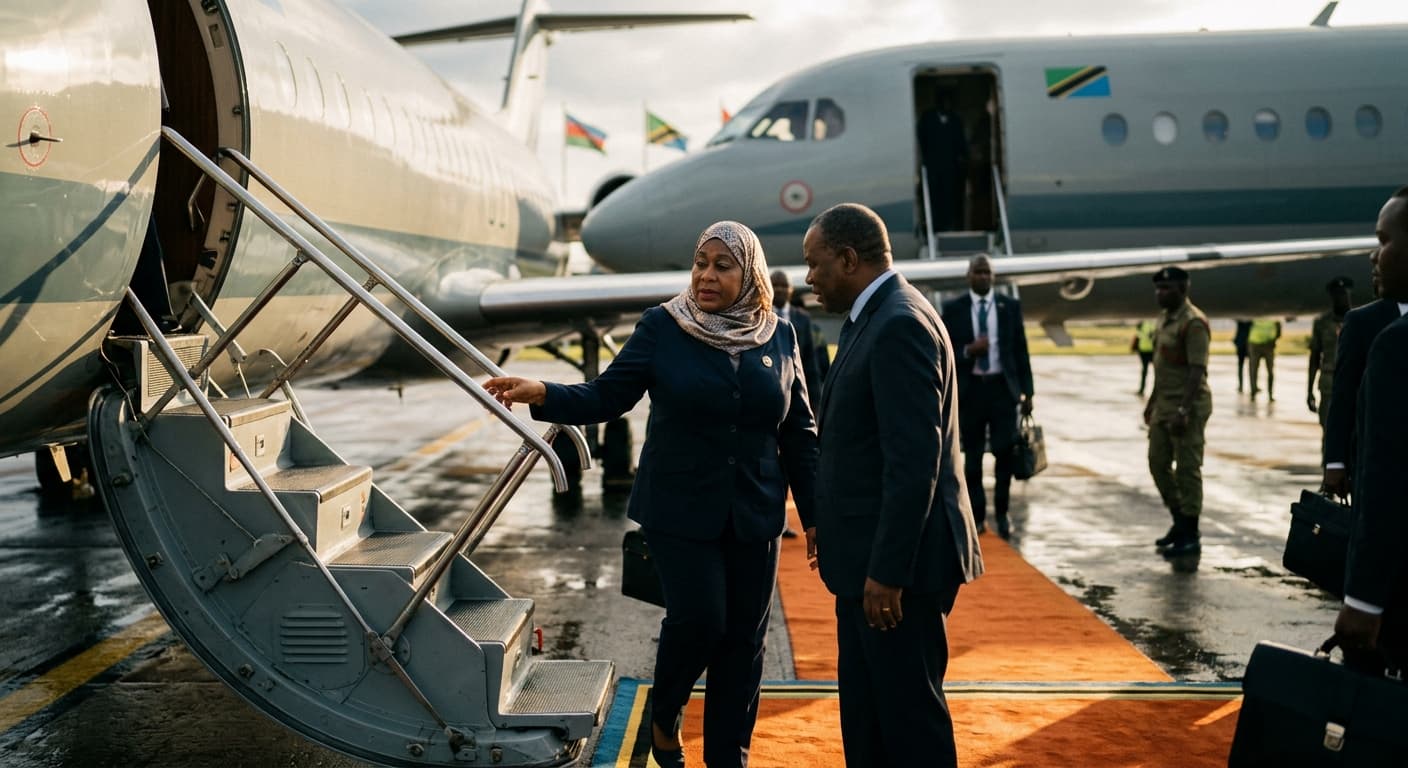
Tanzania's Foreign Policy Is No Longer What It Says on Paper
Tanzania's official foreign policy framework is being rewritten in practice — infrastructure diplomacy and regional energy integration are outpacing the formal strategy review President Samia commissioned in 2023.
The Tanzania Ministry of Foreign Affairs still lists the guiding principles any diplomat would recognize: sovereignty, non-alignment, African unity, South-South cooperation, and economic diplomacy. But the document — rooted in the "New Foreign Policy of 2001" — is now a lagging indicator. President Samia Suluhu Hassan has spent five years rebuilding the international credibility that her predecessor John Magufuli torched, and the real foreign policy is being executed through deals, not doctrine.
The shift is measurable. Under Magufuli (2015–2021), Tanzania clashed with the EU and UN, withdrew from international commitments, and made precisely ten official trips abroad in six years. Samia, by contrast, has pursued what Chatham House describes as "a gradual renewal of Tanzania's commitment and voice on international and multilateral issues" — anchored in an official foreign policy review commissioned in 2023, the first attempted refresh in over two decades.
The review's conclusions have not been formally released. But Tanzania's actions in 2025–2026 tell you where policy is headed before the ink is dry.
Economic Diplomacy, Delivered Through Infrastructure
The signature move is the Lobito Corridor, a transcontinental logistics axis linking Angola's Atlantic port to Tanzania's Indian Ocean coast via Zambia. In June 2026, outgoing Tanzanian ambassador to Angola Matheus Edward Mkingule confirmed that interconnection with the Tanzania-Zambia Railway Authority (TAZARA) is proceeding, creating "a logistical axis between the Atlantic and the Indian Ocean," according to Angola Press Agency. A 2025 state visit by Samia to Luanda cemented the framework. This is not symbolic — it positions Tanzania as the eastern terminus of a corridor that will move minerals, agricultural goods, and manufactured products across the continent, directly serving the African Continental Free Trade Area's ambitions.
Simultaneously, Tanzania is stitching itself into East Africa's energy grid. The Ethiopian News Agency reported in May 2026 that Tanzanian Deputy Minerals Minister Stephen Kiruswa confirmed electricity is already flowing through a regional power-sharing platform connecting Ethiopia, Kenya, and Tanzania. The Mwalimu Julius Nyerere Hydropower Project — one of Africa's largest dams — will export surplus power to Zambia and Malawi. Tanzania is also advancing nuclear energy feasibility, with Samia telling the Nuclear Energy Innovation Summit for Africa in Kigali that small modular reactors are under "active consideration" as part of the Tanzania Development Vision 2050, per
Ghana News Agency.
What the Formal Policy Still Obscures
The official foreign policy document emphasizes non-alignment and South-South cooperation — principles inherited from Julius Nyerere's era. But the practice under Samia reveals a more pragmatic architecture: hedged diversification. Tanzania is simultaneously deepening ties with China (the $10 billion Bagamoyo port talks were restarted), repairing relations with the U.S. (AGOA renewal, critical minerals processing), courting Gulf Arab states (port investments), and building new partnerships with Indonesia, Vietnam, and Turkey.
Chatham House flags that "entrenched suspicion of external investment remains a significant obstacle," exacerbated by domestic political constraints. Samia still governs within the Chama Cha Mapinduzi (CCM) party structure that enabled Magufuli's isolationism. The foreign policy review must reconcile the economic imperatives of openness with a ruling party that remains instinctively suspicious of external leverage — particularly around port concessions and extractive industries.
Who Benefits
Tanzania's industrial base stands to gain if the Lobito Corridor and regional energy integration lower logistics costs and stabilize power supply. International mining firms — including those in nickel (Lifezone Metals' Kabanga project) and LNG (Equinor, Shell, ExxonMobil) — are watching whether the policy review codifies value-added processing requirements before export. Zambia and the DRC gain an Atlantic-Indian Ocean export route that bypasses congested South African ports. Kenya faces a competitive threat: the Voi-Taveta railway rehabilitation linking Mombasa's SGR to Tanzania's network is still in feasibility stages, even as Dar es Salaam accelerates its own corridor ambitions.
What to Watch
The formal foreign policy review document remains the outstanding variable. Its release — or continued delay — will signal how much consensus Samia has built within CCM for an outward-facing strategy. The next concrete test is whether Tanzania rejoins international frameworks it abandoned under Magufuli, particularly on human rights reporting and extractive industry transparency. And the 2025 general election, which returned Samia to office in her own right, gives her a mandate — but how aggressively she uses it depends on a party that has not yet decided whether economic openness is a strategy or a threat.
Discover more

Global Politics
U.S. Naval Blockade Heightens Iran Tensions
The U.S. naval blockade of Iran collapsed oil exports, creating a new maritime regime in Hormuz that favors Tehran.
US Politics
U.S. House Passes Alert Act for Aviation
The House passed the ALERT Act 396–10, replacing the ROTOR Act after Pentagon intervention, impacting aviation safety regulations.

Global Politics
US Naval Blockade on Iran
The US fully imposed a naval blockade on Iranian ports, escalating tensions even as Trump hinted the conflict may soon end while serious risks of war remain.

Economics
Fed's Amex AML order puts correspondent banking on notice
Federal Reserve's Amex AML order requires board-level controls and a 90-day plan; OCC fined the bank $350 million over enterprise-wide deficiencies.