TVK’s Numbers Stall as Governor Seizes the Clock
Vijay’s claim to power is stuck in procedural limbo: the governor is demanding proof, allies are hesitating, and the swearing-in has been pulled back.
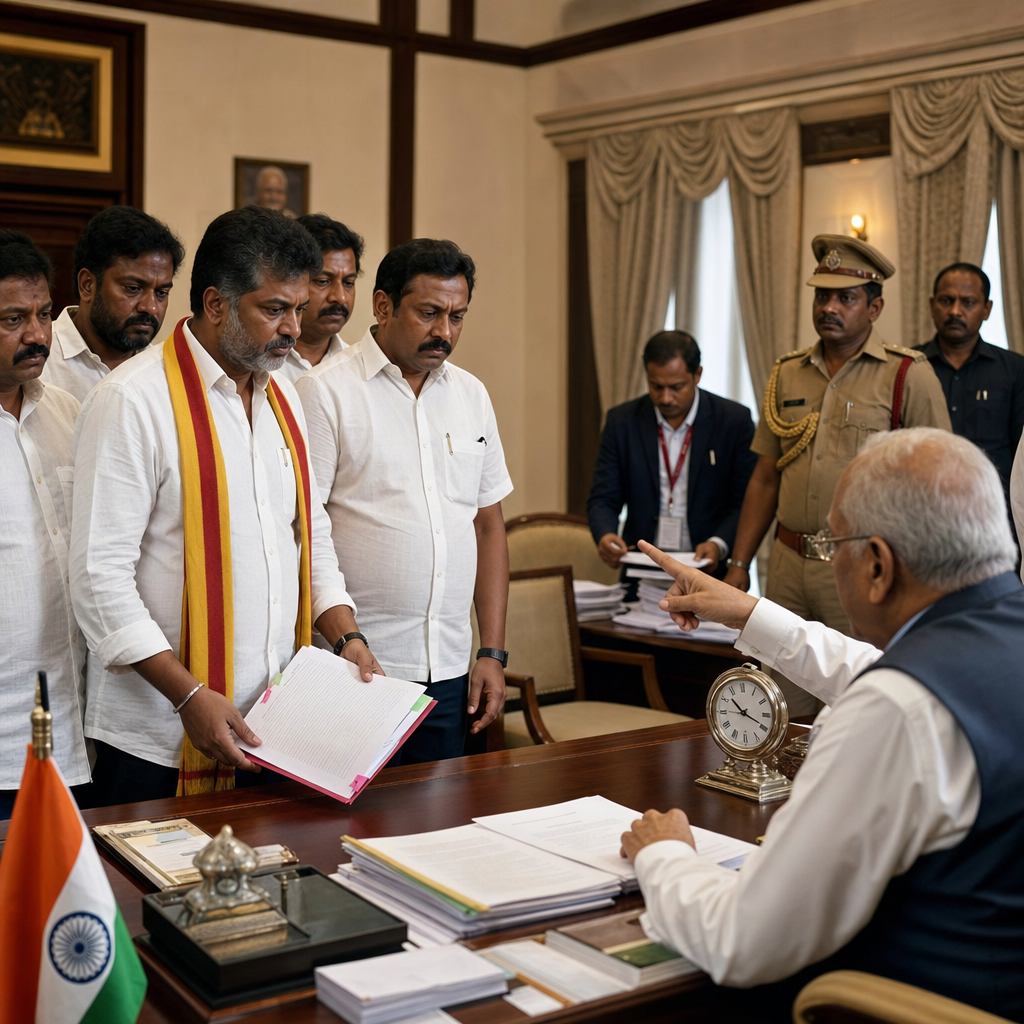
The power dynamic in Chennai is no longer about who won the most seats; it is about who can certify the count. Governor Rajendra Arlekar now controls the timing, after telling TVK chief C. Joseph Vijay that the “requisite majority support” has not been established and then calling off Saturday’s swearing-in, according to  The Hindu and
  The Indian Express.
The arithmetic is real, and it is fragile
TVK’s problem is not optics; it is arithmetic. The party won 108 seats in the 234-member Tamil Nadu Assembly, but Vijay is expected to vacate one of the two constituencies he won, reducing TVK’s effective strength to 107 and pushing the majority threshold to 117 in a 233-member House, according to The Hindu and  The Economic Times. Congress has five MLAs, and the Left, VCK, and IUML are being courted, but several of those parties have only said they will decide after internal consultations, not that they have committed, The Hindu reported.
That leaves Vijay short of a clean, documented majority. In a fractured House, that matters because the governor’s refusal to treat the single-largest party as self-evidently entitled to office has turned coalition math into a gatekeeping tool. For a new party like TVK, the benefit of its electoral surge is obvious; the cost of not locking in allies quickly is equally clear.
The old parties gain leverage from the delay
The delay creates space for Tamil Nadu’s established players to regroup. The Indian Express reported that DMK and AIADMK figures were already gaming out fallback arrangements if Vijay failed to prove his numbers, which is a reminder that a hung Assembly does not just produce uncertainty — it gives the defeated parties a second chance to shape the outcome. The longer TVK stays short of the line, the more room there is for rival bargaining, tactical abstentions, or a constitutional challenge over the governor’s remit.
There is also a broader institutional issue here. The Hindu quoted former law minister Ashwani Kumar arguing that the proper course is to invite the leader and then test majority on the floor of the House. That framing matters because it pits constitutional convention against Raj Bhavan’s insistence on documentary proof in advance. In practice, the governor’s reading determines whether TVK gets an early oath-taking or must keep negotiating outside the House.
What to watch next
The next decision point is simple: whether the VCK, IUML, and the remaining undecided MLAs submit formal letters of support, and whether the governor accepts them as enough to proceed. If they do, Vijay can still be sworn in. If they do not, the fight shifts from arithmetic to procedure — and likely into court. For the bigger state-level readout, see  India and Global Politics.