Turkey's Protest Ban Ahead of NATO Summit
Ankara's crackdown on dissent raises concerns for NATO leaders.
Model Diplomat7 min readEurope
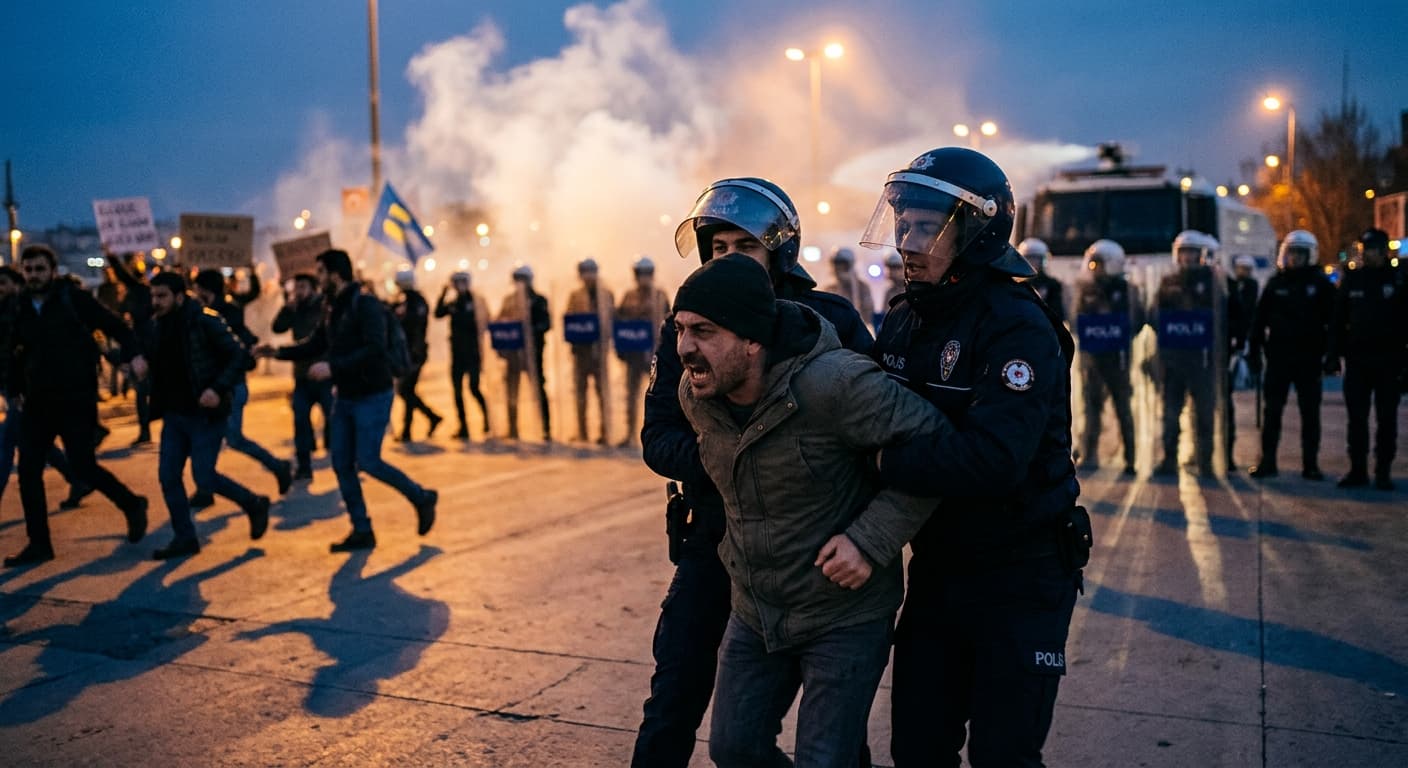
Turkey Detains Hundreds as Ankara Protest Ban Shields NATO Summit
Turkey jailed 103 people ahead of the NATO summit, banned protests for 13 days and dispersed anti-NATO marches with tear gas — what the alliance is walking into.
Turkey has converted the 36th NATO summit into cover for the most sweeping suppression of assembly rights in the capital in a decade — a 13-day blanket protest ban, dawn raids that swept up 225 people, and pretrial detention for lawyers, journalists, academics, and Communist Party activists whose only alleged offence is opposing an alliance meeting on Turkish soil. The story that matters is not the detentions alone; it is that a NATO host is now testing whether allied leaders will publicly tolerate the erosion of an Article 2 obligation — democracy, human rights, the rule of law — inside the alliance itself.
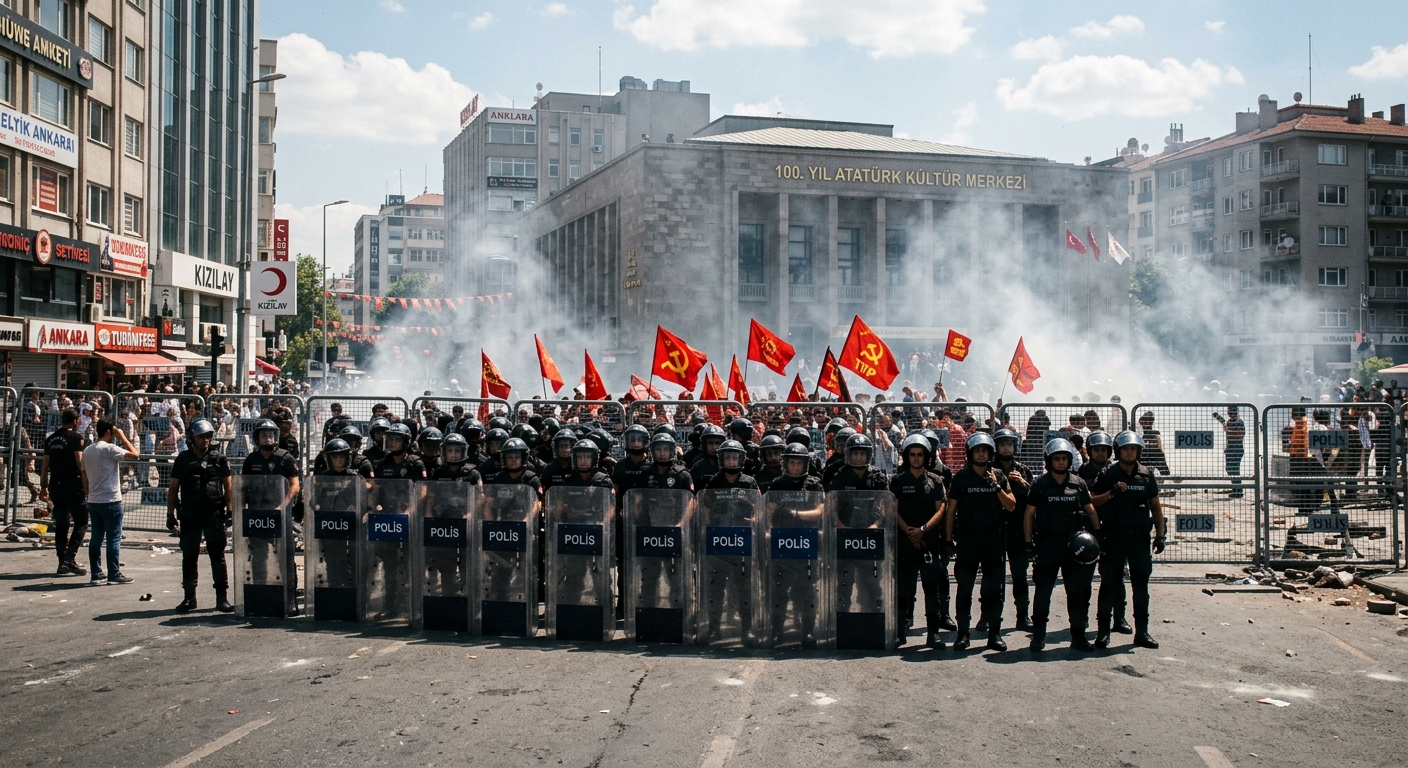
What happened on the ground
Police in central Ankara moved on a Communist Party of Turkey (TKP) march in Kızılay Square on Sunday, using tear gas to disperse demonstrators chanting "Murderer NATO, get out of the country." The party said in a follow-up statement that 145 of its members had been detained across Ankara, Kocaeli and the western district of Soma, and it framed the arrests as an attempt to criminalise anti-NATO discourse. Parallel marches ran in Istanbul from Taksim toward Dolmabahçe, in Izmir's Buca district toward a NATO command facility, and in Adana, Samsun and Çanakkale, according to Turkish Minute.
The Sunday sweep is the tail end of a much larger operation. On 22 June the Ankara Governorate announced a province-wide ban on all public assemblies from 28 June through 23:59 on 10 July — 13 days that entirely enclose the 7–8 July summit at the Beştepe Presidential Compound. According to a statement by the Ankara Chief Public Prosecutor's Office on 25 June, 225 people were rounded up in dawn raids on 23 June; 135 were referred to court, 103 remanded in pretrial detention, and 26 placed under judicial control, including house arrest.
The Ankara police directorate has deployed 56,000 security personnel for the summit and criminalised, until 10 July, "any form of demonstration, stand, tent, leaflet, brochure, poster or banner" inside the capital, BBC Türkçe reports. A further wave of dawn raids on 6 July detained journalists including T24 foreign-desk editor Buse Söğütlü and Oda TV editor Ceren Erdoğdu, plus lawyers from the Progressive Lawyers' Association and academics such as Sibel Özbudun and writer Temel Demirer.
The scale — and why it isn't just about NATO
The pre-summit sweep sits inside a broader pattern documented by Human Rights Watch on 3 July, which concluded that Turkey's "increased geopolitical capital … is proving convenient cover for President Recep Tayyip Erdoğan to jail and remove political rivals and critics at home." HRW's Emma Sinclair-Webb wrote that police "rounded up over 200 people right after the authorities announced draconian bans" and that Erdoğan "is able to count on there being barely a murmur from the country's European partners."
The domestic backdrop is the incarceration of Istanbul mayor Ekrem İmamoğlu, held since March 2025, who — per Turkish Minute — faces three separate hearings on 6 July, the same day NATO leaders arrive. On 21 May 2026, an Ankara regional court removed the entire national leadership of the opposition Republican People's Party (CHP), including chair Özgür Özel, an order the former head of Turkey's Constitutional Court described as a graver democratic breach than any prior party closure. Days later riot police cleared the CHP headquarters with tear gas. Stand-up comic Deniz Göktaş was jailed on 3 July over an Erdoğan-and-Quran routine that drew 9.4 million YouTube views, BBC News reported.
The number that reframes the picture: Turkish Minute reports that Turkey's prison population has surpassed 427,000 and is now at 140 percent capacity — a system already overloaded absorbing the pre-summit intake.
The legal frame European capitals keep declining to invoke
Turkey is not a marginal violator of the European Convention on Human Rights; it is the outlier. According to a joint advocacy briefing by Human Rights Watch, the International Commission of Jurists and the Turkey Human Rights Litigation Support Project, Turkey accounted for 22,450 pending cases at the European Court of Human Rights as of November 2024 — 36.7% of the court's total caseload — and, as of June 2024, had 156 leading and 375 repetitive ECtHR judgments unimplemented, the worst record among all 46 Council of Europe members. The unimplemented rulings cluster precisely on Articles 5, 10 and 11: liberty, expression and assembly.
The European Parliament's 2025 resolution on the Commission's Türkiye report formally condemned Ankara's "sustained and deliberate decision to illegally keep imprisoned, on political grounds, prominent figures such as former HDP party co-chairs Selahattin Demirtaş and Figen Yüksekdağ … and human rights defender Osman Kavala," despite ECtHR rulings ordering their release. Parliament called on member states "to consider applying relevant funding conditionality in relation to compliance with ECtHR rulings." A blanket protest ban and a wave of remand detentions in the run-up to a NATO summit would, on the case law, engage every one of those articles.
Amnesty International's Esther Major put the standard plainly:
"Pretrial detention is an exceptional measure which cannot be deployed to prevent people from exercising their protected rights, such as freedom of peaceful assembly and expression."
That is precisely the tool the Ankara prosecutor's office has used against 103 people ahead of the summit.
Why NATO members are unlikely to say much
The North Atlantic Treaty's preamble binds signatories to "the principles of democracy, individual liberty and the rule of law." The 2026 summit agenda has no room for any of them. According to NATO's own overview of the Ankara summit, the three formal priorities are defence investment toward the 5%-of-GDP target set at The Hague, the Defence Industry Forum, and long-term support for Ukraine. The
U.S. Congressional Research Service briefing for the summit frames the meeting as an exercise in managing Donald Trump's criticisms of the alliance and codifying "NATO 3.0" — a stronger Europe under a still-anchored U.S. There is no line item on host-country democratic backsliding.
Turkey's leverage is why. It fields NATO's second-largest army; hosts the Allied Land Command in Izmir, the Kürecik early-warning radar, and the NATO Rapid Deployable Corps in Istanbul; and, per the European Parliamentary Research Service briefing on the Ankara summit, took command of the KFOR mission in Kosovo in October 2025. Germany approved €230 million in arms exports to Turkey in 2024 and cleared Eurofighter sales in late 2025; the UK signed its own Typhoon deal the same week. Ankara has become indispensable to European rearmament — precisely the story NATO wants to sell in the Beştepe compound.
That indispensability is the ceiling on protest. Germany's Social Democrats — the junior coalition partner — have urged Chancellor Friedrich Merz to "clearly address" Turkey's rule-of-law record with Erdoğan, SPD deputy parliamentary leader Siemtje Möller told the Funke Media Group. Merz's own October 2025 Ankara visit produced only a general reference to "European standards"; the
Centre for Eastern Studies (OSW) assessed that Berlin's model is now a "pragmatic" one in which "contentious issues such as democracy and human rights would play a lesser role." Rutte's own
pre-summit press conference with Merz did not mention the detentions.
The second-order effect is quieter but consequential. NATO's decision to deny accreditation to several independent Turkish outlets — a point Amnesty flagged and the Turkish Journalists' Association protested — outsources media-access decisions to the host government. When the alliance's premier convening delegates newsroom access to a state actively jailing its journalists, it validates the tool.
Who benefits, who loses
Erdoğan wins the optics of a "successful" host and buys 13 days in which peaceful opposition to his most sensitive foreign-policy relationship is legally impossible. The Trump administration wins a summit centred on the 5% spending pledge, without the awkwardness of asking the second-largest army in the alliance to release a mayor. European capitals win an unchallenged industrial and rearmament agenda underwritten by Turkish drone production and Turkish airspace.
The losers are named: İmamoğlu, who faces three courtrooms in a single day; Özel, the removed CHP chair; Kavala, in his ninth year of imprisonment; Demirtaş, in his tenth; the 103 remanded before the summit even opened; and the ECtHR system itself, whose enforcement mechanism has already been triggered once against Turkey — the second time in Council of Europe history under Article 46(4) — with no meaningful behavioural change.
What to watch
- 8 July, 15:00 Ankara time — NATO Secretary General Mark Rutte's closing press conference at the Beştepe compound. Watch for any allied leader referencing İmamoğlu, the protest ban, or the detained journalists on record. Silence is the story.
- 10 July, 23:59 — expiry of the Ankara Governorate's assembly ban. If it is extended or replicated in Istanbul around İmamoğlu hearings, the "summit exception" has become the template.
- September 2026 Council of Europe Committee of Ministers session — the next scheduled review of Turkey's compliance under the Kavala infringement proceedings. The summit-window detentions will be part of that file.
- CHP presidential candidacy — whether İmamoğlu remains a viable candidate after his 6 July hearings; a conviction would resolve Erdoğan's principal domestic problem before any allied leader has left Turkish airspace.
The Bottom Line
Turkey has used a NATO summit as a legal pretext to jail more than 100 people, ban all protest in its capital for nearly two weeks, and disperse dissent with tear gas — and 31 allied democracies are letting it happen because Ankara is now too central to European rearmament to challenge. The Ankara summit will be remembered less for the 5% target than for what it revealed about the alliance's real hierarchy of values: capability first, Article 2 last.
Discover more
India
700 Activists Accuse PM Modi of MCC Breach
Over 700 activists allege PM Modi breached election code with a televised address attacking opposition parties just before state elections.
India
Congress Accuses Modi of Stalling Women's Law
Congress accuses Modi of stalling women's reservation law by linking it to delimitation, revealing a deeper electoral strategy.

US Politics
House Ethics Committee Pushes Sexual Miscond.
The House Ethics Committee has shifted responsibility for sexual harassment settlement records to the Office of Congressional Workplace Rights, complicating disclosure efforts.
Global
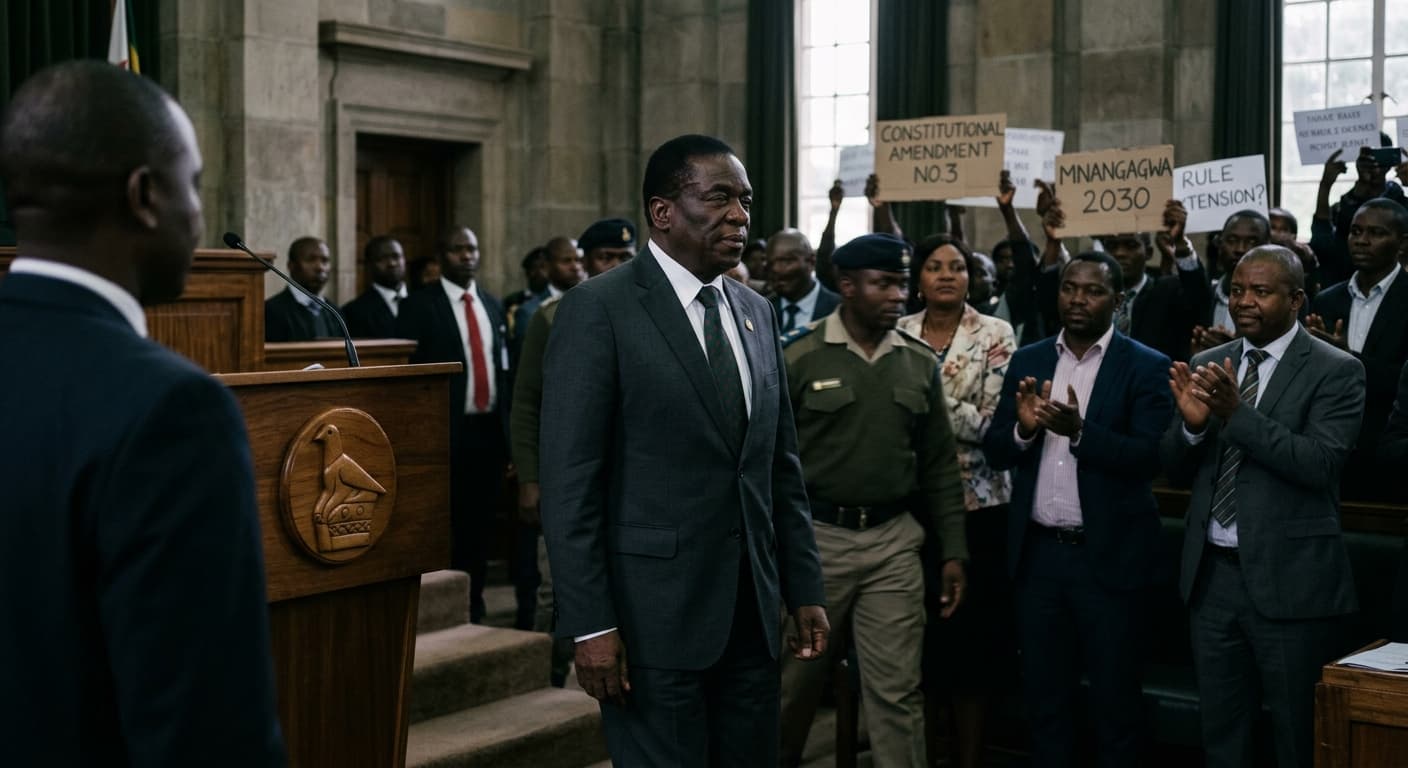
Zimbabwe's 2030 Gambit: Mnangagwa's Rule
Zimbabwe's Constitutional Amendment No. 3 ends direct presidential elections, extending Mnangagwa's rule to 2030 and raising concerns over democratic integrity.