Turkey's F-35 Reset: What Trump Can Deliver
Trump's promises to Turkey face legal and political hurdles.
Model Diplomat10 min readEurope
Turkey's F-35 Reset: What Trump Can Actually Deliver
Trump pledged in Ankara to lift 2020 CAATSA sanctions on Turkey and reopen the F-35 sale, but U.S. statute, an angry Congress, and Israeli lobbying mean the real winners are Europe's Eurofighter consortium and Turkey's KAAN program — not Lockheed Martin.
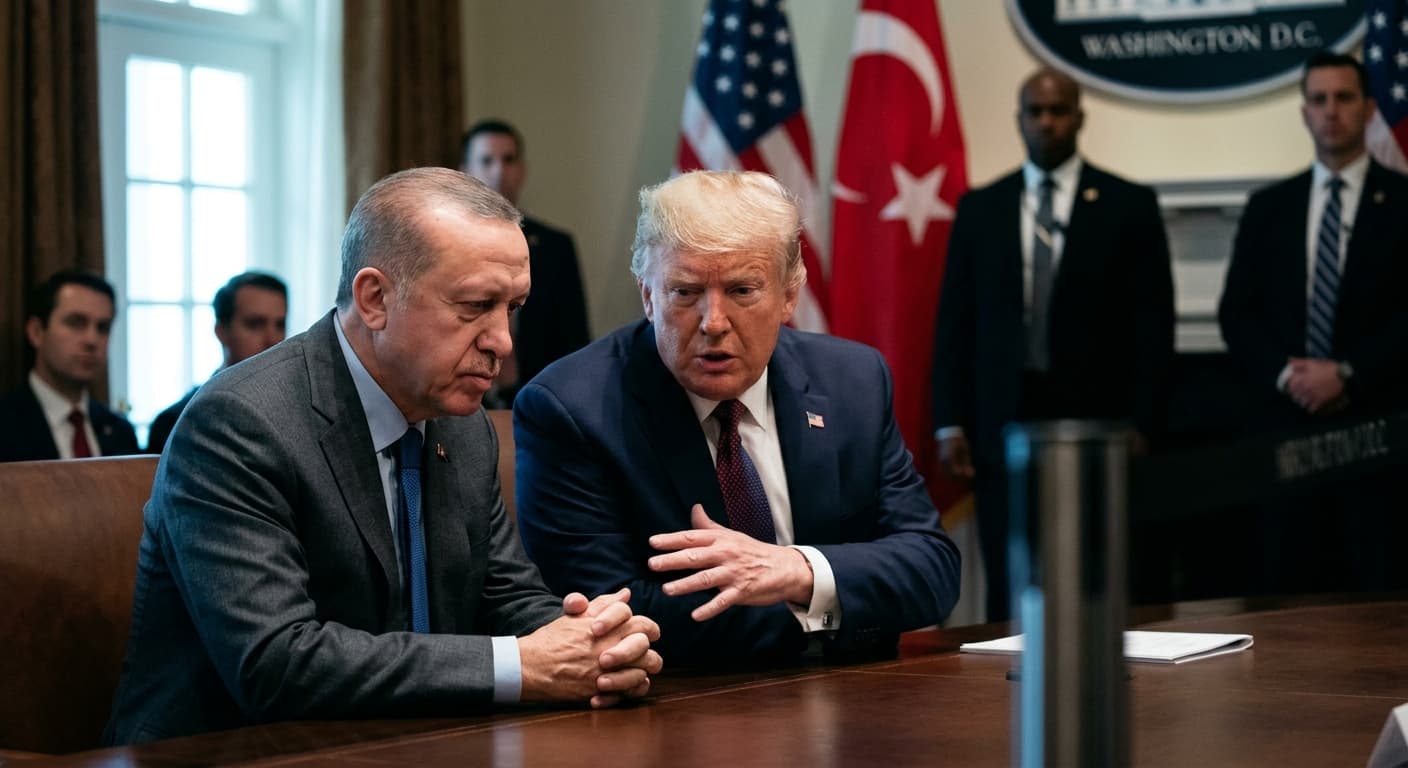
Donald Trump used the July 7, 2026 NATO summit in Ankara to promise Recep Tayyip Erdogan two things Washington has withheld for six years: removal of the Countering America's Adversaries Through Sanctions Act (CAATSA) designations imposed in December 2020, and a reconsideration of the F-35 sale that Turkey lost after buying Russia's S-400. Neither is Trump's to give alone. Both are locked in by federal statute — CAATSA Section 231 and Section 1245 of the FY2020 National Defense Authorization Act — that require either the physical removal of the S-400 or a congressional rewrite. The gesture matters anyway, but not for the reasons Ankara is selling. The biggest immediate beneficiary of the Ankara reset is not Lockheed Martin; it is BAE Systems, the Eurofighter consortium, and GE Aerospace, whose engine sale to power Turkey's indigenous KAAN fighter was already notified to Congress on June 24. The signal to markets and to the Eastern Mediterranean is what actually moves — and it moves in Europe's favor.
What Trump promised and what the law says
At a bilateral before the summit opened, Trump told reporters CAATSA sanctions "destroy" the alliance's internal balance and would be removed, and called the F-35 "the best plane by far" while saying he would "definitely" evaluate a sale. Erdogan went further on the podium, claiming Trump had "given his word" on the six F-35As Turkey has already paid $1.7 billion for and that remain in U.S. storage at Luke Air Force Base, according to Al Jazeera's summit coverage. By the closing news conference on July 8, Trump had walked the F-35 line back to "I haven't totally made up my mind, but my inclination is to say, look, he's done everything," per the
Al Jazeera live blog. That's the tell — an inclination, not a decision.
The statutory reality is unambiguous. CAATSA Section 231 makes sanctions on significant transactions with Russia's defense sector mandatory; termination requires the president to certify to Congress that Turkey "no longer possesses the S-400 air and missile defense system," per the text preserved on Congress.gov. Waiver authority is 180 days at a time, renewable, and requires a national-security determination on paper. Section 1245 of the FY2020 NDAA is a separate prohibition on transferring F-35s to Turkey with the same S-400 condition. The
Congressional Research Service, in its June 2026 update on Turkey, notes flatly that in response to an August 2025 letter from 40 Members of Congress, the State Department confirmed the U.S. position on "Turkey's acquisition and continued possession of the Russian S-400 system has not changed."
That last phrase is the trapdoor. Nothing Trump said in Ankara alters the certification requirement. As BBC Türkçe's summit explainer laid out, permanent removal of CAATSA requires legislation; even a 180-day waiver requires a detailed report to Congress and evidence the S-400 has been rendered inoperable or removed. The two options U.S. and Turkish officials have floated since a March 2025 Trump-Erdogan call, according to CRS, are partial dismantling of the S-400 or moving it to a U.S.-controlled facility on Turkish soil. Neither has happened. Turkish Foreign Minister Hakan Fidan told domestic press in April 2026 that CAATSA has already blocked roughly $20 billion in F-16 spare parts alone — a number that suggests Ankara's real pain point is not the F-35 it never got, but the fleet it already flies.
The historical rhyme is 2019. As Reuters reported at the time, Erdogan left the G20 in Osaka convinced Trump would waive sanctions once S-400 deliveries began. He was wrong then because Congress made it impossible. The players in 2026 are the same; the statute is the same; the calculation should be the same.
The market has already made up its mind
Turkish assets did not spike on the summit headlines because the reset has been priced in since late 2025. In its January 2026 Article IV consultation, the IMF put end-2026 inflation at 23 percent — down from a peak above 75 percent in mid-2024 — with the CBRT policy rate at 37 percent and 4.2 percent projected growth. The World Bank's
June 2026 monitor trimmed 2026 growth to 2.8 percent because of the June Iran war energy shock — Brent up 36 percent on average, natural gas 67 percent — but confirmed the disinflation glide path. The CBRT held its policy rate at 37 percent at its June 2026 meeting after a rate-cutting cycle that started in December 2024 and was briefly reversed in April 2025 when markets seized up,
per BBC Türkçe. No CAATSA-related lira selloff has materialised because sanctions relief has been the base case for six months.
That macro picture rests on a specific bet: that Turkey is done pivoting to Moscow. Foreign Affairs' Aaron Stein and Sinan Ülgen documented the reversal in June 2026, reporting that Erdogan in December 2025 asked Putin to take back the S-400 after years of insisting he would buy a second battery. Erdogan's calculation: with Assad gone in Damascus in late 2024, the U.S. drawing down in Syria, and Iran degraded by the June 2025 U.S.-Israel war, the geopolitical rationale for hedging with Russian air defense collapsed. What replaced it was a shopping list — the F-16 Block 70/72 package, the Eurofighter deal, the GE F110 engines for KAAN, and, if it can be unlocked, the F-35.
The second-order effect worth naming: Russia is the loser twice over. It lost Syria in December 2024, and it is losing its most consequential foreign S-400 customer. Vladimir Putin, according to the Foreign Affairs authors, has effectively been asked to unwind the deal that was Moscow's biggest strategic disruption of NATO in a decade — for $2.5 billion, the S-400 kicked a NATO ally out of the F-35 program and sanctioned it. Now it is being warehoused to reverse both.
The winners are already booked — and most of them aren't American
Look at who is holding signed paper. On October 27, 2025, Keir Starmer and Erdogan signed a £8 billion ($11 billion) contract for 20 Eurofighter Typhoons, the largest UK fighter export deal in nearly two decades, with first deliveries in 2030 and final assembly at BAE's Warton plant in Lancashire. A follow-on
three-year training and support contract was signed in London on March 25, 2026, embedding Turkish pilots and engineers in the UK industrial base. Turkey is separately negotiating 24 second-hand Typhoons from Qatar and Oman, per
Al Jazeera, with the aim of fielding 120 fourth-and-fifth-generation jets before KAAN reaches meaningful numbers.
Brookings' Aaron Stein calls the Typhoon buy "a deliberate strategic choice by Ankara to end its path-dependence on the U.S. Air Force model" — the first such break since 1947 — arguing the premium over F-16Vs is being paid explicitly to escape congressional risk. BBC Türkçe's technical breakdown notes a further attraction: Eurofighter munitions, including the long-range Meteor missile, do not require U.S. re-export approval, and Turkey can build them itself. Even if Trump muscles CAATSA relief through, Turkish procurement officials have already internalised that Washington is not a reliable single supplier — and they are
diversifying to hedge against the next Congress, not the current one.
Second, GE Aerospace. On June 24, 2026, the State Department notified Congress of a $700-million-plus sale of F110 engines to power Turkey's indigenous KAAN fighter, as first reported by Reuters. Congress had a 15-day window to block via joint resolution; that window expired on July 9 without action. Turkey needs those engines because its own TF35000 turbofan, per TUSAŞ general manager Mehmet Demiroğlu, is now targeted for 2032 integration — a slip from the earlier 2028 promise. Every KAAN Block-10 through Block-20 will fly on American engines, whether or not any F-35 ever leaves Fort Worth for Akıncı airbase. Congressional silence on F110 while remaining loud on F-35 is the tell for what the alliance's operating consensus actually is: Turkey inside the Western supply chain is acceptable; Turkey with fifth-generation stealth stationed within range of Israeli airspace is not.
Third, France and Italy. Ankara's SAMP/T air-defense negotiations are the direct beneficiary of the S-400's political toxicity. If Erdogan pulls the S-400s to a warehouse to unlock CAATSA relief, he needs a replacement — and Patriot is unavailable at scale, prioritised for Ukraine and Poland. Foreign Affairs reports Germany will deploy an additional Patriot battery and 150 troops to Turkey at the end of June 2026 to bridge the gap, while a NATO-run multinational corps in Turkey is targeted for completion by 2028.
The two vetoes: Congress and Netanyahu
The strongest opposition to F-35 delivery is not procedural. It is political, and it has two centers.
Benjamin Netanyahu told CNN on the sidelines of the Ankara summit that selling the F-35 to Turkey would "destroy the balance of power in the Middle East," calling Erdogan's government "a regime infected with the Muslim Brotherhood that hates the United States," per BBC Türkçe. Trump publicly dismissed Israeli and Greek objections at his closing news conference, saying they "have no place in my world," according to the
Al Jazeera live blog. Netanyahu's leverage in Washington runs through AIPAC and the pro-Israel bench in both parties — the same coalition that has protected the U.S. commitment to Israel's Qualitative Military Edge codified in Section 201 of the Naval Vessel Transfer Act of 2008. A senior Turkish F-35 buy is a QME question, and Congress knows it.
Congressional opposition is bipartisan and older than Trump's second term. The FY2020 and FY2021 NDAA provisions passed with veto-proof majorities. The original House sanctions bill from 2020, H.R. 7639, embedded the language now controlling termination — the president must certify that "the Government of Turkey and any person acting on its behalf no longer possesses the S-400 air and missile defense system." House Armed Services Committee amendments to the FY2026 NDAA (H.R. 3838) proposing further conditions on Turkey, drawing in part on concerns about Ankara's postures toward Greece, Cyprus, Israel and China, were introduced by members from both parties but did not survive to the floor when the House passed the bill in September 2025, per
CRS R44000. Democratic Senator Jeanne Shaheen — quoted in BBC Türkçe's summit coverage — said she could support Turkey's return to F-35 only if "a solution is found that addresses Washington's concerns."
The Council on Foreign Relations' Ankara analysis, published July 7, frames the summit against an accelerating U.S. decoupling from NATO Europe, including a Pentagon plan to cut F-16 and F-15 jets assigned to NATO by a third, halve strategic bombers, and pull an aircraft carrier from the alliance pool. Read against that backdrop, an F-35 sale to Turkey is not a favor to Erdogan — it is a substitute for U.S. presence. Trump's "NATO 3.0" doctrine, articulated by Undersecretary for Defense Elbridge Colby, wants exactly this: European and Turkish burden-sharing that lets Washington shift resources to the Indo-Pacific.
Greece is the third silent veto. Athens has already taken delivery of 24 Rafale jets, is upgrading 85 F-16s to Viper standard, and ordered 20 F-35s from Lockheed Martin in a $27 billion rearmament programme announced in April 2025. Any Turkish F-35 order will trigger a Greek demand for follow-on stealth capacity, and Athens' pro-Israel voting bloc in Congress runs deep. The Aegean balance is not a bilateral question in Washington.
What the trade actually looks like
Strip the pageantry and the mechanics of a deal come into focus. Ankara moves the S-400 into a storage arrangement — likely with U.S. inspectors, possibly at Incirlik or a segregated site — allowing the White House to certify to Congress that the system is not "operated or maintained by Russian nationals" as CAATSA requires. Trump then invokes 180-day waivers under CAATSA §236, files the vitality-to-national-security report, and pushes a rider through the FY2027 NDAA amending Section 1245. In parallel, Lockheed Martin releases the six stored aircraft — already partially reconfigured toward USAF standard, per prior NDAA appropriations, according to CSIS's earlier account of the unwinding — and books a follow-on for up to 40 more, the number Erdogan has publicly targeted.
The realistic timeline is 12 to 24 months, not weeks. Even if the F-35 sale is unblocked in 2026, aircraft would not arrive before 2029. That is why the market treats the Ankara headlines as a confidence event, not a currency-mover.
Diplomat View
The Ankara reset is real but its geometry is different from what the headlines suggest. Trump's leverage is emotional, not legal — and the legal veto sits with a Congress that has spent seven years hardening the S-400/F-35 firewall. Base case (60 percent probability over 18 months): CAATSA sanctions are lifted via presidential waiver, the six stored F-35s are released after a face-saving S-400 storage deal, and a follow-on purchase of 20 to 40 aircraft is notified to Congress but faces amendments narrowing supply-chain reintegration. Bear case (25 percent): Netanyahu-aligned senators kill Section 1245 relief in the FY2027 NDAA; Turkey doubles down on Eurofighter and KAAN, and Lockheed Martin loses a $10 billion order permanently. Bull case (15 percent): full return to the F-35 program with Turkish supply-chain reinstatement, requiring an S-400 physically leaving Turkey. The forecast changes if any of three conditions trip: physical movement of the S-400 from Mürted airbase; a QME-related written objection from Israel that reaches the Senate Foreign Relations Committee; or a Turkish decision to buy a second S-400 tranche, which would collapse the deal instantly. Watch the conflict and alliance geometry around Turkey's next Eastern Mediterranean moves — they matter more than anything said in Ankara.
Forward catalysts:
- August–September 2026: FY2027 NDAA markup in House and Senate Armed Services Committees — first legislative test of any Section 1245 amendment.
- September 2026: UN General Assembly week — Trump-Erdogan bilateral possible; watch for language on S-400 disposition.
- December 2026: Sixth anniversary of CAATSA designation on Turkey's SSB; annual State Department reporting obligation to Congress falls due.
The Bottom Line
Trump's pledge to lift Turkey's CAATSA sanctions and reopen the F-35 sale is a political signal, not a legal fact — the S-400 has to physically move and Congress has to rewrite Section 1245 of the FY2020 NDAA before a single stealth fighter leaves Fort Worth for Akıncı. The immediate beneficiaries are BAE Systems, the Eurofighter consortium, and GE Aerospace's engine line for KAAN, all of whom are already booking Turkish orders that assume Washington remains unreliable. If the deal holds, it will be the clearest signal yet that Turkey's realignment toward the West is a hedge, not a homecoming — and that Ankara has learned to procure like a country that expects the next Congress to say no.
Discover more

US Politics
SNAP Food Assistance Faces Legal Challenges
In 2026, SNAP faces stricter eligibility rules and mounting legal challenges, threatening food assistance for the millions of Americans who rely on the program.

India
BJP's Misunderstanding of Women's Quota Needs
The BJP's linking of the Women Reservation Bill to delimitation risks delaying women's empowerment in India, misreading the aspirations of female voters.
India
Congress Accuses Modi of Stalling Women's Law
Congress accuses Modi of stalling women's reservation law by linking it to delimitation, revealing a deeper electoral strategy.

Economics
Fed's Amex AML order puts correspondent banking on notice
Federal Reserve's Amex AML order requires board-level controls and a 90-day plan; OCC fined the bank $350 million over enterprise-wide deficiencies.