Trump's Ukrainian Patriot Production Deal
A pivotal NATO summit reshapes air defense in Europe.
Model Diplomat8 min readEurope
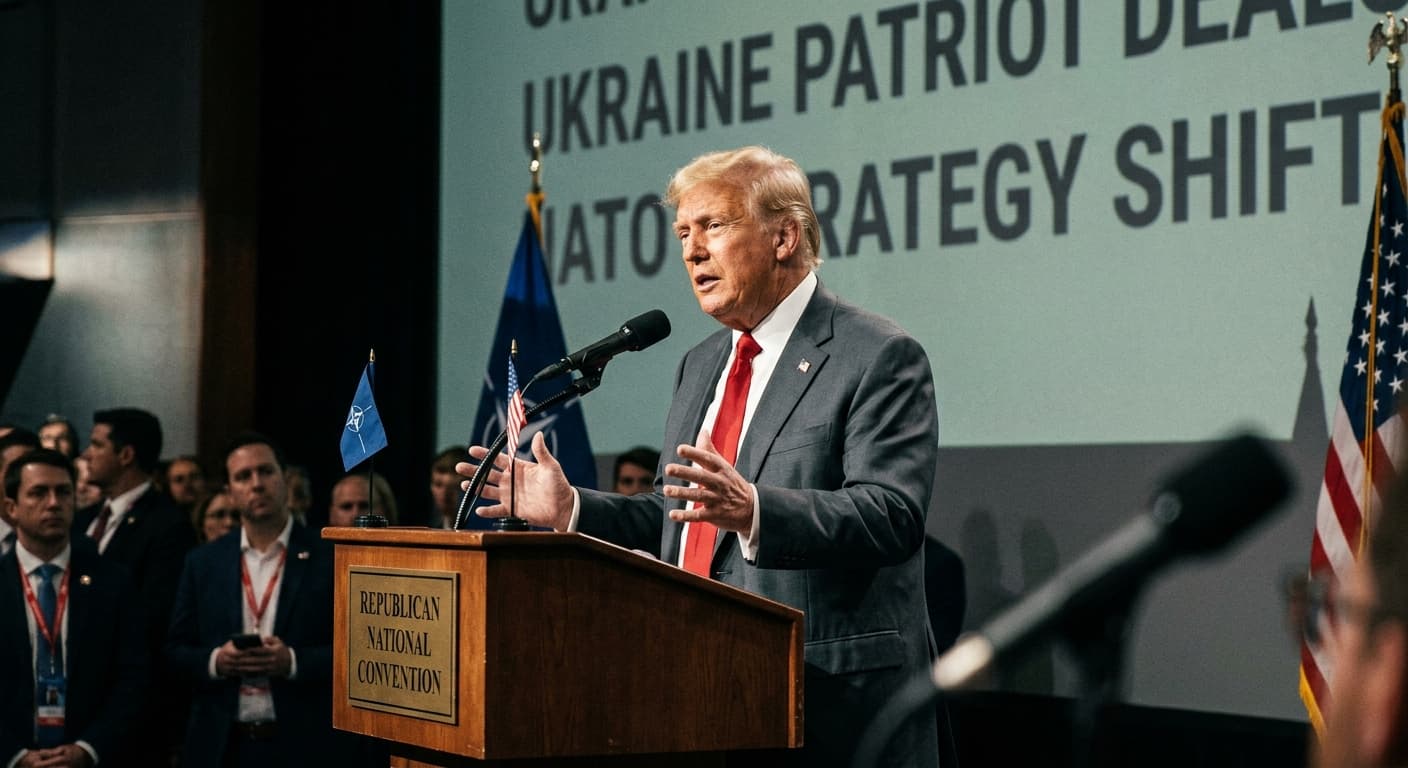
NATO Ankara Summit: Trump greenlights Ukrainian Patriot production
Trump's July 8 offer to license Patriot interceptor production in Ukraine, alongside a five-nation PAC-3 hub anchored in Poland, marks the first structural shift in Western air defence since 2022.
Donald Trump told Volodymyr Zelensky in Ankara on July 8, 2026 that Ukraine will receive a licence to manufacture Patriot interceptor missiles — a decision he acknowledged had not yet been communicated to Lockheed Martin or RTX. Coupled with a government-to-government agreement signed the same week by the United States, Poland, Germany, the Netherlands and Sweden to build a European PAC-3 sustainment hub, the announcement is less a favour to Kyiv than the operational unveiling of what US officials are now openly calling "NATO 3.0": American missile technology, European industrial base, Ukrainian and Polish demand — with the transatlantic bargain rewritten around who builds, not who buys. The immediate winner is not Ukraine. It is Lockheed Martin, which will service a captive European PAC-3 fleet from inside the alliance for a generation, and Poland, which secured its status as Washington's preferred eastern-flank contractor.
What actually happened in Ankara
At the alliance's July 7–8 summit — the first held in Ankara — Trump used a bilateral appearance with Zelensky to offer, without preconditions, a US production licence for Patriot interceptors. "We are gonna give you a licence to make Patriots," he said, according to the BBC. "I think they can produce them very quickly once we explain it." He then noted that neither Lockheed Martin nor RTX had been informed.
That admission matters. Patriot interceptor production is one of the most tightly controlled ITAR items in the US inventory. The current global line, at Lockheed Martin's Camden, Arkansas facility, produces roughly 600 PAC-3 Missile Segment Enhancement (MSE) interceptors per year — the entire supply feeding US forces plus 19 allied operators. A January 2026 framework agreement with the Pentagon, followed by a $4.7 billion contract in April, aims to triple that capacity, according to a Lockheed Martin release. Even so, CSIS estimates that more than half of the US PAC-3 stockpile was expended during Operation Epic Fury against Iran earlier this year.
The parallel — and more concrete — announcement was industrial. At the NATO Summit Defence Industry Forum on July 7, the United States, Germany, the Netherlands, Poland and Sweden signed a joint government-to-government agreement to explore a dedicated PAC-3 Missile Maintenance Facility in Europe, with Lockheed Martin as anchor contractor. In a PRNewswire statement, Lockheed Martin International president Jay Pitman framed it as expanding "regional sustainment networks" for the roughly 19 nations flying Patriot.
The White House fact sheet issued July 8 valued the industrial commitments announced in Ankara at more than $3 billion, adding a Lockheed–Rheinmetall partnership on ATACMS production in Europe, an RTX–Pentagon AMRAAM feasibility study for European production, and an Anduril commitment to build a Barracuda-500 missile line in Poland.
The Zelensky ask, and why the licence is not what it sounds
Zelensky had formally requested US authorisation for licensed Patriot interceptor production in late May 2026. In Ankara he told the alliance's opening forum that "Europe needs affordable mass-produced anti-ballistic systems as soon as possible" and that the work "cannot wait until 2030 or beyond," according to the NATO transcript of his remarks with Secretary General Mark Rutte.
The urgency is empirical. Ukraine's Air Force reported that not a single one of the 23 Russian ballistic missiles fired on the night of July 5–6 was intercepted, and Russian strikes on Kyiv killed at least 11 people on July 6. Jack Watling of the Royal United Services Institute has publicly argued there is "a direct correlation between the number of interceptors supplied to Ukraine and the damage that Russia can inflict with ballistic missiles," as Al Jazeera reported before the summit.
But Trump's offer, taken literally, is unlikely to put a single interceptor on a Ukrainian rail. Ivan Stupak, a former Ukrainian security service officer speaking to the BBC, argued Ukraine simply cannot manufacture the equipment on its own soil: "Unfortunately, Ukraine is not able to produce such kinds of advanced munition, because it's really sophisticated, cutting-edge equipment... Technically and legally, I think this will be deployed to European soil instead — and supervised."
That is the operational key to the story. The Fondation pour la Recherche Stratégique noted in a June 2026 assessment that Lockheed Martin's Paula Hartley has publicly committed to "a third production line outside the United States and Japan" for PAC-3, while the IISS Military Balance dossier reports that Rheinmetall has announced a joint venture with Lockheed Martin targeting 250–300 PAC-3 interceptors per year in Germany. A "Ukrainian" licence is politically potent, but the interceptors will almost certainly roll off a line in Bavaria, Silesia or the Ruhr, then be transferred to Kyiv — a legal and physical arrangement that gives Berlin, Warsaw and Washington a permanent supervisory grip on Ukraine's most advanced air-defence stockpile.
Who wins and who loses
Lockheed Martin is the structural winner of the Ankara summit. The PAC-3 sustainment facility locks European allies into a US-supervised maintenance ecosystem for decades of interceptor life-cycle costs; the "licence" to Ukraine converts a political liability — being seen as the country that could not or would not supply enough Patriots — into an export vehicle that further consolidates the PAC-3 franchise against European rivals like MBDA's SAMP/T. Fondation pour la Recherche Stratégique put it plainly: severe US production bottlenecks are pushing Lockheed to "rethink its international strategy," and Ankara is the moment that pivot became policy.
RTX (Raytheon) is the more ambiguous winner. Its COMLOG joint venture with MBDA Deutschland at Schrobenhausen is already producing PAC-2 GEM-T interceptors under a $3.7 billion Ukraine contract signed in April 2026, per FT/PRNewswire. But the AMRAAM feasibility study announced in Ankara is only that — a study — and the Ukraine Patriot licence, if it materialises, will require RTX cooperation the White House has not yet secured.
Poland is the political winner. Warsaw already sits at roughly 4.7% of GDP on defence, cited by President Karol Nawrocki in his September 2025 White House meeting with Trump; is on a path to 5%; and hosts the US eastern-flank posture reinforced by Trump's May 2025 announcement of 5,000 additional troops, tied explicitly to Nawrocki. Trump's aside in Ankara linking his praise for Zelensky to praise for Nawrocki and Poland was not a courtesy — it signalled who gets first refusal on the industrial spoils. The Anduril Barracuda-500 line and Poland's role as a PAC-3 sustainment node fit that pattern.
The clearest loser is the European Sky Shield Initiative's original German-led logic of buying more American systems off the shelf. Ankara redirects that money into co-production on European soil — a shift the Council on Foreign Relations warned about days before the summit, noting that Trump's team is using the Iran-war rift to accelerate "NATO 3.0" — a Europe expected to act as first responder. Spain, which Trump publicly called "a terrible partner" for refusing US basing during the Iran campaign, is now watching billions in industrial contracts flow to countries that backed Washington.
Russia is the ambient loser but the marginal picture is more mixed. The Ankara Summit Declaration commits allies to €70 billion in military equipment, assistance and training for Ukraine in 2026, with an equivalent 2027 commitment. Yet Trump also confirmed he would "later" speak with Putin, and Bloomberg's read of the summit — carried in translation by
Pravda Polska — was that the US president treated Iran, not Ukraine, as his priority in Ankara.
The historical parallel that reframes this
The closest analogue is not Reagan's 1980s missile-defence diplomacy but the F-16 co-production programme of the 1970s. That deal — signed with Belgium, the Netherlands, Denmark and Norway in 1975 — locked European allies into a US airframe by giving them domestic production shares. It defined the transatlantic combat-aircraft market for 40 years.
Ankara is the missile-defence equivalent, executed in a compressed political window. By offering Ukraine a licence Kyiv cannot immediately use, and simultaneously anchoring PAC-3 sustainment in Poland, Germany, the Netherlands and Sweden, Washington is converting a temporary US industrial bottleneck into a permanent European dependency on the American Patriot ecosystem. The CSIS analysis published in March 2026 warned Europe that funnelling EU money into US co-production, rather than into MBDA's SAMP/T or Diehl's IRIS-T, would "reduce dependence on U.S. supply chains" only in name — the Pentagon retains leverage through ITAR export controls regardless of where the factory sits. Ankara vindicates that warning.
The unexpected beneficiary of the licence gambit is therefore not Zelensky, whose interceptors will still flow through allied European lines under US supervision, but the political architecture that gets Trump to yes on Ukraine. The president said in Ankara that the licence means Kyiv "can't complain that we're not giving them enough" — a formula that lets him claim generosity while offloading production and cost onto Europeans, with Lockheed Martin capturing the margin.
Diplomat View
The Ankara offer of a Ukrainian Patriot licence is a diplomatic instrument, not an industrial one. It buys Trump three things at once: cover to keep US interceptor stocks at home after the Iran campaign, a lever against European capitals that refused to join him against Tehran, and a mechanism to reward Poland and Germany's industrial base for their alignment. The forecast: within 12 months a real production or final-assembly node will emerge in Poland or Germany under Lockheed–Rheinmetall auspices, badged as "Ukrainian-licensed," with interceptors physically built there and delivered to Kyiv under end-use monitoring. What would revise this call: a public Lockheed Martin or RTX statement rejecting the licence, congressional intervention under the Arms Export Control Act, or a Trump–Putin summit that trades the licence away as part of a Ukraine ceasefire package. If Zelensky exits 2026 with fewer than 400 additional interceptors actually delivered — regardless of where the licence sits — Ankara will be judged as symbolism.
What to watch next
- Lockheed Martin and RTX formal responses — Trump conceded in Ankara that neither had been informed. The first public corporate statement, and any congressional notification under the Arms Export Control Act, is the first real test.
- PAC-3 sustainment facility siting decision — Poland, Germany, the Netherlands and Sweden signed only to "explore." A host-nation decision, expected within six months, will determine which European economy captures the anchor investment.
- Trump–Putin call, unscheduled — Trump told reporters in Ankara he would speak with Putin "later." Any resulting ceasefire framework could subsume the Patriot licence as a negotiating chip before it is operationalised.
- NATO NSPA delivery schedule — the alliance's Support and Procurement Agency confirmed acquisition of 700 PAC-2 and 200 PAC-3 interceptors at the
Defence Industry Forum. Delivery cadence in Q4 2026 will show whether Ankara's rhetoric is reaching Ukrainian batteries.
The Bottom Line
Trump's Ankara Patriot licence is not a gift to Ukraine — it is the ignition switch for a European PAC-3 production and sustainment ecosystem anchored in Poland and Germany, with Lockheed Martin as its permanent supplier and Washington as its permanent regulator. If the deal holds, Ankara will be remembered as the summit at which the transatlantic missile-defence market was privatised, on American terms, under a Ukrainian flag of convenience.
Discover more

US Politics
SNAP Food Assistance Faces Legal Challenges
In 2026, SNAP faces stricter eligibility rules and mounting legal challenges, threatening food assistance for the millions of Americans who rely on the program.
India
Congress Accuses Modi of Stalling Women's Law
Congress accuses Modi of stalling women's reservation law by linking it to delimitation, revealing a deeper electoral strategy.

India
BJP's Misunderstanding of Women's Quota Needs
The BJP's linking of the Women Reservation Bill to delimitation risks delaying women's empowerment in India, misreading the aspirations of female voters.

Economics
Fed's Amex AML order puts correspondent banking on notice
Federal Reserve's Amex AML order requires board-level controls and a 90-day plan; OCC fined the bank $350 million over enterprise-wide deficiencies.