Trump's Ukraine Patriot Missile Deal
Trump allows Ukraine to produce Patriot missiles amid ongoing conflict.
Model Diplomat8 min readEurope
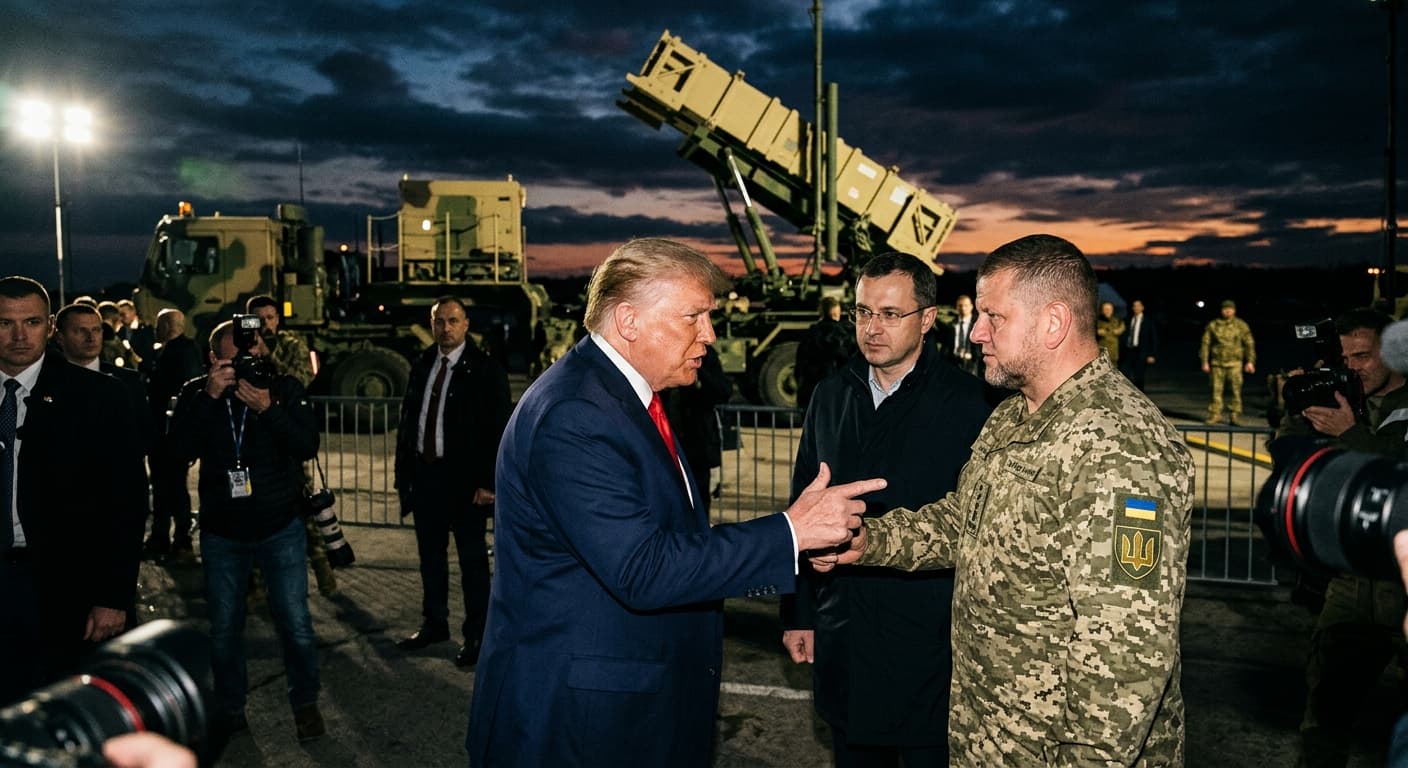
Trump green-lights Ukraine Patriot production as Kyiv burns
Trump told Zelensky on July 8, 2026 that Ukraine can build its own Patriot missiles. Lockheed had not been consulted — and the timeline is years, not weeks.
President Donald Trump's promise on July 8, 2026 to hand Ukraine a licence to manufacture PAC-3 Patriot interceptors is not the strategic gift Kyiv wanted — it is a controlled offload. In the same 48 hours that Russia hit Kyiv for the fourth time in ten days, killing at least four more people and firing eight Iskander ballistic missiles that Ukraine could not intercept, Trump told Volodymyr Zelensky on the sidelines of NATO's Ankara summit: "We'll give them the right to make Patriots. We'll show them how to do it." He conceded he had not spoken to Lockheed Martin or Raytheon before making the offer. The real beneficiaries are not in Kyiv — they are the US primes that just walked out of Ankara with a $3 billion contract stack and a Trump-branded "NATO 3.0" that turns European rearmament into American revenue.
The offer, in Trump's own words
Trump delivered the line at the Çankaya presidential complex during his only bilateral with Zelensky at the summit. According to a BBC report, he said: "We are gonna give you a licence to make Patriots. I think they can produce them very quickly once we explain it," adding he had not yet informed the manufacturers "but that'll work out alright." He justified the shift bluntly — so Ukraine "couldn't complain that we're not giving them enough."
Zelensky, who had formally requested licensed production in May, thanked Trump publicly and pivoted to air defence. The optics were the story Washington wanted: no repeat of the February 2025 Oval Office blow-up, Trump praising Ukraine's willingness to negotiate, and Secretary of State Marco Rubio framing the licence, per
Ukrainska Pravda, as "controlled escalation."
The primary document tells the harder story. The White House fact sheet released the same day makes no mention of Ukrainian production. It lists instead a "Patriot Advanced Capability-3 Missile Sustainment Facility in Europe" for Lockheed Martin, an ATACMS joint venture between Lockheed and Rheinmetall, an AMRAAM feasibility study with RTX, and a Stinger production doubling by 2030. The Ukraine licence is the summit's rhetoric. The Lockheed sustainment facility is the summit's ink.
Why "quickly" isn't quickly
The PAC-3 Missile Segment Enhancement is not a weapon a country reindustrialises overnight. Each interceptor takes more than two years to build and relies on a supply chain of over 400 companies, according to Atlantic Council analyst Peter Dickinson, citing Wall Street Journal reporting. Lockheed Martin produced roughly 620 PAC-3 MSE missiles in 2025. Its April 2026
framework agreement with the Pentagon — a $4.7 billion undefinitized contract action — aims to triple that to 2,000 per year by 2030. That is the number Ukraine alone needs annually to protect its cities, energy grid and military infrastructure.
The Center for Strategic and International Studies is blunter still. In a July 2026 progress report, CSIS concluded that US stockpiles of Patriot and THAAD interceptors "will be insufficient for future conflicts" and that new production lines announced in early 2026 "will not happen overnight." The US-Israeli war on Iran earlier this year reportedly burned through as many as 1,430 Patriot munitions in 39 days, per Atlantic Council reporting citing New York Times data — a consumption rate that has pushed US ally delivery timelines to seven years on new orders.
Andrew Michta of the Atlantic Council, quoted in the think tank's summit reaction package, put the gap between announcement and reality plainly: "No one — in Kyiv or Washington — at this point knows which components will be licensed for joint production," he wrote, adding that new lines in Ukraine "would be a ripe target for Russian ballistic missiles."
What Ukraine has actually built — and why that matters more
The story the wires are missing is that Ukraine has already routed around the Patriot bottleneck. Kyiv's defence minister Mykhailo Fedorov is running the state as a venture investor, backing a domestic missile market that produced a genuine surprise this year: Fire Point's FP-5 Flamingo cruise missile, which in late February hit the Votkinsk defence complex deep inside Russia — the first time Ukraine struck a strategically significant Russian defence-industry site with a locally-made long-range missile, Atlantic Council reported.
Zelensky says Ukraine now produces more than half the weapons it fires. According to a BBC investigation inside a secret Fire Point factory, the company builds 200 long-range drones a day at roughly $50,000 each — a third of the price of a Russian Shahed. Fire Point's chief technical officer, Iryna Terekh, told the BBC the firm deliberately avoids American and Chinese components: "Tomorrow somebody may want to shut it down, and we would not be able to use our own weapons."
That is the analytic pivot. Ukraine spent 2025 learning that US supply is a political variable, not a constant. Its own FirePoint interceptor programme, Estonia's Frankenburg Technologies, and the next-generation French-Italian SAMP/T NG scheduled for testing later this year are the actual replacement pipeline. A Patriot licence — welcome as it is — arrives on a five-to-seven-year clock. The war is on a nightly one.

The Ankara arithmetic: who is actually paying
The Ankara Summit Declaration, published on NATO's official site, commits allies to €70 billion in military equipment, assistance and training for Ukraine in 2026, matched again in 2027. Secretary General Mark Rutte, in his post-summit
press conference, highlighted $258 billion in extra spending by European and Canadian allies across 2025-26 and confirmed the alliance is now on a trajectory toward the 5% GDP defence target agreed at The Hague in June 2025.
The White House explicitly frames this as an America First win. Its fact sheet notes European defence spending supported "nearly 200,000 American jobs" in 2025, and that NATO allies procured over $54 billion in defence equipment from US firms last year. The Prioritized Ukraine Requirements List — the PURL mechanism — has generated more than $5 billion in Ukraine-bound American arms sales that Europeans pay for. Atlantic Council data shows PURL now supplies roughly 70% of Ukraine's Patriot interceptor deliveries.
Read this way, the Patriot licence is entirely consistent, not contradictory. Trump has moved every kinetic dollar off the US taxpayer's ledger. Europeans buy the missiles. Ukrainians (eventually, maybe) assemble them under licence. Lockheed Martin repatriates the profits. Jim Taiclet, Lockheed's chairman and CEO, told analysts in April earnings that framework agreements signed in Q1 2026 would raise PAC-3, THAAD and PrSM production rates "3-4 times current rates." Ankara added the sustainment facility. That is the summit's actual financial architecture.
The parallel that reframes it
The precedent Andrew Michta points to is the F-35 fighter's global licensing model — allied co-production in Europe and Asia, US intellectual property preserved, profits back to Lockheed and its subcontractors. In Michta's phrasing, those deals "yielded better capabilities for American partners, produced at a lower cost than US-based production but with profits repatriated back to US firms."
The Ankara package extends that model to the interceptor tier. Poland is already slated for PAC-3 production under a preliminary approval Washington granted earlier this year, per Atlantic Council reporting. Rheinmetall gets ATACMS. Anduril gets a Barracuda-500 line in Poland. Turkey, whose sanctions Trump promised to lift, is being nudged back toward F-35 eligibility. The Patriot licence to Ukraine slots into a broader industrial map in which US primes take equity, IP and royalties in exchange for allied capacity — and the Pentagon's stockpiles are refilled without straight congressional appropriations.
Ukraine, in this schema, is not a special case. It is the proof-of-concept sale.
Escalation on the ground while diplomats posed
The backdrop matters. On the morning Trump made the licence offer, Al Jazeera reported, Ukrainian air defences intercepted more than 80% of 169 Russian drones overnight — but zero of the five ballistic missiles fired. Ukrainian forces later downed a Russian Su-35 fighter and struck Russian oil refineries; Trump publicly called those refinery strikes "an escalation that could help bring the conflict to an end," according to
Ukrainska Pravda reporting from Ankara. He also confirmed the US will not transfer additional Patriot systems from its own stock — "We need them ourselves."
That is the honest line. The licence is a substitute for the transfer. It is what Washington offers when it will not give up its own interceptors.
The BBC's Frank Gardner, filing from Ankara, distilled the strategic mood: Europe is being told, politely, that once the Ukraine war ends, Russia will complete a rapid rearmament cycle and be positioned to threaten NATO territory within four years. The Patriot licence, the ATACMS joint venture, the AMRAAM feasibility study — these are less about the current war than about Europe's post-war ballistic missile defence, in which US primes lock in the standards and the intellectual property.
What to watch
- Lockheed Martin coordination: whether the company confirms, within 30 days, which PAC-3 sub-components are actually licensable to Ukraine. Trump admitted he had not called; the details are what determine the year the first Ukrainian-made interceptor rolls off a line.
- Q3 2026 earnings: Lockheed's July 2026 results and RTX's guidance will show whether investors are pricing in Ankara. The framework agreements signed in January and April already promised 3-4x rate increases; sustained backlog above $200 billion validates the model.
- PURL 2027 tranche: the Ankara Declaration commits to matching €70 billion again in 2027. Watch which allies fund what, and whether Germany's coalition finance minister confirms the PURL top-up before the Bundestag recess in August.
- Peace-track signals: Trump has floated a Zelensky-Putin meeting; Putin will only host in Moscow. A collapse of talks in the next 60 days — combined with continued Russian ballistic strikes — is the trigger that would test whether Washington accelerates the licence or lets it drift.
- FP-5 Flamingo scaling: Fire Point's ability to reach mass production is the near-term deterrent Kyiv actually controls. A second strike on a Russian production site would confirm the trajectory.
The Bottom Line
Trump's "make them yourself" is not a strategic gift to Ukraine. It is the neatest possible transfer of the Patriot problem from Washington's balance sheet to Kyiv's factory floor, on a timeline measured in years while Russian ballistics arrive nightly. The winners at Ankara are Lockheed Martin, Rheinmetall and a White House that has re-engineered NATO into a revenue stream for US primes. Ukraine's real air defence bet, placed quietly and without American permission, is no longer the Patriot. It is Fire Point, Frankenburg and the SAMP/T NG.
Discover more

US Politics
SNAP Food Assistance Faces Legal Challenges
In 2026, SNAP faces stricter eligibility rules and mounting legal challenges, threatening food assistance for the millions of Americans who rely on the program.
US Politics
House Ethics Committee Pushes Sexual Miscond.
The House Ethics Committee has shifted responsibility for sexual harassment settlement records to the Office of Congressional Workplace Rights, complicating disclosure efforts.
India
Congress Accuses Modi of Stalling Women's Law
Congress accuses Modi of stalling women's reservation law by linking it to delimitation, revealing a deeper electoral strategy.

Economics
Fed's Amex AML order puts correspondent banking on notice
Federal Reserve's Amex AML order requires board-level controls and a 90-day plan; OCC fined the bank $350 million over enterprise-wide deficiencies.