Trump's Trade Halt with Spain: NATO Gamble
A legal vacuum complicates Trump's trade threats against Spain.
Model Diplomat8 min readEurope
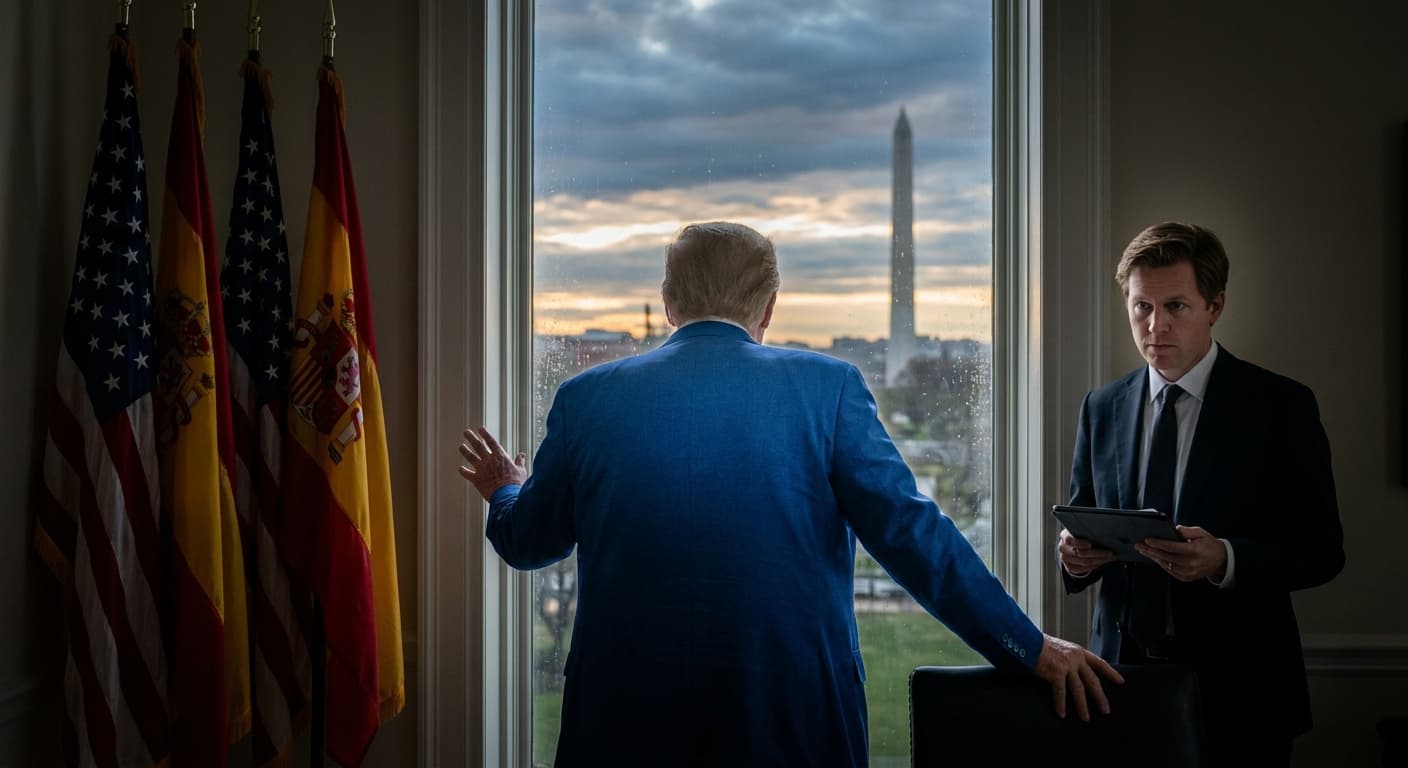
Trump orders trade halt with Spain: NATO's costliest gamble yet
Trump's July 8 order to sever US trade with Spain over NATO spending and Iran collides with a February 2026 Supreme Court ruling that gutted his main tariff tool — leaving threat without instrument.
President Donald Trump's July 8, 2026 order at the NATO summit in Ankara to "cut off" all trade with Spain is the loudest transatlantic breach since the Iraq war — but it lands in a legal vacuum. Four months earlier, the Supreme Court stripped Trump of the emergency-tariff authority he used across 2025, and EU treaty law forbids Washington from singling out one member of the customs union. The result is a $75 billion bilateral relationship held hostage to a threat the White House cannot cleanly execute, and a NATO alliance whose defining fight is no longer with Moscow but with Madrid.
That is the real story from Ankara. Not the shouting. The gap between what Trump ordered and what his Treasury Secretary can lawfully deliver.
What actually happened in Ankara
Standing beside Secretary-General Mark Rutte on day two of the summit, Trump instructed Treasury Secretary Scott Bessent to sever economic ties with Spain, calling Prime Minister Pedro Sánchez's government "a wasted cause" and "a terrible partner in NATO," according to Al Jazeera's summit coverage. He revived, in the same appearance, his demand that the United States take Greenland from Denmark. The BBC's account of the day described Trump as "particularly incandescent" toward Madrid, quoting Sánchez telling reporters he was "not worried" and that Spain was "fulfilling its obligations toward NATO," per the
BBC.
Two grievances drive the White House. First, Spain is the only NATO member to formally reject the alliance's new 5% of GDP defence-spending target agreed last year — 3.5% on hard defence and 1.5% on dual-use infrastructure — after Sánchez wrote to Rutte in June 2025 calling the goal "unreasonable" and "counterproductive," per Al Jazeera. Second, when the US-Israel war on Iran opened with strikes on February 28, 2026, Sánchez closed Spanish airspace to US warplanes and denied American forces the use of Naval Station Rota and Morón Air Base for the campaign, as the
Observer Research Foundation reconstructs it. No other NATO ally went that far.
Spain's reply on July 8 was clinical. Sánchez's office said it was treating the outburst as "business as usual," noted that Spain runs a trade deficit with the US and, decisively, that "as part of the customs and trade union, individual European Union members cannot be singled out," per Al Arabiya. European Commission spokesperson Olof Gill added that Brussels expected Washington to "honour its commitments" under the 2025 EU–US joint trade statement.
The instrument Trump no longer has
The order to Bessent runs into a wall that did not exist a year ago. On February 20, 2026, in Learning Resources, Inc. v. Trump, the Supreme Court held 6–3 (with Chief Justice John Roberts writing) that the International Emergency Economic Powers Act (IEEPA) — the 1977 statute Trump used to impose his 2025 reciprocal, fentanyl and border tariffs — "does not authorize the President to impose tariffs." The opinion, available on the Supreme Court's site, grounded that conclusion in the major questions doctrine: Congress must speak clearly to hand the executive so sweeping a taxing power, and IEEPA does not.
That ruling is the load-bearing fact in this story. It means the fastest, most flexible tool a president has used to raise tariffs across borders — declare an emergency, sign an executive order, apply duties within days — is now closed. What remains is slower and narrower: Section 232 national-security tariffs (requiring a Commerce Department investigation of up to 270 days), Section 301 unfair-practices tariffs (typically 12–18 months of USTR process), and Office of Foreign Assets Control sanctions targeting named persons or entities, not blanket embargoes. None of these can produce a "halt all trade with Spain" order over a weekend.
The EU-side barrier is stiffer still. Under Article 3 of the Treaty on the Functioning of the European Union, common commercial policy is an exclusive Union competence, and Article 207 vests tariff-setting and trade negotiation in Brussels alone, per EUR-Lex. US tariffs on "Spanish" goods land legally on EU-origin goods that happen to be produced in Spain; the customs union has no internal frontiers for Washington to target. A Spain-specific measure would invite an immediate WTO dispute and, in Brussels, activation of the EU Anti-Coercion Instrument.
Who actually gets hurt
The Congressional Research Service, in its June 2026 country brief on Spain, puts two-way US–Spain trade in goods and services at nearly $75 billion in 2025, with US exports of $38.6 billion and imports of $35.8 billion — a US surplus of roughly $3 billion, according to the CRS. Two-way direct investment tops $121 billion, three-quarters of which is Spanish capital in the United States. Spanish affiliates employ about 86,500 Americans; US affiliates employ nearly 195,000 people in Spain. Banco Santander, BBVA, Iberdrola, Ferrovial and Acciona are among the Spanish firms with the largest US footprints — and would be the first calls if Bessent moved on entity-level sanctions rather than tariffs.
The composition matters. Top US exports to Spain are energy products (LNG especially), chemicals and transport equipment. Top imports from Spain are industrial machinery, semi-manufactures, energy products and food, per the CRS. That mix cuts against Trump. A cut-off would strand US LNG cargoes headed for Spanish regasification terminals at a moment when Europe's Iran-crisis energy squeeze is already acute, per the BBC's analysis. It would also whipsaw Republican-state exporters — Texas gas, Louisiana chemicals, Midwestern soy — before it registered in Madrid.
The market read has been muted for the same reason. Sánchez's office pointed out on July 8 that Spain runs a trade deficit with the US and that "economic ties were forged by private companies rather than governments," a line calibrated to reassure the IBEX 35 and the euro-zone bond desk. Eurostat's May 2026 data show the whole EU trade surplus in goods with the US shrank from €80 billion in Q1 2025 to €34 billion in Q1 2026 as tariff turbulence took its toll — Spain's slice of that swing is small, per Eurostat.
The strategic prize Trump is putting at risk
Rota and Morón are not garrison outposts. The Elcano Royal Institute described Rota — expanded to host US ballistic-missile defence destroyers and now Morón's forward-deployed Marine Air-Ground Task Force of up to 2,200 personnel — as "a major front-line base" for US power projection into the Atlantic, Mediterranean and Africa, per Elcano. AEI's Michael Rubin has floated relocating US assets from Rota to British Gibraltar, 65 miles away, but concedes Rota is "an essential node in US logistics" that would take years and billions to replicate,
per AEI.
Julianne Smith, former US ambassador to NATO, told the BBC that punitive measures against Spain "seem over-reactive in light of the fact that allies were never asked to assist the US and Trump has frequently denied that the US actually needed European support." That is the professional consensus in Washington: the Iran grievance is real, but the response is out of proportion to the operational cost.
There is a second-order effect Madrid is quietly leaning on. Under Article 42.7 of the Treaty on European Union, member states are obliged to aid one another in the event of armed aggression. Ursula von der Leyen conceded to the BBC in April 2026 that "the treaty is not clear about what happens when, and who does what." The Ankara summit has done more to accelerate EU thinking on 42.7 as a hedge against Article 5 unreliability than any French white paper of the past decade.
Who benefits — the answer is not in Washington
Three winners emerge from Ankara. The first is Sánchez himself. A CIS poll cited by the BBC in March 2026 found 77% of Spaniards held a "bad" or "very bad" view of Trump, meaning the trade threat is a domestic political gift to a prime minister whose coalition looked wobbly six months ago. The second is the French-led camp inside the EU pushing strategic autonomy: every Trump broadside makes Emmanuel Macron's argument for a European defence-industrial base easier to sell in Berlin, Rome and The Hague. The third, more counter-intuitive winner is Beijing. A US that punishes NATO allies for policy disagreements is a US that trading partners increasingly hedge against — the ASEAN and Gulf capitals watching Ankara are the audience that matters most for the medium term. Track how this fits into the wider international recalibration.
The loser column starts with the alliance itself. Rutte spent the run-up demanding "clear, concrete and credible plans" for spending from every member, per Al Jazeera, and got instead a summit dominated by whether the United States would trade with one of them. The 2035 5% target — the headline deliverable — is now indelibly linked to a public humiliation of Madrid rather than to a serious burden-sharing story.
What to watch next
- Federal Register, next 30 days. If the White House is serious about the halt, it must publish a new national-emergency declaration naming Spain specifically. Absent that, this is rhetoric.
- Section 232 action on Spanish steel, olive oil or auto parts. The path of least legal resistance. Watch Commerce's docket in August and September 2026.
- EU Anti-Coercion Instrument. Brussels has never used it. A Spain-specific US measure is the textbook trigger.
- Rota force-posture review. House Armed Services Republicans have floated moving assets. Any FY2027 NDAA language directing a review is the signal that Ankara's damage is structural, not rhetorical.
- Spanish general election. Sánchez's minority coalition faces a confidence vote before end-2026; Trump's threats have, paradoxically, strengthened his hand.
Diplomat View
The forecast: Trump's July 8 order will not translate into a full trade cut-off in 2026. The Supreme Court's IEEPA ruling closes the fastest legal path, EU exclusive competence closes the neatest one, and US exporters — starting with Gulf Coast LNG and Midwestern agriculture — carry too much political weight to be sacrificed to a Spain-only embargo. Expect instead a package of Section 232 measures on selected Spanish products, OFAC designations of named Spanish firms accused of dual-use exports to Iran (Michael Rubin's AEI piece flagged this line of attack), and a quiet drawdown at Rota framed as "force-posture optimisation." The alliance will paper it over in the summit communiqué.
What would change the forecast: a fresh Iran-linked provocation from Tehran that Washington blames on Spanish complacency; a Sánchez government collapse that brings the Popular Party to power on a pro-Washington platform; or a Trump national-emergency proclamation naming Spain by mid-August. Absent one of those, this is the pattern that has held since March 2026 — maximal threat, minimal instrument, and a NATO alliance whose next real test is not Article 5 but whether it can survive its own summits.
The Bottom Line
Trump's Ankara order is the clearest evidence yet that the White House has run out of coercive tools against allies who refuse to fall into line. The Supreme Court took away his emergency tariff button in February, EU trade law denies him a Spain-shaped target, and the Pentagon's own base in Rota gives Madrid more leverage than Washington wants to admit. What looks like American power projection is, on the evidence, an alliance losing its instruments faster than it is losing its members.
Discover more

US Politics
SNAP Food Assistance Faces Legal Challenges
In 2026, SNAP faces stricter eligibility rules and mounting legal challenges, threatening food assistance for the millions of Americans who rely on the program.
US Politics
House Ethics Committee Pushes Sexual Miscond.
The House Ethics Committee has shifted responsibility for sexual harassment settlement records to the Office of Congressional Workplace Rights, complicating disclosure efforts.

International Relations
Pakistan's Key Role in US-Israel-Iran Meddle
Pakistan is seeking to mediate the US-Israel-Iran conflict, balancing high-stakes diplomacy against severe economic pressures and steep regional challenges.

Conflict & Security
Drone Warfare Killing Aid Workers at Unprec
Over 1,000 humanitarian workers killed in three years as cheap armed drones collapse legal protections. Gaza, Sudan, Ukraine, and DRC see deliberate targeting of aid convoys and hospitals with zero prosecutions.