Trump's Tariff Machine Rebuilt: Section 301
U.S. tariffs shift to Section 301 post-IEEPA ruling
Model Diplomat8 min readNorth America
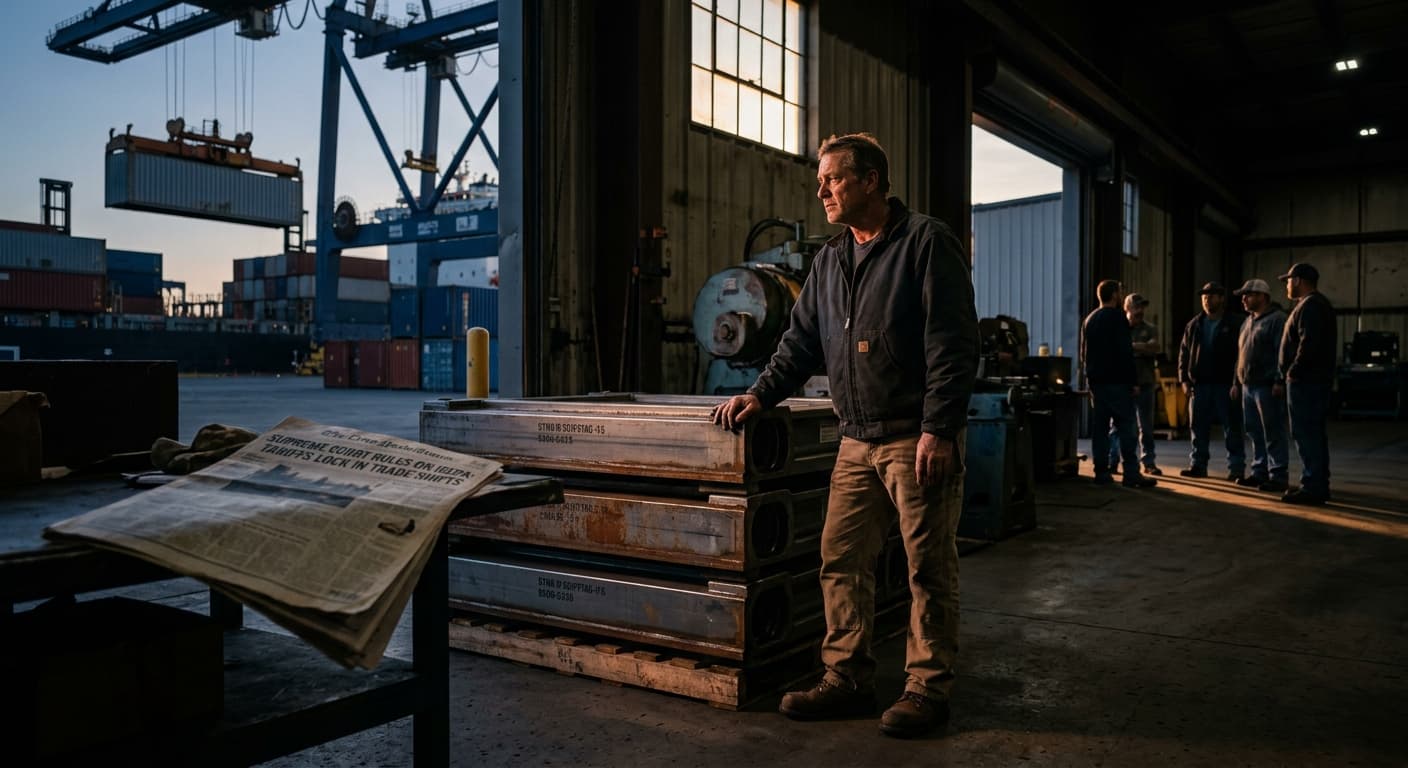
Trump's Tariff Machine Rebuilt: Section 301 Replaces IEEPA
U.S. tariffs are surviving the Supreme Court's IEEPA ruling by migrating to slower authorities — locking in a supply-chain shift toward Vietnam, Taiwan and Mexico.
The U.S. Trade Representative opens hearings today, July 7, 2026, on proposed 10% to 12.5% Section 301 tariffs against 60 economies for failing to police forced-labor imports — the legal scaffolding designed to replace the $166 billion emergency-tariff regime the Supreme Court struck down on February 20. The headline story is a courtroom defeat for Donald Trump. The real story is the opposite: the White House is rebuilding a near-identical tariff wall on a slower, more litigation-resistant foundation, and the reshuffling has already frozen a global supply-chain realignment away from China and toward a handful of "connector" economies — with Vietnam, Taiwan and Mexico capturing most of the redirected trade, and small U.S. importers still waiting for refunds that Treasury Secretary Scott Bessent has publicly conceded may take years.
That is the pivot the wire coverage keeps missing. IEEPA is gone; the tariff burden is not. And the new architecture — Section 122 as a bridge, Section 301 as the permanent load-bearing wall, Section 232 for metals — is designed to withstand exactly the kind of major-questions challenge that killed the first version.
The Supreme Court did not end the tariff war
In Learning Resources, Inc. v. Trump, decided 6–3 on February 20, 2026, Chief Justice John Roberts held that the International Emergency Economic Powers Act "does not authorize the President to impose tariffs," vacating the "Liberation Day" duties and remanding the case. The Supreme Court opinion applied the major-questions doctrine, and Justice Neil Gorsuch's concurrence framed the reasoning bluntly: the President "must identify clear statutory authority for the extraordinary delegated power he claims," and IEEPA's grant to "regulate . importation" did not clear that bar. The
Justia case summary captures the holding in one line: IEEPA is off the table for tariff use, full stop.
The financial stakes are unusually concrete. According to a March filing by Customs and Border Protection reported by Al Jazeera, CBP had collected roughly $166 billion in IEEPA duties from more than 330,000 importers on 53 million entry lines. Judge Richard Eaton of the U.S. Court of International Trade ordered automatic refunds with interest — telling the government, as
NPR reported, that "every single cent must be returned to the importer." CBP responded that its systems could not process the volume without a 45-day rebuild.
The refund process has since become a slow-motion political fight. The BBC reported in April that when the Consolidated Administration and Processing of Entries portal finally opened, 56,000 importers had filed claims worth $127 billion — with refunds promised in 60 to 90 days, and no compensation for consumers who paid the tariff pass-through. Bessent has told reporters he suspects "the American people won't see it." Georgetown law professor Greg Shaffer, quoted in
Al Jazeera, predicts smaller importers will simply give up: "it's a cost-benefit analysis where they might shrug their shoulders and say it's not worth going through the hassle."
Section 301 is the load-bearing wall
Trump signed a Section 122 proclamation the same afternoon the ruling dropped, imposing a 10% global tariff — later raised to 15%, the statutory maximum — as a 150-day bridge. As the BBC's tariff explainer notes, that bridge expires on July 24, 2026, and countries that struck trade deals last year, including the UK, India and the EU, were told the Section 122 global rate would apply on top of their negotiated rates. The Council on Foreign Relations, in its
analysis of the ruling, argued that no single statute could fully replace IEEPA — the tariff would have to be "rebuilt in a patchwork."
Section 301 of the Trade Act of 1974 is the largest patch. It lets the U.S. Trade Representative impose tariffs on "unreasonable or discriminatory" foreign trade practices — but only after notice, investigation, hearing and finding. USTR Jamieson Greer moved fast. Two waves of Section 301 investigations were launched in March: one covering 16 economies for "structural excess capacity," the second covering 60 economies for failing to enforce prohibitions on imports made with forced labor. The USTR initiation notice targets essentially the entire "China-plus-one" universe: China, the EU, Singapore, Switzerland, Norway, Indonesia, Malaysia, Cambodia, Thailand, Korea, Vietnam, Taiwan, Bangladesh, Mexico, Japan and India.
On June 2, USTR issued its proposed remedies and a Federal Register press release setting the forced-labor tariff at 10%, with 12.5% for certain apparel and textile lines and a limited tariff-rate quota for low-income producers. Written comments closed July 6. Today's hearing is the last formal step before duties can be signed.
Brookings analysts Maricarmen Barron Esper and Christopher Sands, in their March policy brief, argue that the forced-labor investigations are less about foreign labor practices than about foreign enforcement — the U.S. is measuring trading partners against the Uyghur Forced Labor Prevention Act's compliance regime. The BBC
reported that USTR concluded "none" of the 60 economies had effectively enforced comparable rules. That framing is deliberate: it makes the tariff punitive against partner policies, not U.S. trade balances, which is a cleaner Section 301 predicate than the "unfair burden" theory used against China in 2018.
Bessent has been explicit about the design goal. He told an audience in Dallas that combining Section 122 with enhanced Section 232 and Section 301 tariffs would leave "virtually unchanged tariff revenue in 2026." Brookings researchers Kari Heerman and Elena Patel estimate the trade-weighted average U.S. tariff rate at roughly 9.1% under the Section 122 bridge — down from a 13.4% peak under IEEPA in January 2026, but still nearly quadruple the 2.6% rate on January 20, 2025.
Winners: Vietnam, Taiwan, Mexico. Losers: small importers and the EU
Here is the finding that reframes the whole story: the tariff war has not repatriated production. It has redistributed it. According to a CSIS analysis of 2025 U.S. trade data, the U.S. bilateral deficits with Vietnam, Taiwan, Thailand and India all hit record highs in 2025 — Taiwan's up 865%, Vietnam's up 351% over the 2018 baseline.
Al Jazeera reported in January that the U.S. goods deficit with Vietnam alone climbed from $123.4 billion in 2024 to $145.7 billion in 2025, despite a negotiated 20% tariff.
An IMF working paper by Tatjana Schulze and Weining Xin, published on the Fund's website, finds this is not primarily transshipment. Using value-added decomposition and synthetic controls, the authors conclude Vietnam has seen genuine "trade reallocation" — rising domestic content in exports to the U.S., driven by Chinese greenfield FDI relocating production. Harvard's Laura Alfaro and Dartmouth's Davin Chor, in a paper
circulated by the IMF, describe the shift as "the Great Reallocation": the U.S. has decoupled from China but not from the world, and diversification has flowed to the existing top-20 partners rather than opening genuinely new source geographies.
The second-order effect is quieter and more consequential. Zichun Huang, a China economist at Capital Economics quoted by Al Jazeera, argues the deeper story is that ASEAN is "importing more machinery and intermediate goods from China" to produce U.S.-bound exports. In other words, China has not been cut out of the U.S. supply chain — it has been moved one node upstream, invisible to the tariff schedule. That is precisely the pattern the new Section 301 excess-capacity investigations are designed to attack.
Mexico is the other structural winner. An IMF working paper on Mexico's role in global value chains documents the substitution: as U.S. imports from China fell, Mexico and a handful of Asian economies filled the gap. Under Section 122, USMCA-origin goods remain exempt, which as the BBC notes leaves Canada with one of the lowest effective tariff rates on U.S.-bound exports of any major economy.
The Bruegel test comes next: does the EU deal hold?
The EU is the load-bearing test case for whether the new architecture holds diplomatically. The Turnberry deal struck in July 2025 caps U.S. tariffs on most EU goods at 15%. European Parliament trade committee chair Bernd Lange has added a suspension clause that triggers if the U.S. imposes additional tariffs above that ceiling. Trump has already tested it: he threatened 25% tariffs on EU cars in May over slow ratification, as
Al Jazeera reported, and threatened 100% tariffs on any country implementing a digital services tax in late June.
William Reinsch of CSIS argues in a June column that the 10–12.5% forced-labor tariffs "have not been met with much foreign opposition because they are at or below the levels agreed to in the trade agreements negotiated last year." But he warns that the 16-country excess-capacity investigation, if it produces additional tariffs stacked on top of forced-labor duties, will "bring the U.S. total tariff level above the caps negotiated last year" — and the EU has been clear that any breach of 15% is a treaty violation.
The WTO's baseline scenario, published in the March 2026 Global Trade Outlook, projects global merchandise trade growth slowing to 1.9% in 2026 from 4.6% in 2025, once frontloading and AI-hardware demand normalise. WTO Director-General Ngozi Okonjo-Iweala credited "the avoidance of tit-for-tat retaliation on tariffs" — a fragile diplomatic peace the EU-U.S. auto dispute could break. The share of world trade conducted on a most-favoured-nation basis fell from 80% in 2024 to 72% by early 2026.
What to watch next
- July 24, 2026 — Section 122 tariffs expire. Either Section 301 forced-labor duties slot in as replacement, or Trump attempts a legally dubious re-imposition that CSIS analysts predict will trigger fresh CIT litigation.
- Late July / August — Findings expected in the 16-country excess-capacity investigation. If tariffs stack on top of the 15% Turnberry cap, expect the European Parliament to invoke its suspension clause.
- Rolling — CBP refund processing on the $127 billion in claims already filed. If small importers get pennies on the dollar while Fortune 500 firms recover in full, expect political fallout in the 2026 midterms.
The Bottom Line
The Supreme Court did not end Trump's tariff war — it forced it into a slower, more procedurally armoured legal shell that is harder to strike down and easier to layer with new grievances like digital-services taxes and forced-labor enforcement. The supply-chain map that resulted is now largely locked in: Vietnam, Taiwan and Mexico absorb the redirected trade, China remains the invisible upstream supplier, and the EU's 15% ceiling becomes the next flashpoint. If today's Section 301 hearing produces the duties USTR has already telegraphed, the tariff floor for 2026 will look almost identical to the IEEPA regime the Court struck down — with the difference being that this time, refunds are unlikely to follow.
Discover more
US Politics
House Ethics Committee Pushes Sexual Miscond.
The House Ethics Committee has shifted responsibility for sexual harassment settlement records to the Office of Congressional Workplace Rights, complicating disclosure efforts.
US Politics
SNAP Food Assistance Faces Legal Challenges
In 2026, SNAP faces stricter eligibility rules and mounting legal challenges, threatening food assistance for the millions of Americans who rely on the program.
India
700 Activists Accuse PM Modi of MCC Breach
Over 700 activists allege PM Modi breached election code with a televised address attacking opposition parties just before state elections.

Conflict & Security
Drone Warfare Killing Aid Workers at Unprec
Over 1,000 humanitarian workers killed in three years as cheap armed drones collapse legal protections. Gaza, Sudan, Ukraine, and DRC see deliberate targeting of aid convoys and hospitals with zero prosecutions.