Trump's Redistricting Strategy
A look at Trump's impact on House redistricting
Model Diplomat8 min readNorth America
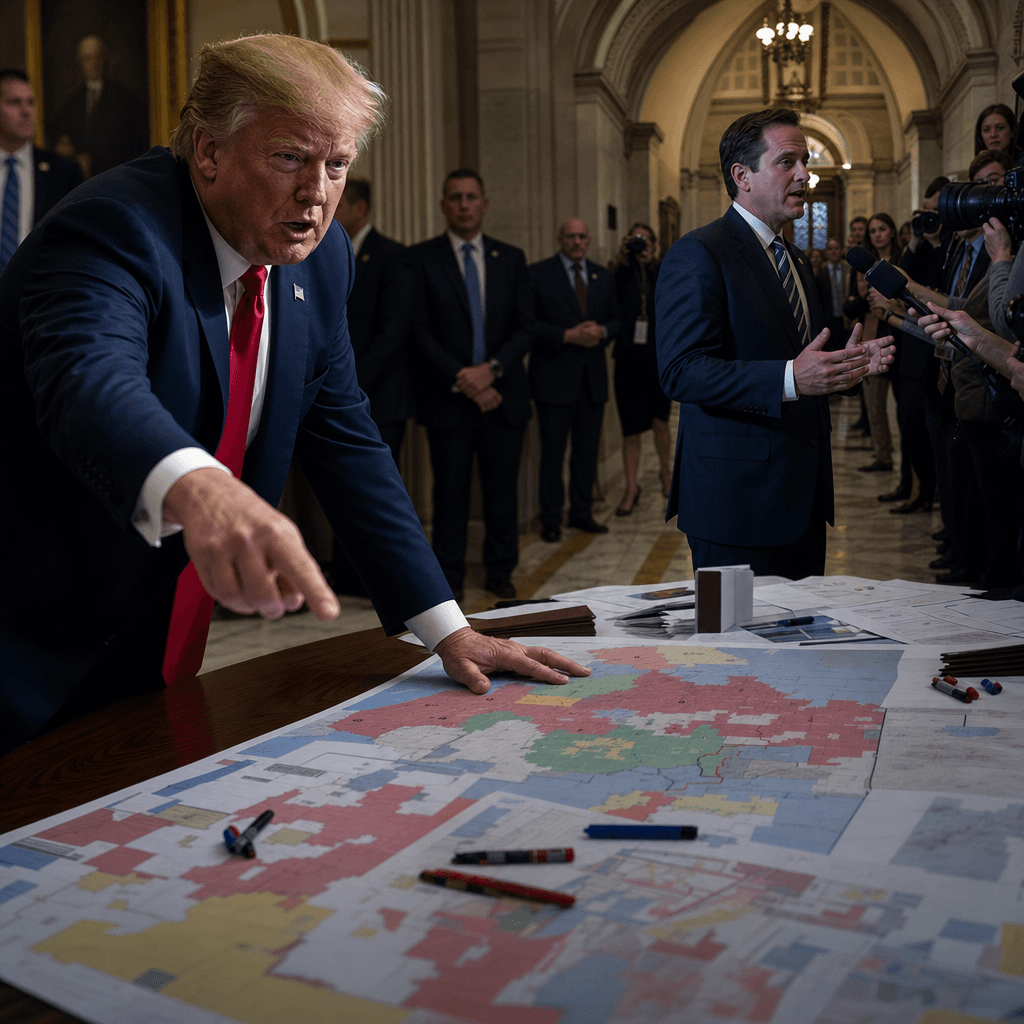
Trump's Redistricting Strategy: A 10-Seat Firewall Against a Midterm Wave
Trump forced eight red states to redraw House maps and won a Supreme Court rewrite of the Voting Rights Act. The seat math still may not save the majority.
President Donald Trump's mid-decade redistricting campaign has manufactured roughly 10 additional Republican-leaning U.S. House seats before the November 3, 2026 midterms, according to an internal House GOP assessment obtained by the BBC — a firewall built to survive a national environment that would otherwise hand Democrats the chamber. The strategy's real payoff, though, is not the seat count. It is the Supreme Court's April 29 ruling in Louisiana v. Callais, which Trump's map-drawing offensive was designed to trigger, and which now permits red-state legislatures to dismantle majority-Black districts for at least the rest of the decade. The midterms are the near-term prize; the deeper win is a redrawn constitutional floor under partisan gerrymandering that outlasts Trump himself.
The strategy: manufacture seats, then change the rules
Trump did not stumble into redistricting. He directed it. In July 2025, his Justice Department sent Texas Governor Greg Abbott a letter branding four Democratic-leaning districts around Houston "unconstitutional racial gerrymanders," giving Abbott legal cover to add congressional lines to a special session ostensibly called for flood relief, NPR reported. Trump was blunter in public: "Texas would be the biggest one, and that will be five," he told reporters outside the White House, promising three to five more seats from other states.
Texas delivered a map targeting five Democratic-held districts in South Texas, Houston and Dallas. Missouri, North Carolina, Ohio and Tennessee followed. When Democrats retaliated — California voters passed Proposition 50 on November 4, 2025, suspending the state's independent commission and projecting five additional Democratic seats, NPR's Guy Marzorati reported — the fight looked, briefly, like a wash.
Then two courts intervened, both in Trump's favor. On April 21, 2026, Virginia's supreme court voided the Democratic-drawn referendum map on procedural grounds, erasing three to four expected Democratic pickups. Eight days later, the U.S. Supreme Court handed down Louisiana v. Callais.
The Callais ruling: the load-bearing legal event
The 6–3 decision, written by Justice Samuel Alito, rewrote the Gingles framework that has governed Section 2 of the Voting Rights Act for 40 years. The Court held that plaintiffs seeking a new majority-minority district can no longer draw illustrative maps using race as a criterion, and that any such map must also satisfy the state's "specified political goals," including "a target partisan distribution of voters," per the slip opinion.
The practical effect is to convert Section 2's decades-old "results test" into an intent test. Justice Elena Kagan, dissenting, warned:
"Under the court's new view of Section 2, a state can, without legal consequence, systematically dilute minority citizens' voting power."
Harvard law professor Nick Stephanopoulos told NPR the ruling meant the Voting Rights Act had "died today, age 60." Within hours, Florida's Republican-controlled legislature passed a DeSantis-drawn map projecting four new GOP seats on a 21-17 Senate vote,
as WFSU's Tristan Wood reported. Tennessee moved to break up Democratic Rep. Steve Cohen's Memphis-anchored 9th District. Louisiana Republicans scrapped their upcoming primary to redraw. On June 2, the Court
issued an unsigned order in Allen v. Caster vacating a lower-court injunction against Alabama's 2023 map and remanding "in light of Callais."
That is the sequence to keep straight. Trump did not merely benefit from a friendly Supreme Court. His administration's mid-decade offensive — Texas's lawsuit posture, Louisiana's defense of SB8, Alabama's petition to reopen Milligan — generated the vehicles the Court used to change the doctrine.
The seat math: real, but smaller than advertised
Strip out the theatrics and the pickups are more modest than either side claims. Brookings scholars Raymond La Raja and Robert Saldin concluded in February 2026 that Texas Republicans will likely gain "only two seats" of the five they targeted, because South Texas mapmakers assumed the 2024 Latino swing to Trump was permanent. Trump's net approval among Texans fell 20 points in 2025, per the Texas Politics Project, and 68% of Texans told pollsters that partisan mid-decade redistricting was "a major problem." Michael Barone at AEI, no ideological ally of that view,
reaches a similar conclusion: Cook Political Report now rates 188 seats solidly Republican and 184 solidly Democratic, with 18 tossups — 14 held by Republicans, 4 by Democrats.
Brookings' Molly Reynolds and Abby Ward tallied the ledger at "nine new Republicans and 10 new Democrats" before Virginia's referendum collapsed. AEI's Philip Wallach
now puts the final Republican gain at "something like 10 'safe' or 'leaning GOP' seats." The internal House Republican assessment obtained by the BBC uses the same figure and puts the number of Democratic-held districts Trump carried in 2024 at 23, up from 13 at cycle open — a doubling of the Democratic defensive burden.
The Economist's forecast model, as of July 2, 2026, still gives Democrats a 53.1% chance of winning the chamber and projects 230 seats to the GOP's 205, according to its interactive tracker. Every Democratic strategist quoted on the record says the same thing: redistricting narrowed their expected majority but did not erase it. Since 1934,
as Al Jazeera noted, the White House party has gained House seats in only three midterm cycles.
Who really benefits: the 2030 map, not the 2026 one
The counterintuitive read is that Trump's team may lose the House anyway — and still consider the strategy a success. Here is why.
First, the Callais precedent applies to state legislatures and local governments, not just Congress. As NPR's Hansi Lo Wang reported, Section 2 was the tool minority plaintiffs used in county commission, city council and school board cases. Brookings' William Galston
estimates up to 12 majority-minority congressional seats are at direct risk in the South alone; the Congressional Black Caucus warns of "far fewer Black members of Congress" in the region. That effect compounds cycle over cycle.
Second, the doctrinal shift lets red states re-redistrict again after 2026 without the Milligan constraint. Brookings notes that between 1878 and 1892, Ohio redrew its congressional map seven times. That is the historical parallel that reframes today's fight: not a one-off Trump gambit but the return of a 19th-century equilibrium in which mid-decade redistricting is the norm whenever majorities are thin.
Third, the fight has hardened partisan asymmetry. California's Proposition 50 required voters to override an independent commission, and exit polls cited by Cook Political Report's Amy Walter showed 92% of Californians still prefer nonpartisan commissions and 64% opposed retaliatory redistricting in principle — but voted yes anyway. Democrats have now spent the political capital to dismantle their own good-government firewall. Republican-led states never had one to spend. The next cycle starts with Democrats fewer procedural protections and Republicans a friendlier Supreme Court.
The losers, named
Concrete casualties, not "communities of interest." In Texas, Democratic Reps. Marc Veasey, Sylvia Garcia and the redrawn South Texas incumbents are the direct targets. In Florida, DeSantis's map guts Rep. Debbie Wasserman Schultz's 25th District and three others in Tampa and Orlando. In Tennessee, Rep. Steve Cohen's Memphis seat is being cracked. In Alabama, the two majority-Black opportunity districts created after 2023's Allen v. Milligan victory are now on the block again — the same litigation, three years later, now cutting the other direction,
per the Court's June 2 order.
The unexpected winner: Republican governors who need Trump's help but not his brand. Ron DeSantis, term-limited and politically weakened, used redistricting to reassert relevance. Greg Abbott absorbed a Justice Department "letter" that gave him political cover the Texas GOP wanted anyway. Both extracted Trump-branded muscle without owing him a policy debt.
What to watch next
- Alabama, weeks not months. The Eleventh Circuit and Northern District of Alabama must now reconsider the state's 2023 map under the Callais standard. Alabama's
May 27 emergency filing sought a ruling in time for an August 11 rerun primary in four districts. If the map is restored, add one more Republican seat to the ledger.
- Florida's constitutional challenge. Florida Democratic Chair Nikki Fried has filed suit under the state's 2010 Fair Districts Amendment. A pre-election ruling by the state supreme court, dominated by DeSantis appointees, is the highest-impact wild card left.
- Post-election domino states. Indiana and Kansas Republicans balked at Trump's redistricting demand in 2025. If Democrats win the House on November 3, expect Trump to renew that pressure in the 2027 sessions to reset the 2028 map — a scenario Cook's Amy Walter explicitly flagged.
- State-level Section 2 cases. Watch litigation over county commissions and school boards in Georgia, Mississippi and South Carolina. These are the first tests of how far Callais reaches below the congressional level.
Diplomat View
Trump's redistricting strategy will probably fail on its narrow metric — Republicans are still slight underdogs to hold the House — and still succeed on its structural one. The forecast this analyst holds: Democrats win a House majority of 5 to 15 seats on November 3, redistricting having shaved a projected 20-plus seat wave down to a narrow flip. But Callais is the load-bearing outcome, not the map count. It converts the Voting Rights Act into a near-dead letter in redistricting, permits red states to erase majority-Black districts through 2030, and sets a precedent that will govern the next full-cycle redraw after 2030 — when Republicans, not Democrats, are likely to control more of the state legislatures doing the drawing.
What would revise this call: a South Texas Latino swing back to 60-40 Democratic margins that flips the Texas map into a net wash; a Florida Supreme Court ruling striking DeSantis's map before November; or an Alabama outcome in which the Eleventh Circuit finds intentional discrimination under the Fourteenth Amendment untouched by Callais, preserving the Milligan remedy. Any two of those and the strategy underperforms on both dimensions.
Absent them, the story of 2026 is not that Trump gerrymandered his way to a House majority. It is that he gerrymandered his way to a Supreme Court doctrine that will still be reshaping American elections in 2035.
The Bottom Line
Trump's redistricting push manufactured roughly 10 Republican-leaning House seats and, more consequentially, forced the Supreme Court's Louisiana v. Callais rewrite of Section 2 of the Voting Rights Act. Democrats are still favored to win the House on November 3, 2026, but the doctrinal shift outlasts the election — it hands red-state legislatures a permanent license to dismantle majority-minority districts through 2030 and beyond. The seat count is the tactical prize; the ruling is the strategic one, and it is already banked.
Discover more
India
BJP's Delimitation Strategy
Congress leader K.C. Venugopal claims the BJP uses women's reservation to advance delimitation, raising fears over electoral fairness ahead of the 2029 polls.

Conflict & Security
Drone Warfare Killing Aid Workers at Unprec
Over 1,000 humanitarian workers killed in three years as cheap armed drones collapse legal protections. Gaza, Sudan, Ukraine, and DRC see deliberate targeting of aid convoys and hospitals with zero prosecutions.

Global
World Normalises Taliban as Afghan Women Eras
UN data shows Afghan women erased from public life as Russia recognises the Taliban, EU hosts officials in Brussels, and ICC warrants for gender persecution go unenforced.
Conflict & Security
West Africa Food Crisis: Three Shocks in 2026
Conflict, climate extremes, and the Strait of Hormuz closure drive a severe food crisis in West and Central Africa, with fertilizer prices surging 80% and millions displaced.