Trump's NATO Test: A US Cloud for Europe
NATO's new tech commitment deepens Europe's US dependence.
Model Diplomat7 min readEurope
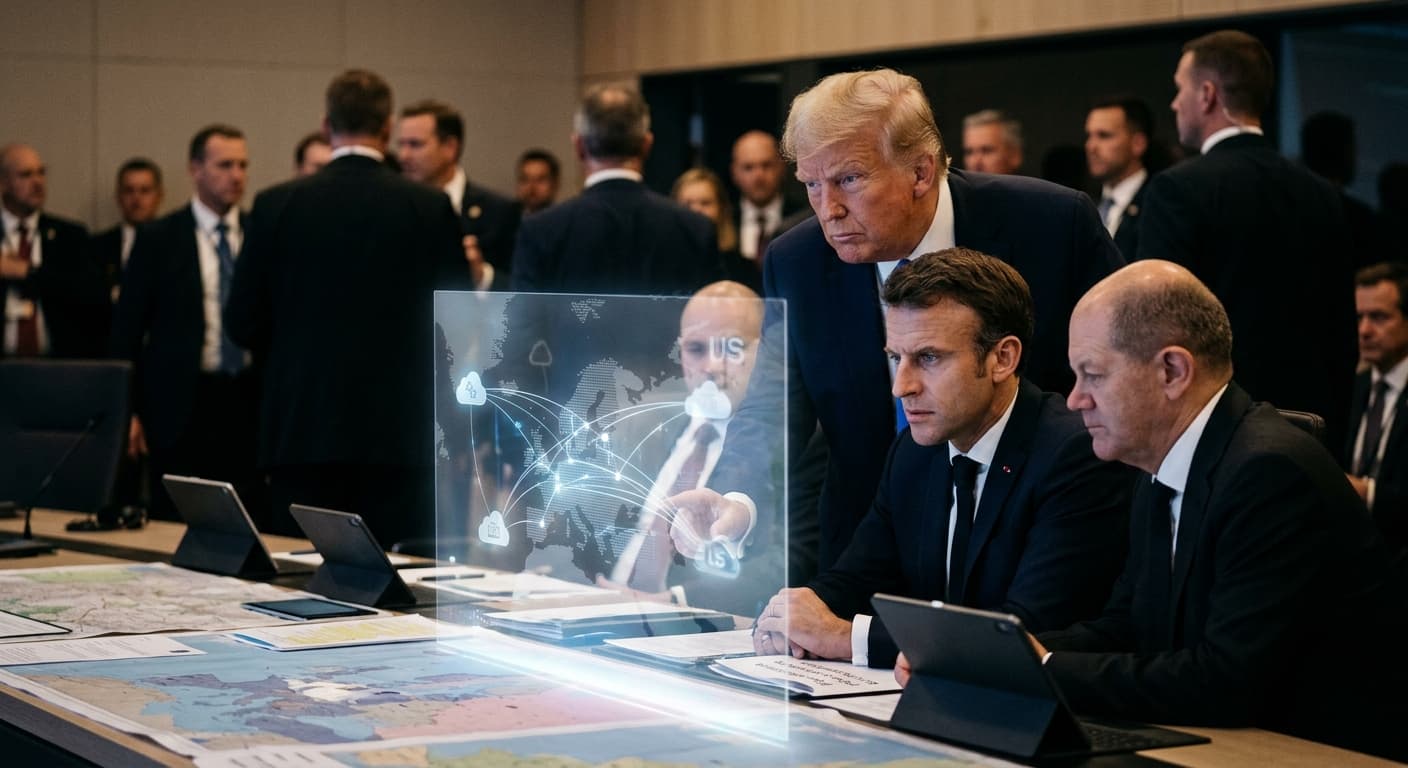
Trump Tests NATO Over Iran — and Binds Europe to a US Cloud
The Ankara declaration commits NATO to a "transatlantic warfighting cloud" and US AI models just as Trump publicly punishes allies over Iran — locking Europe deeper into American tech at its most exposed moment.
Buried in paragraph four of the July 8, 2026 Ankara Summit Declaration is the sentence that will matter longest: NATO is "developing an interoperable transatlantic warfighting cloud and adopting powerful AI models." That commitment lands the same week President Donald Trump named Italy, Germany, France and the United Kingdom as allies who failed his "test" on Iran, threatened to cut trade with Spain, and dangled F-35s at Türkiye. The thesis: Trump's public loyalty test isn't loosening the transatlantic bond — it is tightening Europe's dependence on American compute, chips and AI at exactly the moment those tools are being weaponised as political leverage. That is the story Brussels and Berlin will have to answer for by autumn.
The declaration's quiet tech clause
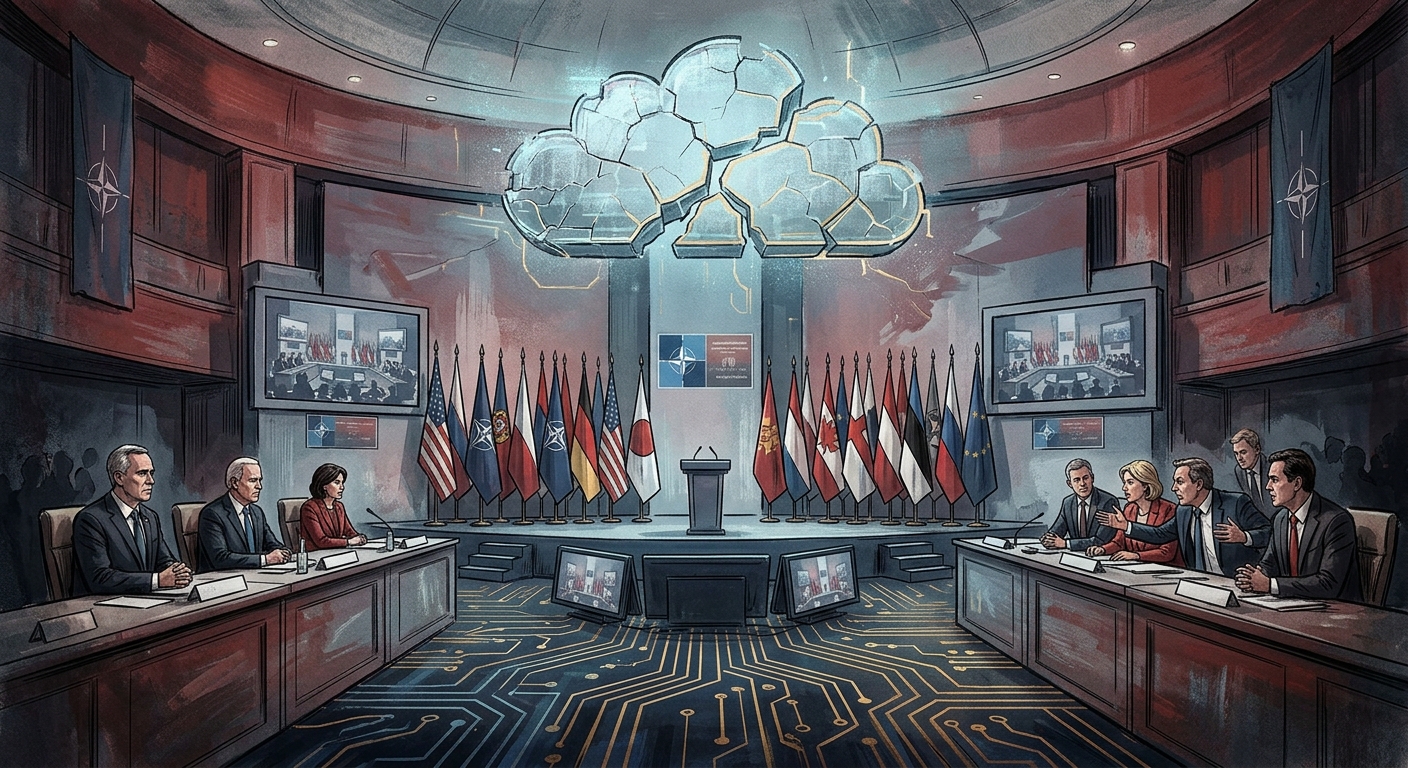
The Ankara Summit Declaration, published by NATO on July 8, 2026, is short — five substantive paragraphs. But three of them are about defence-industrial and digital capacity. Allies logged $139 billion in new 2025 core-defence spending, announced "more than $50 billion in new procurements" in Ankara, and pledged €70 billion in military aid to Ukraine for 2026. The load-bearing line is the commitment to a shared warfighting cloud "complemented by space and cyber assets" and the explicit adoption of "powerful AI models."
That language did not appear at Vilnius in 2023 or The Hague in 2025. It is a first — and it codifies a direction NATO's own Alliance Digital Strategy, adopted in January 2026, set out: a "federated, multi-classification" cloud, tactical-edge inference AI, and accelerated adoption of commercial models. In practice, that means Palantir, Microsoft, Amazon Web Services, Google, Anduril and SpaceX's Starshield — the "neo-primes"
The Economist identified in April 2026 as the winners of the Iran war's procurement lessons. NATO's classified cloud pilot, "Allied Software for Cloud and Edge," is documented by
RUSI as still years from formalisation. In the meantime, allies plug into US stacks.
The loyalty test and its receipts
Trump's framing was explicit. "In a way I was testing people," he told reporters in Ankara, according to the BBC, naming Keir Starmer for having "helped after the war." He complained on Al Jazeera's
live coverage that NATO "didn't want to help us with the number one state sponsor of terror." He also declared the US-Iran ceasefire "over" and threatened new strikes, per
NPR.
The receipts on European hesitation are clear. Spain's Pedro Sánchez barred the US from using bases at Morón and Rota for Iran operations, citing the UN Charter — a decision Madrid tied directly to its refusal to lift defence spending to 5% of GDP. Germany, France and the UK offered to run Strait of Hormuz mine-sweeping only in a "permissive environment" agreed with Iran and Oman, Foreign Minister Johann Wadephul told Al Jazeera. That is not the war Trump was fighting.
The Congressional Research Service captured the mood ahead of Ankara. Its July 2026 briefing, NATO: Issues for the July 2026 Ankara Summit, warned that "U.S. military operations against Iran could lead to procurement shortages and delays that may affect assistance to Ukraine." That is the second squeeze on European planners: buy American, faster, while American munitions stockpiles are being consumed against Iran.
Where the leverage actually sits
Read together, three vectors are converging on the same pressure point — European technological autonomy.
First, chips. Trump's January 2026 Section 232 proclamation imposed a 25% tariff on advanced computing chips including the Nvidia H200 and AMD MI325X, invoking national security and pushing derivative-product tariffs into the pipeline. Those are precisely the accelerators that run the "powerful AI models" the Ankara declaration now names as NATO capability. European allies committing to a US-led warfighting cloud are simultaneously customers of a US chip regime that can be reweighted by executive order.
Second, secondary sanctions. Trump's February 7, 2026 executive order authorised an additional 25% tariff on any country that "directly or indirectly" purchases goods or services from Iran. That instrument was built for Iran but is architecturally general: it lets Washington tax any ally judged insufficiently aligned. Combined with Trump's rhetorical threat to "cut off" trade with Spain, the message to Brussels is that trade access and defence-tech access travel together.
Third, cyber. The Iran war produced the clearest state-attributed cyber-operation of the year. On March 11, 2026, Iran-linked persona Handala hit US medical-device giant Stryker with a wiper attack, per Al Jazeera, and the
BBC documented the group's targeting of an NHS medical supplier. The FBI seized four Handala domains on March 19, 2026, according to the
Jerusalem Institute for Strategy and Security, which traced the persona to Iran's Ministry of Intelligence.
CSIS has since warned of coming upticks against "countries participating in the conflict" — a category that, per Trump's own definition, now includes the allies he says failed him.
The tech policy fine print no one is reading
The Atlantic Council's July 2, 2026 analysis framed Ankara as a moment for transatlantic industrial cooperation. NATO's own
readout of the Defence Industry Forum confirmed multinational procurement coalitions in air defence and strike systems, plus co-production deals letting US primes build in Europe. The Airbus transport-aircraft contract and Sweden's GlobeEye AWACS replacement, both reported by the
BBC, fit that narrative.
But co-production sits on top of a stack that Europe does not control. The European Commission's June 3, 2026 Cloud and AI Development Act proposal puts the number bluntly: the EU spends €264 billion a year "mostly on US proprietary IT products," and roughly 80% of its digital infrastructure is imported. Carnegie Europe's Rosa Balfour, writing in June 2026, called this Europe's
core dilemma: "A new defense built on borrowed foundations is not strategically autonomous… A supplier can impose conditions. A platform can change access."
That is not theory. It is what Trump did on July 7 with Spain and July 8 with Iran. And a NATO cloud running US-made foundation models, on US chips subject to US export controls, hosted by three US hyperscalers, is a supplier relationship with unusual switching costs. The AI clause in the Ankara declaration is the least contested and most consequential paragraph the alliance has signed since Wales in 2014.
What Türkiye's rehabilitation tells you
The other tell is Ankara itself. Trump confirmed he would lift CAATSA sanctions and "consider" F-35 sales to Türkiye — a reversal of the 2019 expulsion, which Congress imposed after Ankara bought Russia's S-400. Netanyahu warned it would "destroy" Middle East balance. But the deal has a defence-tech logic: it re-domiciles a G20 industrial base — the Kaan fighter, drone lines, HISAR air defence — inside the US supply chain, at the cost of ceding leverage over Erdoğan. It is also transactional. Türkiye hosted, Türkiye mediated, Türkiye gets the tech. Loyalty pays; distance costs.
The message to Madrid, Rome and Berlin is unmistakable. And it inverts the usual reading of Trump-as-NATO-disruptor. He is not withdrawing US tech from Europe. He is embedding it deeper, on discriminatory terms.
Diplomat View
Trump's Ankara performance will read in the wire copy as a stress test that NATO passed — Article 5 reaffirmed, $50 billion in new contracts, Rutte calling it "tremendously successful." Read the declaration's tech clause and it looks different. The alliance has just committed, in writing, to a shared cloud and shared AI models at the precise moment the US president is teaching allies that access to American systems is conditional on political alignment on wars they did not choose. The forecast: within 18 months, expect at least one major European capital — most plausibly Paris or Berlin — to carve out a "sovereign" exception in NATO's warfighting-cloud architecture, insisting on domestically-run inference for targeting and intelligence. What would falsify this call: a clean Franco-German capitulation to a single US-hosted stack, or a de-escalation with Tehran that removes the Handala-class cyber threat and lets the dependency question fade. Neither looks likely before year-end.
What to watch
- October 2026 EU Competitiveness Council: expected vote on the Cloud and AI Development Act's sovereignty-assurance-level framework — the first legal test of whether Europe will ring-fence defence compute.
- US-Iran talks track: Trump said negotiators would continue despite calling the ceasefire "over"; a fresh strike would trigger Iranian cyber retaliation against allies that hosted or hedged, per
CSIS.
- CAATSA waiver notification to Congress: any formal F-35 sale to Türkiye requires a Section 36(b) notification; watch the Senate Foreign Relations Committee calendar in September 2026.
- NATO capability targets review, spring 2027: the first hard deadline for the "transatlantic warfighting cloud" to move from communique to signed procurement.
The bottom line: The Ankara summit did not fracture NATO — it re-wired it. By locking in a US-run AI and cloud spine while publicly punishing allies for insufficient loyalty on Iran, Trump has turned technological interoperability into a compliance regime. Europe's answer to that regime, not its defence-spending numbers, is now the real transatlantic negotiation.
Discover more

US Politics
SNAP Food Assistance Faces Legal Challenges
In 2026, SNAP faces stricter eligibility rules and mounting legal challenges, threatening food assistance for the millions of Americans who rely on the program.
India
Congress Accuses Modi of Stalling Women's Law
Congress accuses Modi of stalling women's reservation law by linking it to delimitation, revealing a deeper electoral strategy.

India
BJP's Misunderstanding of Women's Quota Needs
The BJP's linking of the Women Reservation Bill to delimitation risks delaying women's empowerment in India, misreading the aspirations of female voters.

Economics
Fed's Amex AML order puts correspondent banking on notice
Federal Reserve's Amex AML order requires board-level controls and a 90-day plan; OCC fined the bank $350 million over enterprise-wide deficiencies.