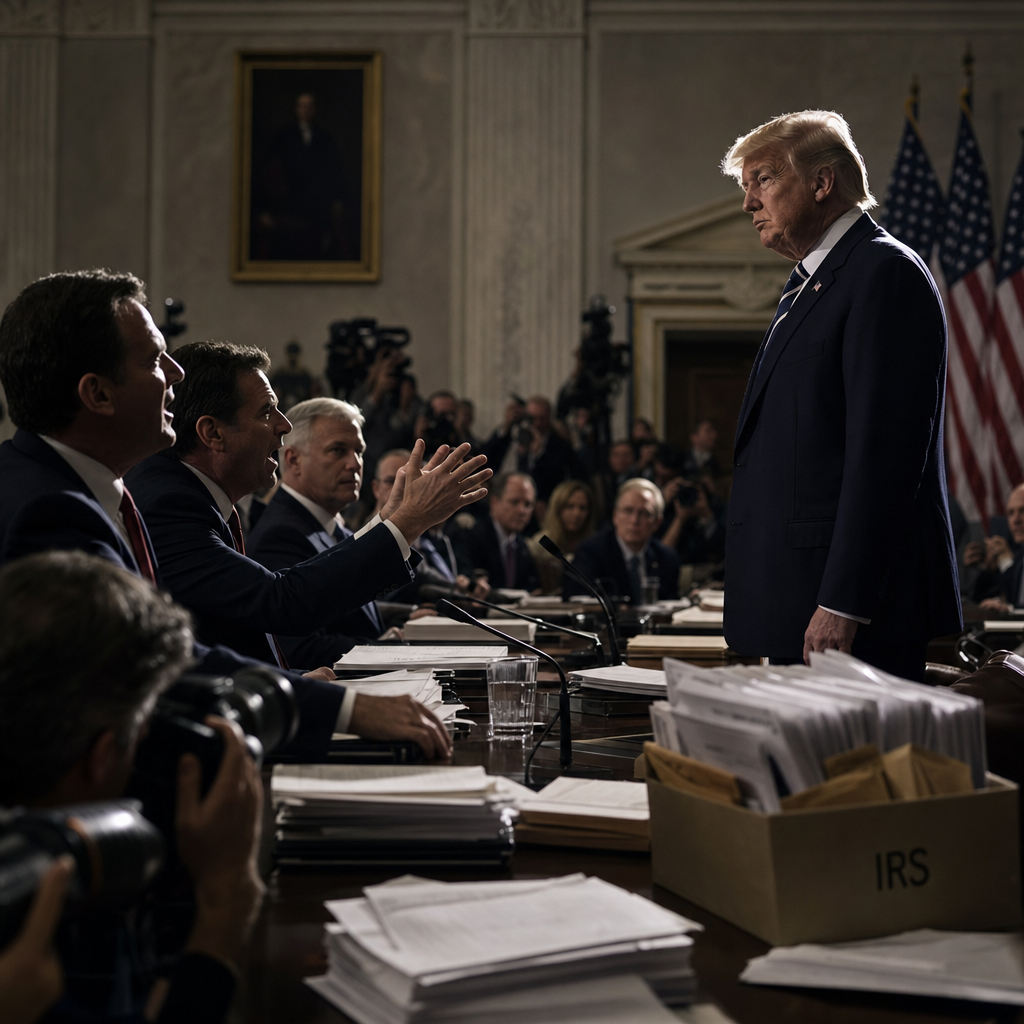
Trump’s IRS Fund Is Already Shaking Congress
The $1.776 billion “Anti-Weaponization Fund” has become a live fight over appropriations, audits, and whether Trump can turn a legal settlement into political patronage.
Congress is discovering that President Donald Trump’s IRS settlement is not a one-off tax dispute but a new pressure point inside his second-term agenda. Politico reported Tuesday that GOP senators’ questions about the nearly $1.8 billion “Anti-Weaponization Fund” helped freeze progress on Republicans’ immigration enforcement package, while Democrats on the Senate Finance Committee are now demanding a hearing on the deal ( Politico). The same settlement also prompted House Ways and Means members Brian Fitzpatrick, a Republican, and Tom Suozzi, a Democrat, to roll out legislation aimed at defanging the fund, with both suggesting they may try to force a floor vote through a discharge petition (Politico).
The leverage runs through Congress, not the courts
Trump’s advantage is simple: he has already changed the terms of the fight. Under the settlement announced by the Justice Department, the government agreed to create a $1.776 billion fund for people claiming “weaponization” or “lawfare,” and separate settlement language makes clear the administration will also drop tax claims and block further examination of Trump’s current tax issues, his family, and related entities ( AP via The Washington Post;
  Globe and Mail/AP). Bloomberg reported that the deal bars “known and unknown” IRS probes and was signed after Trump dropped his $10 billion lawsuit over the leak of his tax records (
 Bloomberg).
That matters because the settlement moves the fight from a narrow tax case into a broader question of executive power and the power of the purse. The fund is being financed through the Judgment Fund, a permanent Treasury account, which gives critics an opening to argue the White House is spending money without fresh congressional authorization (Globe and Mail/AP). That is why Democrats are pressing for hearings and why some Republicans are suddenly uncomfortable: they do not control the legal vehicle Trump has already put in motion, but they do control whether to give it political cover.
The immediate winner is Trump’s coalition
The obvious beneficiaries are the people Trump defines as victims of “weaponization,” including some allies who could seek payouts from the new fund (Politico; Bloomberg). The obvious losers are Republicans trying to pass an immigration funding bill without a floor revolt, and agencies that now have to defend a settlement many lawmakers view as an end-run around normal appropriations and oversight (The Globe and Mail).
The deeper political effect is that Trump has forced GOP senators to choose between loyalty and institutional self-defense. Some Republicans are already objecting to the possibility that Jan. 6 defendants could benefit from the fund, while others are trying to avoid a public break with the president (Politico; The Globe and Mail/AP). That split is the real story: once Trump’s settlement became a vehicle for distribution, it stopped being a tax-law oddity and became a party-management problem.
What to watch next
Watch the Senate Finance Committee first. A hearing would give Democrats a live forum to frame the settlement as abuse, and Republicans a chance to either distance themselves or normalize it (Politico). Next is the House discharge-petition effort from Fitzpatrick and Suozzi, which would test whether enough Republicans will vote against Trump’s settlement to matter on the floor (Politico). If the issue survives into reconciliation talks, the fund will become part of the broader 2026 fight over executive power, spending, and  US politics.
*
US politics.
*