Trump's F-35 Reversal for Turkey
What it means for arms controls, Israel and Greece.
Model Diplomat8 min readMiddle East
Trump's F-35 Reversal for Turkey: The CAATSA Precedent at Stake
Trump signalled a Turkey F-35 sale and CAATSA sanctions relief at the July 2026 NATO Ankara summit. What it means for arms controls, Israel and Greece.
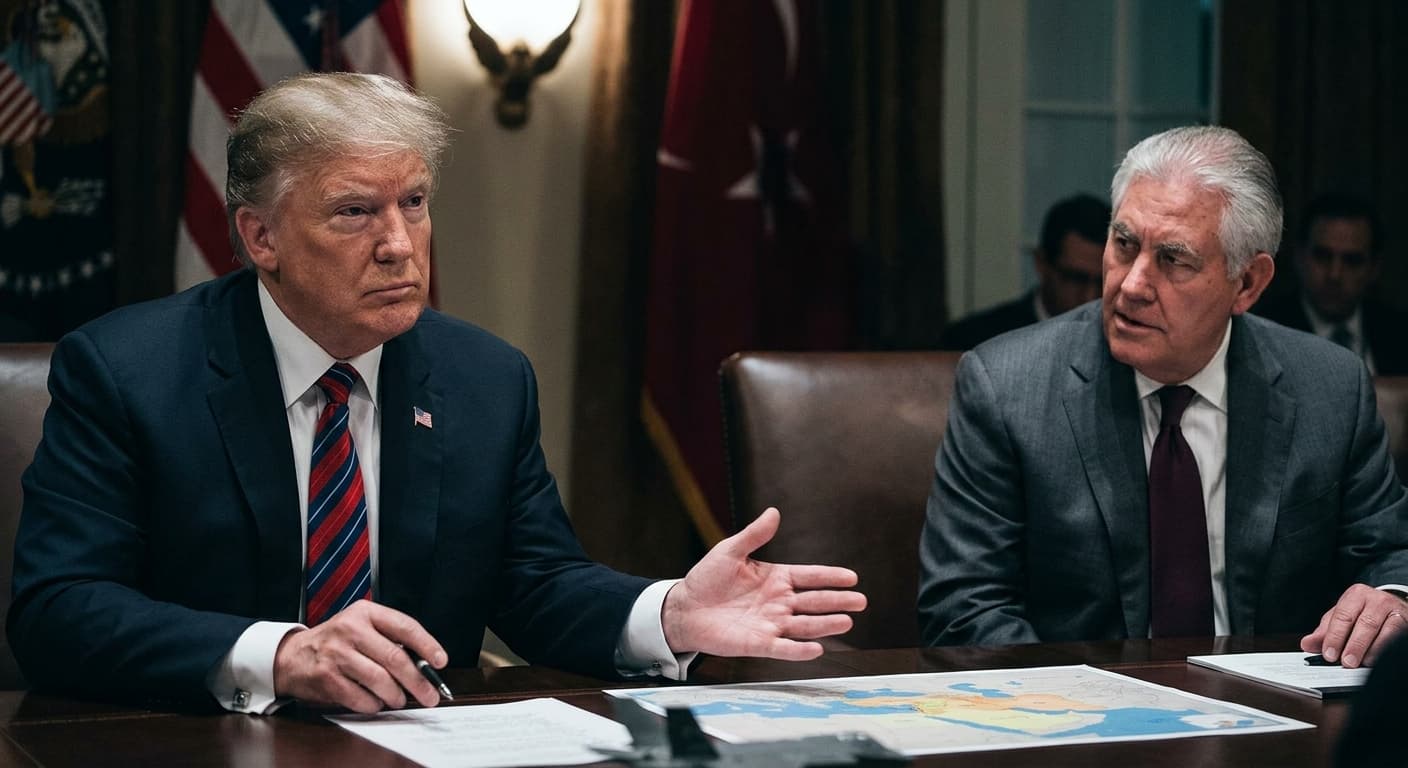
President Donald Trump told reporters in Ankara on July 7, 2026 that Washington will lift CAATSA sanctions on Turkey and is "considering" the sale of F-35 stealth fighters — a reversal that, if it clears Congress, will not simply rearm a NATO ally but blow a hole through the seven-year-old US precedent that buying Russian air defence disqualifies a country from Western fifth-generation aircraft. The load-bearing question is not whether Turkey gets the jets, but whether Congress accepts a reversible "inoperable S-400" fix that Iran and North Korea will immediately cite. According to Al Jazeera, Trump made the announcement seated next to President Recep Tayyip Erdogan on the summit sidelines; Erdogan said he had been promised five jets. Israel's prime minister called it a threat to Middle East balance the same evening. Greece said it would fight the sale. And a bipartisan bloc on Capitol Hill has the statutory authority to stop the whole thing cold.
What actually changed in Ankara
Trump's language shifted three times in 36 hours. On July 7 he said the US would "be taking the sanctions off" and called the F-35 "the best plane by far" — "something we will consider." On July 8, closing the summit, he softened: "I haven't totally made up my mind, but my inclination is to say, look, he's done everything," per the Al Jazeera live blog. Erdogan, more explicit, told reporters "we have been promised five aircraft" — the six F-35As Turkey paid $1.7 billion for and that have sat in US hangars since 2019, minus one presumably scrapped or reassigned.
The mechanical piece Trump has already moved is engines, not airframes. In late June, the administration formally notified Congress of a General Electric F110 engine sale worth roughly $700 million to power the early production run of Turkey's indigenous KAAN fifth-generation fighter, according to BBC Türkçe reporting on Reuters' scoop. The Warsaw-based
OSW Centre for Eastern Studies notes that Turkey aims to buy 40 F-35s and that the KAAN's indigenous TF-35000 engine will not be integration-ready before 2032. Without F110s, Turkey's fifth-generation programme stalls; with them, Ankara buys a decade of operational independence from Washington while it waits on its own powerplant.
That is the deal actually on the table: F110 engines now, F-35 airframes later, CAATSA relief as the price of admission — and roughly $20 billion in F-16 spare parts Turkish Foreign Minister Hakan Fidan says have been blocked by sanctions, per the Congressional Research Service country report on Turkey.
The statutory choke points Trump cannot waive alone
Trump's problem is that CAATSA is not an executive order. Section 231 of the Countering America's Adversaries Through Sanctions Act, as enacted in Public Law 115-44, designated Turkey's acquisition of the S-400 a "significant transaction" and mandated sanctions on the Presidency of Defence Industries in December 2020. The presidential waiver authority exists but is narrow: the White House must certify in writing to congressional committees that the waiver is "vital to the national security interests of the United States," and Congress has a 30-day review window.
The tighter constraint is Section 1245 of the FY2020 National Defense Authorization Act. It bars any transfer of F-35s to Turkey while Ankara "possesses" the S-400. That statutory language — "possesses," not "operates" — is what Trump's technical team is trying to bend. According to American Enterprise Institute analyst Michael Rubin, citing four sources familiar with discussions, the working plan is for Turkey to remove a single component and declare the S-400 "inoperable" — the anti-aircraft equivalent of pulling a rifle's firing pin. Reversible in hours. Cosmetic for the statute.
The German Marshall Fund's Özgür Ünlühisarcıklı had already sketched a more monitored version of this idea years ago: Turkey keeps the S-400 boxed, agrees to regular US inspection, and Washington suspends sanctions, per a GMF analysis. What has changed since is that the Trump team appears willing to skip the monitoring architecture entirely.
That is the real news. The State Department, responding to an August 2025 letter from 40 members of Congress, stated that the administration was "committed to complying with U.S. law, including CAATSA," and that the US position on Turkey's S-400 "has not changed," according to the same CRS Turkey report. Trump's Ankara statement is the reversal of that written assurance in the space of eleven months.
The angle other outlets are missing: the nonproliferation precedent
The frame most reporting has adopted — Israel versus Turkey, Greece versus Turkey, MAGA versus the NATO hawks — is not wrong, but it is second-order. The first-order casualty of a "remove a screw, declare it inoperable" workaround is US arms-control leverage everywhere else.
Trump has been demanding that Iran dismantle its nuclear programme. He has publicly threatened North Korea over missile deployments. If Congress accepts that Turkey can "neutralise" an S-400 by extracting one component and thereby unlock the world's most advanced fighter, Tehran and Pyongyang can cite the precedent verbatim. Rubin's AEI analysis names exactly this risk. Nonproliferation experts inside the executive branch will read the Ankara statement as the moment the US traded a doctrine for a transactional trophy.
There is a second-order beneficiary Trump probably has not weighed: Russia. Moscow sold Turkey the S-400 in 2017 partly to prove that a NATO member could buy Russian and survive. The seven years of CAATSA punishment falsified that thesis. A Trump-brokered rehabilitation restores it — and hands Rosoboronexport a marketing brochure for every future S-400 or S-500 pitch to India, Saudi Arabia, Egypt or Indonesia.
Israel, Greece and the Qualitative Military Edge
The regional resistance is real but arguably manageable, which is part of why Trump moved. Israeli Prime Minister Benjamin Netanyahu told CNN, per BBC Türkçe, that selling F-35s to Turkey would "destroy the balance of power in the Middle East, because Turkey has aggressive ambitions." He framed Erdogan's government as "a regime infected with the Muslim Brotherhood."
The invoked doctrine is Israel's Qualitative Military Edge, codified in US law since 2008 and reaffirmed in every major regional arms deal since — the Council on Foreign Relations traces its evolution from the Obama-era $3.8 billion annual assistance package to today's proposed defence-industrial integration. Under a QME determination, the executive branch must certify that any advanced weapon sold to a regional state does not erode Israel's military superiority. Turkey's air force is already NATO's second largest; adding stealth fifth-gen aircraft, plus access to F-35 software and maintenance networks that touch Israeli-modified "Adir" variants, is the kind of qualitative shift that QME was written to catch.
Yet Trump's comment to reporters — that Israeli and Greek opposition "have no place in my world" — is a signal to Netanyahu that the White House will not run the deal through the QME filter as previous administrations did. Republican Senator Lindsey Graham, one of Israel's staunchest congressional allies, told Türkiye Today that "there might be some pushback in Congress, but a solution might be found." That is not a veto. That is a price negotiation opening.
Greece is the quieter but structurally more important loser. Athens has an informally notified deal for up to 40 F-35s of its own, per CRS IN12111. Its value to Greece is not the airframe count — it is the qualitative gap over Turkey in the Aegean. Erase that gap and Athens is left with a NATO ally that has, on paper, matched every capability it just spent political capital acquiring. Prime Minister Kyriakos Mitsotakis, who addressed a joint session of the US Congress in 2022 explicitly to block a Turkey F-35 sale, has less leverage now than then; the Trump administration's
NPR-reported posture is that European allies who declined to join the US-Israel war on Iran have forfeited claims on Washington's arms-transfer choices.

Industrial reality: Lockheed and GE want this deal
The commercial pull is stronger than most analysts credit. Lockheed Martin has authorisation for up to 780 F-35s across FY2026–FY2030, according to the Joint Program Office acquisition document. Turkey's original programme envisaged 100 aircraft. When Ankara was expelled in 2019,
ELIAMEP research documented that Lockheed had to replace roughly $12 billion of Turkish-manufactured supply-chain production — 900 parts, some sole-sourced. The Pentagon spent $500–600 million standing up alternatives, per the
Middle East Institute.
Bringing Turkey back is not free — the supply chain has moved on — but reopening the export market to 40 Turkish jets underwrites production line economics. GE Aerospace's F110 engine package for KAAN is smaller but strategically potent: it gives US primes a foothold in what would otherwise be a Turkish-Russian or Turkish-European engine competition. Brookings' Riccardo Gasco argued in a June 2026 analysis that Turkey's defence industrialisation still runs into "high-tech bottlenecks" — precisely the gaps American components fill.
The commercial coalition — Lockheed, GE, Raytheon on the Patriot side, and Turkey's own Aselsan and TAI — is now aligned. That is the base the Trump administration is standing on when it dares Congress to block.
The Diplomat View
Trump's Ankara pledge is a bet that the transactional value of Turkey — Erdogan's mediation with Putin, Incirlik's nuclear storage role, Turkey's readiness to host NATO's mine-clearing mission in the Strait of Hormuz — is worth more to Washington than the CAATSA doctrine's deterrent effect on future S-400 buyers. The bet is defensible in isolation and dangerous in aggregate. If Congress swallows the "inoperable" workaround, expect Saudi Arabia, the UAE and India to test the boundary within 24 months by proposing similar reversible fixes for Chinese or Russian systems they already field. If Congress blocks the workaround — likely via an amendment to the FY2027 NDAA tightening Section 1245's "possesses" language — Trump will still get F110 engines to KAAN and partial CAATSA relief, and Turkey's F-35 file returns to the shelf for another two years.
The forecast holds unless one condition flips: a formal Israeli statement conditioning normalisation of Israel-Turkey ties on the sale, which would collapse the QME objection. Absent that, the odds favour engines and sanctions relief, not aircraft, before the 2026 midterm cycle closes the legislative window.
What to watch next
- 30 days from the CAATSA waiver notification: the statutory review clock under Public Law 115-44 §112. If Trump has not formally notified Congress by early August 2026, "sanctions coming off" remains rhetoric.
- FY2027 NDAA markup, House Armed Services Committee (September 2026): expect an amendment tightening or clarifying Section 1245's "possesses" standard on the S-400. This is the single most important legislative choke point.
- The F110 engine transfer license: if the ~$700 million KAAN engine package clears its congressional review without amendment, the airframe deal follows the same procedural path within 6–9 months.
The Bottom Line
The bottom line: Trump's Ankara offer is not an F-35 sale — it is a stress test of whether the CAATSA precedent survives contact with a president who does not value it. If Congress accepts a "remove one component, declare it inoperable" fix for Turkey's S-400, the real winner is Russia, which just proved a NATO member can buy its air defence and still recover access to the world's most advanced fighter. Israel and Greece lose some qualitative edge; the nonproliferation architecture loses more.
Discover more
India
700 Activists Accuse PM Modi of MCC Breach
Over 700 activists allege PM Modi breached election code with a televised address attacking opposition parties just before state elections.
US Politics
House Ethics Committee Pushes Sexual Miscond.
The House Ethics Committee has shifted responsibility for sexual harassment settlement records to the Office of Congressional Workplace Rights, complicating disclosure efforts.
India
Congress Accuses Modi of Stalling Women's Law
Congress accuses Modi of stalling women's reservation law by linking it to delimitation, revealing a deeper electoral strategy.

Economics
Fed's Amex AML order puts correspondent banking on notice
Federal Reserve's Amex AML order requires board-level controls and a 90-day plan; OCC fined the bank $350 million over enterprise-wide deficiencies.