Trump's F-35 Offer to Turkey: NATO Impacts
Analyzing Trump's NATO summit pledge to Turkey.
Model Diplomat8 min readEurope
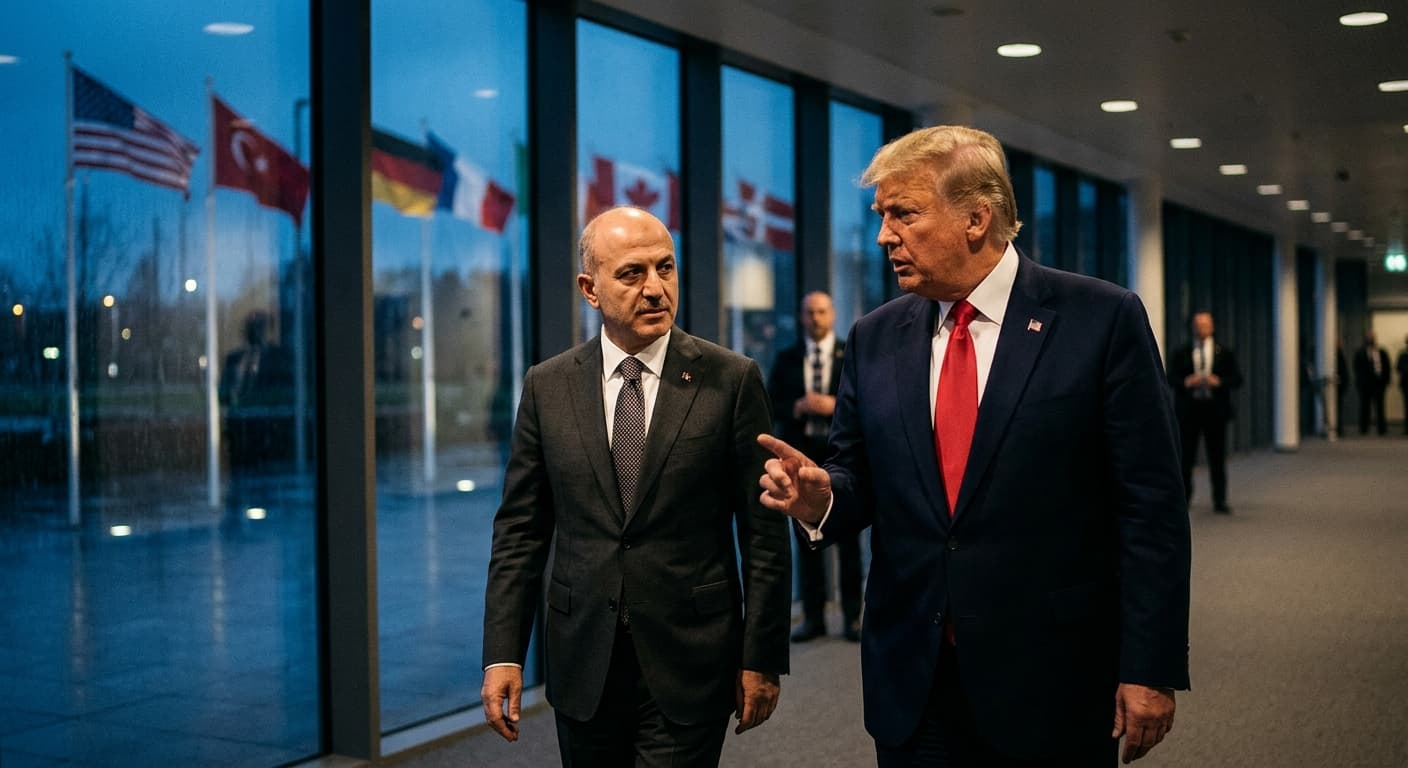
Trump Dangles F-35 for Turkey in Ankara: What NATO's Deal Really Costs
Trump signaled at the July 2026 NATO summit that Turkey may re-enter the F-35 program and see CAATSA sanctions lifted. Here is what it means for NATO, Israel and Greece.
President Donald Trump used the July 7–8 NATO summit in Ankara to hand Recep Tayyip Erdogan two of Turkey's longest-standing wish-list items — a pledge to lift CAATSA sanctions imposed in December 2020, and a public "consideration" of selling F-35 stealth fighters — while acknowledging he has not yet decided. The bet is straightforward: Washington is trading fifth-generation air power and sanctions relief for a Turkish-anchored southern flank in a NATO that Trump is otherwise hollowing out. The losers, if the deal closes, are not Russia or Iran — they are Israel's qualitative military edge and Greece's air balance, both underwritten by U.S. law.
Speaking beside Erdogan, Trump told reporters, "That's a decision we're going to be making. It's a great airplane — the best plane by far — and it's absolutely something we'll consider," according to Al Jazeera. By the summit's close on July 8, he softened the timeline — "I haven't totally made up my mind" — but confirmed his inclination was to reward Erdogan for having "helped us in so many different ways," per the
Al Jazeera live blog. Erdogan, in the same room, claimed a personal commitment for the release of five aircraft.
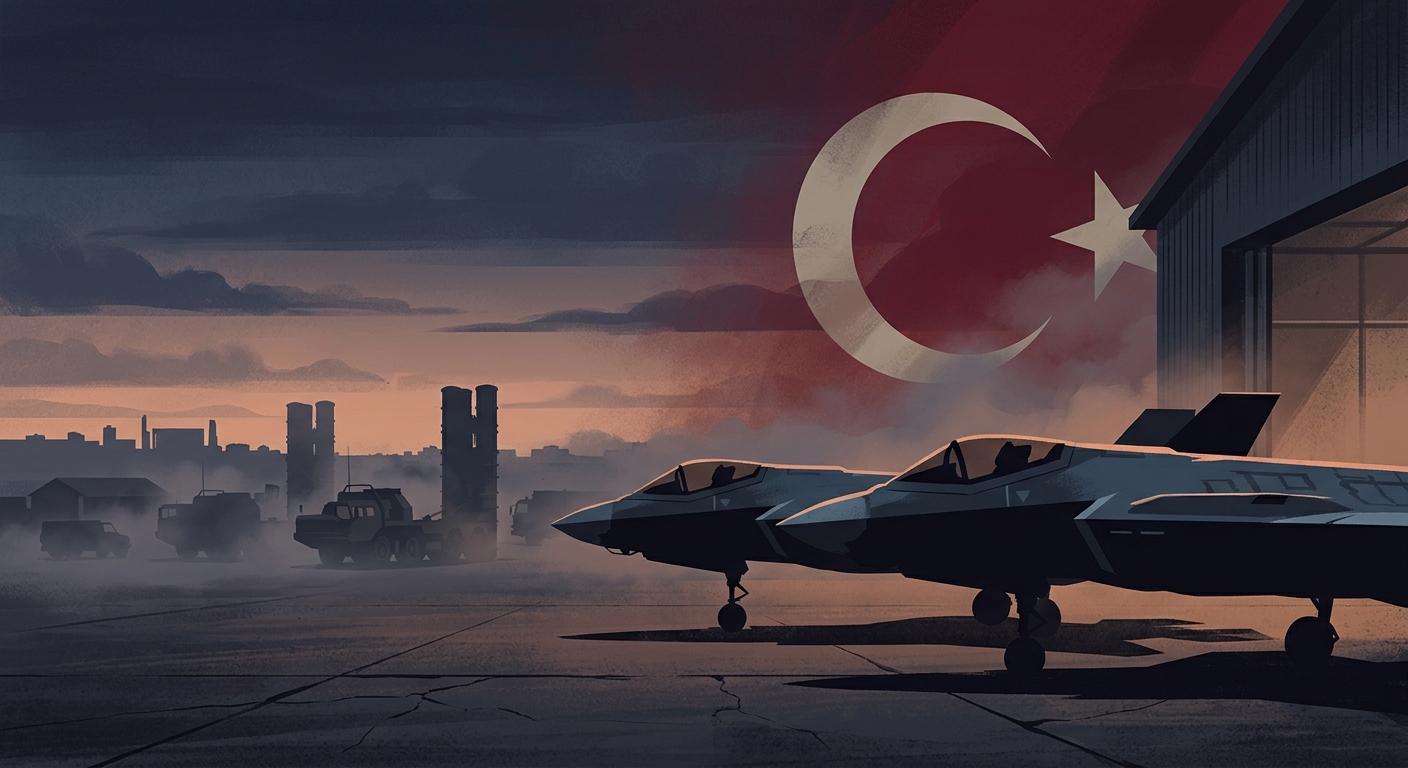
The leverage: Turkey is now the fulcrum of a hollowed-out alliance
Trump did not pick Ankara at random. The summit unfolded against a Pentagon-announced withdrawal of roughly 5,000 U.S. troops from Germany, a phased pullback of American air power in Europe, and Trump's own remark that he might not have flown to a NATO meeting hosted anywhere else — reporting compiled by Al Jazeera's summit preview.
Turkey is filling that void by exporting arms and burden-sharing at a scale Europe cannot match on short notice. Between 2020 and 2024, SIPRI ranked Turkey the world's 11th-largest arms exporter, with a 1.7% global share and rising, driven by drones, corvettes and the Bayraktar franchise. A Brookings analysis by Riccardo Gasco, published just before the summit, argues that Turkey has now "matured" into a defence industrial actor whose export order book — including a 48-jet KAAN deal with Indonesia — makes it more than a client of Washington (
Brookings).
That is the leverage Erdogan brought to the table. Trump wants a NATO where European allies pay more and Turkey polices more; Erdogan wants the sanctions and export-licence architecture that has capped Turkey's ceiling since 2019 dismantled. The F-35 is the price tag on that bargain.
The legal problem: Trump cannot deliver by fiat
The White House's biggest constraint is not diplomatic. It is statutory. Two sets of laws stand between Trump and a signed F-35 deal.
First, Section 1245 of the FY2020 National Defense Authorization Act prohibits the Defense Department from transferring F-35s to Turkey "unless Turkey no longer possesses the S-400" or associated items, according to a July 2025 update to the Congressional Research Service report on Turkey. Six Turkish-owned F-35As remain in U.S. storage; Turkey has already paid $1.7 billion for them. Section 1241 of the FY2021 NDAA layered on further conditions on CAATSA termination.
Second, CAATSA sanctions themselves are not a switch on the president's desk. 22 U.S.C. § 9411 lets the president waive individual Section 231 designations for renewable 180-day windows — but only after certifying to Congress that the waiver is "vital to the national security interests of the United States" and describing "the activity that resulted in the person being subject to sanctions." That certification is a legal document, not a press conference in Ankara. The statute is reproduced verbatim in the original 2017
CAATSA public law, which reads:
The President may waive, on a case-by-case basis and for a period of not more than 180 days, a requirement … to impose or maintain sanctions with respect to a person … not less than 30 days after the President determines and reports to the appropriate congressional committees that it is vital to the national security interests of the United States.
Every 180 days, the report has to be renewed. Congressional appropriators can starve the sale in the interim. And any full termination of the Section 231 designations against Turkey's SSB defence-procurement agency requires certification that Ankara "no longer possesses" the S-400 — a condition U.S. Ambassador Tom Barrack reiterated as recently as December 2025, according to reporting from BBC Turkish.
The pushback: Israel, Greece and a bipartisan Hill
Trump is running into three organised veto players.
Israeli Prime Minister Benjamin Netanyahu made his opposition explicit within hours of the Trump-Erdogan meeting, telling CNN that an F-35 sale would "destroy the balance of power in the Middle East" because Turkey harbours "aggressive ambitions," according to BBC Turkish. His argument is anchored in U.S. law: since 2008, Washington has been statutorily obligated to preserve Israel's Qualitative Military Edge, and Israel is currently the only operator of the F-35 in the Middle East. Congress is separately advancing the U.S.-Israel Defense Technology Cooperation Initiative as Section 224 of the FY2027 NDAA, which would tie the two defence industries more tightly — a structural counterweight to any Turkish transfer, per
Al Jazeera reporting on the bill.
Greece has been quieter but no less pointed. Prime Minister Kyriakos Mitsotakis, in a Financial Times interview weeks before the summit, urged Washington to "look at the eastern Mediterranean, to look at the security challenges in our region; to look at Turkey," according to an FT transcript. Athens is already integrating Rafales and is in advanced talks to acquire its own F-35s — a purchase whose deterrent value would be materially eroded if the same platform sits at Konya and Akıncı bases. An analysis from Israel's
Institute for National Security Studies argues that Turkey's return to the F-35 would prompt "even greater opposition in Congress" precisely because "the regional balance of power" is on the line.
Congress is the third veto point, and the most concrete one. When the Trump administration formally notified a $700m-plus GE F110 engine sale for the KAAN program on June 24, the House Foreign Affairs Committee's ranking Democrat Gregory Meeks blocked the informal review, and Representatives Chris Pappas and Dina Titus signalled a joint resolution of disapproval, according to BBC Turkish's Reuters-sourced report. Even Senator Chris Van Hollen, discussing Turkey policy at a June 24, 2026
Council on Foreign Relations event, framed the issue as conditional: "we want Turkey to get the F-35" — but only on terms that address the S-400.
What Ankara really needs — engines, not jets
The most consequential piece of Trump's announcement is not the F-35 headline. It is the F110 engine package. Turkey's indigenous KAAN fifth-generation fighter cannot enter serial production without General Electric's F110-GE-129, the same powerplant used in F-16s. The domestic replacement, TR Motor's TF35000, is not scheduled for integration until 2032, according to statements by TUSAŞ general manager Mehmet Demiroğlu compiled by BBC Turkish. Turkey has an $10-billion-plus KAAN export contract with Indonesia — 48 aircraft — riding on that engine supply.
That is why the June 24 congressional notification matters more than any Ankara photo-op. The F110 licence is the load-bearing wall. If it passes review, Turkey's KAAN program becomes viable at scale and its aging F-16 fleet gets a bridge. If Congress kills it, no amount of presidential rhetoric on F-35s substitutes.
Gönül Tol of the Middle East Institute, quoted by Reuters via BBC Turkish, put the calculation plainly: engine supply is a promise Trump can plausibly deliver; a full F-35 return is not.
The technical problem nobody wants to say aloud
There is a reason the S-400 is not merely a diplomatic irritant. The F-35's operating architecture — the Autonomic Logistics Information System, now transitioning to the cloud-based Operational Data Integrated Network — routes sustainment and mission data through a global network. A 2024 Congressional Research Service F-35 report documents that the ALIS-to-ODIN transition, scheduled to complete in 2025, was built precisely because ALIS was "vulnerable to cyberattack" and produced "incorrect results."
Placing a fully networked F-35 in a country that also operates an active Russian S-400 radar and command system is, per the IISS, what U.S. and NATO officials assess could "expose at least some of the F-35's highly classified features to Russian intelligence gathering," per the institute's strategic comment on the S-400 issue. Israeli-designed components embedded in the F-35's electronic-warfare and sensor suites compound that risk. This is the technical bedrock of Israel's objection — and the reason a Turkish F-35 sale cannot be handled as a normal Foreign Military Sale.
Diplomat View
The Ankara announcement is best read as a leveraged option rather than a done deal. Trump has signalled willingness; he has not signed anything. The F110 engine sale — quieter, cheaper, and legally cleaner — is the real deliverable and is the leading indicator to track. A KAAN engine package worth roughly $700 million is executable within the current congressional calendar; a full F-35 transfer requires either a Turkish decision to render the S-400 inoperable (a partial dismantle or a move to a U.S.-controlled base, per the CRS) or an act of Congress amending Section 1245.
Our call: the engines go through; the F-35 does not — not in this Congress, and not without a face-saving S-400 arrangement Ankara has so far refused. The forecast changes if any of three things happen. First, if Erdogan publicly agrees to mothball the S-400 under U.S. supervision, congressional resistance collapses. Second, if Netanyahu falls in Israel's coming election and Gadi Eisenkot's opposition takes power, the Israeli QME veto softens. Third, if Trump attaches an F-35 transfer to a broader Ukraine, Iran or Syria bargain that gives Republicans a strategic prize, Section 1245 becomes negotiable. Absent one of those, the sale remains a talking point — expensive for Netanyahu, useful for Erdogan, symbolic for Trump.
What to watch next
- CAATSA waiver report to Congress. Under 22 U.S.C. § 9411, any lifting of Section 231 sanctions on Turkey's SSB triggers a 30-day congressional-notification window. If no report is filed by mid-August 2026, Trump's Ankara pledge is rhetorical.
- House Foreign Affairs vote on the F110 engine package. Meeks's hold expires in the informal review; a formal notification means a 30-day joint-resolution clock begins.
- FY2027 NDAA conference (September–December 2026). Watch for amendments to Sections 1241/1245 that would relax the F-35 prohibition — the only route to a legal sale short of an S-400 divestment.
- Israeli general election (expected Q4 2026). A Netanyahu loss would recalibrate the QME argument in Washington.
- Turkey-U.S. technical working group on S-400 status. Any announcement that the system will be "rendered inoperable" or relocated is the single largest catalyst.
Key takeaways
- Trump used the July 7–8, 2026 NATO summit in Ankara to signal both CAATSA sanctions relief and F-35 openness — but by July 8 said no decision was final.
- Section 1245 of the FY2020 NDAA and CAATSA Section 231 require legal steps the president cannot execute unilaterally.
- Six Turkish-owned F-35As remain in U.S. storage; Turkey has already paid $1.7 billion.
- Israel, Greece and a bipartisan Congress each hold a functional veto; the June 24 F110 engine sale drew immediate opposition from senior House Democrats.
- The engine sale for Turkey's KAAN fighter is the executable deliverable; a full F-35 transfer is not.
For deeper context on Ankara's balancing between Washington and its own defence ambitions, see our Turkey country brief and
conflict topic hub.
Discover more
India
Congress Accuses Modi of Stalling Women's Law
Congress accuses Modi of stalling women's reservation law by linking it to delimitation, revealing a deeper electoral strategy.

India
UN Expert Albanese: India Violates Law
UN Rapporteur Francesca Albanese accuses India of breaching international law, spotlighting human rights concerns in Kashmir and prompting diplomatic pushback.
India
700 Activists Accuse PM Modi of MCC Breach
Over 700 activists allege PM Modi breached election code with a televised address attacking opposition parties just before state elections.

Conflict & Security
Drone Warfare Killing Aid Workers at Unprec
Over 1,000 humanitarian workers killed in three years as cheap armed drones collapse legal protections. Gaza, Sudan, Ukraine, and DRC see deliberate targeting of aid convoys and hospitals with zero prosecutions.