Trump's Order to Fast-Track Ibogaine Access
Executive order aims to expedite ibogaine's FDA review process.
Model Diplomat8 min readUnited States

Trump's Ibogaine Order: Fast-Track for a Schedule I Drug
Trump's April 2026 executive order tells the FDA to fast-track ibogaine and other psychedelics — but the drug named in the Oval Office has no completed U.S. trial and a well-documented cardiac risk.
President Donald Trump signed Executive Order 14401 on April 18, 2026, directing the FDA to issue "national priority vouchers" for psychedelic drugs and committing $50 million in federal money to match state programs — with ibogaine, a Schedule I hallucinogen with no completed U.S. clinical trial, named repeatedly in the text and in the Oval Office ceremony beside podcaster Joe Rogan. The order does not legalize anything. What it does is politically bigger: it converts a veterans' advocacy campaign, a Texas research program, and a Rogan text message into federal drug policy — and hands the FDA a mandate to move a compound with a documented cardiac-arrest risk toward the market ahead of psychedelics with far stronger data. The winners are Texas, a handful of clinics operating in Mexico, and a small tier of biotech firms. The loser, if the order works as written, may be the FDA's own evidentiary standard — the one it enforced 20 months earlier when it rejected MDMA.
What the order actually does
The text of Executive Order 14401, published April 18, 2026, sets four mechanisms in motion. Section 2 directs the FDA Commissioner to issue Commissioner's National Priority Vouchers to psychedelic drugs that already hold Breakthrough Therapy designation and instructs the FDA and DEA to build a Right to Try pathway for eligible patients to access investigational psychedelics, including "ibogaine compounds," under 21 U.S.C. 360bbb-0a. Section 3 tells HHS to route "at least $50 million from existing funds" through ARPA-H to match state programs. Section 5 orders the Attorney General to begin rescheduling review the moment a Schedule I psychedelic completes Phase 3 trials — collapsing a process that typically runs years, per a
Congressional Research Service brief on CSA scheduling, into something DEA is expected to finish "as quickly as practicable."
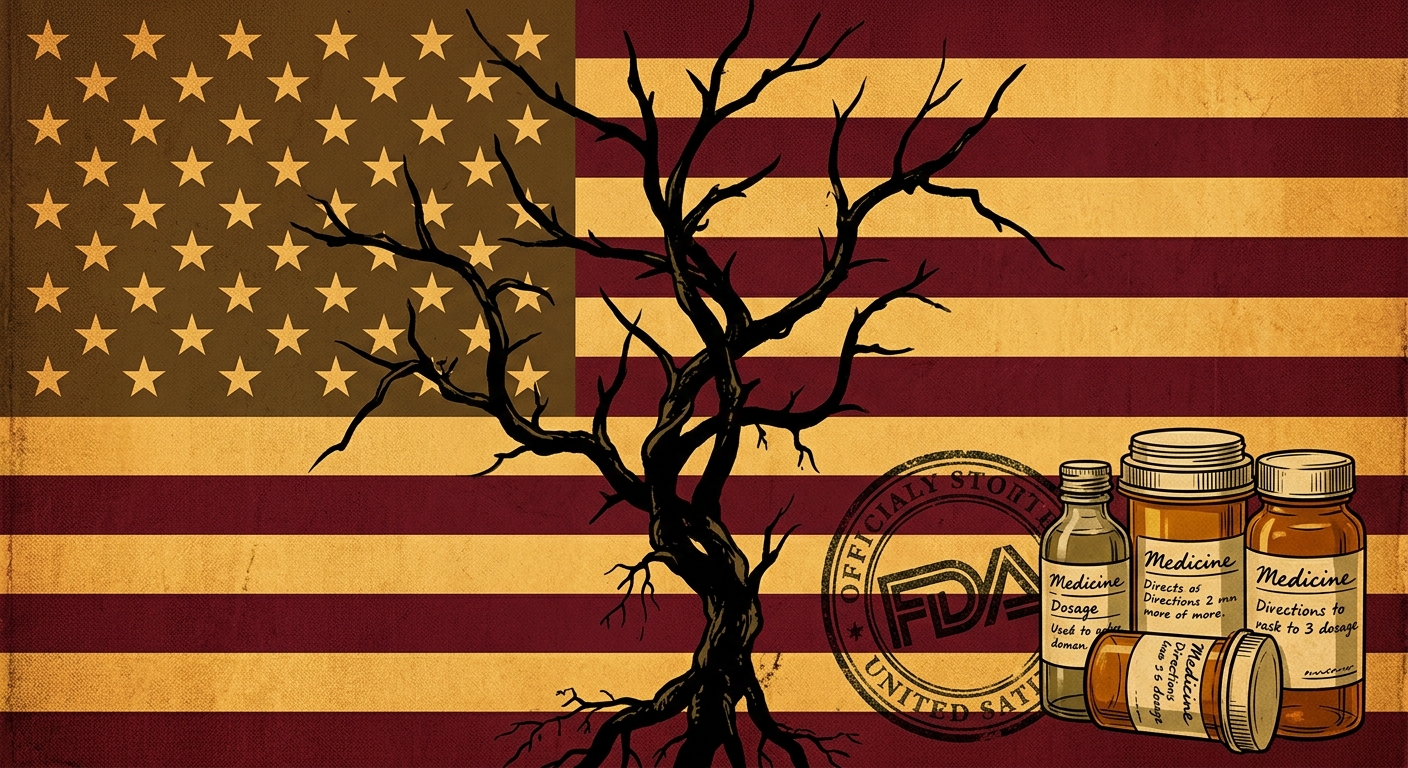
The White House fact sheet frames the package as a veterans' mental-health measure, citing the 14 million American adults living with serious mental illness and the administration's 2025 HALT Fentanyl Act, which liberalized Schedule I research handling. FDA Commissioner Marty Makary told reporters at the signing that the agency would issue priority vouchers to three psychedelics "next week," which, according to
NPR's reporting, could compress FDA review to a matter of weeks — the first time the agency has offered to fast-track any psychedelic.
The number driving the politics
The animating figure is 17.5. That is the average number of U.S. veterans who died by suicide per day in 2021, at a rate 71.8% higher than nonveteran adults, according to a Congressional Research Service brief drawing on VA data. In sworn House testimony on April 30, 2025, VA Deputy Executive Director Ilse Wiechers told the Oversight Subcommittee that VA suicide-prevention spending had risen more than 11,000% since 2008 — from $4.4 million to $522 million a year — while the annual death count has hovered around 6,500 (
VHA statement, House Committee on Veterans' Affairs). That is the policy vacuum ibogaine advocates walked into. When Rick Perry, former Texas governor and chairman of Americans for Ibogaine, and the veterans' group VETS Inc. began pushing state and federal money toward the drug, they were selling a treatment against a problem federal spending had visibly failed to move.
The evidence problem
The best-published human data on ibogaine come from a Stanford-monitored observational study of 30 U.S. special-forces veterans who traveled to Mexico for treatment. Published in Nature Medicine in 2024, the MISTIC protocol paper reported large effect sizes for PTSD (Cohen's d = 2.54), depression (d = 2.80) and anxiety (d = 2.13) one month after a single ibogaine dose, coadministered with intravenous magnesium to blunt cardiac risk. The authors themselves flagged the limits: open-label, no control arm, no randomization, no FDA IND. A
2025 narrative review of thirty years of ibogaine research concluded that "no double-blind RCT to date has demonstrated that ibogaine or noribogaine can effectively treat opioid use disorder" and that "current evidence is insufficient to support its clinical use."
The safety signal is not theoretical. A prospective open-label safety study of a 10 mg/kg ibogaine dose in opioid-dependent patients found QTc prolongation averaging 95 ms, with half of subjects passing 500 ms — the threshold associated with torsade de pointes (PubMed / Knuijver et al.). Case-series literature documents multiple sudden cardiac deaths (
Koenig & Hilber, 2015). Alan Davis, who runs Ohio State's Center for Psychedelic Drug Research, told
NPR plainly: "There's no compelling evidence to date that suggests that ibogaine is better than these other psychedelics, but there is evidence to suggest that it's more risky." A separate ibogaine trial run by his team on psilocybin reported 75% PTSD remission in veterans — a compound with a substantially larger evidence base that the order treats as coequal.
The MDMA parallel — and why this is different
Twenty months before the ibogaine order, on August 9, 2024, the FDA rejected Lykos Therapeutics' MDMA-assisted therapy for PTSD in a complete response letter, after an advisory panel voted 10–1 that the benefits did not outweigh the risks, per NPR's coverage. The agency demanded a fresh Phase 3 trial — a process Lykos estimated would take years. A subsequent
Science analysis reported that Psychopharmacology retracted three underlying Lykos papers the day after the rejection, over undisclosed misconduct in an earlier trial.
MDMA had two Phase 3 trials, roughly 200 patients, a breakthrough designation from 2017, and 80 lawmakers lobbying for approval. It was rejected on evidentiary grounds. Ibogaine has none of those trials — and is now being escorted to the same regulatory door under a presidential executive order and a novel voucher pathway. The Brookings analysis of the Commissioner's National Priority Voucher notes the vouchers can compress standard 10-month reviews into a 30–60 day window and, on the secondary market, could be worth "well over $150 million." That is the financial payload the order is quietly attaching to a compound whose Phase 3 dossier does not yet exist.
Who wins
The concrete winners are already visible. Texas is first among them: in 2025, the state launched a $50 million ibogaine research consortium — the sum the BBC's ibogaine feature confirms was earmarked for OUD, PTSD and TBI trials — and Section 3 of the executive order is drafted so tightly that Texas is effectively the only state with a shovel-ready program to absorb ARPA-H matching funds. NPR reporter Will Stone noted on the
NPR Politics Podcast that Texas "was looking for just that same amount of money," making the state the near-certain first recipient.
The second tier of winners is corporate. Beond, a Cancún-based ibogaine clinic whose CEO Tom Feegel released a statement on the White House press page, stands to gain from the Right to Try pathway that would allow U.S. patients formal access to a compound they currently obtain by flying to Mexico. Sponsors developing ibogaine-derivative pharmaceuticals — the Marazziti et al. review in
Expert Opinion on Pharmacotherapy lists a growing pipeline including Beckley Psytech, GH Research and Compass — see valuation upside from priority vouchers alone. And Joe Rogan, whose text to Trump the president read aloud in the Oval Office, has now permanently altered the political economy of American drug approval by demonstrating that podcast advocacy can move a Schedule I compound into the priority-review queue.
The quieter beneficiary is Gabon, source of the Tabernanthe iboga shrub, whose forestry-dependent economy grew 2.9% in 2024 per the World Bank's 2025 Gabon Economic Update. A UK government botanical assessment
flags the sustainability question directly: "if clinical trials studying ibogaine's effectiveness and safety in treating drug addiction are successful, and no synthetic substitute for ibogaine is developed, demand for the raw material should rise further." The plant is already reportedly overharvested; a U.S. medical market would multiply pressure on a species central to the Bwiti religious tradition in Gabon, Cameroon and Equatorial Guinea.
Who loses
The clearest loser is the FDA's institutional posture. The agency spent 2024 defending an evidentiary bar against MDMA that veterans and 80 lawmakers had asked it to lower. The White House presidential-action release quotes Rep. Dan Crenshaw calling the order the end of "regulatory red tape." Whatever the merits, the FDA now operates in a policy environment in which the White House has publicly encoded a preference for a specific Schedule I compound.
Psilocybin developers are the second loser. As the Science news coverage observed, psilocybin was expected to be the first psychedelic to reach U.S. market. By naming ibogaine repeatedly, Trump has shifted attention — and potentially voucher allocation — toward the weaker candidate. Companies with Phase 3 psilocybin dossiers ready to submit now compete for scarce priority slots against a compound the president personally endorsed.
The historical parallel
The closest analog is not another drug approval. It is the Right to Try Act of 2018, which Trump signed in his first term and which the current order invokes as its patient-access mechanism. That law was politically popular and pharmacologically marginal: it created a workaround for terminally ill patients that, per the FDA's own statements at the time, largely duplicated the pre-existing expanded-access program. Section 2(b) of the executive order does the same for psychedelics. The
PBS NewsHour coverage notes that the substances remain fully Schedule I; the order changes the political framing more than the legal architecture.
What to watch
- The first voucher. Which three psychedelics Makary's FDA designates. If ibogaine is on the list without an IND-approved Phase 3 trial, the evidentiary bar has moved.
- The ARPA-H obligation. Whether the $50 million matches Texas alone or is spread; the
Federal Register notice provides the audit trail.
- The first U.S. ibogaine IND.
Al Jazeera reported the FDA is clearing the way for the first U.S. human trials; the sponsor and cardiac-monitoring protocol will define the risk envelope.
- DEA rescheduling posture. Section 5 requires the AG to move on rescheduling review after Phase 3 completion. The first test case will set the tempo for the entire field.
Diplomat View
The order is a bet, not a breakthrough. Trump has wagered that the veteran-suicide crisis is politically urgent enough to justify moving a compound with a well-characterized cardiac risk and no completed U.S. Phase 3 trial to the front of the FDA's queue — and that the priority-voucher mechanism will hold up under a case it was not designed for. The forecast: within 18 months the FDA will grant a national priority voucher to at least one psychedelic sponsor and Texas will receive most of the ARPA-H match, but ibogaine itself will not gain approval before 2028 because no completed pivotal trial exists to review. Falsification conditions are specific: if the FDA issues a voucher to an ibogaine sponsor lacking Phase 3 data, or if a Right to Try-accessed patient dies of a QT-related cardiac event, the political scaffolding under this order collapses fast. Watch the first voucher decision, and watch whether the VA signs the data-sharing memorandum Section 4 requires. Those two moves, more than the signing ceremony, will tell you whether Executive Order 14401 is a genuine regulatory shift or a Rogan-shaped press release.
Discover more
Conflict & Security
De la Espriella's Razor Win Resets US-Colomb
De la Espriella's razor-thin election win signals a reset in US-Colombia relations, reshaping security ties and the agenda under a Trump-aligned approach.
International Relations
Colombia's Razor-Thin Rightward Pivot
Colombia swings right as Abelardo de la Espriella narrowly wins the presidential runoff by under one percent, exposing a deeply divided and polarized nation.

Global Politics
Iran Demands US Enforce Ceasefire
Iran insists the United States must enforce a ceasefire in Lebanon to uphold the memorandum of understanding, raising pressure on Washington and Netanyahu.

Conflict & Security
Trump's Iran Deal Faces Bipartisan Backlash
Trump's Iran deal draws fierce criticism from both Republicans and Democrats, exposing deep political divides over the ceasefire and the terms of the agreement.