Trump's Dyslexia Insults Spark Disability Sti
Trump's remarks on dyslexia ignite backlash and policy implications.
Model Diplomat7 min readUnited States
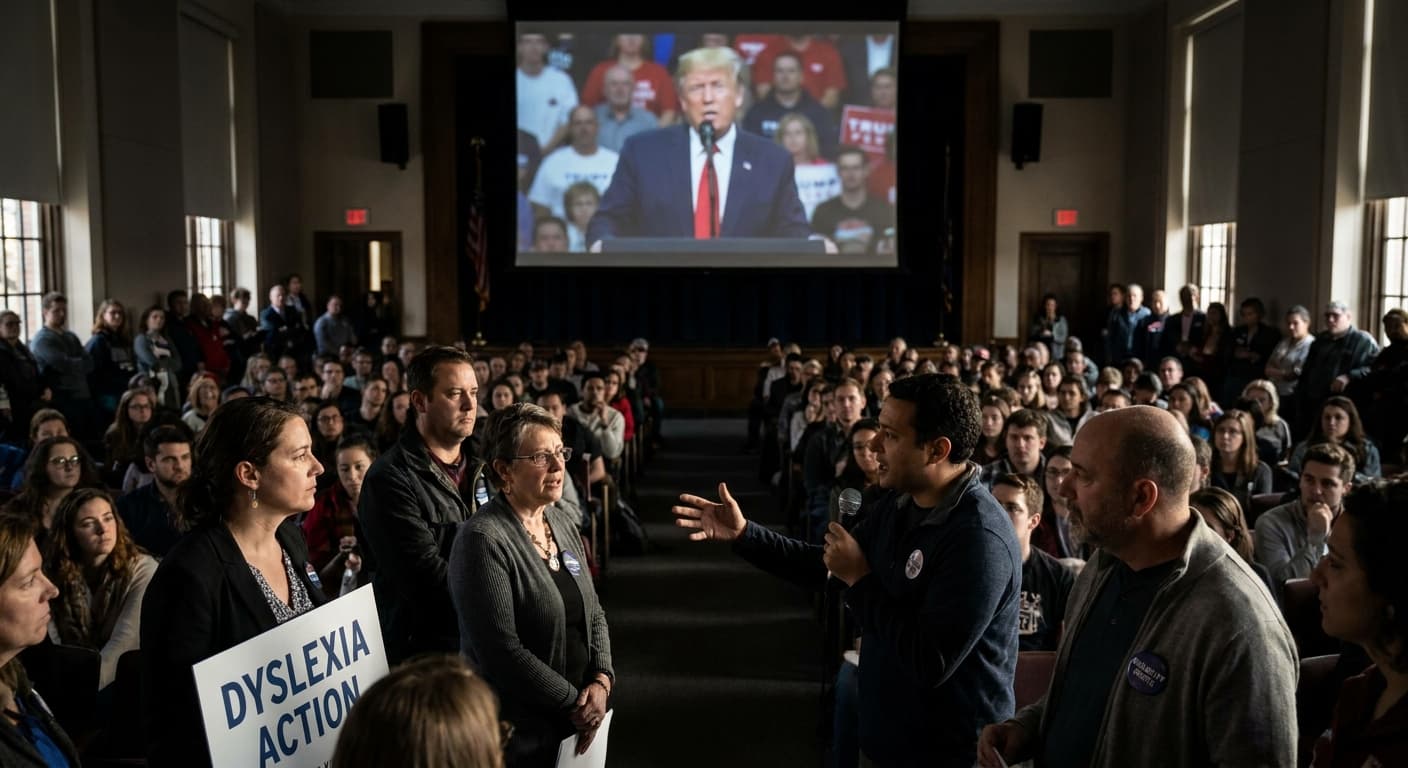
Trump's Dyslexia Insults Spark Disability Stigma Fight
Trump said presidents "should not have learning disabilities," attacking Newsom's dyslexia. The backlash is exposing a policy fight, not just an insult.
President Donald Trump told reporters in the Oval Office on July 6, 2026 that "a president should not have learning disabilities," a line aimed at California Governor Gavin Newsom's dyslexia that, within 24 hours, drew formal condemnation from the National Center for Learning Disabilities, a rebuke from a British MP and a counter-attack from Newsom himself. The insults matter less than what they camouflage: the administration is simultaneously dismantling the federal machinery that serves the 7.9 million American children the government classifies as disabled learners — with roughly a third of them protected under the very "specific learning disability" category that includes dyslexia, according to the Congressional Research Service. This is not a gaffe cycle. It is stigma weaponised at the exact moment federal disability infrastructure is being pulled apart.
What Trump actually said, and to whom
Trump's remarks to reporters, quoted by the BBC, were unusually explicit. "With a low IQ person, you know, because Gavin Newscum has admitted that he has learning disabilities," Trump said. "Honestly, I'm all for people with learning disabilities, but not for my president. I don't want, I think a president should not have learning disabilities, OK? And I know it's highly controversial to say such a horrible thing." He followed up on Truth Social, calling Newsom a "Cognitive Mess" who "can't read, has dyslexia, and has a mental disorder."
The trigger was a February 2026 on-stage conversation in Atlanta, where Newsom told a majority-Black audience "I'm like you," citing failed exams and difficulty reading. "You've never seen me read a speech, because I cannot read a speech," he added, according to the same BBC account. Newsom then folded the story into his February memoir Young Man in a Hurry, which
NPR previewed as the launch pad for a 2028 presidential run. Newsom's on-record answer this week: "I know that's hard for a brain-dead moron who bombs children and protects pedophiles to understand."
The immediate political audience is 2028 primary voters and California donors. The bigger audience — the one this feature is about — is the roughly 40 million Americans the U.S. Department of Health and Human Services estimates have some form of dyslexia, plus the parents and teachers who spent 50 years building a legal architecture that treats the condition as a civil-rights matter, not a competence disqualifier.
The stigma is scientifically wrong. That is the point.
Jackie Rodriguez, chief executive of the National Center for Learning Disabilities, told the BBC that dyslexia "does not impair a person's intelligence, judgement or ability to lead. In fact, people with learning disabilities have risen to the upper echelon of every public office in the United States, including former presidents." The
Independent walked through the same evidence, quoting 18-year-old Lauryn Muller on the specific harm of hearing a president equate her diagnosis with stupidity.
The scientific record here is not close. A landmark meta-analysis in the American Educational Research Journal by Stuebing and colleagues, published via SAGE, found "substantial overlap" between poor readers with high IQs and those with low IQs, casting "doubt on the need for IQ tests in identifying these students." Linda Siegel's
Journal of Learning Disabilities work concluded flatly that "IQ scores are irrelevant to the definition and analysis of reading disability." Bennett and Sally Shaywitz's Connecticut Longitudinal Study at Yale,
also published in SAGE, showed dyslexia sits across the ability spectrum — not at "the lower tail." A 2022 Frontiers in Psychology paper indexed on
PubMed goes further, arguing that dyslexic cognition reflects a "specialization in explorative cognitive search" — an evolutionary asset, not a deficit.
Federal law codifies the same view. Under 42 U.S.C. § 12102, the Americans with Disabilities Act defines disability to include impairments that substantially limit "learning, reading, concentrating, thinking" — and the Legal Information Institute text mandates that the definition "be construed in favor of broad coverage." The Justice Department's implementing regulation at
28 CFR § 36.105 names dyslexia explicitly and notes that "someone with a learning disability may achieve a high level of academic success." The EEOC's Title I guidance, at
29 CFR Part 1630, holds that employers may not use qualification standards that "screen out" people with learning disabilities absent business necessity. Trump's public standard — that dyslexia disqualifies a person from the presidency — is the textbook conduct the ADA was written to bar in every other American workplace.
Why now: the insult is a wedge for the policy
Read the rhetorical campaign against the policy campaign, and the alignment is exact. In March 2025 Trump announced he would move "special needs" out of the Department of Education and into Health and Human Services, an approach NPR reported tracks Project 2025's blueprint. Education Secretary Linda McMahon cut the department's workforce roughly in half; the Office for Civil Rights lost more than 40% of its staff and seven of its 12 regional offices.
On March 28, 2025 the National Center for Learning Disabilities filed a Supreme Court amicus brief opposing the administration's mass termination of teacher-training grants under the Supporting Effective Educator Development and Teacher Quality Partnership programmes. The brief called the terminations an "unprecedented campaign" to "wipe away entire statutory programs that Congress has mandated," and warned that slashing those pipelines has "direct and unequivocally detrimental impacts" on students with disabilities. By December,
NPR documented HHS instructing Head Start grantees to avoid the words "disability," "disabilities" and "inclusion" in funding applications. Rodriguez's response then: "Banning the word 'disability' from Head Start is morally repugnant and a violation of federal law."
That is the frame the Oval Office remarks slot into. When the president publicly recasts dyslexia as a marker of unfitness, the political cost of gutting the programmes that serve dyslexic children drops. The stigma does regulatory work.
The 7.9-million-child stake
The scale is easy to miss. The Congressional Research Service reports that in 2023–24 approximately 7.9 million children ages 3 through 21 received services under Part B of the Individuals with Disabilities Education Act, with "specific learning disability" — the category that names dyslexia, dysgraphia and developmental aphasia — the single largest bucket at roughly one-third. Congress appropriated $15.4 billion for IDEA in fiscal 2024,
NPR reported, money that flows through the Education Department the administration is trying to close. NCLD's Rodriguez told
NPR in December that without federal staff support "we are concerned special education will cease to exist."
Estimates of dyslexia prevalence in the general U.S. population run from 10% to 20%; a 2020 study in the Journal of Learning Disabilities published in SAGE argues prevalence is better modelled as a distribution across severity than a single point. HHS's own working estimate is around 15%. On any of those numbers, Trump's disqualification rule would exclude between one in ten and one in five Americans from the office he currently holds.
The transatlantic and domestic backlash
The condemnation crossed the Atlantic within a day. Yeovil MP Adam Dance, who is dyslexic and introduced a UK bill in September for universal neurodivergence screening, told the BBC Trump's comments were "deeply troubling, offensive and completely out of step with reality," and demanded a "sincere apology" to Newsom and "the wider dyslexic community." The
Seattle Times and
TIME documented the domestic advocacy response. The
Associated Press, in a widely syndicated feature, walked through the personal cost — Muller's, and hundreds of others' — of a president using "stupid" and "low IQ" as synonyms for a diagnosis codified in federal statute.
Newsom, meanwhile, is monetising the fight. He has grown his national profile precisely by baiting Trump, BBC coverage of a Justice Department probe of his wife and former chief of staff noted, and his team openly mocks Trump's caps-lock style on X. The dyslexia clash gives him a story arc — vulnerability, resilience, national villain — that no policy paper can match.
Diplomat View
The forecast is specific: Trump's dyslexia line will not be retracted, and it will be repeated, because it is doing three jobs at once. It softens the political cost of dismantling IDEA-adjacent programmes, it primes the electorate to read Newsom's 2028 candidacy as a fitness question rather than an ideological one, and it satisfies a base that reads "disability" as elite grievance. Expect the administration to formally propose moving IDEA administration to HHS within the next twelve months, and expect the stigma rhetoric to intensify as that fight lands in Congress. The forecast changes if: (a) a federal court blocks the Education Department dissolution on ADA or spending-clause grounds; (b) a Republican senator with a dyslexic child breaks publicly, giving cover to others; or (c) Newsom's 2028 numbers stall, removing the political incentive on Trump's side to keep the target lit. Absent those, expect the AP feature cycle — Lauryn Muller's story, told a hundred ways — to become a durable feature of the 2028 campaign.
What to watch next
- The Supreme Court's disposition in the NCLD-adjacent Tucker Act litigation on grant terminations, which will set the ceiling on executive impoundment of disability funds.
- Any HHS Notice of Proposed Rulemaking on transferring IDEA administration — the formal trigger for a congressional fight.
- Newsom's fall 2026 travel schedule outside California, the leading indicator of a 2028 announcement and the moment Trump's rhetoric will sharpen again.
The Bottom Line
Trump's claim that presidents "should not have learning disabilities" is not a stray insult — it is stigma deployed in service of a policy programme that is defunding the exact federal apparatus protecting 7.9 million disabled American children. The scientific and legal consensus, from Yale's Shaywitz labs to 42 U.S.C. § 12102, points the other way. The next twelve months will show whether the courts, Congress or the 2028 electorate treat that gap between rhetoric and law as disqualifying — for Trump, not for Newsom.
Discover more
Conflict & Security
De la Espriella's Razor Win Resets US-Colomb
De la Espriella's razor-thin election win signals a reset in US-Colombia relations, reshaping security ties and the agenda under a Trump-aligned approach.
International Relations
Colombia's Razor-Thin Rightward Pivot
Colombia swings right as Abelardo de la Espriella narrowly wins the presidential runoff by under one percent, exposing a deeply divided and polarized nation.

Global Politics
Iran Demands US Enforce Ceasefire
Iran insists the United States must enforce a ceasefire in Lebanon to uphold the memorandum of understanding, raising pressure on Washington and Netanyahu.

Conflict & Security
Trump's Iran Deal Faces Bipartisan Backlash
Trump's Iran deal draws fierce criticism from both Republicans and Democrats, exposing deep political divides over the ceasefire and the terms of the agreement.