Trump's China Tariffs
Examining the fragility of Trump's tariff policies on China.
Model Diplomat7 min readNorth America
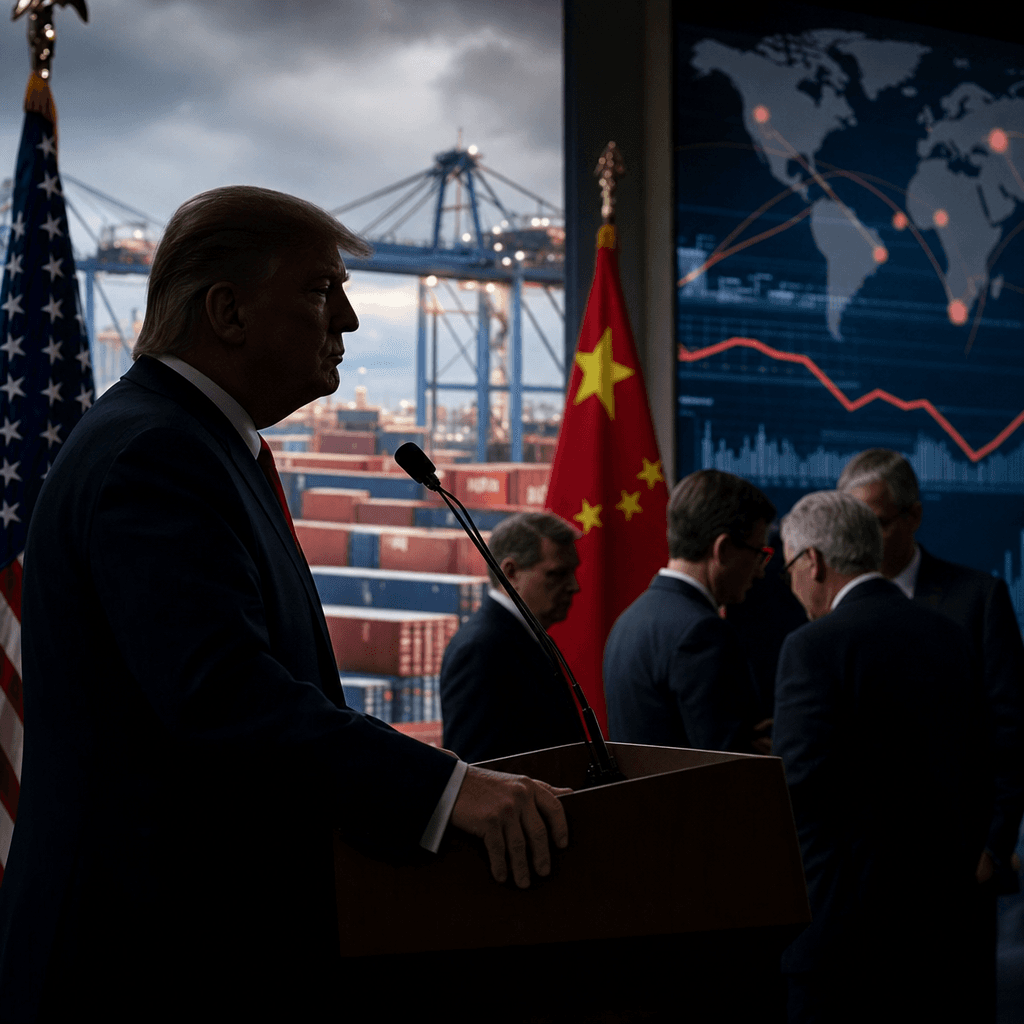
Trump's China Tariffs: The Wall Is Cracking, Not Falling
Trump's China tariffs still average about 39% in July 2026 — but Section 122 expires this month, the Supreme Court gutted IEEPA, and China holds the leverage.
Trump's tariff wall around China is now held up not by presidential fiat but by three brittle props: a 1962 statute, a 1974 statute, and a one-year truce signed in Kuala Lumpur that expires on November 10, 2026. That is the operative fact eight months after the Supreme Court struck down the sweeping "reciprocal" duties that made Trump's second-term trade policy legible. The wall still stands at an effective 39% average — but the leverage has quietly shifted to Beijing, which now holds a rare-earth switch it can flip in a week and a soybean order book it can walk away from.
What is actually in force
Strip out the noise and the tariff stack on Chinese goods in July 2026 has four layers. The oldest — and the only fully court-proofed one — is the Section 301 architecture from 2018, ranging from 7.5% on apparel to 100% on Chinese-made electric vehicles, per the Congressional Research Service overview U.S.-China Tariff Actions Since 2018. On top sit Section 232 duties on steel, aluminum and autos. Then two IEEPA-era layers that Trump has kept alive by other means: a 10% "fentanyl" tariff, folded into the Trump-Xi deal, and a 10% "reciprocal" tariff now propped up by Section 122 of the Trade Act of 1974.
The result, according to CRS: average U.S. tariffs on Chinese goods fell from a peak of 164% in mid-April 2025 to 39% by November 2025, and have stayed roughly there. China's average tariff on U.S. goods is about 31%. Both figures are more than triple the pre-Trump baseline of about 11%.
The Kuala Lumpur Joint Arrangement, laid out in the White House's November 4, 2025 proclamation, suspended the heightened reciprocal duties until 12:01 a.m. on November 10, 2026. In return, Beijing suspended the export-control regime on rare earths and permanent magnets it had rolled out on October 9 — a regime that, had it taken effect, would have required a Chinese license for any product anywhere in the world containing trace amounts of Chinese-origin rare earths.
The Supreme Court cracked the foundation
The wall's legal foundation collapsed on February 20, 2026. In a 6-3 opinion authored by Chief Justice Roberts, the Supreme Court in Learning Resources, Inc. v. Trump held that the International Emergency Economic Powers Act does not authorize the President to impose tariffs. The Court applied the major-questions doctrine and rejected the government's reading of "regulate . importation" as a delegation of tariff power.
"Regardless of what [certain precedents] might mean for the President's inherent wartime authority, all agree that the President enjoys no inherent authority to impose tariffs during peacetime."
The ruling, NPR reported, left roughly $175 billion in collected duties in refund limbo — the majority declined to say how the money should be returned, and Justice Kavanaugh's dissent warned the unwind would be a "mess." Treasury Secretary Scott Bessent has told importers the litigation will drag on for years.
Within four days, Trump invoked Section 122 of the Trade Act of 1974 — a balance-of-payments authority never used before — to impose a temporary 10% blanket tariff, later raised to 15%. The White House's own fact sheet acknowledges the duty runs for only 150 days. That window closes around July 23, 2026 — barely two weeks from now. The Court of International Trade already ruled on May 7 that Trump's use of Section 122 exceeded the statute's limits, per the
Atlantic Council tariff tracker; the tariffs remain in effect pending appeal.
Who actually holds the leverage now
The conventional read in Washington is that Trump crushed Xi into a deal. The evidence points the other way. Brookings' Ryan Hass and Mireya Solís conclude that the November agreement primarily rolled back escalations that Trump himself had launched: "on January 20, China was purchasing U.S. soybeans, cooperating on fentanyl, and had no rare earths export control regime in place," they wrote after Busan. "Now, in exchange for these stop-gap measures, the United States has lowered tariffs on China and pulled back a U.S. Commerce Department rule on export controls."
The rare-earth episode is the clearest read on the balance of power. When China imposed foreign-direct-product controls on rare earths in October 2025, U.S. automakers began shutting lines within weeks — a shock CSIS calls "the fragility of a system still heavily dependent on Beijing" in its one-year retrospective. China controls roughly 60% of global mining and 92% of processing. The Kuala Lumpur deal papered over that dependence for a year; it did not resolve it.
Beijing's calibration has been surgical. As RSIS analysts note, China has embedded rare-earth controls in permanent regulatory architecture but applies them with "cautious calibration" — tightening to push back, loosening to bargain. The Peterson Institute documents the corollary on the U.S. side: American exports to China collapsed to levels not seen since 2008-09, and even after the truce U.S. soybean shipments to China totaled just $3.1 billion in 2025 — a $9.6 billion drop from 2024.
The soybean pledges themselves are shakier than the headline suggests. China has committed to 12 million metric tons in late 2025 and 25 MMT annually through 2028, plus $17 billion in additional farm goods a year, per the May 2026 White House readout. But
CSIS tracked actual liftings: as of April 30, USDA data showed only 10.6 MMT physically exported against the 12 MMT pledge, and the deadline was quietly relaxed to "the end of the growing season." Beijing's 10% retaliatory tariff on U.S. soybeans, applied on top of MFN duties, still leaves American farmers at a structural disadvantage to Brazil.
The Diplomat View: The bill comes due in Q3
The wall now leaks in three places at once — legal, economic, and diplomatic — and each leak forces a decision inside the next four months.
Legal. Section 122 expires around July 23. The administration cannot legally roll it forward without Congress, and Republican leaders have no appetite to hold a vote on tariff extension five months before the midterms. Bessent's stated plan, laid out in Brookings analysis, is to substitute Section 232 and accelerated Section 301 findings — but a Section 301 investigation typically takes 12 months, and the two the administration launched in March 2026 (structural overcapacity and forced labor) will not produce actionable determinations before autumn.
Economic. The Council on Foreign Relations projects that by mid-2026 U.S. consumers will bear roughly 67% of tariff costs, up from 22% in June 2025, as pre-tariff inventories run out. The Peterson Institute warns that lagged pass-through could push headline inflation above 4% by year-end. AEI economist Joseph Glauber's
April 2026 assessment puts near-full pass-through on food staples: coffee prices rose 31.9%, ground beef 17.9%, between January and November 2025. That is the political timer.
Diplomatic. Both the fentanyl-tariff carve-out and China's rare-earth suspension expire on November 10, 2026 — days after the U.S. midterm election. If the truce lapses without renewal, China can reimpose the October 9 export-control regime immediately; the U.S. cannot rebuild reciprocal tariffs as quickly. The asymmetry — days to escalate on Beijing's side, months on Washington's — is the single most important fact for anyone modeling the next round.
The bottom line: Trump's China tariff wall is being held up by scaffolding that comes down this month, not by the executive muscle that built it. The Supreme Court has moved tariff-making back toward Congress; Section 122 expires in weeks; the truce holding down the fentanyl and reciprocal layers expires days after the midterms. That means the next real Trump-China tariff decision is not whether to escalate but whether the administration can rebuild the legal architecture, through Section 301, before Beijing chooses whether to reactivate its rare-earth chokehold in November. On current form, China holds the tighter timer.
The forecast we would revise: if Congress moves on a discrete China tariff statute before September — a possibility if Section 232 tariffs on semiconductors force a legislative response — or if the Federal Circuit affirms the CIT's Section 122 ruling and forces a summer refund posture, the balance shifts back toward Washington. Absent those, expect the White House to arrive at Kuala Lumpur's expiry with less leverage than it had in Busan.
What to watch
- ~July 23, 2026: Section 122 150-day window expires. Watch for a Trump proclamation attempting to restack tariffs under Section 232 auto-parts or Section 301 overcapacity findings.
- August–September 2026: USTR expected to close its accelerated Section 301 investigations into structural excess capacity (14 countries plus the EU) and forced labor (59 countries plus the EU). A finding against China is the near-term substitute for the voided IEEPA duties.
- November 10, 2026: Kuala Lumpur Arrangement expires. Reciprocal-tariff suspension and China's rare-earth freeze both lapse on the same day, five days after the U.S. midterms — the single highest-consequence date on the U.S.-China trade calendar.
Related coverage: Global Politics · country profile:
China.
Discover more
Global Politics
Trump's Conflicting Messages on Iran War
Trump's mixed messages on Iran reflect a strategy of audience management, benefiting Tehran amid a complex geopolitical landscape.

Conflict & Security
Drone Warfare Killing Aid Workers at Unprec
Over 1,000 humanitarian workers killed in three years as cheap armed drones collapse legal protections. Gaza, Sudan, Ukraine, and DRC see deliberate targeting of aid convoys and hospitals with zero prosecutions.

Global
World Normalises Taliban as Afghan Women Eras
UN data shows Afghan women erased from public life as Russia recognises the Taliban, EU hosts officials in Brussels, and ICC warrants for gender persecution go unenforced.
Conflict & Security
West Africa Food Crisis: Three Shocks in 2026
Conflict, climate extremes, and the Strait of Hormuz closure drive a severe food crisis in West and Central Africa, with fertilizer prices surging 80% and millions displaced.