Trump's Plan to Boost Psychedelic Access
Executive Order 14401 accelerates psychedelic drug approvals.
Model Diplomat7 min readUnited States

Trump's Psychedelic Order Hands Compass Pathways the Prize
How Executive Order 14401 turned a Joe Rogan text into a $150-million voucher — and quietly picked winners in the psychedelic drug race before a single trial finished.
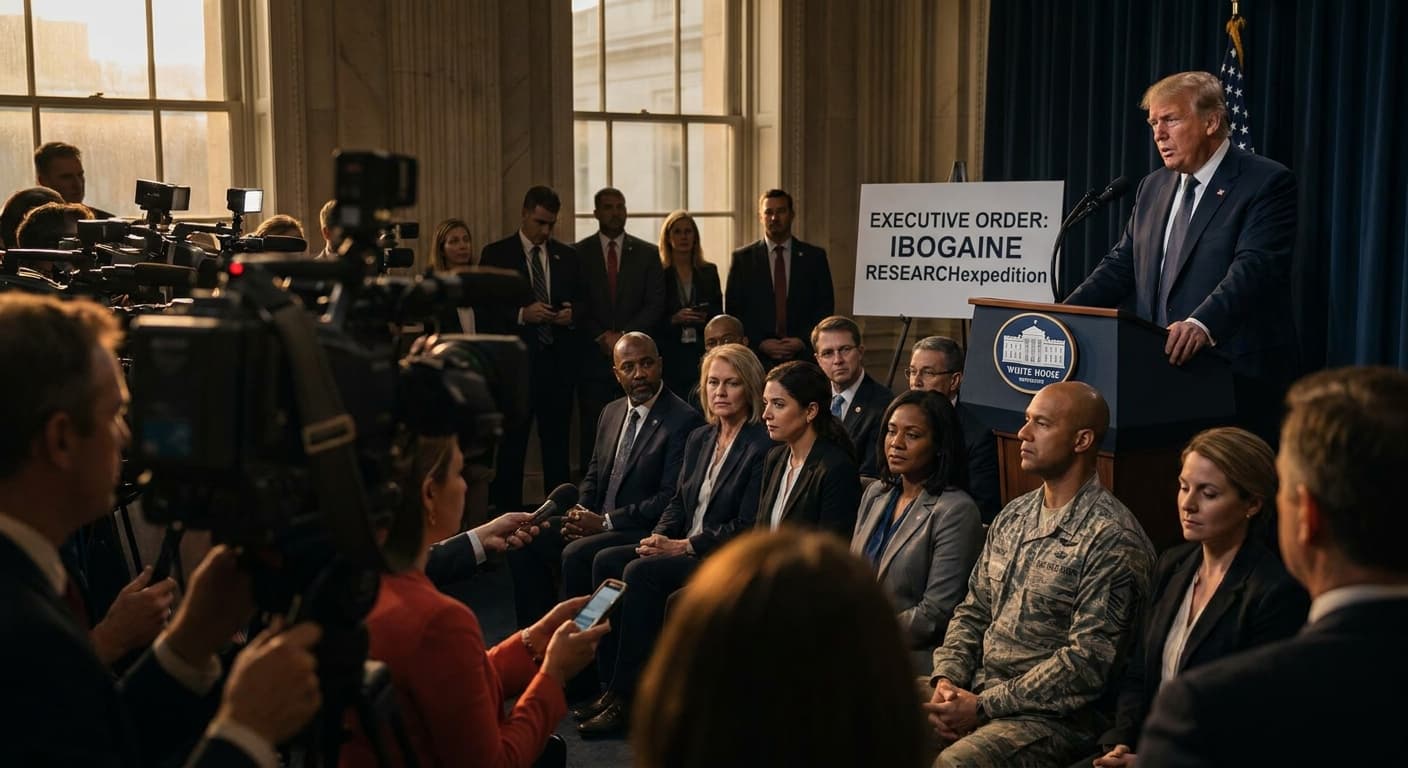
Executive Order 14401, signed by President Donald Trump on April 18, 2026, does not legalize psychedelics — it hands the Food and Drug Administration a list of specific companies to move to the front of the queue and directs the Justice Department to reschedule their products the moment Phase 3 data clears. The order commits $50 million in Advanced Research Projects Agency for Health (ARPA-H) money to match state programs, opens a Right to Try pathway for investigational ibogaine, and, most consequentially, aims the FDA's new Commissioner's National Priority Voucher at drugs like Compass Pathways' synthetic psilocybin. The winner is not the ibogaine advocacy movement Trump invoked at the signing. It is a British-founded, Peter Thiel–backed biotech whose stock had cratered ten months earlier — and which now stands to become the first company in history to sell a licensed psychedelic medicine in the United States.
What the order actually does
The text of the order is unusually operational for a mental-health directive. Section 2 instructs the FDA Commissioner to issue Commissioner's National Priority Vouchers to psychedelic drugs holding Breakthrough Therapy designation, and directs FDA and DEA to build a Right to Try pathway — with Schedule I handling waivers — for eligible patients seeking investigational psychedelics, "including ibogaine compounds." Section 3 obligates the HHS Secretary to allocate "at least $50 million from existing funds" via ARPA-H to match state programs. Section 5 tells the Attorney General to begin rescheduling reviews the moment any Schedule I psychedelic clears Phase 3 for a serious mental illness.
The White House fact sheet frames the package as veteran-focused: 6,000-plus veteran suicides annually, a veteran suicide rate more than double the civilian adult rate, and 14 million American adults living with serious mental illness. According to
NPR, then-FDA Commissioner Marty Makary said the agency would issue national priority vouchers to three psychedelic candidates within a week of the signing, with reviews that could conclude "in just weeks." Al Jazeera
reported that the FDA also cleared the way for the first US human trials of ibogaine, which had been stalled by cardiac-safety concerns.
The origin story is by now well-known: podcaster Joe Rogan texted Trump about ibogaine after an episode with veteran advocates. Trump, according to his own account to Science, replied: "Sounds great. Do you want FDA approval? Let's do it." Rogan stood beside him in the Oval Office at the signing.
The Rogan story is a decoy. Follow the voucher.
The politically legible narrative is ibogaine — a West African plant compound championed by former Texas Governor Rick Perry and Rep. Dan Crenshaw, and the drug Rogan actually pitched to Trump. Texas committed $50 million in 2025 to a first-in-nation ibogaine research consortium, and the executive order's ARPA-H matching mechanism is transparently built to top that pot up.
But ibogaine is years from an FDA filing. What is not years away is Compass Pathways' COMP360, a synthetic psilocybin. On February 17, 2026 — two months before the order — Compass reported positive results in two Phase 3 trials for treatment-resistant depression. As the Economist noted, if approved, COMP360 would be the first psychedelic drug to become a fully licensed medicine in the United States. Compass CEO Kabir Nath confirmed in the
White House's own release that the company is already in a rolling FDA submission and is "ready to make this treatment available to patients" under an accelerated pathway.
That is the pivot. The Commissioner's National Priority Voucher, launched in June 2025 under Makary, compresses standard 10-month reviews to 30–60 days. Brookings estimates that if such vouchers become tradable at scale, each could command well over $150 million on the secondary market — before any drug revenues. The order effectively guarantees Compass's psilocybin one of the first ever awarded to a psychedelic, alongside Definium Therapeutics' lysergide tartrate program and, likely, an ibogaine candidate to satisfy the political optics.

The Lykos lesson the industry already absorbed
To understand why Compass wins, look at who does not. On August 9, 2024, the FDA rejected Lykos Therapeutics' MDMA-assisted therapy for PTSD — the treatment that had been the sector's presumptive front-runner. According to Science, an advisory committee had voted 10-1 against, citing unblinding, allegations that therapists discouraged patients from reporting adverse events, and a case of therapist misconduct. Executive Order 14401 does nothing to unstick Lykos. It does not resolve the data-integrity findings, and a second Phase 3 trial — which the
BBC reported Lykos said "would take several years" — is still required.
The order's beneficiaries are companies whose data are already clean and whose molecules are already synthetic and standardizable. Compass fits both criteria; MDMA-plus-therapy did not. The FDA's implicit message, reinforced by Executive Order 14401, is that psychedelics reach market as drugs, not as drug-plus-psychotherapy protocols the agency has no authority to regulate. Jennifer Mitchell, a UCSF neuroscientist and Lykos Phase 3 investigator, told Science that "looking at a psychedelic drug on its own without psychotherapy would likely make the FDA gauntlet easier to run."
The ibogaine problem no order can solve
Ibogaine remains the political mascot of Trump's order — and the scientific outlier. A 2021 open-label study published in Addiction found that 50% of opioid-use-disorder patients dosed with 10 mg/kg ibogaine hydrochloride experienced QT-interval prolongation above 500 milliseconds, the threshold at which risk of torsades de pointes — a potentially fatal arrhythmia — becomes clinically significant. A follow-up
pharmacokinetics study tied that cardiotoxicity directly to ibogaine plasma concentrations, mediated by CYP2D6 genotype.
The most promising domestic data — Stanford's MISTIC protocol in Nature Medicine — coadministers magnesium sulfate to blunt the arrhythmia risk. It reported large effect sizes on PTSD, depression, and anxiety in 30 male special-operations veterans one month post-treatment. But it is a 30-patient, open-label, single-arm study conducted at a clinic in Mexico, not an FDA-approvable trial. The Texas consortium, funded in 2025 to run the first US FDA-track ibogaine trials, is starting from that base. The $50 million ARPA-H match Trump ordered will help — but ibogaine is unlikely to see approval before the end of the decade regardless of executive orders. In the meantime, veterans continue to fly to Tijuana.
Alan Davis, who directs Ohio State's Center for Psychedelic Drug Research and Education, told NPR that Trump's ibogaine emphasis was "puzzling" given that psilocybin has stronger safety and efficacy data — his own recent trial put 75% of veteran participants in PTSD remission after psilocybin treatment. In other words, the drug Trump named and the drug his order actually accelerates are not the same drug.
The missing commissioner
The forecast now has a wildcard: the commissioner who architected the priority-voucher system is gone. On May 13, 2026, NPR reported that Marty Makary resigned after 13 months, with White House pressure over flavored-vape approvals cited as the final straw. Kyle Diamantas, a lawyer previously overseeing food safety, was named acting commissioner. Bloomberg-style intelligence: no permanent FDA head is confirmed as of July 7, 2026, and Diamantas has no track record on drug-approval philosophy. That vacuum sits directly on top of the voucher pipeline the executive order depends on.
Scott Gottlieb, Trump's first-term FDA commissioner, wrote at AEI that the order "strikes a delicate balance of promoting the development of these compounds as a genuine treatment for serious mental illness while maintaining critical oversight" — an implicit warning that the MAHA wing of the administration would prefer to jettison that balance. If Diamantas or a successor loosens the CNPV criteria, expect Right to Try to become the vector for de facto access before formal approval, particularly for ibogaine.
What to watch next
- Q3 2026: First priority voucher issued to a psychedelic. Compass's COMP360 for treatment-resistant depression is the near-certain first recipient. Approval within 60 days of voucher issuance would make it the first FDA-licensed psychedelic in US history.
- Fall 2026: DEA rescheduling review. Section 5 requires the Attorney General to begin the rescheduling process the moment Phase 3 data are complete. Watch whether Attorney General Bondi's DOJ moves psilocybin from Schedule I in parallel with FDA review, or waits for approval.
- October 1, 2026: ARPA-H obligation deadline. The executive order specifies "existing funds," meaning HHS must reprogram the $50 million from FY2026 ARPA-H appropriations. If Congress does not backfill, other ARPA-H programs will lose funding — a politically legible sacrifice worth tracking.
- Late 2026–2027: First US ibogaine Phase 1 trial reads out. The Texas consortium and its FDA-cleared program will produce the first controlled US safety data on the drug Trump publicly championed. Cardiac adverse events would reset the political conversation overnight.
Diplomat View
Executive Order 14401 is best read not as psychedelic-policy reform but as a single-molecule acceleration act dressed up in ibogaine populism. The order's political theater is aimed at veterans and the Rogan audience; its regulatory machinery is aimed at Compass Pathways and the roughly three Breakthrough-designated psilocybin and psilocybin-adjacent programs behind it. Our forecast: the first FDA-licensed psychedelic medicine in US history will be Compass's COMP360, approved before the 2026 midterms, with rescheduling of psilocybin following within 12 months. Two conditions would falsify this call — first, a serious adverse event in Compass's rolling submission data; second, a MAHA-aligned FDA commissioner who scraps the Priority Voucher framework rather than reforming it. Absent either, the biggest winner from Trump's psychedelic order will be a company most of his supporters have never heard of, treating a disease — treatment-resistant depression — that was never mentioned in the Oval Office ceremony.
This story sits in US Politics.
Discover more

US Politics
Trump's Bold Drug Policy Shift
Trump's administration is reclassifying medical marijuana and funding psychedelics research for veterans, a bold drug policy shift that breaks with GOP norms.

US Politics
Trump's Order to Fast-Track Ibogaine Access
Trump's Executive Order 14401 directs the FDA to fast-track ibogaine, a Schedule I drug with no completed trials, raising safety and regulatory concerns.
US Politics
Trump's Order to Fast-Track Psychedelics
Trump's April 2026 executive order accelerates FDA approval for psilocybin, signaling a shift in psychedelic drug policy.
US Politics
Trump's Executive Order on Ibogaine
Trump's Executive Order 14401 on ibogaine prioritizes psilocybin over the plant, benefiting veterans' lobby and Compass Pathways.