Trump's Aid Cuts Fuel Ebola Crisis in DRC
Ebola outbreak worsens as U.S. aid cuts impact response efforts.
Model Diplomat3 min readAfrica
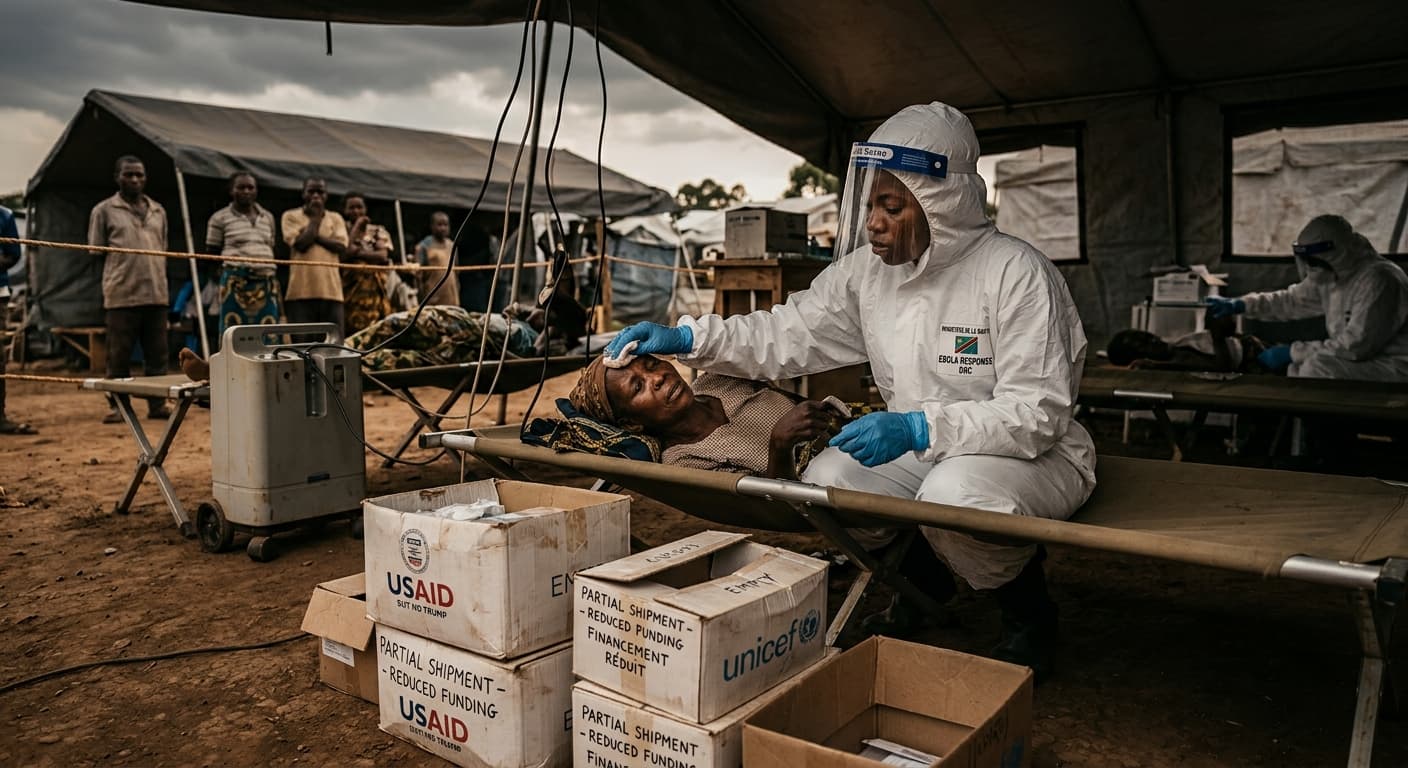
Trump's Aid Cuts Cut Deep as Ebola Spreads in Congo
The outbreak, officially declared in May, has killed 232 people as virus detection falters and health surveillance networks collapse.
The question posed in NPR's latest headline asks whether Trump's foreign aid cuts fueled the Ebola outbreak now tearing through eastern Democratic Republic of Congo. The evidence suggests a more precise answer: the cuts didn't cause the virus, but they gutted the infrastructure that would have caught it faster and contained it earlier.
Since the Trump administration dismantled USAID in 2025, the DRC lost its back-office. Community health workers who staffed disease surveillance networks abandoned their posts or moved into other work to survive. Personal protective equipment stocks depleted. Most critically, American "eyes and ears on the ground"—the networks that flag outbreaks before they metastasize—vanished. The rare Bundibugyo strain of Ebola had been circulating for months before authorities formally declared the outbreak on May 15, a delay that cost speed in response when speed is everything.
By June 24, the DRC recorded 896 confirmed cases and 232 deaths, with 75 healthcare workers infected and 17 dead—a casualty rate that underscores how far behind containment remains.
CDC projections warn that if isolation rates don't improve sharply, the outbreak could exceed 20,000 cases in three months, rivaling the 2014 West Africa catastrophe. Conditions that would have made response difficult in any era—armed conflict, displaced populations, a healthcare system with roughly one-tenth the worker density of richer nations—became catastrophic in the absence of institutional support America once provided.
The Funding Collapse
The aid cuts extend beyond USAID. UN data shows that funding for water, sanitation, and hygiene programs in the DRC more than halved between 2024 and 2025, dropping to $38 million from what was previously higher levels. These are not peripheral. In a disease transmitted through bodily fluids, toilets and handwashing stations are the first line between epidemic and control. The 2026 UN appeal for $80 million in humanitarian assistance was only 21 percent funded heading into June, leaving treatment centers
scrambling to secure basic protective equipment like gloves and masks.
The Trump administration also withdrew the U.S. from WHO coordination, imposing what the Council on Foreign Relations calls "self-imposed constraints on communication, cooperation, and coordination" precisely when an Ebola outbreak demands integrated global surveillance and logistics.
The Rebound and Ambiguity
The Trump administration has since mobilized. The CDC deployed $107 million in emergency funding, while the State Department committed over $270 million for response activities, redeploying contracts with longstanding partners. The administration also signaled that DRC security and disease remain strategic priorities, particularly given competition with China over critical minerals and regional influence. This suggests less ideological objection to aid than to the institutional apparatus—USAID itself—that once delivered it.
But the lag matters. Early detection and rapid isolation could still constrain this outbreak; the architecture to do so no longer exists. One public health expert told NPR that the U.S. now finds itself "much, much weaker" than it would have been 18 to 24 months prior. Money deployed in June cannot buy back surveillance capacity lost in early 2025.
What to Watch
The decisive threshold: isolation rates. CDC modeling shows that if 70 percent of cases isolate within two days of symptoms, the outbreak stays under 10,000 cases; if only 20 percent isolate, it explodes past 20,000. Whether the belated emergency funding can rebuild contact-tracing networks fast enough—and whether armed conflict in Ituri province permits health workers safe access—will determine whether this becomes a contained emergency or a regional humanitarian catastrophe. Absent a breakthrough on the security front by mid-July, the calculus shifts toward containment failure.
Discover more
Global Politics
Trump's Conflicting Messages on Iran War
Trump's mixed messages on Iran reflect a strategy of audience management, benefiting Tehran amid a complex geopolitical landscape.

US Politics
SNAP Food Assistance Faces Legal Challenges
In 2026, SNAP faces stricter eligibility rules and mounting legal challenges, threatening food assistance for the millions of Americans who rely on the program.

Global Politics
US Seizes Iranian Ship, Tensions Surge
The US seizure of the Iranian ship Touska highlights a shift in control over the Strait of Hormuz, favoring Iran's strategic position.

Conflict & Security
Drone Warfare Killing Aid Workers at Unprec
Over 1,000 humanitarian workers killed in three years as cheap armed drones collapse legal protections. Gaza, Sudan, Ukraine, and DRC see deliberate targeting of aid convoys and hospitals with zero prosecutions.